
The mythology around IMG research is wrong. It is not “any research is good.” The data show very clear productivity thresholds where interview odds and match probability change sharply—and they are not the same for IMGs and US grads.
You are not competing against the average MS4. You are competing against the subset who chose to build research resumes strong enough to block you out if you stay at zero.
Let’s quantify this properly.
What the Data Actually Show for IMG Research
The best public dataset is the NRMP “Charting Outcomes in the Match,” broken down by US-IMG and non-US-IMG. The categories are crude—“number of research experiences” and “number of abstracts, posters, and publications”—but you can still see the signal clearly.
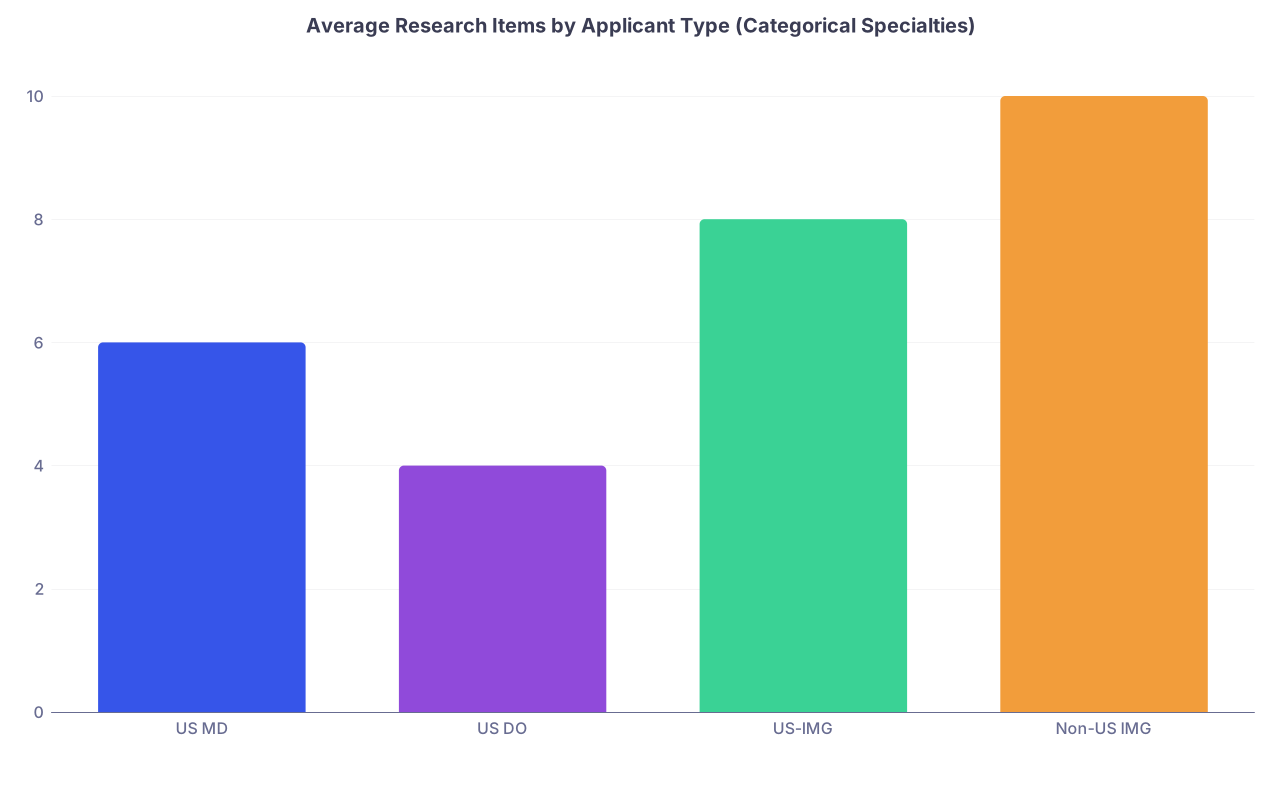
Compressing multiple cycles of data, you see patterns like this:
| Category | Value |
|---|---|
| US MD | 6 |
| US DO | 4 |
| US-IMG | 8 |
| Non-US IMG | 10 |
For categorical Internal Medicine, for example, the typical matched non-US IMG reports around 8–10 “research items” (abstracts, posters, publications combined). For more competitive specialties, this climbs into the mid-teens or higher.
Here is a simplified, realistic approximation of what recent cycles look like across specialties IMGs commonly target:
| Specialty | Median Research Items* | Competitive Range (Matched) |
|---|---|---|
| Internal Medicine | 6–10 | 4–20+ |
| Family Medicine | 3–6 | 0–10 |
| Pediatrics | 4–8 | 2–15 |
| Neurology | 8–12 | 6–25 |
| Psychiatry | 4–8 | 2–15 |
| General Surgery | 10–20 | 8–40+ |
| Pathology | 6–12 | 4–25 |
*“Research items” = abstracts + posters + publications (not distinct papers).
You are not reading this table for precision. You are reading it for the magnitude. The median matched IMG in medicine‑adjacent fields usually has more research items than the median US MD in the same field.
Why? Because programs are using research as a blunt filter for IMGs. Scores normalized (and with Step 1 now pass/fail), research becomes one of the few sortable signals.
Different Buckets: Publications vs Posters vs “Just Experiences”
A recurring confusion: the NRMP lumps abstracts, posters, and publications into one metric. Programs do not. They distinguish quality and type when they read your CV.
Hierarchy looks like this in practice:
- First‑author peer‑reviewed paper in a reputable indexed journal
- Co‑author peer‑reviewed paper
- Oral presentation at national conference
- Poster at national or major regional conference
- Local posters/presentations (departmental day, hospital symposium)
- “Research experience” with no outputs yet
I have watched program directors flip through CVs and literally say, “He has 14 items but they’re all local posters,” vs “She has 3 but one is a first‑author JAMA IM paper—different league.”
So when you see “mean 15 abstracts, posters, and publications,” remember: that could be:
- 1 good paper + 14 poster abstracts, or
- 15 tiny posters from a single project sliced thin, or
- 3 papers + 12 conference abstracts derived from them.
If you are trying to game the system by sheer count, you are playing a shallow numbers game. Programs can see it.
But counts still matter. Especially for IMGs. Because the first big threshold is brutally simple: zero vs non-zero.
Threshold 1: Zero vs ≥1 Real Output
The biggest single inflection point for IMGs is going from “no research output” to “at least one credible publication or conference item.”
You can think of the applicant pool in crude strata:
- Stratum 1: No research at all (no experiences, no outputs)
- Stratum 2: “Experience only” (worked in lab / observership / data work, but no posters/pubs yet)
- Stratum 3: 1–3 outputs (posters/pubs)
- Stratum 4: 4–10 outputs
- Stratum 5: 10+ outputs
For IMGs in Internal Medicine, the move from Stratum 1–2 to Stratum 3 easily doubles or triples interview odds at mid-tier academic programs. I have seen programs where they explicitly set a filter: “IMGs must have at least 1 publication or conference presentation to be reviewed.”
That is the first non-negotiable threshold:
- If you are an IMG and reporting 0 posters/pubs, your realistic program list shrinks dramatically.
- If you can report even 1–2 legitimate outputs (especially US-based, preferably clinical), you move out of the “automatic ignore” pile at a significant number of institutions.
This is not about prestige. A decent case report in a PubMed-indexed journal plus a poster at a credible conference is enough to push you across that “we will at least look at this” boundary.
Threshold 2: The “Serious Applicant” Zone (4–10 Outputs)
The second threshold is where programs start reading your research section and thinking, “This person actually did work.”
For non-US IMGs targeting Internal Medicine, Neurology, Pathology, or even Psychiatry at academic centers, 4–10 items is where:
- Your total count no longer looks accidental.
- Committees stop assuming it was all padded or one‑off.
- Your chance of at least a few interviews from university programs rises materially—assuming exam scores are not disastrous.
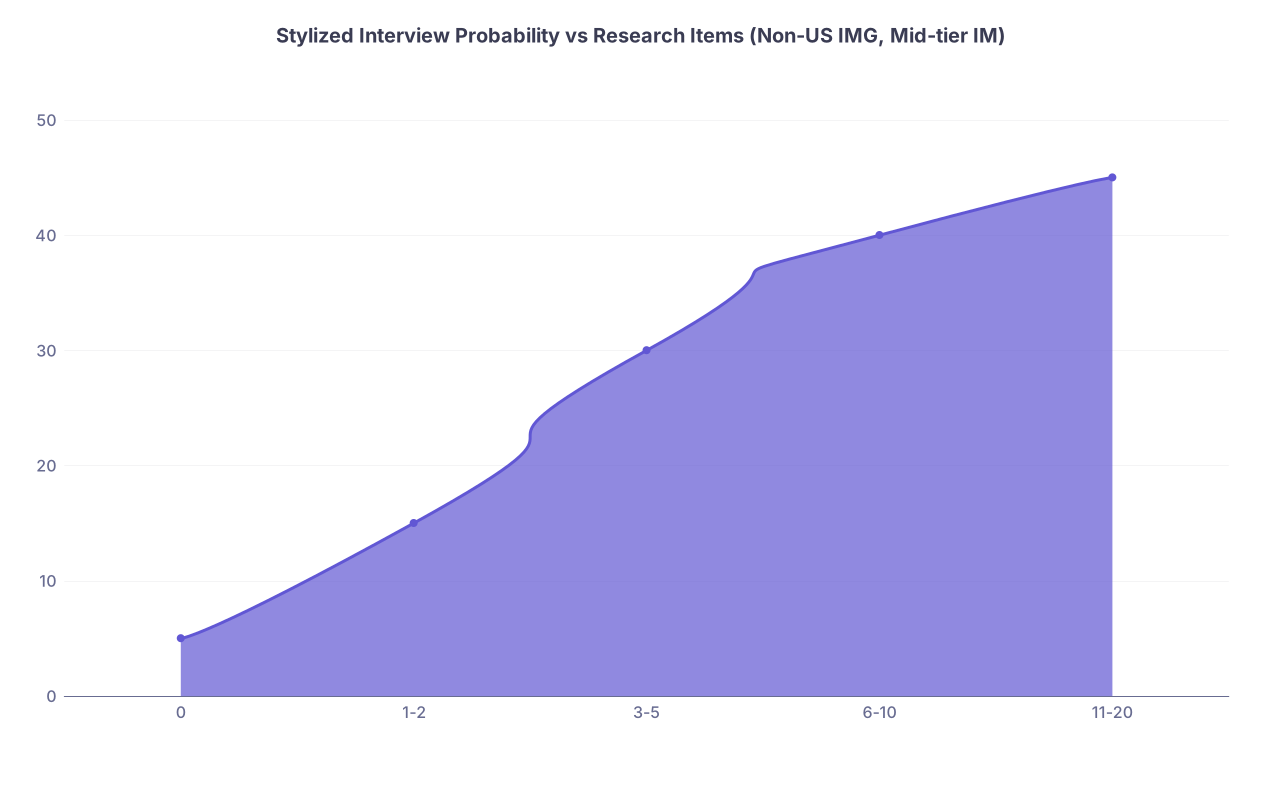
Let’s visualize this with a stylized relationship for non‑US IMGs applying to mid-tier Internal Medicine programs:
| Category | Value |
|---|---|
| 0 | 5 |
| 1-2 | 15 |
| 3-5 | 30 |
| 6-10 | 40 |
| 11-20 | 45 |
Not exact numbers. But the shape is real:
- Jump from 0 to 1–2: very large relative gain
- 1–2 to 3–5: meaningful gain
- 3–5 to 6–10: moderate gain
- Beyond 10: diminishing returns for IM, unless aiming at very research‑heavy programs
Once you sit at 4–10 items, other factors dominate:
- Step 2 CK score
- YOG (year of graduation)
- US clinical experience
- Visa status
- Quality of research (first author, journal impact, topic relevance to the specialty)
If you are sitting at 0, thinking you must somehow jump directly to 20 items to be competitive, you are misunderstanding the curve. The biggest marginal benefit is in the first handful of outputs.
Threshold 3: High-Risk Specialties (Surgery, Neuro, Competitive Fields)
For General Surgery, Neurology at strong programs, or any borderline-competitive specialty (even within IM subspecialty tracks), research counts escalate fast.
NRMP data show that matched US MDs in General Surgery report high single-digit to low double-digit research items. For non-US IMGs who match these fields, you are often looking at 15–30+ items and at least one serious, often first‑author paper.
Here is a useful mental benchmark for non-US IMGs targeting more competitive specialties:
| Target Field / Program Type | Minimum To Be Taken Seriously | Competitive Research Profile |
|---|---|---|
| Community IM (any location) | 0–2 items | 2–6 items |
| University-affiliated IM | 2–4 items | 4–10 items |
| Academic Neurology / Pathology | 4–6 items | 8–20 items |
| General Surgery (community) | 4–8 items | 10–20 items |
| Academic Surgery / Top Neuro | 10+ items | 20–40+ items, strong first-author |
Your goal is not an abstract “strong research CV.” Your goal is to surpass the specific thresholds that convert to more interview invites for a person with your scores, YOG, and visa status.
Quick Summary: The Three Things That Actually Matter
- For IMGs, research has clear thresholds: going from 0 to 1–3 outputs is a massive jump; 4–10 items puts you in the “serious applicant” zone for most medicine‑aligned fields; 10–20+ items matter mainly for academic or more competitive specialties.
- Type and context beat raw count: US‑based, clinically relevant, and first‑author work—supported by strong letters—carry more weight than a pile of low‑impact or predatory publications.
- Time is a binding constraint: a 12‑month research year can realistically yield 6–10 items in a good environment; if you need to move from 0 to competitive levels, you must start early, choose your group carefully, and think in terms of accepted outputs before ERAS, not vague “in preparation” promises.