Meta description: Matched as an IMG? Learn how visa paperwork can change after Match, where delays happen, what to ask your program, and how to protect your start date.

You matched. Great. Now the part nobody celebrates starts: immigration paperwork, institutional onboarding, and last-minute changes that can wreck your timeline if you assume "the program has it handled."
Educational disclaimer: This article is for general educational purposes only and is not legal, immigration, financial, or tax advice. Visa eligibility, sponsorship strategy, start-date rules, and employment onboarding requirements vary by institution and by case. Always confirm details with your program, the designated immigration office, ECFMG when relevant, and a qualified immigration attorney or advisor for case-specific guidance.
Here's the truth. Policy changes are real. Internal hospital rules change. Government processing changes. Start dates shift. And when a program says, "Don't worry, we'll take care of it," that can mean anything from "our immigration team is excellent" to "we haven't looked at your file yet."
This is the practical IMG guide to what actually changes after Match, who really controls the process, where delays happen, and how to protect yourself before a paperwork problem becomes a July disaster.
Why "Visa Paperwork Changes" Happen After You Match (Even in Good Programs)
A post-match visa change doesn't automatically mean your program is disorganized. Sometimes the change is normal. Annoying, but normal.
The most common triggers are predictable:
- Employer sponsorship details change. The sponsoring entity may be the hospital, university, GME office, or an affiliated employer. That matters because forms, signatories, and timelines change with the employer.
- The planned visa pathway changes or gets resequenced. A case may start as one plan and then shift because of timing, credentials, cap issues, ECFMG processing, or institutional policy.
- Your job start date moves. Even a small shift can affect what paperwork is possible and when.
- The institution changes its own rules. I've seen hospitals suddenly require earlier onboarding, stricter background check completion, or different document review before immigration will even submit a case.
- Government processing requirements change. New guidance, slower adjudications, consular delays, or administrative processing can wreck a clean timeline fast.
And here's the part applicants misunderstand: your PD is not the final authority on immigration paperwork. Not even close.
Your PD can be supportive. Your coordinator can be responsive. That helps. But the actual outcome is usually driven by:
- the hospital or university immigration office,
- outside counsel if the institution uses them,
- ECFMG or other sponsoring/credentialing bodies when relevant, and
- federal agency requirements.
That means a "visa-friendly" program can still produce a messy experience if the internal workflow is sloppy or the institution's immigration team is overloaded.
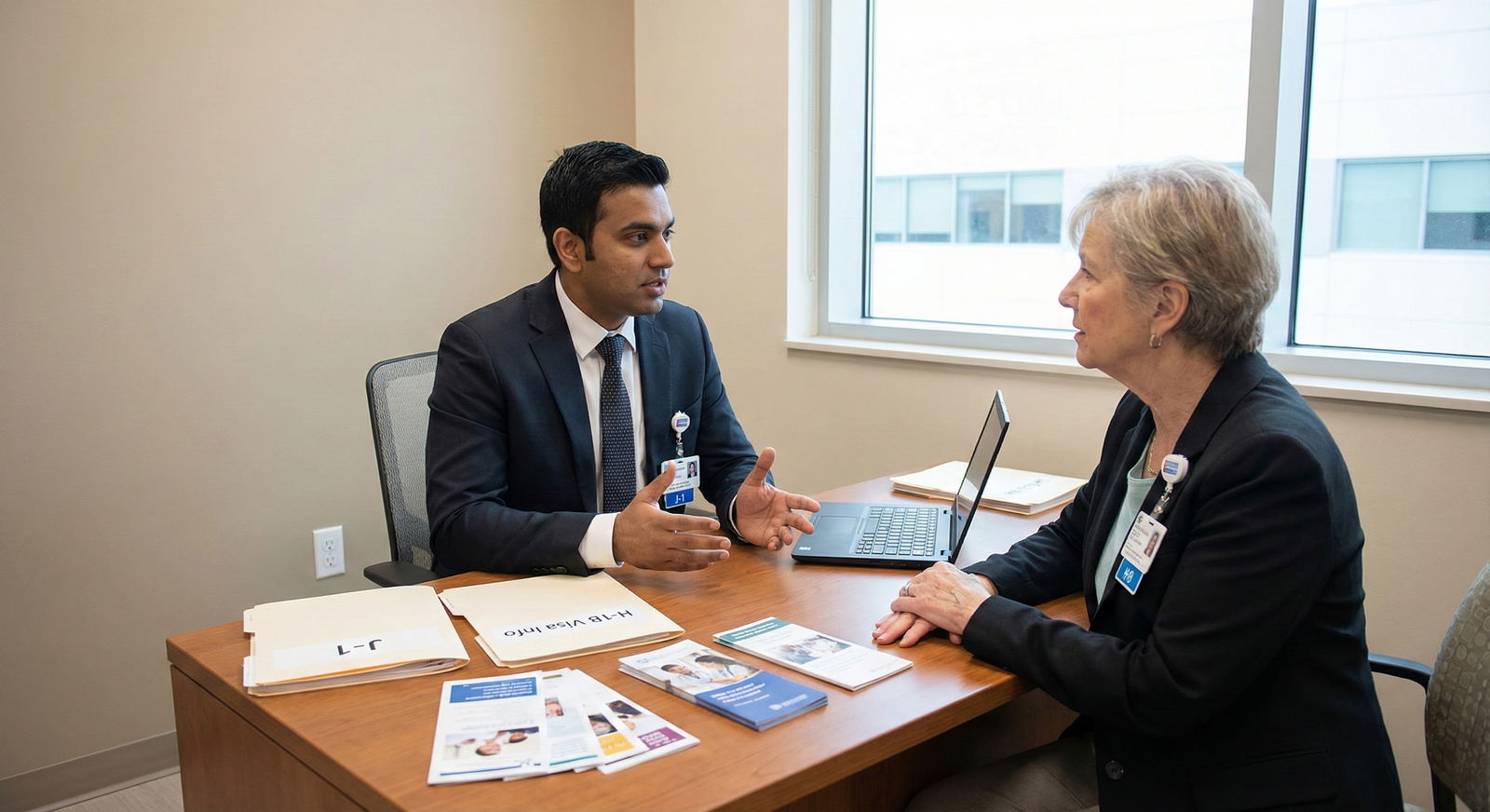
A good rule: treat reassurance as nice, but not sufficient. Written timelines beat verbal comfort every time.
The Three Paperwork Shifts You Should Expect (and How to Ask About Them)
These are the three shifts I'd expect in almost every IMG post-match process.
1) Your start date and work authorization may move
This is the biggest one. Programs talk about July 1 as if it's carved into stone. It isn't. Your orientation may be earlier. Your payroll date may differ from your first clinical date. Your legal work authorization date may not line up neatly with either.
Ask directly:
- What is the earliest start date the institution can support?
- What is the latest start date that still keeps me in good standing?
- If authorization is delayed, what happens to orientation, onboarding modules, badge access, payroll, and clinical duties?
- Is there a written contingency plan if I can't begin on the original date?
Don't ask vague questions like "Will this be okay?" That invites vague answers. Ask for dates.
2) The visa type or sequence may change because timing changes
This is where people get burned by assumptions. A program may have historically supported one pathway, but your individual file may require a different sequence. Or the intended route stays the same, but the order of steps changes.
You need the current intended pathway in writing. Not "we usually do X." Not "it should be fine." The actual plan for you.
Ask:
- What is the currently intended immigration pathway for my appointment?
- Is the plan J-1, H-1B, O-1, F-1 OPT, cap-gap-related timing, or another route?
- Is this plan final, or are there alternative pathways if timing changes?
- What event would trigger a change in the pathway?
This matters because each route has different dependencies, deadlines, travel restrictions, document needs, and failure points.
3) Ownership of documents and timelines is often fuzzy unless you force clarity
This is the most fixable problem. And the most common.
Nobody tells you who is preparing what, who signs first, where documents are uploaded, whether scans are acceptable, whether originals are needed later, and who's responsible for tracking submission.
That ambiguity is stupid. Fix it early.
Ask for a simple responsibilities breakdown:
- Which office sends the intake packet?
- Who drafts forms or petitions?
- What documents must I provide?
- What format do you want them in?
- What are my signing deadlines?
- How will I review filings before submission?
- Will I receive copies of final packets and receipts?
If you don't ask these questions, you'll end up in the classic IMG trap: the program thinks immigration contacted you, immigration thinks the coordinator contacted you, and you're sitting there waiting politely while the calendar burns.
What PDs (Often) Won't Tell You: Failure Points, Communication Gaps, and Hidden Dependencies
Here's the part people learn the hard way: residency recruitment and immigration processing are not the same system. They barely speak the same language.
The PD is focused on filling a slot, building a class, and making sure you show up clinically ready. The immigration office is focused on compliance, eligibility, form accuracy, deadlines, employer authorization, and whether your paperwork matches federal requirements exactly. Those are different priorities. So things fall into the cracks.
I've seen this happen over and over:
- The PD assumes the immigration office will "take over."
- The immigration office is waiting for your passport scan, diploma, training verification, prior visa history, or a corrected address.
- The coordinator thinks you already uploaded everything.
- You think silence means progress.
It doesn't. Silence usually means the file is sitting somewhere.
Even programs with genuinely IMG-friendly policies still depend on third parties they don't control:
- your medical school sending documents correctly,
- prior training institutions responding on time,
- background check vendors,
- credential verification services,
- state licensing boards,
- passport renewal timelines,
- employer compliance review,
- consular appointment availability,
- and sometimes plain old administrative processing.
That last one is brutal because nobody can speed it up just by sounding concerned on email.
The hidden failure points are rarely dramatic. They're boring. That's why they're dangerous.
Common examples:
- Passport validity is too short. This is one of the dumbest avoidable problems. Renew early if there's any doubt.
- Name mismatch across documents. One middle name format difference can trigger review.
- Missing prior training dates. Exact start and end dates matter.
- Old certifications uploaded by mistake. People swear they sent the right file. They didn't.
- Incomplete licensing history. Even if a permit was brief, expired, or never used, disclose it accurately.
- Delayed signatures. Sometimes the entire packet sits because one signature page wasn't returned.
- Wrong address history. Background checks hate inconsistency.
- Untranslated or poorly scanned documents. If the reviewer can't read it, it may as well not exist.
- Medical school letters arriving late. Friendly program, hostile timeline.
- Prior visa history described incorrectly. Don't guess. Confirm dates and categories from records.
This is why I tell IMGs to stop thinking of immigration as "one more onboarding task." It's not. It's the task that can block all the others.
Also, don't overinterpret the phrase "we sponsor visas." That's marketing language unless it comes with details.
What you actually need to know is:
- which visa types they support,
- for which specialties or circumstances,
- who files,
- what timeline they expect,
- whether they've onboarded IMGs recently,
- and what happens when things go wrong.
That's the real test of a friendly policy.
Your Pre-Start Checklist: Documents, Deadlines, and a Copy-Strategy That Saves You
Here's the system that works. Simple, boring, reliable.
Build a document custody system
Create one master folder in cloud storage and one local backup. Inside it, make subfolders like:
- Passport
- Visa history
- Degree/diploma
- ECFMG and exam documents
- Prior training verification
- Licenses/permits
- Hospital forms
- Final signed packets
- Receipts and tracking
- Travel plans
Save everything as PDFs with clean file names. Example: Passport_Expires_2029-04.pdf or TrainingVerification_InternalMedicine_2023-2024.pdf.
Keep copies of:
- every form you submit,
- every final packet you sign,
- every receipt notice,
- every courier tracking number,
- every appointment confirmation,
- and every email containing instructions or deadlines.
If someone later says, "We never received that," you want a timestamp, attachment, and confirmation ready to go.
Create a deadline calendar
Ask your program or immigration office for four dates:
- Intake deadline
- Target submission date
- Estimated adjudication or processing window
- Travel/entry target date
Then build reminders for each one. Don't rely on memory. Match season already fries enough of your brain.
Validate prerequisites early
Before anyone asks, confirm:
- passport validity is long enough,
- your name matches across documents,
- all prior visa dates are correct,
- prior training dates and locations are exact,
- your mailing address is current,
- you can access payment methods if fees are involved,
- your phone and email are monitored daily,
- and your scans are readable.

This isn't paranoia. It's competence.
How to Communicate with Your Program Without Sounding Difficult
You do not need to be passive to be professional.
The best emails are short, specific, and easy to answer. You're not trying to impress anyone with politeness theater. You're trying to get clear operational information.
Use a structure like this:
- confirm the current plan,
- list the decisions you need,
- ask for one point person,
- ask for dates,
- and ask what's expected from you next.
Good phrasing:
- "To avoid last-minute problems, can we confirm the intended visa pathway in writing?"
- "Could you share the target submission date and any deadlines I'm responsible for?"
- "Who should I contact directly for immigration processing updates?"
- "If the planned timeline changes, what is the escalation path?"
Also ask for a single immigration coordinator or designated contact. If you're bouncing between the PD, program coordinator, GME office, and immigration counsel, that's not a system. That's chaos with email signatures.
And send updates without being prompted when something material changes:
- renewed passport,
- address change,
- new notice received,
- corrected document,
- appointment booked,
- delay alert from consular processing.
That makes you look organized, not difficult.
If Something Changes: Contingency Plans for Start-Date Shifts, Visa Delays, and Administrative Processing
Don't wait for a delay to ask what happens if there's a delay. Ask now.
You want a contingency plan for four things:
- delayed filing,
- delayed approval,
- delayed visa appointment or stamping,
- and administrative processing after interview or review.
Specifically ask:
- Can onboarding be completed remotely if needed?
- Can orientation be separated from clinical start?
- What happens to salary timing, benefits activation, or badge access if the start date changes?
- If housing or travel plans need to shift, who should I notify first?
- Is there a hard deadline after which the institution can't hold the slot?
You should also know the escalation triggers. Mine are simple:
- A promised intake packet doesn't arrive by the stated week
- No clear visa pathway is confirmed in writing
- Submission milestones slip without explanation
- You're asked for a document you already provided
- Different offices give different answers
That's when you escalate. Politely, fast, in writing.
Escalation path:
- designated immigration coordinator,
- immigration office lead or assigned counsel,
- GME office or program coordinator,
- program leadership if deadlines are at risk.
Don't jump straight to the PD for every minor issue. But don't sit quietly while key dates pass either. That passive "I didn't want to bother them" approach is how people lose time they can't get back.
High-Impact Questions to Ask Your PD/Program Right Now (Copy-Paste)
Use this. Send it today if you need to.
Subject: Post-match immigration timeline confirmation
Hi [Name], To avoid last-minute problems, can we confirm the following in writing?
- What is the currently intended visa pathway for my appointment?
- Which office is managing the immigration process for me?
- Who is my direct immigration point person?
- What is the intake deadline for my documents?
- What is the target submission date for my case?
- What documents or signatures are currently needed from me?
- What are the earliest and latest start dates the program can support if timing changes?
- If there is a visa delay or administrative processing, what contingency plan is available?
- Will I receive copies of final submitted paperwork and receipt notices?
- What is the escalation path if a deadline is missed or I don't receive an update by [date]?
Thanks very much, I want to make sure I stay ahead of any processing issues.
That email works because it's cooperative but impossible to answer with fluff.
Summary: Your Goal Is Control of Timing, Paperwork, and Escalation
Here's the answer you're looking for: after you match, don't assume visa paperwork will run smoothly just because the program sounds confident.
Get the visa plan in writing. Lock the timeline. Keep copies of everything. Track every milestone like it matters, because it does. And escalate early when communication slips.
Calm, organized, persistent. That's how IMGs avoid preventable post-match disasters. Not by trusting the process. By managing it.