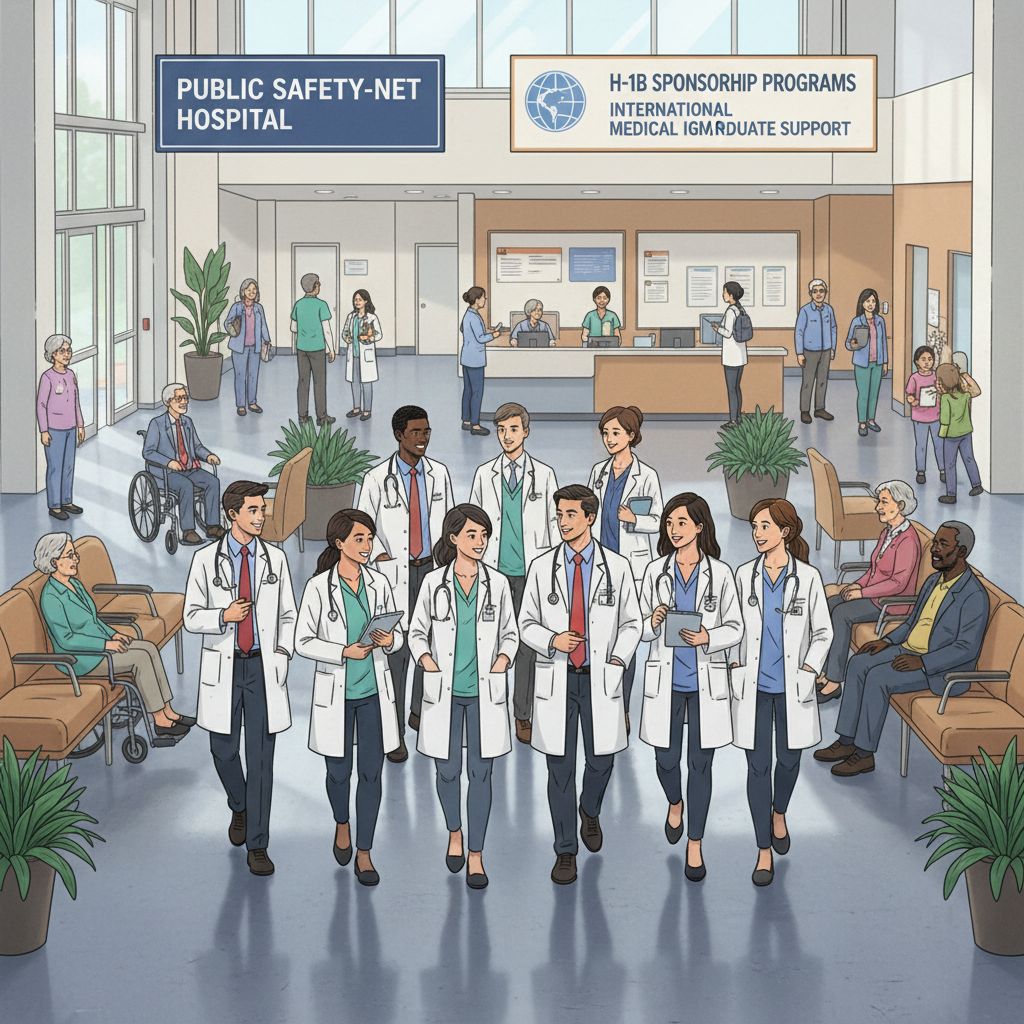
Understanding H-1B Sponsorship in Nuclear Medicine
Nuclear medicine is a small but highly specialized field that attracts many international medical graduates (IMGs) because of its blend of imaging, physiology, and targeted therapies. If you are an IMG hoping to build a career in nuclear medicine in the United States, understanding how H-1B sponsorship programs work is essential.
In nuclear medicine residency, visa options are more limited than in larger specialties like internal medicine or family medicine. Many programs sponsor only J-1 visas through the Educational Commission for Foreign Medical Graduates (ECFMG). However, a subset of academic centers and larger health systems are willing to sponsor H-1B visas, and this can be a key pathway—especially if you plan to avoid the J-1 home residency requirement or if you already passed USMLE Step 3.
This guide explains:
- How H-1B sponsorship works for nuclear medicine residency
- Key requirements and timelines
- The role of H-1B cap-exempt institutions
- How to identify and approach H-1B-friendly programs
- Practical application strategies and common pitfalls
Throughout, you’ll see the terms nuclear medicine residency, nuclear medicine match, H-1B residency programs, H-1B sponsor list, and H-1B cap exempt—these are the major concepts you need to master for a successful application strategy.
H-1B vs J-1 in Nuclear Medicine: What You Need to Know
Before targeting H-1B sponsorship programs, you should understand how H-1B compares with the more common J-1 pathway.
J-1 Visa: The Default for Many Nuclear Medicine Programs
Most nuclear medicine residency programs default to J-1 sponsorship via ECFMG because:
- The process is familiar and streamlined
- ECFMG handles much of the administrative work
- It’s available for residents who have not passed USMLE Step 3
Pros of J-1:
- Widely available across nuclear medicine programs
- Predictable timelines and requirements
- Does not require the employer to file a labor condition application (LCA) or petition with USCIS
Cons of J-1:
- Two-year home country physical presence requirement after training (unless you get a waiver)
- Limited flexibility in changing employers during training
- Some employers and fellowships prefer (or require) candidates without the J-1 home residency requirement
For applicants who envision staying in the U.S. long-term, the J-1 “return home” requirement can be a major obstacle.
H-1B Visa: Less Common but Strategically Powerful
The H-1B visa is a work visa sponsored directly by the training institution (or affiliated university). In nuclear medicine, H-1B sponsorship is less common—but often more attractive—for IMGs planning a long-term U.S. career.
Pros of H-1B in nuclear medicine residency:
- No automatic two-year home residency requirement
- Potentially smoother transition to employment or fellowship afterward
- Clear dual-intent pathway (you can pursue permanent residency while on H-1B)
- Can sometimes be extended beyond initial years if you pursue additional training or employment at H-1B cap-exempt institutions
Cons of H-1B:
- Requires USMLE Step 3 before the visa petition can be filed
- More paperwork and cost for institutions (LCA, USCIS filing fees, prevailing wage determinations)
- Not all programs are willing or able to sponsor H-1B
- Timing is tight: delayed Step 3 or late match decisions can complicate visa processing
Because nuclear medicine is a small specialty, programs are cautious about administrative complexity and cost. That means H-1B options exist—but you must target them deliberately.
Key Requirements for H-1B Sponsorship in Nuclear Medicine
To be considered seriously by H-1B residency programs in nuclear medicine, you must satisfy specific academic, credentialing, and timing requirements.
1. USMLE Step Requirements
For H-1B sponsorship, virtually all GME offices require:
- USMLE Step 1 – Passed
- USMLE Step 2 CK – Passed
- USMLE Step 3 – Passed before visa filing (and often before ranking or contract finalization)
Some nuclear medicine programs will list “Step 3 preferred” but in practice, if they actually sponsor H-1B, Step 3 is almost always mandatory for that visa category.
Practical advice:
- If you are aiming for H-1B in the same match cycle, plan to take and pass Step 3 at least 6–9 months before July 1 of your intended start year.
- Consider taking Step 3 before ERAS opens, so you can confidently signal H-1B eligibility in your application and personal statement.
2. ECFMG Certification
For IMGs, ECFMG certification is required for residency regardless of visa type. For H-1B purposes:
- You must have ECFMG certification by the time of contract signing or visa petition filing.
- Many nuclear medicine programs will not proceed with H-1B documentation until your ECFMG certificate is issued.
If your medical school is outside the U.S. and Canada, confirm that it is recognized in the World Directory of Medical Schools with ECFMG eligibility.
3. State Medical Licensure or Training License
Most states require at least a training license for residents, and some states require Step 3 for certain license categories. Nuclear medicine residency usually follows the same rules as other specialties at that institution.
For H-1B:
- The program must show that you are fully authorized to practice in a training capacity in that state.
- The timing of licensure affects when the program can file the H-1B petition.
This is one reason programs sometimes prefer J-1 (less link between licensing timing and visa filing). If you are applying to H-1B residency programs, review the licensing requirements in the state(s) where you are applying.
4. Prevailing Wage and Specialty Requirements
For an H-1B petition, the institution must:
- Demonstrate that nuclear medicine residency qualifies as a specialty occupation (it does—advanced medical training with specific educational requirements).
- Pay you at least the prevailing wage or the institution’s established GME salary for that year and level.
Most academic nuclear medicine programs have established wage scales, so this is usually manageable, but it adds complexity that some smaller institutions prefer to avoid.

H-1B Cap, Cap-Exempt Institutions, and Nuclear Medicine
One of the most confusing aspects for applicants is the distinction between H-1B cap-subject and H-1B cap-exempt petitions. Understanding this is critical if you want to identify realistic H-1B sponsor programs in nuclear medicine.
What Is the H-1B Cap?
The standard H-1B category is subject to an annual numerical limit (the “cap”), which is currently:
- 65,000 regular H-1B visas
- 20,000 additional for U.S. master’s degree or higher
These cap-subject visas are allocated via a lottery that opens each March. However, most residency and fellowship programs do not use this lottery because they qualify as H-1B cap exempt.
H-1B Cap-Exempt Institutions: The Real Opportunity
Most nuclear medicine residencies that sponsor H-1B are located in institutions that are cap-exempt, meaning they are not limited by the annual H-1B cap or lottery. These typically include:
- Non-profit hospitals affiliated with universities
- Academic medical centers
- Certain research institutions
- Government or public hospitals (in some cases)
This cap-exempt status allows them to:
- File H-1B petitions at any time of year
- Avoid competition for limited annual H-1B numbers
- Align visa timing with the nuclear medicine match and July 1 start date
In practice, most H-1B residency programs in nuclear medicine will be at academic centers that are H-1B cap exempt.
Using Cap-Exempt Status Strategically
For an IMG targeting nuclear medicine:
- Prioritize university-affiliated programs and large teaching hospitals in your application list.
- In your research, look for language like “We are a cap-exempt H-1B sponsor” or “We sponsor H-1B for GME at our institution.”
- If you complete residency and then move into employment at another cap-exempt institution, you can sometimes extend or transfer your H-1B more flexibly.
If your long-term plan is academic nuclear medicine, cap-exempt H-1B pathways are especially powerful because they offer continuity from residency to fellowship or attending roles.
Finding H-1B-Friendly Nuclear Medicine Residency Programs
There is no official, centralized H-1B sponsor list for nuclear medicine residency, and policies can change yearly. You need to combine systematic research with direct communication.
1. Start with Program Websites and Institutional GME Pages
Most nuclear medicine residency programs will include some visa information, but often it’s brief. Look for:
- “We sponsor J-1 visas only”
- “We sponsor J-1 and H-1B visas (for eligible candidates)”
- “H-1B considered on a case-by-case basis”
- “H-1B sponsorship available for candidates who have passed USMLE Step 3”
Some sites are vague or outdated; always cross-check with the GME office or program coordinator.
Actionable step:
- Create a spreadsheet of all ACGME-accredited nuclear medicine programs.
- Add columns: “J-1,” “H-1B,” “Unknown,” “Requires Step 3,” “Notes.”
- As you investigate each program’s website and GME pages, update this sheet.
2. Contact GME Offices and Program Coordinators Directly
Because policies shift and websites lag behind, direct communication is crucial. When emailing:
- Use a concise subject line:
“Prospective IMG Applicant – Question about H-1B Sponsorship for Nuclear Medicine Residency” - Briefly introduce yourself (name, medical school, graduation year).
- State that you are interested in nuclear medicine residency and would like clarification on visa sponsorship.
Sample email wording:
I am an international medical graduate preparing to apply for nuclear medicine residency in the upcoming ERAS cycle. Could you please confirm whether your program or institution sponsors H-1B visas for residents, and if so, whether USMLE Step 3 must be completed before ranking or before the start of training?
Ask also:
- Does the institution generally sponsor H-1B for any residency/fellowship?
- Is H-1B sponsorship limited to specific departments?
3. Leverage Current and Former Residents
Networking is particularly valuable in a small field like nuclear medicine. Use:
- Program websites’ current residents lists
- LinkedIn searches (filter by “nuclear medicine resident,” “nuclear radiology fellow,” “nuclear medicine physician”)
- Alumni pages
- Specialty interest groups for IMGs
Questions you might ask a current or recent resident (politely and briefly):
- “Were any residents in your program on H-1B during your time there?”
- “Does your institution have a GME policy on H-1B sponsorship?”
- “Is Step 3 mandatory before they consider H-1B applicants?”
Often, internal candidates know which visa categories are realistically supported—even when the website is unclear.
4. Identify Patterns by Institution Type
In the nuclear medicine match, programs that are more likely to support H-1B include:
- Large public university hospitals (often H-1B cap exempt)
- Private non-profit academic medical centers
- Institutions with multiple IMGs across various specialties
Programs less likely to support H-1B:
- Small community hospitals
- Programs listing only J-1 explicitly
- Institutions with strict GME policies limiting visa types
While there are exceptions, this pattern can help you prioritize.

Application Strategy: Maximizing Your Chances at H-1B Sponsorship
Your profile and strategy should be tailored to the realities of nuclear medicine and H-1B sponsorship.
1. Timing Your Exams and the Nuclear Medicine Match
The single most important timing factor is USMLE Step 3.
- For a July 1 start, plan to have Step 3 results available by November–December of the preceding year.
- This allows nuclear medicine programs to know early in the interview season that you are H-1B-eligible.
- Some programs may still interview you without Step 3, but they are far more likely to rank you highly if Step 3 is already passed.
If you cannot complete Step 3 in time, consider:
- Applying broadly to J-1 friendly programs this cycle and aiming for H-1B in fellowship or later employment, or
- Delaying your application by one cycle to align Step 3 with H-1B goals.
2. Targeting Programs Realistically
Because nuclear medicine is relatively small, you cannot rely solely on H-1B-friendly programs. A common approach:
- Core target list: 5–10 nuclear medicine programs you know can or do sponsor H-1B
- Secondary list: 10–15 additional nuclear medicine programs that sponsor J-1 only but are IMG-friendly
- Backup plan: Related specialties or preliminary/transitional programs if needed, depending on your career stage
Remember that nuclear medicine residency can be entered:
- After a preliminary year in internal medicine/surgery, or
- In some structures as part of diagnostic radiology or integrated programs.
Check each program’s eligibility route.
3. Presenting Yourself as a Strong H-1B Candidate
Programs will only take on H-1B complexity for candidates they believe are worth the effort. Strengthen your profile by:
- Competitive USMLE scores (particularly Step 2 CK and Step 3)
- Strong letters of recommendation from U.S. nuclear medicine, radiology, or internal medicine faculty
- Demonstrated interest in nuclear medicine:
- Electives or observerships in nuclear medicine
- Research or case reports in PET/CT, SPECT, theranostics, etc.
- Clear coherence in your personal statement: explain why nuclear medicine and why the U.S. healthcare system.
When relevant, you may briefly mention:
I have completed USMLE Step 3 and am eligible for H-1B sponsorship. I am particularly interested in programs that can provide long-term training and potential academic pathways.
This signals to H-1B residency programs that the infrastructure they invest in you may pay off in multi-year contributions.
4. Navigating the Visa Discussion During Interviews
Programs can be sensitive about visa questions, but you must still clarify their policies. Good practices:
- Do not make visa status the first topic in every interview conversation.
- Wait for an appropriate moment—often near the end—to ask:
- “Could you share how your institution handles visas for international graduates?”
- If they mention J-1 only, you can respond:
- “Thank you, that’s very helpful. I wanted to understand if H-1B is ever considered for residents who have passed Step 3, or if the institution strictly limits residency visas to J-1.”
- Respect their answer and avoid arguing. Use it to refine your ranking strategy.
5. After the Match: Working With GME and Legal Teams
If you successfully match into a nuclear medicine residency that sponsors H-1B:
- You will work closely with the GME office and often an immigration attorney hired by the institution.
- Respond quickly to all document requests:
- Medical school diplomas and transcripts
- ECFMG certificate
- USMLE score reports
- Passport and prior visa documents
- Confirm timelines for:
- H-1B petition filing
- Expected USCIS processing (standard vs premium processing)
- State licensing or training permit
Avoid last-minute changes to your travel or visa status without consulting the GME office, as they can affect your petition.
Common Pitfalls and How to Avoid Them
1. Assuming All Academic Programs Sponsor H-1B
Not every university-affiliated nuclear medicine residency will sponsor H-1B, even if the institution is technically H-1B cap exempt. Some GME offices have:
- A strict “J-1 only” policy
- A cap on the number of H-1B residents per year
- Restrictions by department
Always verify each program’s current policy directly.
2. Taking Step 3 Too Late
If your Step 3 result arrives:
- After rank lists are finalized, or
- Too close to the residency start date for safe petition processing,
Programs may decline to use H-1B even if they conceptually support it. Time Step 3 aggressively if you want nuclear medicine H-1B options.
3. Applying Narrowly Only to H-1B Programs
Nuclear medicine has limited residency slots nationwide. Restricting your application only to a small subset of H-1B-sponsoring programs dramatically lowers your match chances.
Broaden your approach:
- Apply to a mix of J-1 and H-1B-friendly programs.
- Consider nuclear radiology fellowships later if your path into nuclear medicine is indirect.
4. Not Considering Long-Term Visa Strategy
An H-1B during residency is one piece of your long-term immigration plan. Think ahead:
- Do you plan to pursue a nuclear medicine fellowship or theranostics subspecialization in the U.S.?
- Are your likely future employers cap-exempt (academic centers) or cap-subject (private practices, imaging centers)?
- Will you need to transition to a different visa or pursue permanent residency soon after training?
Discuss these topics with immigration counsel where possible, especially if you plan a long-term academic nuclear medicine career.
FAQs About H-1B Sponsorship in Nuclear Medicine Residency
1. Are there many H-1B residency programs in nuclear medicine?
No, the number is relatively small compared to larger specialties. However, some university-based nuclear medicine residency programs and large academic medical centers do sponsor H-1B, especially if they are H-1B cap exempt institutions. The availability varies year by year and must be confirmed directly with each program or GME office.
2. Is USMLE Step 3 absolutely required for H-1B nuclear medicine residency?
Practically speaking, yes. For H-1B petitions in residency training, most institutions require that IMGs have passed USMLE Step 3 prior to filing the H-1B petition and often before ranking or signing a contract. Without Step 3, you may still be eligible for J-1 sponsorship, but H-1B options will be extremely limited.
3. Can I switch from J-1 to H-1B during nuclear medicine residency?
Switching from J-1 to H-1B during the same training program is uncommon and complicated. The J-1 usually carries a two-year home residency requirement, and waiving this requirement mid-training is not straightforward. Most residents complete their nuclear medicine residency on the same visa category with which they entered. If you anticipate needing H-1B, it is better to plan for it at the outset.
4. Where can I find a reliable H-1B sponsor list for nuclear medicine?
There is no official, specialty-specific H-1B sponsor list for nuclear medicine residency. Instead, you should:
- Review each program’s website and GME pages
- Email program coordinators and GME offices
- Network with current or former nuclear medicine residents
- Look at institutional patterns (large, university-affiliated, academic centers)
Creating your own up-to-date list based on direct confirmation is far more reliable than relying on informal online lists that may be outdated or incomplete.
By understanding how H-1B sponsorship operates—especially in the context of cap-exempt academic medical centers—and aligning your exam timing, application strategy, and communication accordingly, you can significantly improve your chances of matching into a nuclear medicine residency that supports your long-term goals in the United States.