
The idea that “programs with lots of IMGs are IMG‑friendly” is lazy and often wrong.
If you sort FREIDA by “% IMG” and call it a day, you’re not finding IMG‑friendly programs. You’re mostly finding places with weak applicant pools, chronic staffing problems, or locations U.S. grads avoid. That’s not the same thing as a program that actually supports, advocates for, and invests in international medical graduates.
Let’s tear this apart properly.
The Core Myth: High IMG % = IMG Friendly
Here’s the misconception in its purest form:
- Applicant opens FREIDA (or Residency Explorer).
- Filters internal medicine programs.
- Sorts by “% international medical graduates.”
- Assumes: “Oh, 80% IMG. They must love IMGs. This is an IMG‑friendly program.”
This is the same logic as saying “That restaurant is always empty, so it must be easy to get a table, so it must be great.” No. It means people with better options go elsewhere.
High IMG proportion tells you one thing: historically, enough IMGs matched there to raise the percentage. It doesn’t tell you:
- How many IMGs applied.
- How many were screened out without an interview.
- Whether IMGs were treated well once they arrived.
- Whether the program is stable, accredited without issues, and produces board‑pass graduates.
I’ve watched too many applicants anchor on %IMG and then be shocked later:
- “They had 70% IMGs but hard‑cutoff Step scores above mine.”
- “Everyone was an IMG, but they made it clear they don’t sponsor visas anymore.”
- “The culture was toxic; senior residents literally said, ‘We’re here because no one else wanted us.’”
You need to separate who fills the spots from how they treat those people and how they select them.
What High IMG Percentage Usually Really Means
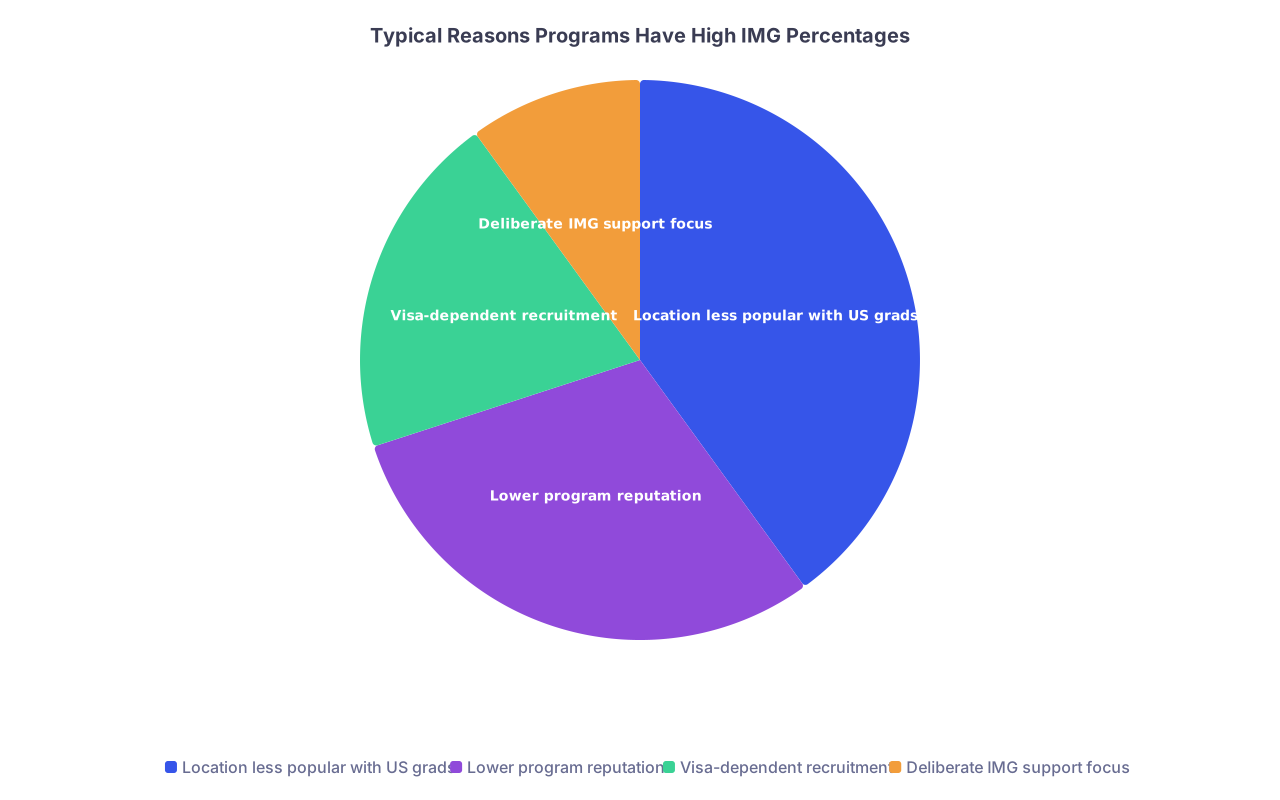
Let’s be blunt. High IMG % is often a downstream effect of three things:
- Less desirable location (to U.S. MD/DOs)
- Lower perceived program prestige or weaker academic reputation
- Chronic recruitment difficulties
That’s it. Not “we love IMGs.”
Look at where the highest‑IMG programs cluster:
- Small community hospitals in less popular states.
- Safety‑net hospitals in rough urban neighborhoods.
- Programs with limited subspecialty exposure, minimal research, or shaky ACGME histories.
Do some of these programs still provide good training? Of course. But the reason they have lots of IMGs is not “friendly policies.” It’s “not enough U.S. grads want to be there.”
| Category | Value |
|---|---|
| Location less popular with US grads | 40 |
| Lower program reputation | 30 |
| Visa-dependent recruitment | 20 |
| Deliberate IMG support focus | 10 |
That pie chart is conceptual, but it matches what I’ve seen repeatedly when you actually talk to program leadership.
If you’re an IMG, you must answer a sharper question:
“Does this program rely on IMGs because it wants us, or because it has no better options?”
Only one of those is good for you.
What Actually Defines an IMG‑Friendly Program
Let’s talk about policies and behavior, not just census numbers.
An IMG‑friendly program, in reality, has at least some of the following:
Clear, consistent visa support
- Explicitly states J‑1 and/or H‑1B sponsorship on website and in NRMP documents.
- Has a track record: multiple current residents on visas, no sudden reversals year to year.
- Knows basic immigration timelines and doesn’t “figure it out later.”
Reasonable exam and graduation cutoffs
- Step 1 pass / Step 2 CK expectations that are demanding but not absurd (e.g., requiring 255+ for IMGs but 235+ for U.S. grads is not “friendly”).
- Accepts graduates >3–5 years out, or at least states a sane limit and sticks to it.
- Doesn’t quietly filter non‑U.S. grads out by bots using unrealistic criteria.
Transparency about requirements
- Website tells you: minimum scores, visa types, required U.S. clinical experience, how many IMGs currently in each PGY.
- They answer IMG‑specific questions without sounding annoyed or evasive.
Supportive culture and outcomes for IMGs
- IMGs in leadership roles: chief residents, fellowship matches, quality‑improvement leads.
- Alumni IMGs going to solid fellowships or jobs, not just disappearing after graduation.
- Residents report good teaching, not just “service.” (Yes, this means you actually talk to them.)
Structured support for “hidden curriculum”
- Orientation that explains U.S. documentation, billing, patient communication expectations.
- Feedback systems that do not assume you magically know U.S. hospital culture.
None of that is captured in “% of residents who are international graduates.”
A Simple Comparison: High IMG % vs IMG‑Friendly
| Feature | High IMG % Program | Truly IMG-Friendly Program |
|---|---|---|
| Visa policy | Unclear or changing | Explicit, stable, documented |
| Exam score expectations | Hidden, often high | Stated, consistent, realistic |
| Website information | Minimal, outdated | Detailed, updated, IMG-specific info |
| Culture toward IMGs | “We take whoever comes” | “We invest in and promote IMGs” |
| IMG outcomes | Unknown, vague | Track record of fellowships/jobs |
The reason so many IMGs get burned is they confuse the left column with the right one.
What the Available Data Actually Shows
Let’s ground this in the limited but useful data we have—NRMP and program disclosures.
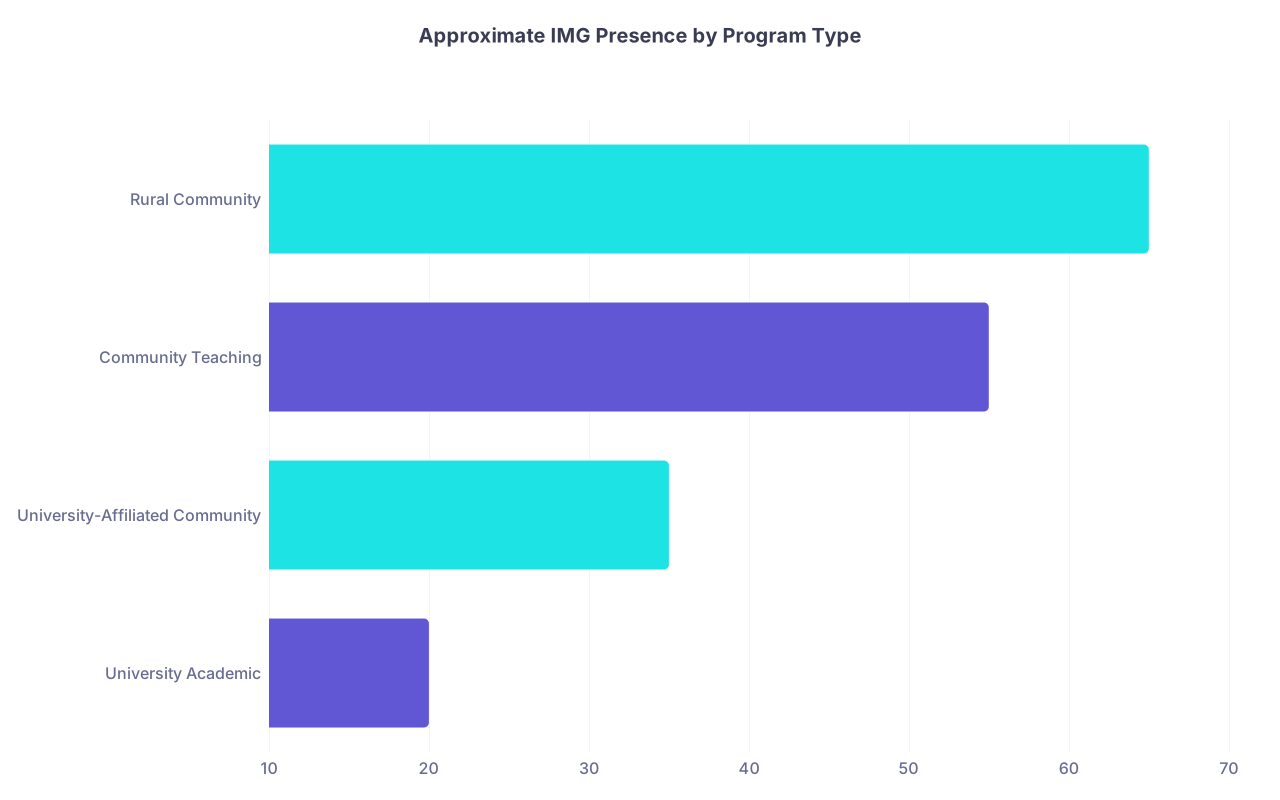
We know, for example, that certain specialties and program types carry a much higher share of IMGs. Internal medicine, family medicine, pediatrics, and neurology consistently have more international grads than dermatology, orthopedic surgery, or radiation oncology. Community programs tend to have more than big‑name academic centers.
But within those, %IMG distribution is lumpy.
| Category | Value |
|---|---|
| University Academic | 20 |
| University-Affiliated Community | 35 |
| Community Teaching | 55 |
| Rural Community | 65 |
Who’s applying where?
- University programs get tons of U.S. MD/DO applicants with high scores and built‑in pipelines from their own medical schools.
- Rural community hospitals might struggle to fill even with SOAP, so they become heavily dependent on IMGs.
Again: dependence ≠ friendliness.
I’ve seen programs that are 70–80% IMGs but have quietly raised their Step 2 CK cutoffs into the 250s because they can now cherry‑pick the desperate top of an oversupplied IMG pool. They look “IMG‑heavy” but they’re the opposite of forgiving.
On the flip side, I’ve seen university‑affiliated programs with only 20–30% IMGs that:
- Consistently sponsor H‑1B visas
- Take candidates 5–7 years out of graduation if their recent experience is strong
- Have multiple IMG chiefs and strong fellowship placements
They look less IMG‑dense on paper but are far safer, more supportive ecosystems if you can clear their (clearly stated) bar.
The Red Flags Hidden Behind High IMG Numbers
You want contrarian? Here you go: some of the most IMG‑dense programs should be avoided unless you’re desperate.
Common red flags I’ve seen in high‑IMG programs:
Chronic ACGME citations or probation
You might find this only after digging into ACGME public notices or hearing rumors from residents.Exploitative workload
“We’re like a work visa factory. IMGs come here, work 80+ hours, never complain because they’re scared, and the hospital loves the cheap labor.”Weak teaching / no didactics
The schedule says “daily conference.” In reality, it’s cancelled half the time because service demands are insane.Toxic hierarchy
IMG interns doing all the scut. U.S. grads (if any) shielded from certain tasks. Seniors threatening visas indirectly when residents push back.No one passes boards
Residents regularly failing ABIM or ABFM. But the hospital doesn’t care because they just need bodies for overnight coverage.
The ugly truth: some programs take a lot of IMGs precisely because IMGs are easier to pressure and less likely to walk away. If your visa depends on your job, you have less bargaining power. Unscrupulous leadership knows that.
A high IMG percentage in that context is a warning label, not a green light.
How to Actually Evaluate Whether a Program is IMG‑Friendly
You want data? Start collecting the right data. Here’s a practical system I push on IMG applicants I advise.
1. Score Programs on Concrete IMG Policies
Do not trust vibes. Build a small spreadsheet and grade each program 0–2 on key domains:
- Visa sponsorship: 0 = no; 1 = J‑1 only; 2 = J‑1 and H‑1B, clearly stated.
- Step cutoffs: 0 = vague/high rumors; 1 = some info; 2 = explicit thresholds, same for IMGs and US grads.
- YOG (year of graduation) policy: 0 = unknown or “within 3 years” hard cutoff; 2 = flexible or clearly defined with exceptions.
Then sort by your composite score, not by %IMG.
2. Look at Recent Resident Lists, Not Just Percentages
Go to program websites. Look at their current and recent graduates:
- Are there IMGs from schools or regions similar to yours?
- Do they have residents on visas right now? (It’s usually obvious from names/schools and LinkedIn profiles.)
- Where did graduates go next—fellowships, community jobs, nothing traceable?
Programs that are truly IMG‑friendly are not shy about this. You’ll see named fellowships, alumni spotlights, chief resident bios that include international grads.
3. Talk to Current IMGs at the Program
Not the PGY‑1 who matched 3 months ago and is still in the honeymoon phase. The PGY‑2 or PGY‑3 who’s seen the good, bad, and ugly.
Ask them directly:
- Did the program honor what it told you during recruitment (visas, research, rotations)?
- How are IMGs treated compared to U.S. grads?
- Have there been any sudden changes in policies (e.g., stopped H‑1Bs, raised score cutoffs)?
- Would you recommend this program to a friend from your home school?
Listen to the pauses. The half‑answers. “It’s… okay, I guess” often means “Run.”
4. Put %IMG in Its Proper Place
Use %IMG only as a contextual variable:
- Extremely low IMG % (0–5%) in your specialty might mean they almost never rank IMGs; you’re wasting an application unless you’re a statistical outlier.
- Moderate IMG % (10–30%) can be a sweet spot: more competitive, but IMGs clearly can and do match there.
- Very high IMG % (50–90%) should trigger deeper checking of accreditation, workload, and culture.
The percentage is a screening clue, not a verdict.
A Simple Framework to Rank Programs as an IMG
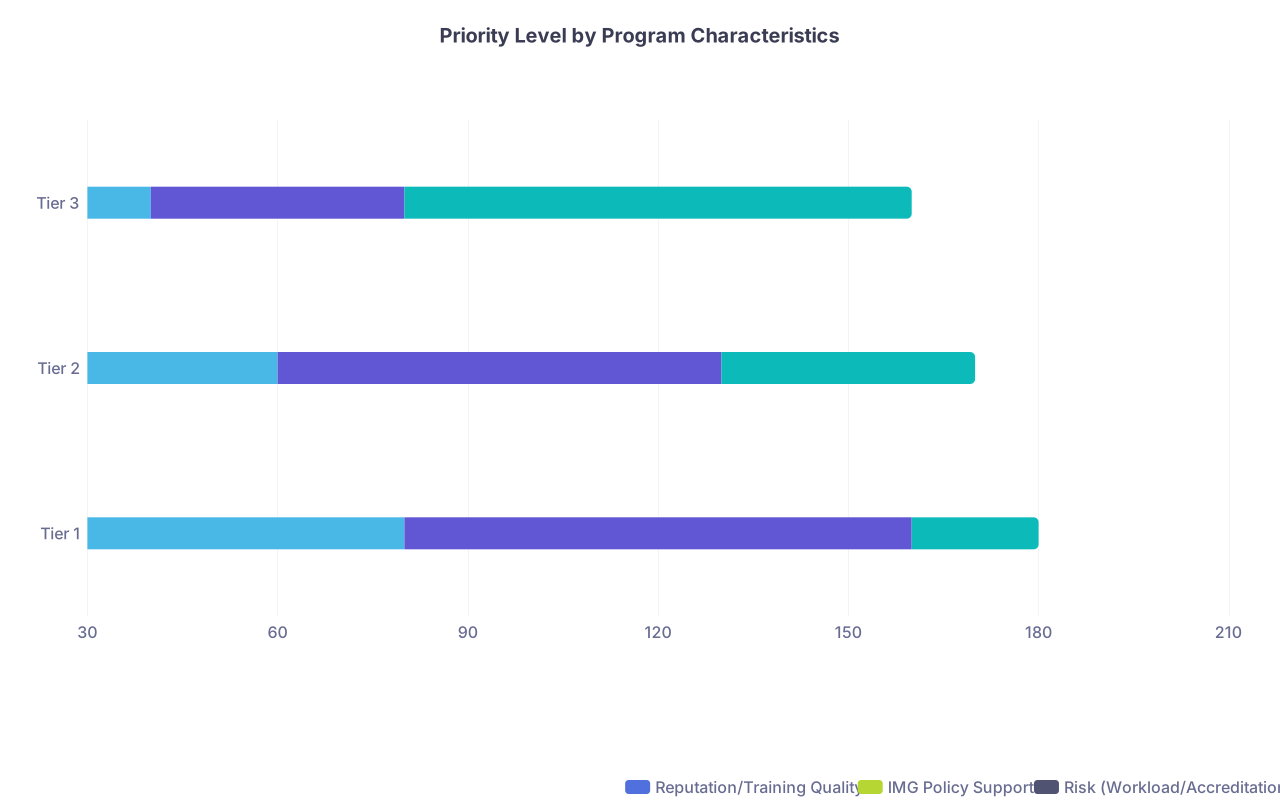
Summing this into a practical framework, here’s roughly how I’d prioritize, if I were you:
Tier 1 (Ideal)
- Good to excellent reputation, moderate IMG % (10–40%).
- Transparent visa + score policies.
- Visible IMG success stories.
- Strong board pass rates.
Tier 2 (Reasonable Targets)
- Community or university‑affiliated with moderate‑high IMG % (30–60%).
- Decent teaching structure, some fellowship placements.
- Stable visa policies, some support for IMGs navigating systems.
Tier 3 (Caution)
- Very high IMG % (60–90%).
- Weak web presence, little data on outcomes.
- Rumors of overwork or shaky accreditation.
- Consider only if your application is weak and you have few options—and you’ve spoken to residents.
| Category | Reputation/Training Quality | IMG Policy Support | Risk (Workload/Accreditation) |
|---|---|---|---|
| Tier 1 | 80 | 80 | 20 |
| Tier 2 | 60 | 70 | 40 |
| Tier 3 | 40 | 40 | 80 |
You’re not just trying to match somewhere. You’re trying to avoid spending 3 years in a program that treats you like interchangeable labor and does nothing for your future.
The Bottom Line: Stop Worshiping %IMG
Strip it down to essentials:
- High IMG percentage usually reflects difficulty attracting U.S. grads, not genuine IMG‑friendly policies.
- True IMG‑friendliness is about clear visas, realistic and transparent requirements, solid training, and proven outcomes for IMGs—not headcount.
- Use %IMG as a small context clue, then do the real work: investigate policies, talk to current IMG residents, and judge the program by how it treats and advances its people, not just who fills the slots.
If you remember nothing else: a program full of IMGs can still be a bad place for IMGs.