
IMG-friendly programs are not hiding in the middle of nowhere. That cliché is lazy, outdated, and flat‑out wrong.
The story you’ve probably heard: if you’re an international medical graduate, your only realistic shot is some tiny community hospital in a town no one has heard of, with weak training, no research, and miserable lifestyle. If you want a “real” city or strong academic program? Forget it.
Let me be blunt: that’s a comforting excuse, not reality.
The real picture is messier, and much more hopeful. There are IMG-heavy programs in major cities. Academic centers that routinely rank IMGs. Competitive specialties where IMGs quietly match every single year. And plenty of so‑called “desirable” locations where the bottleneck is not geography—it’s applicant strategy, visa status, and performance.
You do not win this game by assuming all good places are closed to you. You win by understanding what the data actually shows—and then exploiting the gaps other IMGs are too discouraged to touch.
What “IMG-Friendly” Actually Means (And Why People Get It Wrong)
Before we go further, let’s kill a basic misunderstanding.
Most people define “IMG-friendly” as: “a place that will take anyone with an ECFMG certificate and a heartbeat.” That’s not how programs think.
Program directors look at three things, in roughly this order:
- Can this applicant handle the clinical work?
- Will they be a visa headache?
- Do they fit the culture and track record of prior IMGs here?
“IMG-friendly” usually means:
- They have a history of taking IMGs repeatedly, not as a one-off.
- They offer (or are willing to offer) H-1B or J-1 visas.
- They don’t have an explicit or de facto “US grads only” filter.
- Past IMGs from that program have done well—fellowships, jobs, board pass rates.
Nowhere in that definition: “must be in the middle of a cornfield”.
Many IMGs conflate “less competitive program” with “undesirable location.” Not the same thing. A program can be:
- Mid-tier academically,
- In a major metro,
- And still relatively IMG-friendly
…because US grads are chasing name prestige, not geography. Or because the specialty is less glam. Or because the call schedule is rough and US grads self-sort away.
That’s the pattern you should be hunting—not this myth that “all good locations are closed.”
What the Data Actually Shows: IMGs Are Everywhere, Including Big Cities
Let’s bring in some numbers instead of vibes.
NRMP publishes data every year on where IMGs match and in what specialties. Combine that with program rosters and you notice a few things quickly:
- In Internal Medicine and Family Medicine, a huge portion of residents in major US cities are IMGs.
- Many large academic centers in New York, New Jersey, Michigan, Florida, Texas, Illinois, and California match IMGs every single year.
- Even in more competitive fields—like Neurology, Pathology, PM&R—you can find IMG-heavy programs in very desirable locations.
Here’s a simplified snapshot to illustrate the point (numbers illustrative, but the structure matches what you’ll find if you actually scan program rosters):
| Program Type | Location (Metro Area) | Approx. IMG Share | Visa Sponsorship |
|---|---|---|---|
| Community IM | New York City | 60–80% | J-1, some H-1B |
| University-Affiliated IM | Chicago | 40–60% | J-1, H-1B |
| Community FM | Houston | 30–50% | J-1 |
| Academic Neurology | Detroit | 20–40% | J-1, some H-1B |
| Community Pathology | Miami | 30–50% | J-1 |
Those are not obscure locations. These are major metros where rents are high, food is good, traffic is terrible, and IMGs are absolutely training and graduating.
Are there IMG-heavy programs in genuinely remote, less desirable areas? Of course. But the claim that only those exist is fantasy. You see IMGs in:
- New York (Bronx, Brooklyn, Queens-heavy IMGs)
- Chicago (multiple university-affiliated hospitals)
- Detroit, Newark, Cleveland, Philadelphia, Houston, Miami, Dallas, LA suburbs, and more
Programs in these cities aren’t doing IMGs a favor. They’re filling service-heavy positions with hardworking trainees who are grateful for the opportunity and often outperform expectations.
Why the “Only Bad Locations” Myth Persists
The myth hangs around for a few reasons, none of them good.
1. Survivorship bias and gossip
You hear stories like: “My cousin matched IM in [small town], it’s all that was available for him as an IMG.” You don’t hear as much about the IMG who matched in a Bronx academic center or a mid-tier Chicago university hospital because, frankly, they’re busy, and their story doesn’t sound tragic or dramatic enough to circulate.
I’ve sat in rooms where senior residents tell juniors: “Don’t waste time applying in big cities, they’ll never take you.” Meanwhile, the PGY-3 down the hall literally is an IMG in a big city program. But no one is doing the basic work of checking actual rosters.
2. Confusing prestige with location
A lot of IMGs mean this when they say “desirable location”: Harvard in Boston, UCSF in San Francisco, Columbia or Cornell in Manhattan.
That’s not a geography issue. That’s a competitiveness issue. Those programs are brutal for everyone—US grads included. Blaming IMG status alone is convenient, but dishonest.
What is true:
Elite “top-10” academic programs very rarely take IMGs, and when they do, those IMGs are exceptional outliers (top scores, publications, US research fellowships, connections).
But that doesn’t mean Boston or San Francisco or New York are completely off-limits. It means those specific institutions are.
3. Outdated mental models
A lot of advice floating around is frozen in time—pre-2020 Step 1, pre-visa policy shifts, pre-telehealth, pre-COVID program upheavals.
US grads’ preferences have evolved: more want lifestyle, less want insane call. That moves them toward certain specialties and away from high-service community programs, opening slots in places that are geographically attractive but less “sexy” on a CV.
Visa Sponsorship: The Real Geography Constraint (But Not How You Think)
If there’s one factor that actually distorts location options for IMGs, it’s visa sponsorship—not program “friendliness” in some moral sense.
Programs sort themselves, roughly, into three bins:
- No visas at all (US grads and green card holders only)
- J-1 only (Easier paperwork, but limits you later with waiver jobs)
- J-1 and H-1B (Harder on the program, more attractive to you)
Now, look at where many of the H-1B-friendly, IMG-heavy programs live:
Big coastal states with lots of immigration infrastructure (NY, NJ, CA), plus heavy-service Rust Belt and Southern metros (MI, OH, TX, FL).
Not exactly the middle of nowhere.
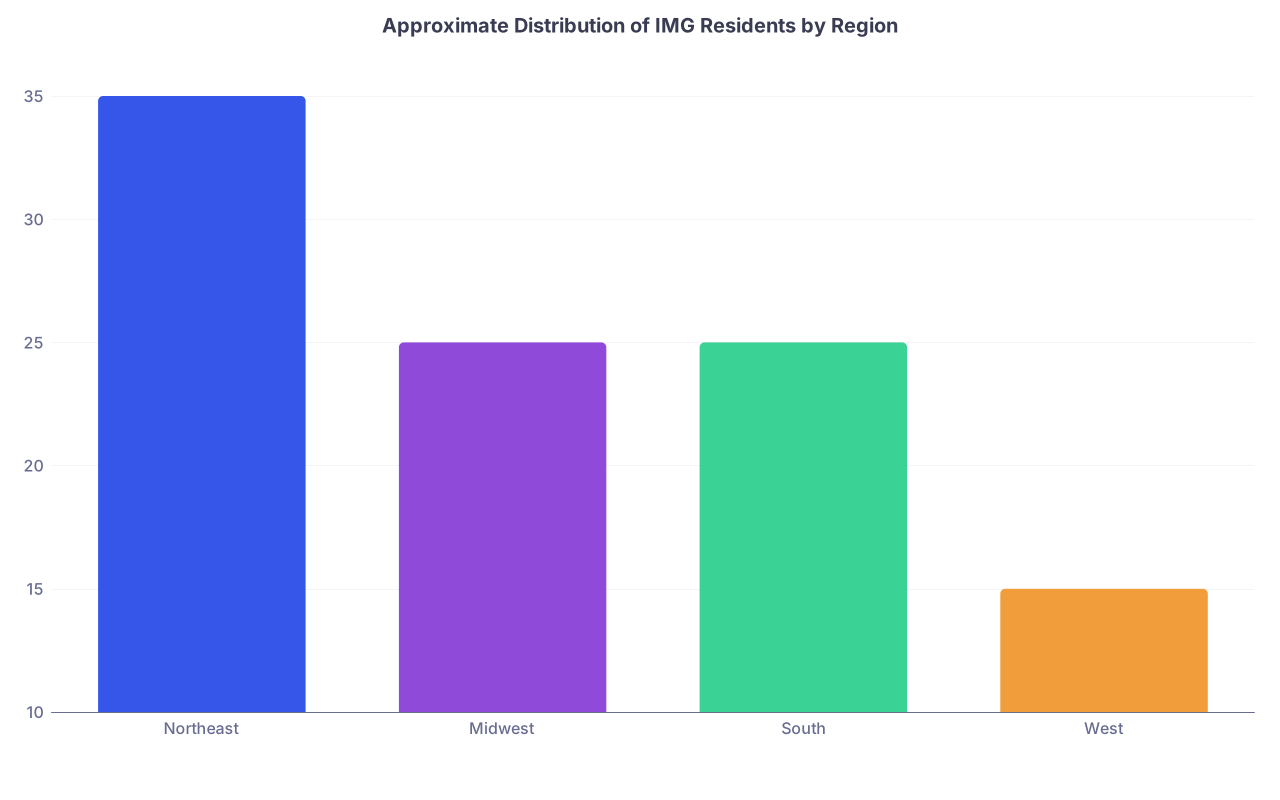
| Category | Value |
|---|---|
| Northeast | 35 |
| Midwest | 25 |
| South | 25 |
| West | 15 |
Again, if you do the legwork and check program websites, FREIDA, or actual resident bios, you’ll see the immigration pattern clearly.
Where do you run into true geographic constraints?
- University programs in smaller, homogenous regions that never built a system for visas and don’t feel the need to start now
- Hyper-competitive coastal flagships that can fill with local US grads without touching visas
- Certain states where post-residency waiver jobs are harder to find (which program directors know and factor in)
But the idea that “if they sponsor visas they must be in a bad location” is simply false. It’s almost the opposite: high-volume safety-net hospitals in major immigrant-heavy cities are often deeply dependent on IMGs.
Academic vs Community: The Real Axis That Matters
The more useful distinction for an IMG is not “good location vs bad location.” It’s “academic vs community” and “safety-net vs boutique.”
Let me draw a simple picture.
| Profile | Location Type | IMG-Friendliness | Pros for IMGs | Cons for IMGs |
|---|---|---|---|---|
| Big-City Safety-Net IM | Major metro | High | Visa support, high volume, jobs | Heavy workload, less prestige |
| University-Affiliate IM | Metro/suburban | Moderate-High | Some research, decent name | More selective, Step-heavy |
| Community FM/IM Rural | Small town/rural | Very High | Easier match, autonomy | Geographic isolation, fewer subs |
| Elite Academic Flagship | Major metro | Very Low | Prestige, research, fellowship | Rare IMGs, extreme competition |
| Boutique Lifestyle FM | Suburban/affluent | Low | Nice lifestyle, cush schedule | Limited IMGs, often US grads |
Where are IMGs thriving?
In profile 1 and 2. And those are disproportionately located in…major metros. Think:
- County hospitals
- City safety-net systems
- University-affiliated community programs
If what you really want is strong training, reasonable shot at fellowship, and a city where your spouse can find a job and your kids can attend good schools—you don’t have to exile yourself to nowhere. You need to target the right type of program within the city.
How IMGs Actually Get Into “Desirable” Locations
Here’s where most IMGs sabotage themselves. They either:
- Blanket-apply to every big-name program in a city, or
- Give up on cities altogether and only apply to places they’d never choose if they had options.
Both are bad strategies.
You need a targeted, realistic, data-driven approach:
1. Use rosters, not rumors
Spend a weekend doing what almost no one does: open program websites, look at current residents, and count how many are IMGs. Don’t guess—count.
If a program has had 1 IMG in 5 years, consider it “IMG-neutral at best.”
If half the roster is IMGs, that is a signal.
2. Look at where those IMGs came from
Are they mostly from one or two specific countries or schools? That tells you there’s a pipeline or faculty connection. Use it.
I’ve watched programs quietly favor certain schools in India, Pakistan, the Caribbean, Eastern Europe, the Middle East, because they’ve had strong experiences with those grads. If you match that profile, you’re not walking in cold.
3. Filter city programs by service load, not prestige
In every major city there are:
- A couple of trophy hospitals
- A handful of mid-tier academic centers
- Many community and safety-net hospitals
Guess which ones need IMGs the most? The ones doing the most work for the most underserved patients. They may not have the shiniest branding, but they’re in the city you want, they’ll support visas, and you’ll see more pathology in three years than some cush programs see in ten.
4. Stop pretending Step scores don’t matter
Even after Step 1 went pass/fail, Step 2 CK is still a major filter. Programs in competitive locations will happily consider IMGs—but they will not drop standards just because you’re “willing to go anywhere.”
If you want the leverage to choose geography, you need to be above the median for IMGs in your specialty. Not barely scraping the minimum.
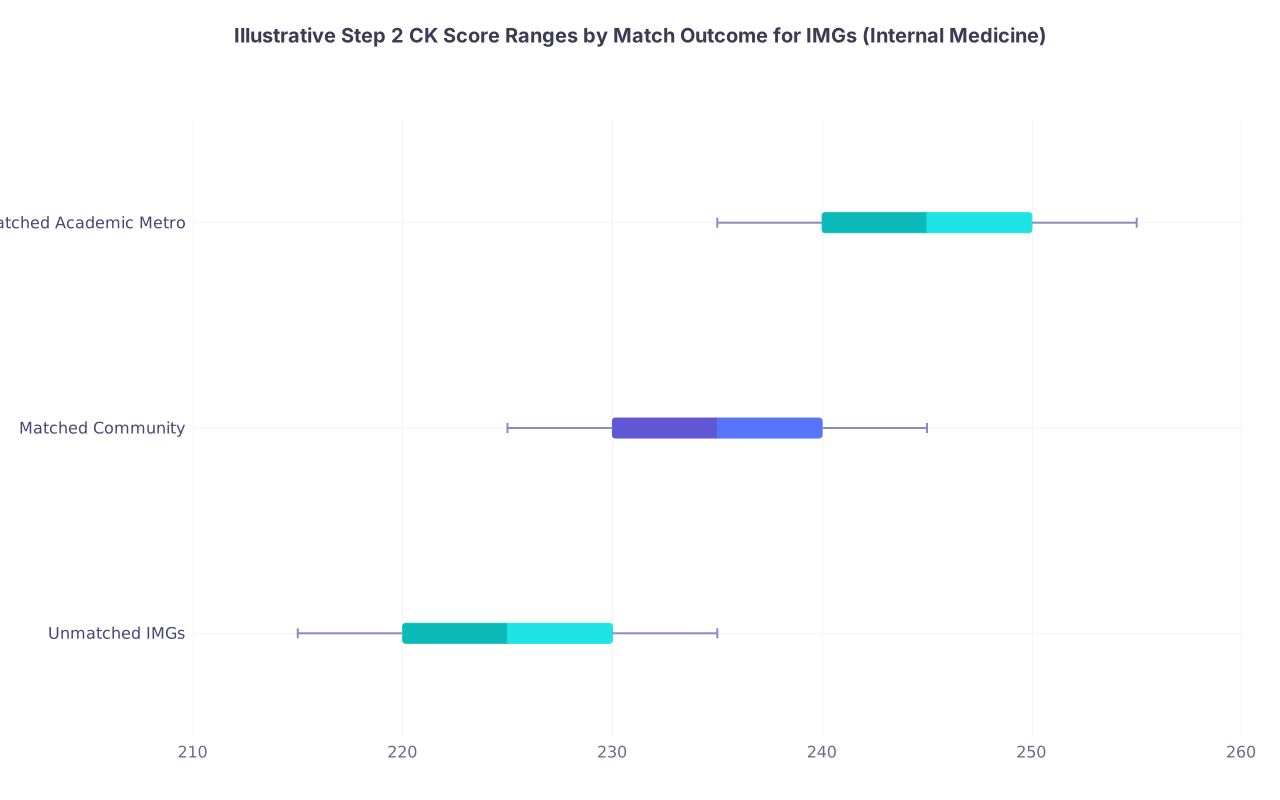
| Category | Min | Q1 | Median | Q3 | Max |
|---|---|---|---|---|---|
| Unmatched IMGs | 215 | 220 | 225 | 230 | 235 |
| Matched Community | 225 | 230 | 235 | 240 | 245 |
| Matched Academic Metro | 235 | 240 | 245 | 250 | 255 |
You want the city plus the IMG-friendly program? Then you’re playing in the right half of that last box.
The Tradeoffs You Actually Face (Not the Mythical Ones)
Let me spell out the real choices you’re facing, stripped of the drama.
You are not facing:
“Small town prison sentence vs zero chance in any good city.”
You are facing something like:
- High-volume city safety-net program, IMG-heavy, rough hours, good experience, medium prestige, often solid fellowship pipelines
vs - Rural or small-town community program, very IMG-friendly, lighter academic exposure, potentially less competitive for some fellowships, quieter lifestyle
And beyond that, an outer ring of:
- Elite university flagships in desirable cities that almost never take IMGs unless you’re an outlier
- Boutique low-service programs that can fill with US grads and thus rarely look at you
Once you accept that structure, you can plan with a clear head.
You might decide, rationally, to pick a great but smaller city over a huge one. Or to do IM at a city safety-net hospital instead of chasing a top-10 name that will never rank you. Or to accept a rural program with a fantastic fellowship track record over a big-city program with no subspecialties.
All of those are real tradeoffs.
What you should stop doing is assuming every good location is closed and every available program is geographically miserable. That’s fear talking, not facts.
Three Things to Remember
- IMG-friendly programs exist in major, desirable cities—especially in safety-net and university-affiliated hospitals. The myth that you’re limited to “undesirable locations” is flatly wrong.
- Your real constraints are visa sponsorship, program type, and your own competitiveness (Step 2 CK, US clinical experience, and letters), not geography alone.
- You gain leverage by using data: actual rosters, visa policies, and score ranges—not rumors from seniors who never bothered to check where IMGs are already training.