
Community programs are not automatically more IMG-friendly than academic programs. That belief survives because people repeat anecdotes louder than they read data.
Let me be blunt: “Just apply mostly community, they take IMGs” is lazy advice. It’s how people end up wasting money on hostile programs and ignoring academic places that would have actually ranked them.
You want the truth? IMG-friendliness has almost nothing to do with “community vs academic” and everything to do with three things:
- Historical match patterns
- Visa infrastructure and institutional policy
- Program leadership and culture
And those do not split cleanly along “community” and “university” lines.
Where This Myth Comes From (And Why It’s Wrong)
I’ve heard this exact line in advising sessions:
“University programs are too competitive; I’ll just apply to community ones. They take IMGs.”
Translation:
“I have not actually looked at data. I’m just assuming.”
Here’s what actually drives the myth:
- Many top-tier academic “big-name” places (think MGH, UCSF, Hopkins for IM) take almost no IMGs. People overgeneralize that to mean all academic programs are IMG-hostile.
- Some well-known community internal medicine and family medicine programs match a lot of IMGs. People overgeneralize that to mean all community programs are IMG-friendly.
- Applicants see a few match lists: community-heavy = many IMGs; academic-heavy = few IMGs. Correlation becomes gospel.
But when you zoom out, the pattern falls apart.
Look at NRMP and program websites for internal medicine, family medicine, pediatrics, neurology, psychiatry. You’ll see:
- University-affiliated programs with 40–70% IMGs.
- Community programs with 0 IMGs and explicit “no visa” policies.
- Large academic centers with explicit J-1 and H-1B sponsorship and long histories of training IMGs.
The label “community” or “academic” doesn’t predict friendliness. Historical behavior does.
What The Data Actually Shows
We don’t have a perfect, unified public database that says “this program is IMG-friendly, this one isn’t.” But we do have:
- NRMP Program Director Surveys
- Specialty match data by US-IMG and non-US IMG proportions
- Program rosters on websites and social media
- Visa policies and institutional GME pages
When you cross-check those, a pattern emerges: program type alone is a weak predictor of IMG-friendliness.
To visualize this, think of something like:
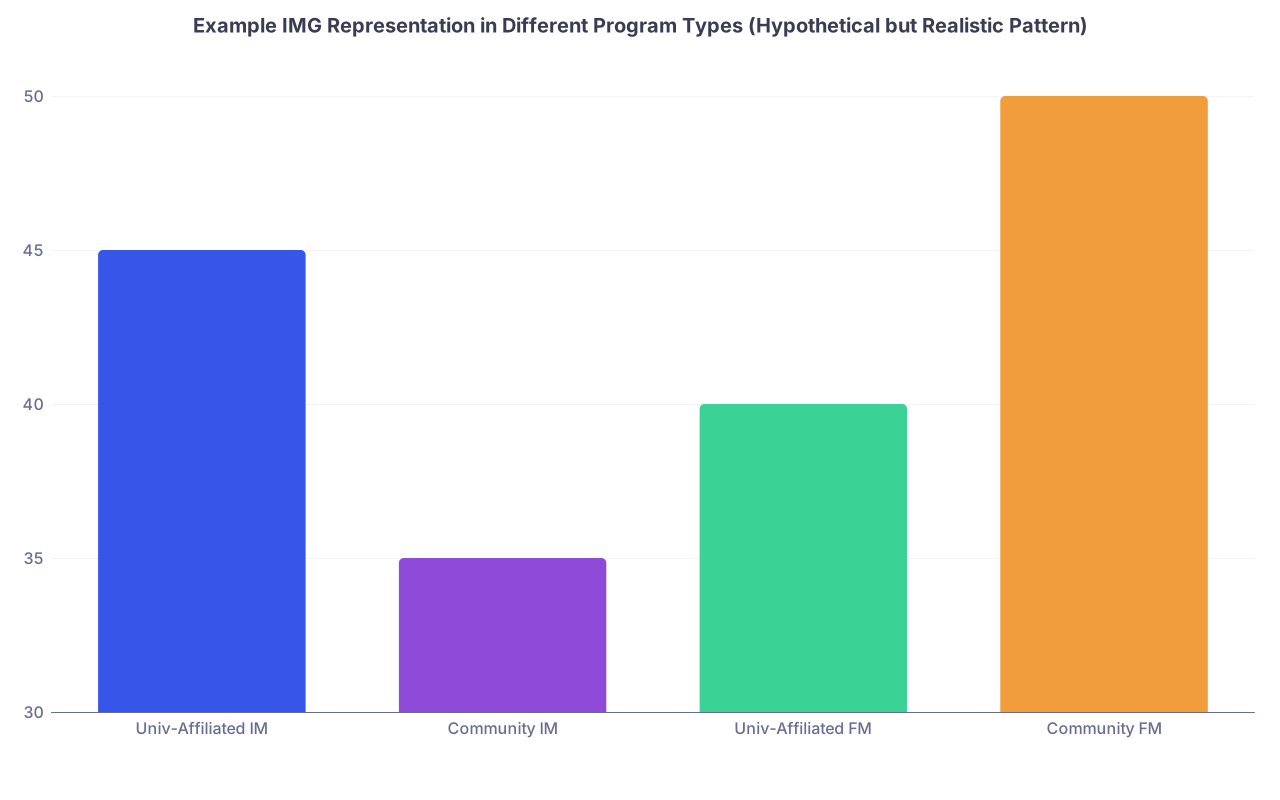
| Category | Value |
|---|---|
| Univ-Affiliated IM | 45 |
| Community IM | 35 |
| Univ-Affiliated FM | 40 |
| Community FM | 50 |
Those percentages (approximate, illustrative) are residents who are IMGs in certain broad buckets. What you don’t see is:
- “Academic = 5% IMGs”
- “Community = 90% IMGs”
Reality: it’s a spread. Some community internal medicine programs are basically mini-universities with research, subspecialty faculty, and established pipelines from specific foreign schools. Others are community hospitals mostly filling with US grads and DOs.
I’ve looked at rosters where:
- University-affiliated IM program in the Midwest: 60–70% IMGs, mostly on J-1, some H-1B.
- Large community hospital in a desirable city: 5–10% IMGs, no H-1B, inconsistent J-1 usage.
- Mid-tier academic psych program: 30–40% IMGs across 4 classes.
If you walk in assuming “community = safe,” you will misread the field and misallocate your applications.
The Real Drivers Of IMG-Friendliness
Stop thinking in binaries. Start thinking in mechanisms.
1. Historical Track Record
The most predictive factor is brutally simple:
Has this program consistently matched IMGs in the last 3–5 years?
You verify that by:
- Looking at current resident bios: med school, country, visa status if posted
- Checking alumni lists
- Cross-checking program Instagram/LinkedIn pages
Programs are creatures of habit. If their current PGY-1 to PGY-3 classes are 40% IMGs, it’s not an accident. Someone in leadership:
- Knows how to trust non-US transcripts and letters
- Has relationships with certain international schools
- Feels comfortable evaluating your profile
If the resident page looks like:
- 95% US MD, zero IMGs for 5 years → program is effectively non-IMG, regardless of “community” or “academic” branding.
2. Visa Infrastructure
Visa policy is where community vs academic sometimes shows up—BUT not how people think.
Larger academic centers are more likely to have:
- A centralized GME office that handles J-1 and sometimes H-1B regularly
- An institutional policy already aligned with ECFMG and immigration requirements
- Legal counsel and payroll systems used to dealing with visa issues
Many smaller community hospitals struggle here. It’s not bias, it’s bureaucracy. They just don’t have:
- In-house immigration counsel
- Budget for H-1B wages that match institutional standards
- Administrative bandwidth to navigate visa audits
So what happens? They quietly or explicitly adopt “We don’t sponsor visas.” You see language like:
- “Applicants must be US citizens or permanent residents.”
- “We do not sponsor visas at this time.”
- “Only J-1 visas considered.”
And yes, some academically affiliated programs have the exact same language. But plenty don’t. They clearly state:
- “We sponsor J-1 visas through ECFMG; H-1B sponsorship is considered for strong candidates.”
That’s an actual policy, not a vibe. It matters more than “community vs academic.”
Concrete Comparison: What You Should Actually Look At
Let’s put some structure to this. If you’re deciding where to apply, this is the reality check you need.
| Factor | What You Want to See |
|---|---|
| Resident roster | Multiple current IMGs, consistently each year |
| Visa policy | Clear J-1 support, maybe H-1B |
| Program leadership | PD/APDs with history of mentoring IMGs |
| Institutional GME support | Dedicated office listing visa details |
| Board pass rates | Solid, showing IMGs succeed there |
None of those columns say “community” or “academic.” Because that’s not the point.
Program Type vs Culture: Stop Confusing Them
I’ve seen community programs that behave like rigid academic powerhouses. And academic-affiliated ones that are scrappy, welcoming, and heavily dependent on IMGs.
Culture is determined by:
- Who the program director is
- What the chair values
- How many home US grads feed into the program
- Prior experiences with IMGs (good or bad)
For example:
A community IM program with a new PD who trained at a top US academic center and wants to “raise the bar” may suddenly tighten filters: higher USMLE cutoffs, fewer visas, more home-school DOs. Overnight, the “IMG-friendly community program” disappears.
An academic-affiliated county hospital with a strong mission to serve underserved communities often loves IMGs—especially those with prior clinical experience abroad and language skills. Half the class may be IMGs.
Trying to read this from the name alone is like trying to predict someone’s personality from their email domain. Useless.
How To Actually Identify IMG-Friendly Programs
You want a practical playbook, not just theory. So here it is.
Step 1: Ignore the Label, Audit the Roster
Go to the program’s website. Look at current residents. Ask:
- How many are clearly international grads (non-US schools)?
- Is that true across multiple years, not just a one-off?
- Do they come from a mix of schools or just one partner international school?
If you see 1 IMG in PGY-3 and none in PGY-1/2, that’s not a friendly program. That’s a relic from a prior era or a fluke.
If 40–70% of residents are IMGs across all classes, you’ve found a real pipeline.
Step 2: Read Visa Language Like a Lawyer
Do not hand-wave this. A single sentence can save you hundreds of dollars.
Look for:
- “We sponsor J-1 visas through ECFMG.” → Okay for most IMGs.
- “We sponsor H-1B visas for highly qualified candidates.” → Critical if you’re trying to avoid J-1.
- “We do not sponsor visas.” → Stop. Don’t apply if you need one.
- “We consider visa sponsorship on a case-by-case basis.” → In practice, often means: rare, and usually J-1 only.
If they don’t mention visas at all, that’s a red flag. You then:
- Check the GME office website for institutional policy
- Email the program coordinator with a one-line question about visa sponsorship
I’ve watched IMGs apply to 20+ programs that never sponsor visas, purely because they “heard the program was community and took IMGs.” That’s self-sabotage.
A More Honest View of Specialty and Competitiveness
Another layer people ignore: the impact of specialty and competitiveness.
IMG-friendliness is much more influenced by:
- How competitive the specialty is nationally
- Geographic desirability
- Whether there’s a large pool of US MD/DO applicants to fill slots
Put simply:
- Internal Medicine, Family Medicine, Pediatrics, Neurology, Psychiatry → more IMG entry points, both community and academic.
- Dermatology, ENT, Ortho, Plastics, Neurosurgery → community vs academic is irrelevant; both sectors rarely take IMGs.
And within a specialty like IM:
- Academic safety-net / county hospitals, VA-based programs, and mid-tier university-affiliated programs in less desirable locations often have high IMG proportions.
- Highly desirable coastal community programs in big cities can be more competitive and less IMG-friendly than some midwestern university programs.
To visualize the trend:
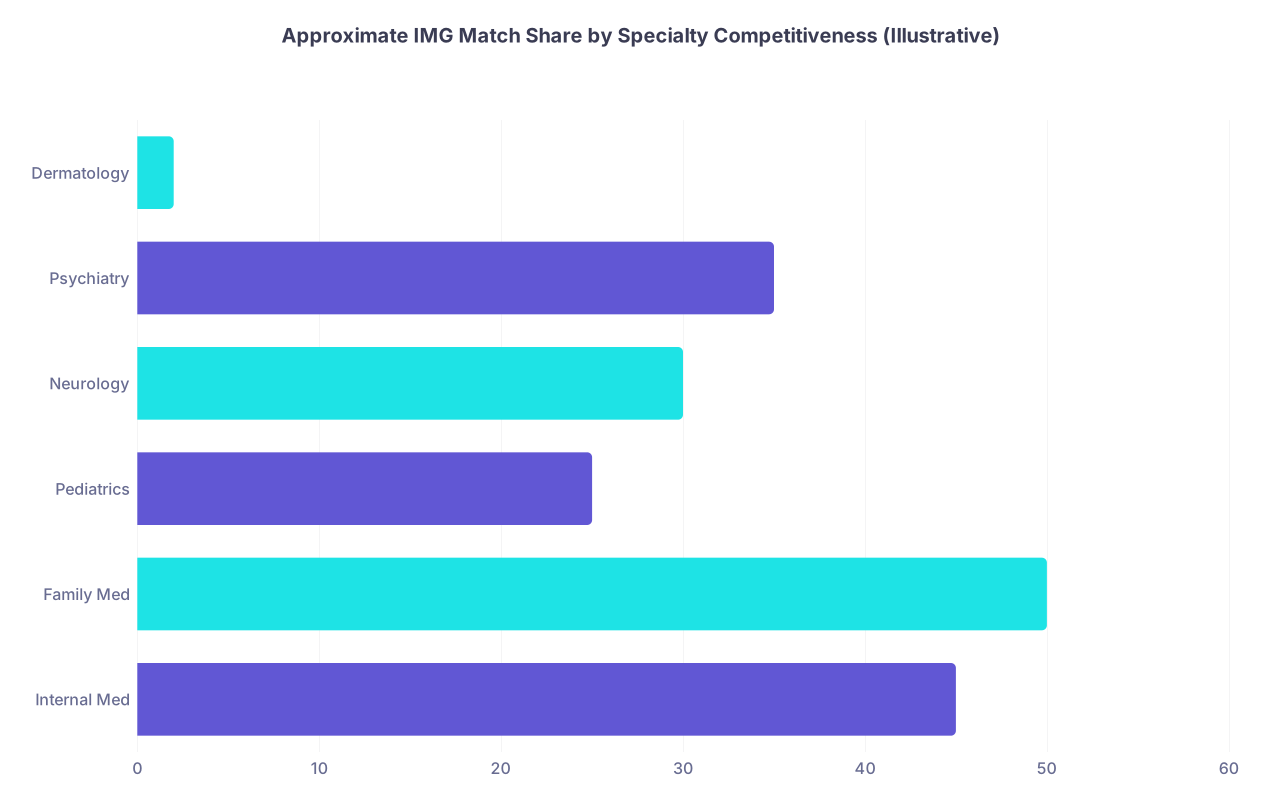
| Category | Value |
|---|---|
| Internal Med | 45 |
| Family Med | 50 |
| Pediatrics | 25 |
| Neurology | 30 |
| Psychiatry | 35 |
| Dermatology | 2 |
Community vs academic barely explains that pattern. Specialty competitiveness and geography do.
Geography: The Elephant in the Room
Where the program is matters. A lot.
- Less desirable locations (rural, Rust Belt, certain Southern areas) often rely more on IMGs, both community and academic.
- Highly desirable metros (NYC, LA, SF, Boston, Miami, Seattle) have deep applicant pools. Even “community” hospitals there can fill with US grads and become relatively IMG-cold.
I’ve seen “small academic” programs in the Midwest with 70% IMGs and “big community” programs in Florida with 10% IMGs and no visas. The myth falls apart the second you account for geography.
A Smarter Application Strategy for IMGs
If you take nothing else from this, take this: filter programs by behavior, not branding.
A more rational target list for an IMG might:
- Mix university-affiliated and community programs, but
- Restrict to those with:
- Clear visa support aligned with your needs
- 30%+ current IMGs across all classes
- Locations where IMGs historically match well
You also prioritize programs whose selection criteria line up with your stats:
| Your Profile | Programs To Prioritize |
|---|---|
| 250+ scores, strong research | Mid-tier academics, IMG-heavy university programs |
| 220–235 scores, no USCE | Community-heavy, IMG-dense, less desirable locales |
| Strong USCE, average scores | Mixed academic/community with clear IMG track record |
And if a program is:
- Community
- In a big, desirable city
- With near-zero IMGs on the roster
- Ambiguous or negative on visas
…then “community” doesn’t save you. That’s not your program.
One More Reality Check: US-IMG vs Non-US IMG
Even among IMGs, the playing field isn’t uniform.
- US-IMGs (Caribbean schools, etc.) sometimes get treated more like US DOs, especially in less competitive specialties.
- Non-US IMGs often lean heavily on programs with deep history taking non-US graduates.
Some programs are “IMG-friendly” only in the sense that they take lots of US-IMGs, but virtually no non-US IMGs. Again: look at the med schools listed on resident bios, not just the total IMG count.
Visualizing a Saner Process
Here’s what your internal decision-making actually should look like:

| Step | Description |
|---|---|
| Step 1 | Identify Specialty |
| Step 2 | List All Programs |
| Step 3 | Check Visa Policy |
| Step 4 | Remove Program |
| Step 5 | Check Resident Roster |
| Step 6 | Deprioritize |
| Step 7 | Check Location and Competitiveness |
| Step 8 | Apply Strategically |
Notice what’s missing?
“Is it community or academic?” Not a decision node. Because it’s not the right question.
Bottom Line
Community programs are not inherently more IMG-friendly than academic programs. That myth survives because it’s simple, not because it’s true.
The real levers that matter:
- Track record beats branding. Look at actual current residents, alumni, and visa histories. Ignore the “community vs academic” label – it’s a distraction.
- Visa policy and geography drive opportunity. Clear visa sponsorship and less desirable locations, in both academic and community settings, are where IMGs reliably match.
- Apply to behavior, not reputation. Build your list based on documented IMG-friendliness, not on vague advice that “community programs take IMGs.”
If you stop chasing the myth and start reading the evidence, your application list will instantly get smarter—and your odds will go up.