
Most “IMG-friendly” programs are not actually IMG-friendly. They’re visa-tolerant when it’s convenient. Behind closed doors, the conversation is way more blunt than anything you’ll ever see on a website or in a Zoom info session.
I’ve sat in those rooms. I’ve heard the exact phrases that decide your fate:
“Do we really want to deal with this visa headache again?”
“Great applicant, but we only have two H‑1B slots.”
“Can they get here on time, or is immigration going to blow up our schedule?”
If you’re an IMG, especially one needing a visa, you need to understand how your name is being discussed when you’re not there. Because your strategy depends on their reality, not their marketing.
Let me walk you through what actually happens.
The First Wall: Program Policy vs Real Behavior
Programs love vague language. “We sponsor visas.” “We consider all applicants.” It sounds inclusive. Inside the room, it’s much more specific.
Here’s how the internal structure usually looks.
There are three layers:
Institutional rules – Set by GME office and legal. This determines:
- Whether they can sponsor J‑1, H‑1B, both, or neither
- Any hard caps on numbers (e.g., “Max 8 H‑1B residents across all programs”)
Program director decisions – How aggressively they use those options:
- “We’ll take a couple of J‑1s every year, but only one H‑1B if absolutely outstanding”
- “We’re not touching H‑1B this year, budget is tight”
Faculty culture – The unspoken rules:
- “We had a visa delay two years ago that wrecked our schedule; let’s avoid that”
- “Our best chief was a J‑1; we should keep recruiting like that”
The website shows layer 1. The real decision-making is layers 2 and 3.
So when you see: “Visas: J‑1, H‑1B”, that does not mean:
- They’ll actually offer you H‑1B
- They’ll prioritize you equally to a US citizen with similar stats
- They understand the nuances of your situation
What it really means behind closed doors is more like: “We could sponsor this. If we feel like it. And if it doesn’t cause too much trouble.”
How Committees Actually Categorize IMG + Visa Applicants
On paper, everyone is “holistically reviewed.” In the room? They quickly sort you into buckets.
The unspoken categories look more like this:
| Bucket | How They Talk About You |
|---|---|
| 1. No visa needed | “Easy pick, no HR issues.” |
| 2. J‑1 okay | “Standard ECFMG, no big deal.” |
| 3. H‑1B possible | “Strong enough to justify the hassle?” |
| 4. Unknown / complex | “I don’t want to touch this.” |
You’re fighting an uphill battle the second someone says your name followed by a question about your visa.
Typical comments you’d hear in a selection meeting:
- “Is this one J‑1 or H‑1B?”
- “Do they already have Step 3? If not, no H‑1B.”
- “We have no more H‑1B slots this year, so if we like them it has to be J‑1.”
- “They’re Canadian, this is easier.”
- “They’re in-country already? That helps.”
Notice the pattern? Before they talk about your research, your LORs, your sub‑I… they often talk about your paperwork.
J‑1 vs H‑1B: The Real Internal Calculus
J‑1 – the “default” IMG visa
Behind closed doors, the J‑1 is viewed as:
- Cheaper
- More predictable
- Processed through ECFMG (GME offices like that)
- Lower institutional risk
In meetings, the J‑1 is often described as “no big deal.” I’ve heard PDs say, “J‑1 is fine; HR knows that pathway by heart.” So at many academic or IMG-heavy community programs, if they say they’re IMG-friendly, they mostly mean “we’re comfortable with J‑1s.”
Where it gets tricky is when faculty start thinking long term.
You’ll hear:
- “If they’re J‑1, they’ll probably leave after a waiver job. Are we OK with that?”
- “We’re not necessarily training future faculty if we go J‑1-heavy.”
But 9 times out of 10, if they’re already recruiting many IMGs, J‑1 is not what blocks you. Your scores and performance do. The visa itself is just a logistical step.
H‑1B – the “premium” and restricted option
H‑1B is a different animal. Inside those rooms, people use phrases like:
- “We need to save that H‑1B slot for a superstar.”
- “Is this candidate worth burning an H‑1B on?”
- “We got burned last year with H‑1B timing; I don’t want that again.”
So internally, if they sponsor H‑1B at all, they usually:
- Cap the number per year, often very low (1–2 slots)
- Reserve them for:
- Research monsters
- High boards + great US experience
- People they see as future fellows/academic types
Also, the Step 3 issue is huge. Off the record, I’ve heard PDs say:
“If they don’t already have Step 3, I’m not going to lose sleep over this. Just move on.”
That means:
- You without Step 3 = “Maybe J‑1, but no H‑1B energy.”
- You with Step 3 passed early = “OK, we can talk about H‑1B if they’re top-tier.”
The Real Risk Conversation: Delays, No-Shows, and HR Panic
Visa issues scare people. Not because they’re anti-IMG (though some are). Because they’ve been burned.
In confidential meetings, a PD or coordinator will bring up specific horror stories:
- Resident’s visa delayed → They started 4–6 weeks late → Schedule chaos, angry attendings
- Someone denied a visa → Program suddenly short a resident → Coverage crisis
- Last-minute transfer issues → GME had to scramble paperwork → PD gets blamed
So behind closed doors, when a visa-needing IMG comes up, someone will say:
“Can they actually get here on time? I don’t want to rearrange the rotation blocks again.”
And the room will silently remember the one year everything imploded because of visa delays.
This is what you’re never told:
Your individual risk is judged not just on your file but on the institution’s memory of prior disasters.
If they had a mess with a visa last year, the unofficial policy this year might be:
- “Let’s just minimize visa-heavy applicants.”
Even if nothing changed on the website.
How “IMG-Friendly” Programs Talk About You
Some programs really are IMG-friendly. But not because they’re nice. Because they’ve built systems around you.
At those places (think large community IM, family med, some university-affiliated safety-net hospitals), the conversation is very different:
- “Half our best residents are IMGs.”
- “We know the J‑1 process cold, our coordinator is amazing.”
- “We’ve got our H‑1Bs mapped out already; we can give one to a superstar IMGer.”
You’ll see internal spreadsheets where:
- Applicants are tagged by visa needs
- Step 3 status is clearly marked
- Notes like: “Eligible for H‑1B” or “J‑1 only, no Step 3”
And they actively plan:
- “We’ll likely rank 4–5 strong J‑1 IMGs in our top 15.”
- “We’ll try to get 1–2 H‑1Bs through GME if they’re worth it.”
The real IMG-friendly vs fake IMG-friendly
The subtle difference:
True IMG-friendly program discussion:
- “We expect to sponsor multiple visas each year.”
- “Our process works; we’ve done this for years.”
- “Yes, we can take J‑1s and a few H‑1Bs; we know the requirements.”
Fake or marginally IMG-friendly program:
- “We can sponsor visas in theory.”
- “We did an H‑1B once, it was a huge pain.”
- “We’ll consider it if they’re extraordinary, but I’d rather not.”
And that shows in something applicants rarely ask: How many visa residents are currently in the program, and on what visas?
That number tells the truth.
What Happens in Rank Meetings When Your Name Comes Up
You’re imagining they’re dissecting your personal statement. No. They’re often staring at a spreadsheet.
Columns you don’t see:
- Visa: None / J‑1 / H‑1B possible
- Step 3: Y/N
- In-country vs abroad
- Current status: student / graduate / research / clinical
When rank list discussions get serious, the visa talk becomes sharper.
Typical internal phrases:
- “We already have four visa candidates in our top 10; do we want more?”
- “If we end up with three H‑1Bs, GME may push back.”
- “Let’s spread our risk – mix of citizens, green cards, J‑1s.”
And yes, there is a risk-balancing mentality:
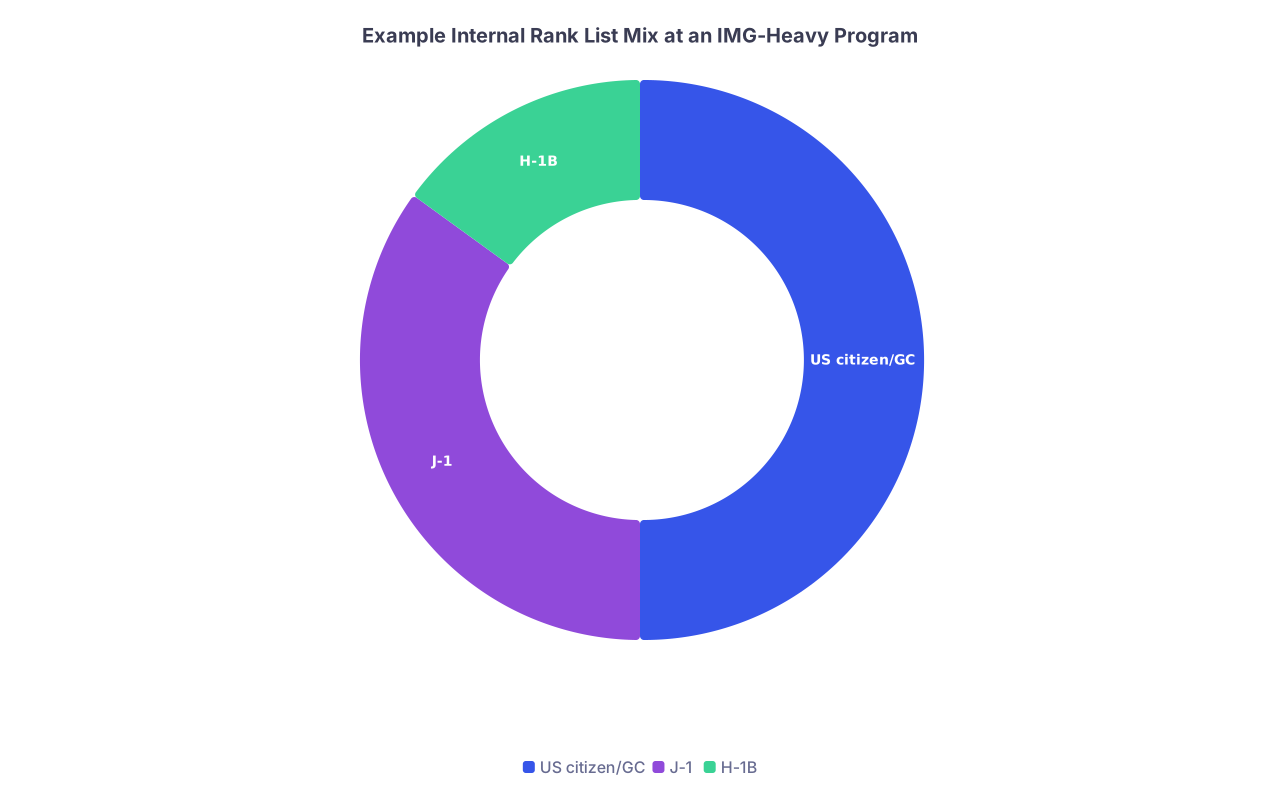
| Category | Value |
|---|---|
| US citizen/GC | 50 |
| J-1 | 35 |
| H-1B | 15 |
No one writes that chart on the whiteboard, but they behave as if it exists.
So you, as a visa-needing IMG, are very unlikely to be:
- Rank #1 at a program with minimal IMG history
- Clustered with many other visa-heavy applicants at the very top
Even if they like you, they often “distribute” visa-dependent candidates across the top 25–30 spots to “avoid all or nothing outcomes.”
The Conversations About Red Flags Unique to IMGs
There are a few phrases I’ve heard repeatedly when IMG + visa + any complication shows up:
- “Old grad plus visa issues? Too risky.”
- “Two Step failures and visa needs? Hard pass.”
- “Multiple transfers, plus we have to sponsor them? Not worth the headache.”
For a US grad, a failed Step or a leave of absence might be gray-zone. For an IMG with visa needs, those same issues make the room tense.
So what’s happening behind the scenes is a harsher threshold for risk:
Same applicant quality, but:
- No visa: “Let’s give them a chance; we can work with this.”
- Needs visa: “Add one problem to immigration and this becomes our nightmare.”
That’s the brutal, unspoken truth.
How Emails and Questions from You Change the Discussion
You might think asking about visas makes you look “difficult.” Depends how you do it.
Inside programs, here’s what I’ve seen:
Applicant sends a vague, anxious email:
- “Will you sponsor H‑1B? I really need H‑1B. I cannot do J‑1.” Room reaction: eye rolls. “This is going to be complicated.”
Applicant sends a precise, professional update:
- “I have passed Step 3, ECFMG certified, currently on OPT in the US. I am eligible for both J‑1 and H‑1B. I wanted to confirm your program’s practices so I can apply appropriately.” Room reaction: “Organized. Informed. Low drama.”
During interviews, applicants who are clear on their visa reality tend to be rated as less risky. Because faculty think: “They understand their own situation. They won’t surprise us in April with some disaster.”
Sometimes, after a particularly strong interview, I’ve heard:
- “If we absolutely need to, could we push for an H‑1B for this one? They’re worth it.”
That sentence almost never gets said for someone who sounds confused about their own visa landscape.
Behind-the-Scenes Differences by Specialty and Program Type
Not all specialties treat this the same. The internal visa talk is heavily shaped by:
- Competitiveness
- Program fill risk
- Service needs
Here’s how it often looks behind closed doors:
| Program Type | Internal Attitude Toward Visas |
|---|---|
| Community IM/FM/psych | “We rely on IMGs, visas are routine.” |
| Big academic IM | “J‑1 fine, H‑1B reserved for stars.” |
| Surgical specialties | “We rarely deal with visas; only for exceptional candidates.” |
| Competitive fields (derm, ortho, plastics) | “We have more strong US applicants than spots; why add visa complexity?” |
| Rural community | “We need warm bodies; GME will help with visas if needed.” |
So designing your strategy based purely on “IMG-friendly listicles” is naïve. The real categorization is by:
- Their historical reliance on IMGs
- Their local patient load and staffing needs
- Their GME office’s tolerance for immigration complexity
What You Can Do To Change That Closed-Door Conversation
You cannot rewrite institutional policy. But you can radically alter how your name is handled in that room.
Here’s what tilts them in your favor:
1. Remove doubt about eligibility
When your file clearly shows:
- ECFMG certified
- Step 3 passed (if you’re hoping for H‑1B)
- Current location and status (in US vs abroad, OPT vs not)
The committee conversation loses one whole layer of anxiety. They stop asking, “Can we even sponsor this person?” and start asking, “Do we want to?”
If you leave things ambiguous, the opposite happens. They fear surprises.
2. Signal flexibility explicitly and early
Programs hate being cornered.
If you rigidly insist “H‑1B only, no J‑1,” the internal comment often becomes:
- “Let someone else deal with that.”
If instead you demonstrate:
- You understand both options
- You’re open to J‑1 at most places and H‑1B where realistic
You’re now a lower-risk visa applicant. I’ve heard PDs tell committees:
“They’re informed and flexible. If GME pushes back on H‑1B, we can flip to J‑1 and they’ll be fine.”
That sentence alone can save your rank position.
3. Apply to programs where your visa is normal, not exceptional
This is the biggest mistake IMGs make. They fall in love with brand names that barely take IMGs, then wonder why nothing sticks.
In internal meetings:
- At an IMG-heavy community IM program, your visa is routine, processed every year.
- At a surgical subspecialty with one IMG in 10 years, your visa is a high-level policy discussion.
Guess which room you want to be part of.
A Quick Internal Reality Check Timeline
Here’s how the “visa conversation” evolves across the season inside programs:
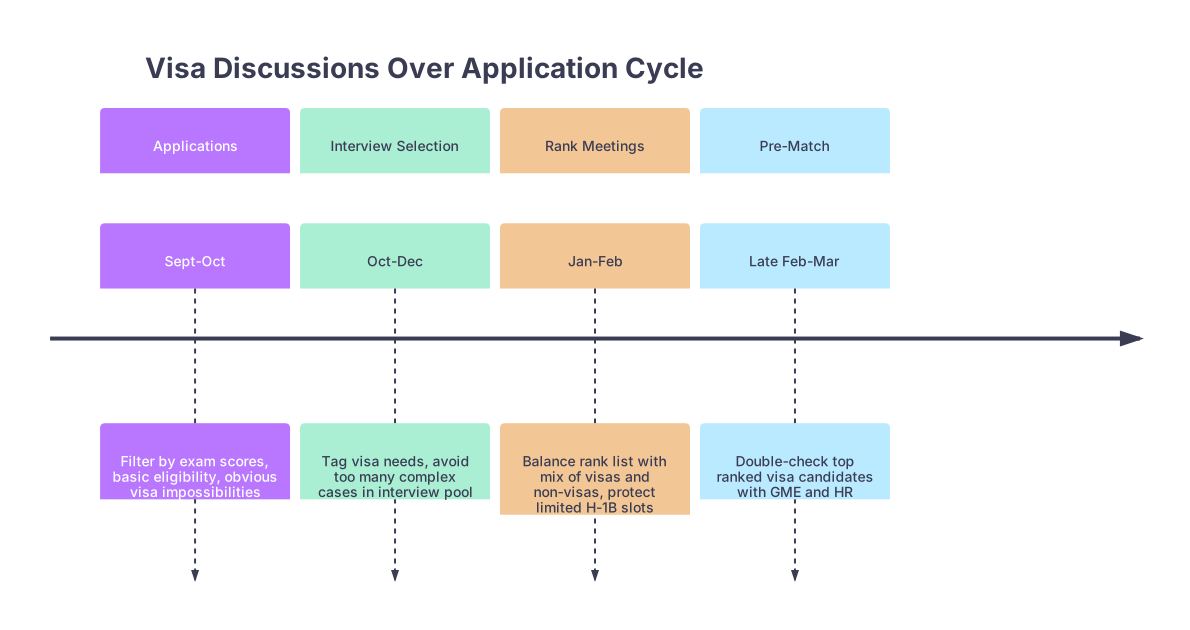
| Period | Event |
|---|---|
| Applications - Sept-Oct | Filter by exam scores, basic eligibility, obvious visa impossibilities |
| Interview Selection - Oct-Dec | Tag visa needs, avoid too many complex cases in interview pool |
| Rank Meetings - Jan-Feb | Balance rank list with mix of visas and non-visas, protect limited H-1B slots |
| Pre-Match - Late Feb-Mar | Double-check top ranked visa candidates with GME and HR |
The most ruthless cutoff happens early: many never even get invited because someone quickly filters out “too complicated” or “not clearly eligible.”
FAQs: What You Really Want To Ask (And What PDs Really Think)
1. “If a program says they sponsor H‑1B, can I assume I have a fair shot?”
No. Internally, “we sponsor H‑1B” usually means “we have done it, rarely, under select circumstances, for exceptional candidates.” The committee will ask: “Is this person in our top few percent?” If the answer is no, your theoretical eligibility doesn’t help you. Unless you are clearly a standout, treat H‑1B as a bonus, not a baseline.
2. “Does having Step 3 done really matter that much for H‑1B?”
Inside the room, yes. It’s a switch. Without Step 3, you’re an instant nonstarter for H‑1B at most places, and they may not even bother arguing for you with GME. With Step 3, at least the conversation is possible: “They’re ready; we could try to get them on H‑1B if we want them badly enough.” It doesn’t guarantee anything but removes a hard block.
3. “Will asking directly about visas hurt me?”
If you sound panicked or demanding, yes. If you sound informed and professional, no. PDs appreciate applicants who understand their own visa status. The internal comment becomes: “They’re on top of their situation.” Keep it specific, short, and clearly non-confrontational. You’re gathering data, not issuing ultimatums.
4. “Are some programs secretly biased against IMGs with visas, even if the website says otherwise?”
Yes. Bias exists. Sometimes based on prior bad experiences, sometimes based on ignorance, sometimes based on simple laziness: “We have more local applicants than we need; why deal with this?” Those programs will rarely admit it publicly. The only reliable indicators are: their current resident roster, their historic match lists, and what current residents quietly tell you.
5. “If I’m a strong IMG with visa needs, is it still realistic to match well?”
Yes, if you play in the right arena. Internally, truly IMG-heavy programs will fight for top-tier visa candidates. I’ve watched PDs go to GME and argue for an extra H‑1B specifically for a standout IMG. But that only happens where IMGs are central to the program’s identity, not peripheral. Target those places, have your exam and paperwork lined up early, and you move from “risky headache” to “high-value recruit.”
Key takeaways:
Most “IMG-friendly” language is marketing; the real decisions happen in a room where your visa is weighed as risk and cost. J‑1 is routine at true IMG programs, H‑1B is a scarce resource reserved for the few they’re willing to fight for. Your job is to remove doubt, signal flexibility, and target places where your visa is normal, not a special exception.