
The most IMG‑friendly programs will still cross you off their rank list if you make the wrong interview‑day mistakes.
1. Believing “IMG‑Friendly” Means “Low Standards”
Supportive does not mean easy. Programs that routinely rank IMGs usually do it because they know exactly what they want and they are ruthless about fit.
Here is the trap I see every year:
An IMG gets interviews mostly at community, “IMG‑heavy,” or so‑called friendly programs. They relax. They think: “They already like IMGs, I just have to show up and be myself.” Then they act casual, under‑prepared, or overly grateful instead of looking like a future colleague.
Do not do that.
Common forms this mistake takes:
- Arriving with superficial knowledge of the program “because they take lots of IMGs anyway”
- Assuming your scores or visa needs will be overlooked because “they understand”
- Overemphasizing your struggle story and underemphasizing your clinical readiness
Supportive programs are actually more sensitive to red flags from IMGs, not less. Why? Because they have been burned before. They have seen:
- IMGs who struggled with documentation, EMR, or communication
- Residents who were clinically strong but unreliable or overly dependent
- Visa holders who created scheduling chaos by leaving or delaying
So what do they do? They build mental checklists and they enforce them. On interview day they are asking themselves:
- Can this person function as a day‑one intern?
- Will they integrate with our mostly IMG team?
- Will they stay for the full training period, given visa issues and goals?
If you show up acting like the bar is lower, you just confirmed their worst fear.
How to avoid this:
- Treat every interview like it is a top‑10 academic center. Same research, same prep, same polish.
- Have specific reasons for that particular program: patient population, service structure, recent changes, not just “you take IMGs and sponsor visas.”
- Emphasize capability first, gratitude second. “I can do this job” before “I am thankful for the opportunity.”
“Friendly to IMGs” is an opportunity. It is not a safety net.
2. Underestimating Culture Fit in IMG‑Heavy Programs
You are not just applying to a program. You are applying to a micro‑culture. Supportive programs usually have tight, family‑like resident groups, often with a large proportion of IMGs from diverse backgrounds. That does not mean “any IMG fits.”
I have watched interviewers walk a candidate to the door saying, “Great scores, but they will not survive our nights” or “Too rigid for this place.” That is code for poor culture fit.
Common culture‑fit mistakes IMGs make at friendly programs:
- Talking like you want a research‑heavy, super‑academic career when the program is service‑heavy community medicine
- Sounding like you plan to leave the state or the country immediately after residency when the program desperately wants people who might stay
- Acting superior to community medicine or underserved populations (huge red flag at many IMG‑friendly sites)
- Overly hierarchical communication: never joking, never relaxed, calling everyone “Sir/Ma’am” in a place where attendings go by first names
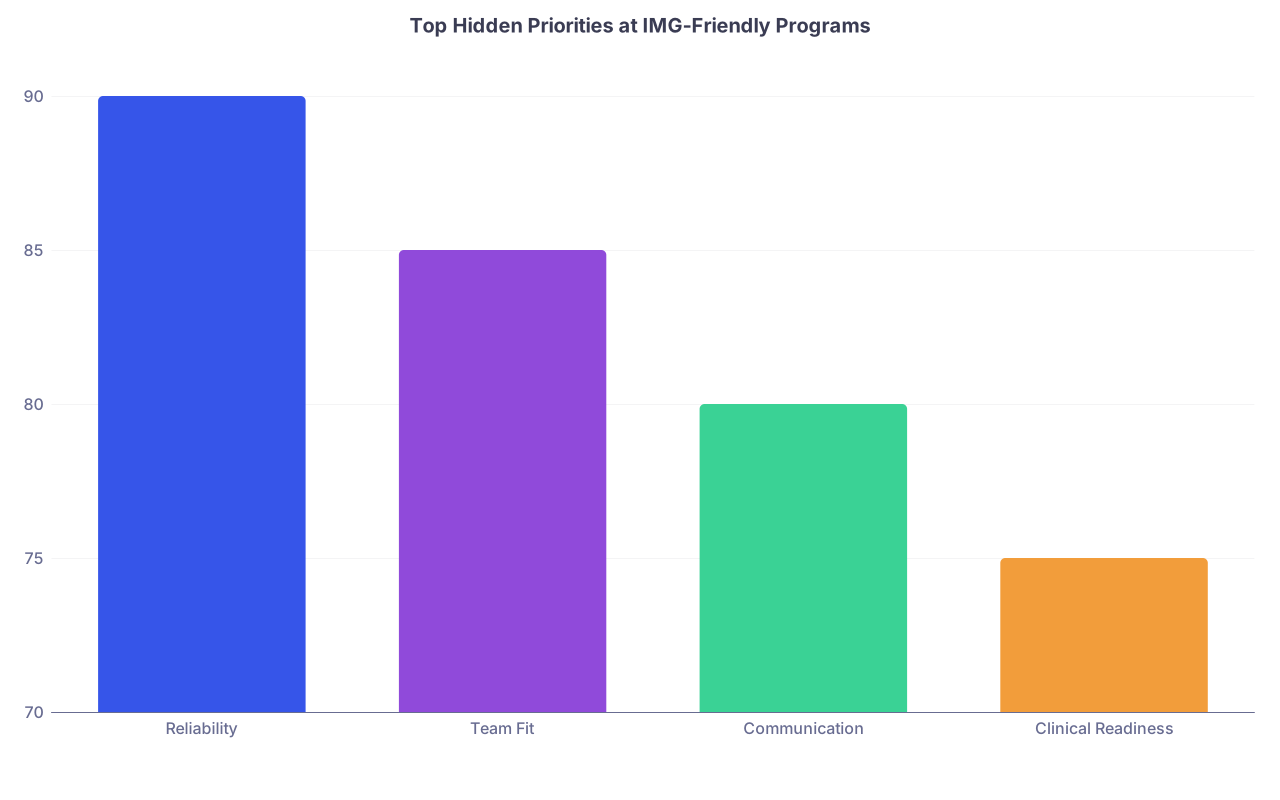
| Category | Value |
|---|---|
| Reliability | 90 |
| Team Fit | 85 |
| Communication | 80 |
| Clinical Readiness | 75 |
They are not looking for the “best resume.” They are looking for:
- People who will carry the pager without drama
- Residents who can work in sometimes chaotic, under‑resourced settings
- Colleagues they can sit with at 2 a.m. and not want to strangle
How to protect yourself:
Study the culture, not just the website.
Look at resident photos, bios, social media. Are they all talking about QI projects and conferences? Or about work‑life balance and community clinics? Adjust what you emphasize.Align your story.
If the program serves a largely immigrant, uninsured, or rural population, do not spend your time describing how you only want cutting‑edge subspecialty work in quaternary centers. Show you understand and value their actual work.Watch your body language.
Residents in supportive programs are often close. If you sit stiffly, never smile, or respond to their jokes with nervous silence, they will assume you will stay isolated and miserable.
If they cannot picture you in their work room at 1 a.m., you will not be high on their rank list.
3. Over‑ or Under‑Playing Visa and Commitment
Nothing kills an IMG’s chances faster at a supportive program than mishandling the visa conversation.
I have seen all three extremes:
- The “I never mention visa; maybe they will forget” approach
- The over‑apologetic “I know visa is a big problem, sorry, sorry, sorry”
- The entitled “You are IMG‑friendly, so obviously you will sponsor or transfer anything I need”
All three are bad.
Here is the reality:
IMG‑friendly programs often have internal fights every year about how many visas they can support, which type (J‑1 vs H‑1B), and whether to risk candidates with complex situations. Your job is to make them feel safe, not cornered.
Mistakes to avoid:
- Bringing up a desire to switch later to H‑1B in a way that sounds like a demand
- Vaguely saying “I can manage the visa” when you clearly do not understand the timeline or costs
- Hinting that you might leave early, transfer, or switch specialties depending on “better opportunities”
How to talk about visa without sinking yourself:
- Know exactly what you need and what they usually offer by reading official program information and recent interview reports.
- When asked, answer clearly and calmly: “I am eligible for J‑1 and understand that your program typically sponsors J‑1 visas. That aligns with my plans. I intend to complete residency here.”
- If you prefer H‑1B, do not sound like you are negotiating a contract on interview day. One simple, non‑pushy statement is enough: “If possible, I would be very grateful for H‑1B sponsorship, but I understand this depends on institutional policy.”
Then stop. Do not keep circling back to it. Do not turn your entire interview into a visa seminar.
Supportive programs want residents who understand reality, can commit, and will not turn into a yearly visa crisis.
4. Failing the “Communication Under Pressure” Test
IMG‑friendly programs often carry a heavy clinical load. They need residents who can communicate quickly, clearly, and safely, even when tired. Interview day is their only chance to test this without a patient in front of you.
The mistake IMGs make: assuming that “formal English” is enough. It is not.
I have watched outstanding clinicians implode in interviews because:
- Their answers were long, meandering, and never reached a point
- They struggled to understand fast‑spoken questions or accents and pretended they understood
- They could not switch from formal speech to natural back‑and‑forth small talk
- They overused scripted phrases that did not quite fit the question
The program’s translation: “If this person cannot answer a simple ‘tell me about a conflict’ in three minutes without getting lost, they will not safely call a code or hand off patients.”
You must avoid these:
- Ignoring a question you did not understand. Saying, “Could you please repeat or rephrase?” is far safer than answering the wrong question.
- Talking for 5 minutes straight without stopping. Interviewers are tired. They need concise.
- Memorizing complicated sentences that you cannot adapt. Once they ask a slightly different version, you freeze.
Practice like this:
- Record 60–90 second answers to the most common behavioral questions. Not 6 minutes.
- Practice with fast speakers, different accents if possible. Ask them to speed up, interrupt, push back.
- Force yourself to summarize at the end of each answer: “So in summary, I learned X, and now I do Y.”
Aim for simple, clear, structured language. They want safe, not poetic.
5. Ignoring Resident Signals and Questions
At IMG‑friendly programs, residents carry disproportionate weight in ranking decisions. They are the ones working the crazy shifts with you. If the residents do not want you, your “great board scores” will not save you.
One of the biggest mistakes: treating resident interactions as casual or unimportant. Many IMGs think the “real” interview is only with the PD and faculty. That assumption is wrong and dangerous.

| Step | Description |
|---|---|
| Step 1 | Interview Day |
| Step 2 | Resident Lunch |
| Step 3 | Faculty Interviews |
| Step 4 | PD Meeting |
| Step 5 | Resident Feedback Meeting |
| Step 6 | Rank Meeting |
| Step 7 | Final Rank List |
Common errors:
- Being visibly more formal and respectful with faculty than with residents (the residents notice)
- Complaining about previous programs, exams, or systems during resident‑only time
- Asking no questions or only superficial questions at lunch or tours, signaling disinterest
- Oversharing about visa stress, family drama, or financial hardship in a way that makes you look fragile rather than resilient
Residents are looking for:
- Someone they can trust on nights
- Someone who will share the workload, not create extra work
- Someone who understands what they are walking into
Smart IMGs use resident time to show:
- You know intern year will be rough and you are ready for it
- You can handle joking, teasing, and informal conversation while staying professional
- You ask questions that show you care about workflow, support, and education
Do not make the mistake of thinking, “Resident lunch is the relaxing part.” It is an interview in disguise.
6. Over‑Indexing on Scores and Under‑Indexing on Readiness
Supportive programs already know your story: older graduation year, some gaps, multiple attempts, or lower USMLE scores. That is often why they are willing to consider you anyway. But here is the twist: once you land the interview, they are less interested in your scores and far more interested in how you will perform clinically.
A lot of IMGs sabotage themselves by:
- Apologizing for their scores over and over again
- Explaining in great detail every exam attempt instead of showing how they fixed the underlying problem
- Making their entire identity “the hard‑working, low‑score underdog” instead of “the ready‑to‑work intern”
You are not there to re‑argue your ERAS. They already saw the numbers and chose to talk to you. On interview day they care about:
- How you handle mistakes
- How you prioritize when overloaded
- Whether you can take feedback without getting defensive
Answer like a future intern, not like an exam defendant.
When they ask about:
- A failure: spend 20% on why it happened, 80% on what you changed and the proof that it worked.
- A difficult patient or conflict: give a concrete example and then show your growth, not your victim story.
- Time management: describe how you actually structure a day under pressure, not some vague “I work hard and stay organized.”
If you stay stuck in your test history, they will assume you will stay stuck there during residency too.
7. Being Vague or Naive About Future Plans
Friendly programs are wary of being used as a mere stepping stone. They have seen IMGs complete training, disappear, and never look back. They are understandably tired of it.
The mistake: answering future‑plan questions with either wild fantasies or generic buzzwords.
Bad examples:
- “I want to match cardiology or GI at a top university, publish a lot, maybe move to Canada or the UK eventually.”
- “I am open to anything, maybe academic, maybe private practice, I just want to learn.”
- “I want to pass the boards and then see what opportunities I get.”
These answers make you look unfocused and uninterested in their context. At many supportive programs, what they are really hoping to hear is some version of:
- You can see yourself practicing in that region, state, or type of community.
- You value community medicine and underserved work.
- Your goals are ambitious but realistic for their training environment.
| Aspect | Strong Signal Example | Risky Signal Example |
|---|---|---|
| Location | Open to staying in region or similar setting | Only wants big coastal academic centers |
| Career focus | Community practice with some niche interest | Only high‑end subspecialty in academia |
| Commitment | Clear plan to finish training there | Talks about transfers or switching fields |
You do not have to swear to stay in that city forever. But you should not sound like your entire goal is to escape the moment you graduate.
Safer framing:
- “I am very interested in community‑based practice with strong inpatient exposure. I can see myself working in a setting like this long term, possibly with a focus on X population.”
- “If I pursue fellowship, I want solid generalist training first, and your program’s exposure to Y is exactly what I need.”
Show that your aspirations and their reality intersect. Or they will rank someone who does.
8. Sloppy Professionalism: The Easy, Avoidable Killers
Supportive programs are often more forgiving of nontraditional backgrounds. They are not forgiving of basic professionalism lapses. The harsh truth: IMGs get less benefit of the doubt. Any small concern feels bigger because of distance, visas, and paperwork.
Common professionalism mistakes on interview day:
- Cutting arrival times too close, underestimating transportation, time zones, or virtual log‑in issues
- Casual dress because “it is just a community program” – no, it is still a hospital
- Strange email addresses, Zoom names, or backgrounds
- Rambling or complaining about other programs, exams, or systems
- Appearing distracted (checking phone, glancing away constantly, fidgeting aggressively)

Virtual‑specific errors I have personally seen sink candidates:
- Logging in from a noisy environment with people walking behind you
- Audio echo or terrible mic you never tested before
- Lighting so bad they cannot see your face
- Name displayed as “iPhone” or nickname instead of your full name
These are not small issues. They signal what you will be like on call, during sign‑out, with documentation. Sloppy on interview day = risky as a resident.
Protect yourself with boring but effective steps:
- Do a full tech rehearsal a few days earlier at the exact time of day (lighting, bandwidth).
- Use a neutral background, real or virtual, that does not distract.
- Dress one step more formal than you think you need. You will never be punished for being slightly overdressed; you will be judged for being underdressed.
- Have a printed schedule and direct contact numbers in case something breaks.
Supportive does not mean tolerant of chaos.
9. Not Using Questions Strategically
Too many IMGs treat “Do you have any questions for us?” as a formality. At IMG‑friendly programs, it is actually a diagnostic tool. They are testing what you value and whether you have any idea what residency is like in the United States.
Common bad questions:
- “How competitive is your program?” (They already know you are not choosing them for prestige.)
- “What are your fellowship match rates?” (You can ask this, but if it is your first and only question, you look focused on leaving, not training.)
- “Do you sponsor visas?” (This should have been clear from research; save specifics for PD/coordination, not every interviewer.)
Much better questions at supportive programs:
- “How does the program support new IMGs adjusting to documentation and EMR?”
- “What makes an intern successful here in the first three months?”
- “What systems are in place when residents feel overwhelmed or burned out?”
- “How do seniors typically support interns on busy call nights?”
These questions show you understand the reality: this will be hard, and you want to be the kind of person who survives and adds value.
Also, do not waste your PD time asking things that the website clearly explains or that residents already covered. That signals poor preparation or poor listening.
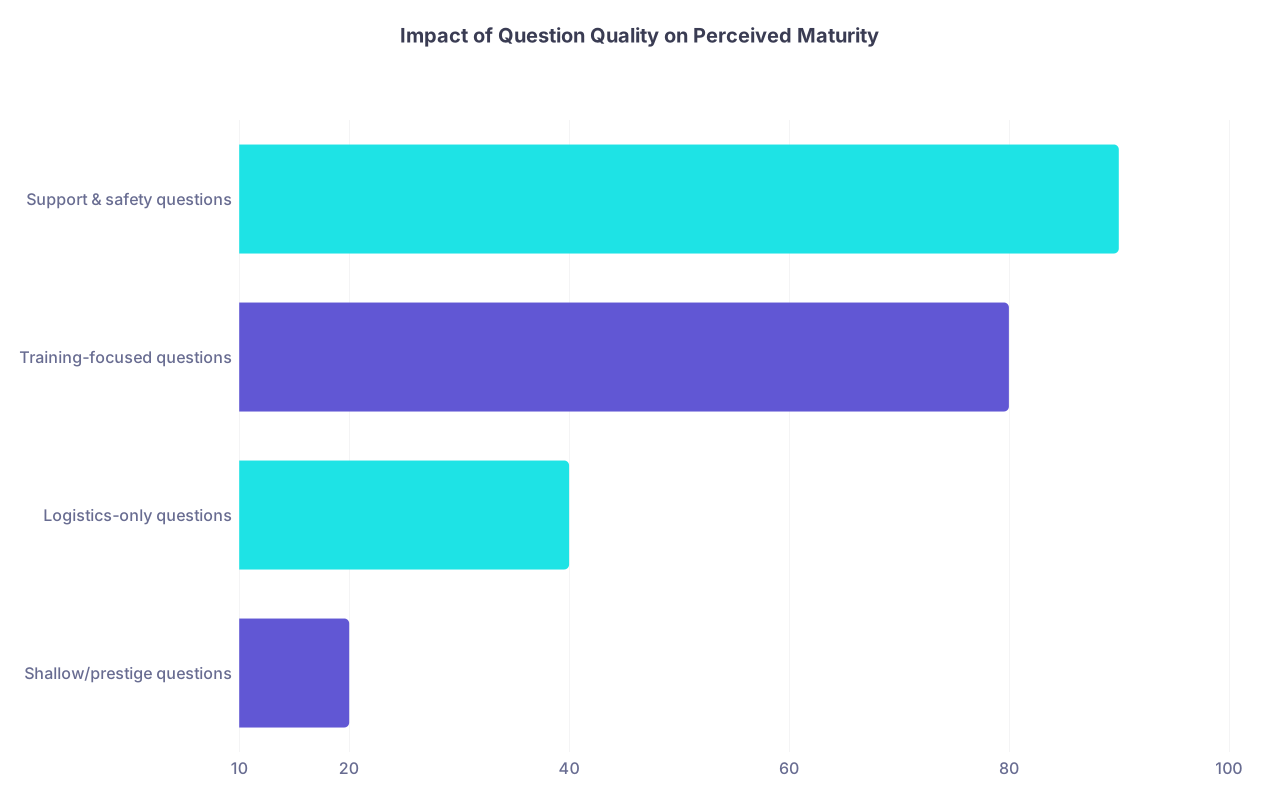
| Category | Value |
|---|---|
| Shallow/prestige questions | 20 |
| Logistics-only questions | 40 |
| Training-focused questions | 80 |
| Support & safety questions | 90 |
Smart questions are one of the few levers you fully control. Use them.
10. Forgetting That Every Interaction Is Part of the Interview
At supportive programs, everyone talks. The coordinator. The chief resident. The PGY‑1 who picked you up from the lobby. The person who helped you with your password for the virtual platform.
I have watched candidates behave like this:
- Perfectly polite with PD, but curt or dismissive with staff
- Overly casual with residents on social events the night before, then stiff and formal the next day
- Ignoring some interviewers because they are “only” chief residents, not faculty
Programs that like IMGs often rely heavily on a few “gatekeepers” who fought for more IMG spots years ago. Insult those people, directly or indirectly, and you lose your ally.
Golden rules:
- Treat the coordinator like the most important person you will meet that day. They often are.
- Assume residents will share a summary impression of you in a group chat before the rank meeting.
- Keep your tone consistent: professional but human with everyone.
You are being evaluated for how you will function in a real team, not how you perform a scripted conversation.
FAQ (Exactly 3 Questions)
1. Should I openly say I prefer an H‑1B visa at an IMG‑friendly program that usually sponsors J‑1?
You can acknowledge a preference once, briefly and respectfully, but do not push. Say something like, “If institutional policy allows, I would be very grateful for H‑1B, but I understand your program typically sponsors J‑1 and that would work for me.” Then move on. Turning the interview into a negotiation over visa type is a fast way to drop on the rank list.
2. How much should I talk about my exam failures or gaps in training during interviews?
Only as much as they directly ask for, and always with a focus on what changed and how you improved. One concise, honest, structured explanation is enough. Do not repeat or revisit it in every answer. Once they invite you, they are looking at how you will function as an intern, not regrading your transcript.
3. Is it a mistake to say I want a fellowship when interviewing at a community, IMG‑heavy program?
Not inherently, but it becomes a mistake if you make it sound like community training is just a stepping stone or that you care only about prestige. Frame it as: “I want strong general training first, and your patient population and high volume will prepare me well. If later I pursue fellowship in X, that will build on the broad base I get here.” Ambition is fine; contempt for their actual work is not.
Key points to leave with:
- “IMG‑friendly” does not mean “forgiving of interview‑day mistakes.” You will be judged more, not less.
- Everything you do on interview day signals either readiness and reliability, or risk and chaos.
- Focus relentlessly on culture fit, clear communication, and concrete proof that you can thrive as a day‑one intern in their reality, not your fantasy.