It’s late. You’re in your apartment, 20 tabs open: small community hospitals you’ve never heard of, massive “University of ___” systems with shiny websites. Everyone keeps telling you, “Community programs are more IMG-friendly,” and “Academics are more competitive, don’t waste your tokens.”
So you do what most IMGs do:
You start labeling programs in your head.
- Community = “safe,” “lower standards,” “they’ll take me.”
- University/academic = “impossible,” “US-grads only,” “why even bother.”
This is exactly how strong IMGs quietly sabotage their own match.
Let me be blunt: IMGs systematically misjudge which community and academic programs truly support them. They over-trust red-flag community programs, under-apply to realistic academic ones, and completely miss the actual IMG-friendly pockets inside big university systems.
You’re not just choosing where to work. You’re choosing your visa sponsor, your fellowship access, and whether you’re supported or slowly burned out.
Let’s make sure you do not screw this up.
The Core Mistake: Treating “Community” and “Academic” Like Personality Types
The first error is mental laziness: turning “community” and “academic” into stereotypes.
You probably recognize these:
- “Community programs are chill, hands-on, IMG-friendly.”
- “Academic programs are malignant, super competitive, and only want 260 Step scores.”
- “Community = family vibe. Academic = research robots.”
Wrong often enough to be dangerous.
Here’s the reality I keep seeing:
- There are community programs that eat IMGs alive: no visa help, no teaching, low board pass rates, zero graduates into fellowship.
- There are academic programs with quietly strong IMG support: stable visa processes, structured teaching, 40–70% IMG residents, multiple IMGs matching cards, GI, pulm, etc.
Your biggest mistake is assuming the program’s label tells you how it treats IMGs.
It doesn’t.
| Assumption | Reality Check |
|---|---|
| Community = IMG-friendly | Many are; some are toxic or unstable |
| Academic = IMG-unfriendly | Some are; others rely heavily on IMGs |
| University = better for fellowship | Not if their IMGs never match anywhere |
| Small hospital = easier to get into | Some have tight score/attempt cutoffs |
| Rural = desperate, will take anyone | Some are visa-averse, prefer green cards |
If you keep thinking in stereotypes, you will discard places that could have been perfect for you and chase ones that quietly blacklist you on criteria you didn’t even bother to check.
Mistake #1: Thinking “Community = Automatically Safe for IMGs”
The most common IMG error:
“I’ll focus on community programs. They’re always more welcoming.”
Sometimes true. Often lazy.
Red Flags in Community Programs IMGs Ignore
Here’s what I’ve seen IMGs ignore because they were so relieved to see “non-university” in the name:
No or minimal track record of IMGs
- Website shows resident photos, you zoom in: all US-IMG or AMG, no foreign grads, no accents, no international schools listed.
- Recent classes: zero IMGs for 3–5 years.
- That’s not “we’re open to everyone”; that’s “they don’t actually rank IMGs.”
-
- PD email: “We review IMGs on a case-by-case basis for visa sponsorship.”
Translation: you are a problem, not a standard workflow. - They “sometimes” sponsor J-1, “rarely” H-1B.
In practice, their GME office hasn’t filed an H-1B in years and has no idea what they’re doing.
- PD email: “We review IMGs on a case-by-case basis for visa sponsorship.”
-
- Community programs with repeated board failures are extremely dangerous for IMGs.
- If your Step scores are average and the program has a weak educational structure, you’re the one who gets burned.
-
- Talk to current residents:
“We’re mostly just scut. Teaching depends on the attending. No real curriculum.” - That’s not “hands-on.” That’s cheap labor.
- Talk to current residents:
No graduates into decent next steps
- Check: Where did their last 5–10 graduates go?
- If the answer is: “Mostly hospitalist locally, few fellowships, nothing competitive,” that matters.
- A purely service-heavy community program with no outgoing pipeline is a cul-de-sac for many IMGs.
- Check: Where did their last 5–10 graduates go?
How to Not Fall for This
Before you label a community program as “safe”:
- Look for:
- Current and recent IMGs (especially FMGs, not just Caribbean)
- Clear statement on visa support
- Board pass rates
- Graduate outcomes (fellowships, hospitalist at good systems, etc.)
If you cannot find any of this and you’re short on applications, that program is not automatically “friendly” just because it’s small and non-university.
Mistake #2: Blindly Writing Off Academic Programs That Actually Rely on IMGs
The second big error goes in the opposite direction:
You look at a big-name university and tell yourself, “No way they’ll interview me with my 225 and one attempt.”
Sometimes that’s true.
Sometimes that’s exactly the kind of program where half the residents are IMGs with profiles like yours.
The Hidden Truth: Many Academic Programs Run on IMGs
I’ve seen this over and over in Internal Medicine, Pediatrics, Psychiatry, FM:
- Big name at the top of the logo.
- Affiliated community hospitals in the system.
- Residency classes that are:
- 30–70% IMGs
- Multiple visa holders every year
- IMGs in chief positions
But IMGs filter them out on ERAS because:
- “University of ___” sounds intimidating.
- They don’t have a 250 and a publication in NEJM.
Here’s the trick: look at what they do, not what you assume.
How to Quickly Screen Academic Programs for IMG-Friendliness
Use these hard filters:
- Resident roster:
- Count how many are IMGs.
- Note: If many are from schools like yours (India, Pakistan, Egypt, Nigeria, etc.), that’s good.
- Visa statements:
- “We sponsor J-1 and H-1B visas” = someone fought this battle and won.
- “We do not sponsor visas” = don’t waste a token.
- Fellowship track record for IMGs:
- Are IMGs going into fellowship?
- Or only US grads?
| Signal | Good Sign | Bad Sign |
|---|---|---|
| Resident mix | 30–70% IMGs, multiple schools | 0–1 IMGs in several years |
| Visa support | J-1 + H-1B listed clearly | “Case by case” or silence on visas |
| Chief residents | Includes IMGs | Always AMGs only |
| Fellowship outcomes | IMGs in cards, GI, pulm, heme/onc | Only AMGs in competitive fellowships |
| Website tone | Inclusive, mentions IMGs specifically | Subtle “US grad preferred” language |
If you see 40% IMGs, H-1B support, and prior IMG chiefs, and you still tell yourself “they’ll never interview me,” you’re not being realistic. You’re being scared.
Mistake #3: Not Understanding How Different Program Types Handle Visas
If you’re an IMG who needs a visa and you’re not laser-focused on this, you are the exact applicant who matches and then discovers your hospital has no idea how to file your H-1B.
Yes, this happens. Yearly.
Common Visa-Related Misjudgments
- Assuming all “IMG-friendly” programs support H-1B
Bad assumption. Many very IMG-heavy community programs only sponsor J-1.
Some academic centers will do both but have strict rules (e.g., Step 3 required before rank list).
- Not checking who actually handles immigration
- Academic centers usually have a central GME/immigration office.
- Small community programs sometimes rely on hospital HR with limited visa experience.
- That difference shows up when:
- Your DS-2019 is delayed
- Your H-1B is filed wrong
- You’re stuck outside the US waiting on paperwork
- Believing verbal promises more than written policy
If it’s not on the website or in an email, it doesn’t exist.
“Yeah, we can probably do H-1B” is not a policy. It’s noise.
Quick Visa Reality Check for Any Program
Ask or search for:
- Which visas do you routinely sponsor for residency?
- Any Step 3 requirement before H-1B?
- Do they have multiple current visa-holding residents?
- Who handles the filing – centralized GME vs random HR person?
If you see only J-1 listed, with no flexibility, and you absolutely want an H-1B pathway, stop kidding yourself. That “nice” community program is not aligned with your long-term plan.
Mistake #4: Confusing “Hands-On” With “Unsupervised and Unsafe”
IMGs often tell me, “I want a community program for more autonomy and procedures.”
Reasonable. Until they land somewhere that throws them into night float with zero backup.
Here’s the pattern:
You think:
- Big academic program = “I’ll be stuck writing notes while fellows do everything.”
- Community program = “I’ll get to intubate, do lines, run codes.”
Reality:
- Some academic programs do give residents massive exposure and procedures, with structured teaching and supervision.
- Some community programs dump residents into high-acuity medicine with poor coverage and no real teaching.
What you’re actually looking for is structured responsibility.
Not unsafe independence.
Signs a Program (Community or Academic) Is Dangerous for IMGs
- Residents complain of:
- No attendings around at night.
- Minimal feedback or teaching.
- Constant fear of missing something serious because they’re overwhelmed.
- No formal simulation, no boot camps, no protected didactics.
- High burnout, high attrition, or frequent mid-year resignations.
If you come from a system where you already feel less confident in US-style documentation, medico-legal issues, and EMR, dropping into that type of environment is asking for trouble.
A strong academic program with:
- Protected didactics
- Simulation labs
- Clear supervision policies
…can be safer and more supportive for an IMG than a chaotic community shop that calls it “autonomy.”
Mistake #5: Using the Wrong Criteria to Build Your List
Most IMGs triage programs with two blunt tools:
- Program type: community vs academic
- Reputation/hospital name
Both are lazy filters. They miss the one thing that actually matters: proof that they invest in IMGs like you.
What You Should Actually Be Prioritizing
Forget the label for a moment. For each program, ask:
Do they consistently match IMGs?
- Not just once in 2016. Every year. In real numbers.
Do they consistently sponsor visas?
- Not “we did one H-1B 5 years ago.” Real, routine sponsorship.
Do their IMGs pass boards and land solid jobs/fellowships?
Is there someone in leadership who is an IMG?
- PD, APD, chief, or key faculty.
How do current IMGs talk about:
- Support when they struggled.
- Fairness compared to US grads.
- Teaching culture.
That data is way more predictive than “community vs academic.”
Mistake #6: Ignoring the Hybrid Programs Sitting in the Middle
Another big oversight: IMGs often ignore hybrid situations.
- University program with strong rotations at community affiliate hospitals.
- Community program with formal academic affiliation and strong research ties.
These can be gold mines:
- You get:
- University name on your CV.
- Community-hospital style autonomy and patient volume.
- Access to academic faculty and sometimes fellowships.
But most IMGs open ERAS, see “University of ___ Internal Medicine” and bail out mentally.
Or they see “XYZ Community Hospital – Affiliated with ___ University” and assume it’s just marketing fluff, not a real academic connection.
You’re missing nuance that could dramatically change your outcome.
A Simple Framework: How Not to Misjudge Programs That Support IMGs
Stop thinking:
- “Community vs academic”
Start thinking:
- “Evidence of IMG support vs lack of evidence”
Use this 4-step filter for each program you’re serious about:
1. Check the Roster
- How many IMGs per class?
- How many from your region (South Asia, Middle East, Latin America, etc.)?
- Any IMG chiefs or recent grads with strong career moves?
2. Check Visa History
- Clear statement: J-1 only or J-1 + H-1B.
- At least 2–3 current residents on visas is reassuring.
- If they’re vague or silent, treat it as a negative unless they explicitly confirm by email.
3. Check Outcomes
- Where did graduates go?
- Hospitalist at good systems?
- Subspecialty fellowships at recognized institutions?
- Or nowhere impressive for 5 years straight?
4. Tune in to Culture
- Watch resident videos, read between lines:
- Does anyone talk about “support,” “mentorship,” “family” in a specific way?
- Or is it all generic fluff and marketing?
- If you can, cold email or DM current IMGs:
- Ask very direct questions:
- “Do you feel supported as an IMG compared to US grads?”
- “How responsive are leadership and GME to visa needs and scheduling issues?”
- Ask very direct questions:
You are looking for places that repeatedly choose, train, and support IMGs. Those may be community. They may be academic. The label doesn’t matter. The track record does.
Visual: Where IMGs Actually Match
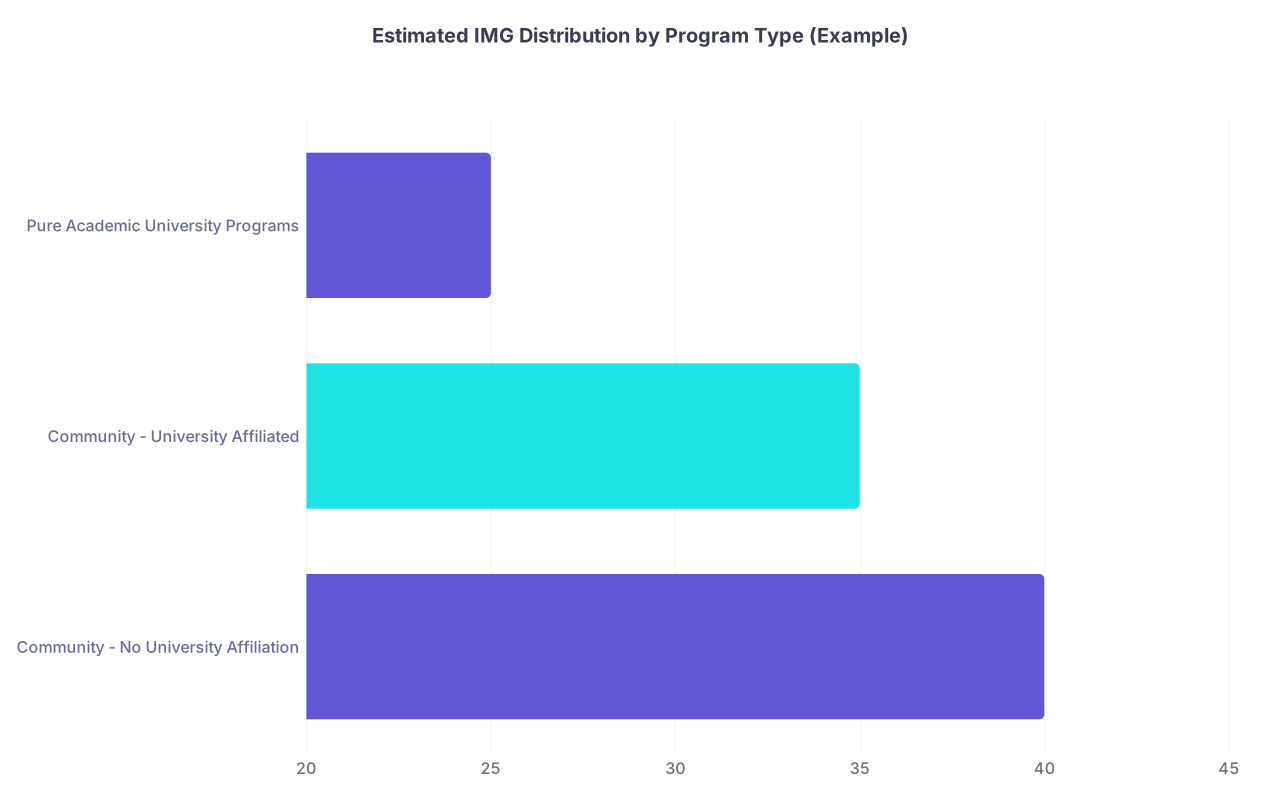
| Category | Value |
|---|---|
| Community - No University Affiliation | 40 |
| Community - University Affiliated | 35 |
| Pure Academic University Programs | 25 |
Roughly how it often shakes out in Internal Medicine and some other core specialties:
- A big chunk of IMGs do end up in pure community programs.
- A surprisingly large chunk lands in community programs with strong university ties.
- A non-trivial group match directly into core academic university programs that many IMGs never even applied to.
Stop self-sorting into one bucket before you even test your chances.
Common Red Flags IMGs Should Not Ignore (Regardless of Program Type)
These are universal. If you see several of these in any program, be cautious:
- No clear policy or history on visa sponsorship, but “we’re open.”
- Website not updated in years; resident list stops at 2020.
- Multiple residents left mid-year, and no one will say why.
- PD or coordinator takes weeks to answer a basic question.
- Board pass rates below national averages for multiple years.
- Residents describe culture as “survival,” “sink or swim,” “you just figure it out.”
Don’t tell yourself, “At least it’s a community program, I’ll be fine.”
You won’t.
FAQs
1. Should I prioritize community programs over academic ones as an IMG?
No. You should prioritize programs with proven IMG support over everything else. Some will be community, some academic, some hybrid. Sort by:
- Track record of IMGs in recent years
- Visa sponsorship clarity and consistency
- Board pass rates and graduate outcomes
- Culture and support reported by current IMGs
If you just say “community > academic,” you’ll miss strong academic programs that would have happily taken you and possibly land in a weak community program with poor support.
2. Are academic programs always better for fellowship chances?
Not automatically. An academic program with no IMGs matching into fellowship is not better for you than a community/university-affiliated program where IMGs regularly match GI, cards, or heme/onc. You’re not asking, “Is it academic?” You’re asking, “Do IMGs like me, trained here, actually get the fellowships I want?” Many strong community-affiliated and hybrid programs punch way above their weight in fellowship placements for IMGs.
3. How many “reach” academic programs should I include as an IMG?
Assuming a typical IMG with decent but not stellar scores and some USCE, I’d usually tell you to include 10–20% of your list as true academic reach programs that still show clear IMG representation and visa history. If you’re very strong (high 230s+/240s+ with solid US letters and research), you can push that higher. The mistake is going to zero because you’re scared, or blowing half your applications on programs that have taken one IMG in a decade.
Open your program list right now. For the next 10 programs on it, ignore whether they’re community or academic and look only at three things: current IMG residents, visa policy, and recent graduate outcomes. If you cannot find convincing evidence on at least two of those three, either research deeper or move them down your priority list.