
The Big Mistake of Ignoring Alumni Outcomes at IMG-Friendly Programs
What do you think matters more when picking an “IMG‑friendly” residency: the number of IMGs they accept, or what actually happens to those IMGs five years later?
If you answered “how many they accept,” you’re walking straight into one of the most expensive mistakes of your career.
Let me be very clear: IMGs who focus only on “programs that take IMGs” and ignore alumni outcomes often match into places that quietly trap them—weak fellowship placement, poor board pass rates, terrible job options, and no realistic path to a visa-sponsored future. I have watched this exact pattern repeat. Year after year.
You are not just trying to match. You are trying to build a career you’re not stuck in.
This is where alumni outcomes come in. And this is where most IMGs do far too little homework.
Why Alumni Outcomes Matter More Than “IMG-Friendly” Labels
You’ll see the same phrases over and over: “We are IMG-friendly”, “We welcome international graduates”, “We value diversity”.
Nice words. Totally meaningless if their graduates are failing board exams or stuck in community jobs they never wanted.
Alumni outcomes answer one question: What actually happens to people like you after training here? Not what they say on the website. Not what the program director tells you on interview day. What the data shows.
Here’s what you need to know: “IMG-friendly” can mean two very different things.
- A strong program that genuinely invests in IMGs and gets them:
- Solid board pass rates
- Competitive fellowships
- Good jobs (and visas)
- A desperate program that can’t attract US grads and uses IMGs as cheap labor, with:
- Poor teaching
- Little mentorship
- Almost no track record of graduates moving on to anything better
Programs in group #2 will still proudly call themselves “IMG-friendly”. And many of them match IMGs every single year.
Your job is to distinguish between those two. Fast.
The Classic IMG Trap: Matching First, Realizing the Damage Later
I’ve seen this too many times.
A candidate from India with solid scores, let’s call him Raj, matches into an “IMG-friendly” internal medicine program in the Midwest. The selling point? Year after year, they fill 80–90% of positions with IMGs. He’s thrilled. Match Day feels like victory.
Fast forward 3–4 years:
- Only 60–70% of residents are passing ABIM on the first try
- Almost no one is matching into cardiology or GI, even the strongest residents
- Graduates are mostly going into low-paying hospitalist jobs in undesirable locations
- The program offers zero meaningful research mentorship
- Visa support is shaky; some J-1s walk into waiver chaos with no help
Raj only finds out about all this in PGY2, when he starts thinking about fellowship. By then, he’s fighting an uphill battle that has nothing to do with his intelligence and everything to do with where he trained.
The mistake? He checked “Do they take IMGs?” but not “What happens to their IMGs afterward?”
Don’t repeat this.
Key Alumni Outcomes You Cannot Afford to Ignore
You don’t need a full data science project. But you do need to be ruthless about a few specific metrics.
1. Board Pass Rates: Your Non-Negotiable Red Flag Scanner
If a program can’t consistently get its residents through boards, that’s a training failure. Period.
Look for:
- First-time board pass rates over several years (3–5 if possible)
- Whether IMG graduates specifically are passing at similar rates as the overall program
Many specialties publish board pass stats by program (some on the specialty board website, some via FREIDA, some via program brochures). If you cannot find them, ask directly in an email:
“Can you share the last 3 years of board pass rates for your residents?”
If they dodge the question or provide vague answers like “We strongly support residents to be successful,” that’s not support. That’s spin.
Programs with weak outcomes will:
- Change the subject to ‘supportive environment’
- Blame “challenging cohorts” or “test anxiety”
- Emphasize wellness instead of performance (wellness is good, but it’s not a substitute for good training)
Do not ignore this. A failed board exam narrows your options brutally, especially as an IMG.
2. Fellowship Match: Not Just “If”, But “Where” and “In What”
This is where many IMG-friendly programs quietly expose their true level.
Ask or research:
- Which fellowships their graduates matched into over the last 3–5 years
- Which institutions those fellowships were at (community vs strong academic centers)
- How many residents went into hospitalist work because they wanted to, not because they had no options
If a program’s answer is always vague—“Our graduates go into a variety of fellowships and practice settings”—I already know what that means. Not much.
Look for at least some graduates going to:
- Recognized academic centers (not necessarily top-10, but respectable name brands)
- Competitive specialties if that’s your goal (GI, cards, heme/onc, etc.)
| Metric | Program A (Stronger) | Program B (Risky) |
|---|---|---|
| 3-year ABIM pass rate | 96% | 78% |
| Recent GI fellowship match | 3 grads to mid-tier academics | 0 in 5 years |
| Cards fellowship match | 4 in 5 years | 1 community cards |
| Hospitalist jobs by default | ~50% by choice | ~80% by necessity |
| Research publications per year | 20+ | 2–3 |
Both may call themselves “IMG-friendly.” Easy to see which one actually is.
3. Job Outcomes and Visa Reality
You’re not training just for a few more framed certificates. You need a job you can actually hold on to.
Key details to dig for (and most IMGs don’t):
- Do alumni get stable jobs with visa sponsorship?
- Are many graduates stuck in remote locations as their only option?
- Does the program help with:
- J‑1 waiver placements
- H‑1B opportunities
- Networking with prior grads now in leadership positions
Talk to current residents off-interview. Ask bluntly:
- “Where are recent grads working now?”
- “Did anyone struggle to find a job due to visa issues?”
- “Do attendings or alumni actually help with job leads?”
Programs that care about your future know this information. Programs that see you as a short-term labor source do not.
4. Academic vs Service Balance: The Hidden Career Killer
Some IMG-heavy programs are really just service machines with a residency label.
Warning signs:
- Insane patient caps and constant cross-cover
- Very little protected didactic time
- Almost no research infrastructure
- Faculty who are too overwhelmed to mentor
This combination kills your chances of a strong fellowship application. You won’t have time for research, you’ll struggle to shine, and letters of recommendation may be rushed or generic.
Look for:
- Chief residents who’ve matched into reasonable fellowships
- Residents presenting at conferences (check ACP, ACG, CHEST, ASCO, etc.)
- Any mention of scholarly projects in resident bios on the website
If their “scholarly activity” section is a barren desert, that tells you a lot.
How to Actually Research Alumni Outcomes (Without Losing Your Mind)
Most IMGs skip this step because they think it’s too hard or too time-consuming. It’s not. It just requires discipline.
Step 1: Use Public Sources Aggressively
Start with:
- Program websites – resident bios, alumni pages, “Where our graduates go” sections
- FREIDA – some programs list board pass rates and fellowship outcomes
- LinkedIn – search “[Program Name] Internal Medicine Residency” and check alumni
You’ll notice patterns:
- Certain programs send the same type of graduate to similar places year after year
- Some have nearly no visible alumni with academic titles or fellowships
- Others surprisingly have strong records despite low name recognition
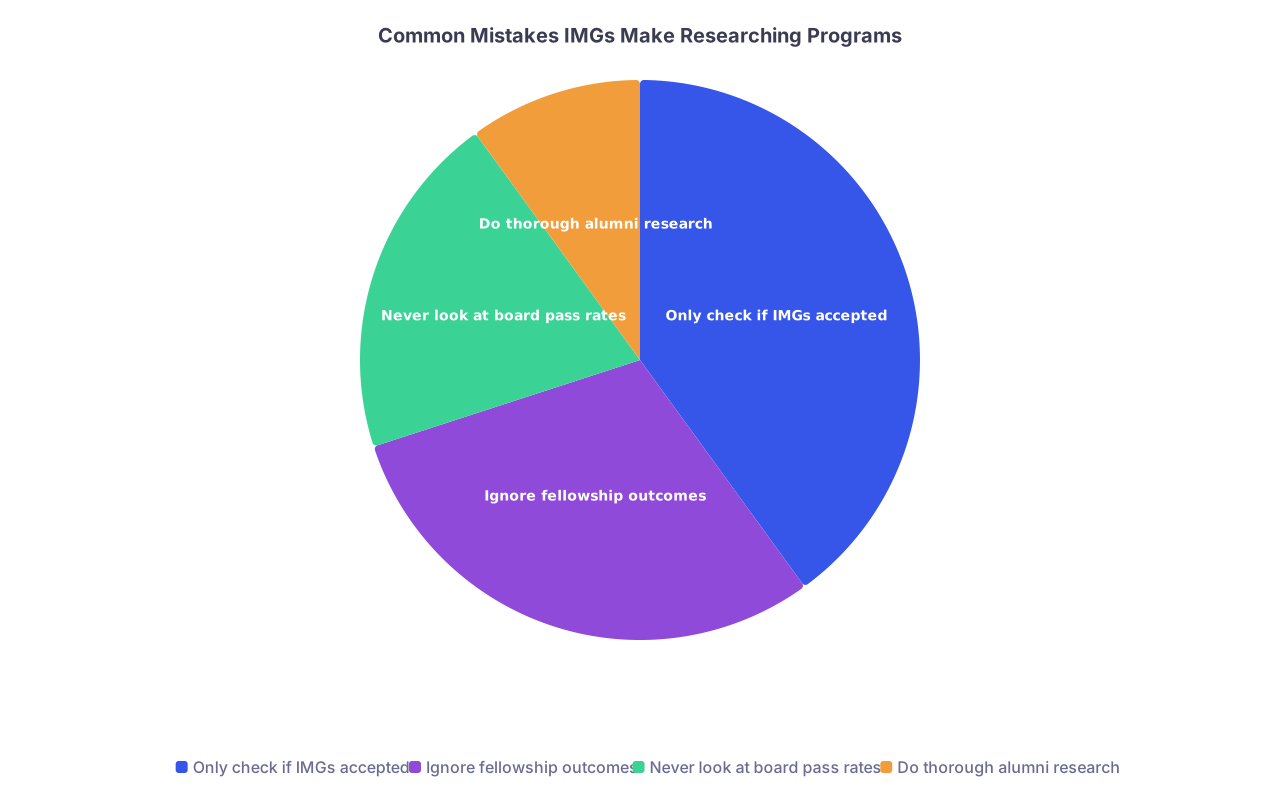
| Category | Value |
|---|---|
| Only check if IMGs accepted | 40 |
| Ignore fellowship outcomes | 30 |
| Never look at board pass rates | 20 |
| Do thorough alumni research | 10 |
Most applicants cluster in the first three slices. You want to be in the last one.
Step 2: Contact Alumni, Not Just Current Residents
Current residents can be restricted in what they say. Alumni are often more honest.
Find them via:
- PubMed (look up publications and see where the author trained)
- Program website alumni lists
Send a short, respectful message:
“Hi Dr. X, I’m an IMG applying to internal medicine this cycle and strongly considering [Program Name]. I saw that you trained there and went on to [fellowship/job]. Would you be willing to briefly share your perspective on how well the program prepared you, particularly regarding fellowship/job opportunities for IMGs?”
You’re not asking for a recommendation. You’re asking for reality.
Listen closely to:
- Hesitation around mentorship or research
- Comments like “You have to be extremely self-directed here” (translation: you’re mostly on your own)
- Praise that sounds generic versus specific (“Great teaching on wards,” “Strong support in my cardiology application,” etc.)
Step 3: Decode the Interview Day Hype
Programs will showcase their best stories. That’s fine. Your job is to ask questions they don’t expect.
Ask directly:
- “Where did your last 3–5 graduating classes go (fellowship vs hospitalist vs other)?”
- “Do you have any data on board pass rates you can share?”
- “What percentage of your IMGs pursue fellowships, and how successful have they been?”
- “Have there been any residents in recent years who struggled to find jobs due to visa issues?”
Then watch how they answer.
Strong programs:
- Have numbers, examples, and specific names
- Are proud (appropriately) of their track record
- Don’t get defensive when you ask about outcomes
Weak programs:
- Answer in generalities only
- Emphasize happiness and “we’re like a family” when you ask about data
- Ignore the IMG-specific part of your question
You’re not being rude by asking. You’re being smart.
Step 4: Compare Programs Side by Side (Not Just on “IMG-Friendliness”)
Too many IMGs do this mental math:
“Program X took 12 IMGs last year, Program Y took 4. So X is better for me.”
No. Program X may be where careers stall.
I prefer a simple side-by-side evaluation for your top options.
| Factor | Program X | Program Y |
|---|---|---|
| % IMGs in residency | 85% | 40% |
| ABIM pass rate (3 years) | 80% | 95% |
| Recent fellowship matches | Mostly none | Cards, GI, Heme/Onc |
| Alumni in academic roles | 1–2 | Several |
| Visa/job support | “Case by case” | Structured process |
If you only look at the first row, you pick Program X. If you look at the whole table, you at least think hard before doing something you’ll regret.
The Hidden Cost of Getting This Wrong as an IMG
For a US MD/DO, a mediocre program can sometimes be “good enough.” They’re starting with some inherent advantages in the job market.
You’re not.
As an IMG, a poor alumni track record can cost you:
- Fellowship opportunities that never even consider your application
- Academic jobs that silently filter out low-prestige or low-performance programs
- Visa pathways that close because your program has no connections or structured help
And worst of all, it costs you time. Three years. Maybe more. In a system that is already stacked against you.
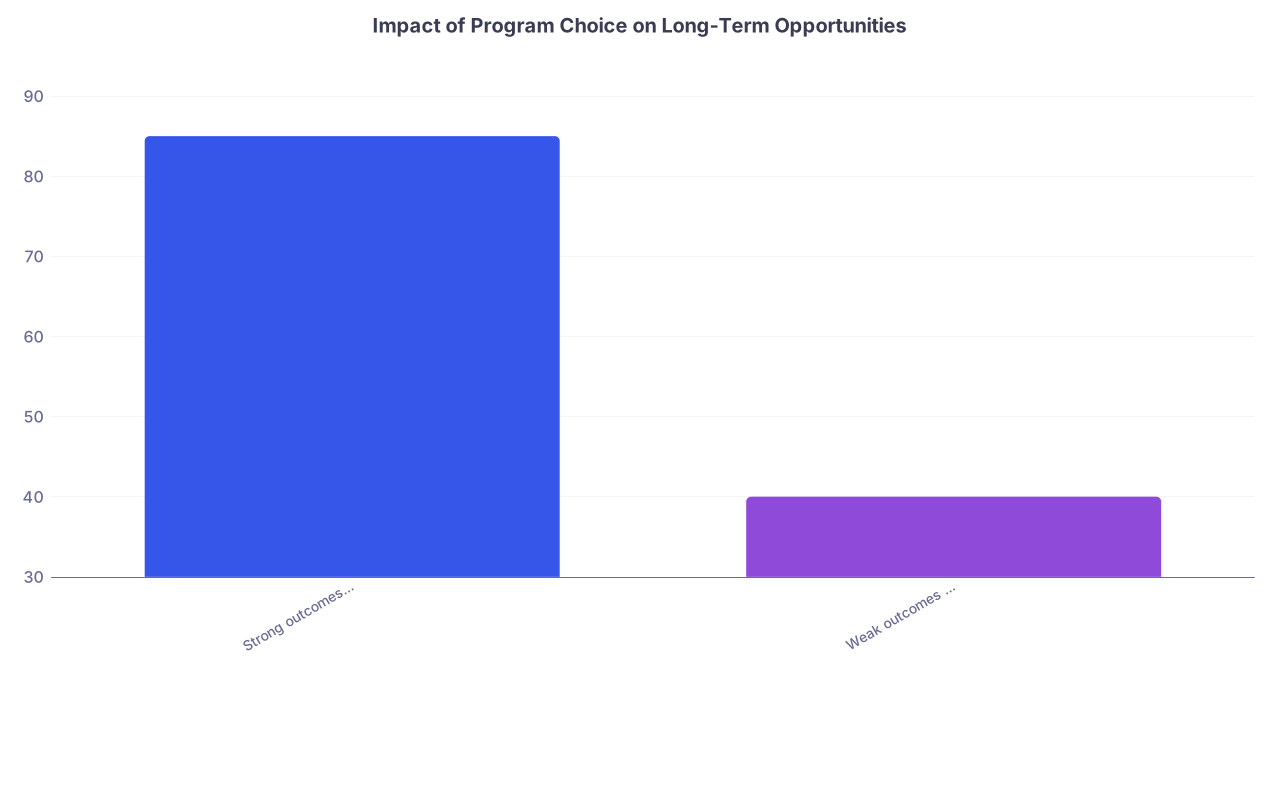
| Category | Value |
|---|---|
| Strong outcomes program | 85 |
| Weak outcomes program | 40 |
Interpretation: out of 100 residents, maybe 85 from a strong-outcomes program end up with decent fellowships or jobs they’re satisfied with, versus 40 from a weak one. Not exact numbers, but the directional reality is accurate.
How to Prioritize When You Don’t Have Perfect Options
Let’s be honest. Many IMGs are not choosing between Mayo and Mass General. You might be choosing between mid-tier community programs or lower-tier university affiliates.
Even then, you still rank them based on outcomes, not just who seems “nicer” or “more IMG-friendly.”
If you’re forced to choose:
- Program with modest name but strong board pass rates and a few decent fellowships
vs - Program that takes tons of IMGs but has garbage outcomes
Pick the first one almost every time.
If you come from a non-competitive background, you may feel tempted to grab any guaranteed “IMG-heavy” program. Just remember: three years from now, fellowship directors won’t care that you needed “a chance.” They will care where you trained and what you achieved there.
IMGs do not have the luxury of ignoring alumni outcomes. US grads sometimes get away with that. You usually won’t.

| Step | Description |
|---|---|
| Step 1 | Find IMG friendly program |
| Step 2 | High risk - investigate more |
| Step 3 | Lower on rank list |
| Step 4 | Consider competitive choice |
| Step 5 | Contact alumni and residents |
| Step 6 | Apply but rank cautiously |
| Step 7 | Prioritize on rank list |
| Step 8 | Check alumni outcomes |
FAQ (Exactly 3 Questions)
1. What if a program has no published alumni data—should I automatically avoid it?
Not automatically, but you should increase your skepticism. Some smaller community programs simply haven’t built a slick website. That’s fine. What’s not fine is a total inability to give specific examples: where graduates work, which fellowships they’ve matched into, what their board pass rates look like. If after asking directly you still get only vague, marketing-style answers, that’s a strong sign to rank that program lower unless you truly have no alternatives.
2. As an IMG with average scores, do I really have the luxury to care about outcomes, or should I just aim to match anywhere?
You always have to care about outcomes, even if your options are limited. Maybe you can’t be hyper-picky, but you can still create tiers. Among the places that will realistically interview you, some will clearly have better track records than others. Rank those higher. What you must not do is treat all IMG-friendly programs as equal just because they’re willing to consider you. They’re not equal, and you’re the one who pays for that difference.
3. How much weight should I give alumni outcomes compared to location, salary, and lifestyle?
For IMGs, alumni outcomes are near the top of the list—right under visa reliability and above almost everything else. Location and lifestyle matter, of course, but if you sacrifice outcomes for comfort, you may end up comfortable for three years and stuck for the next thirty. Salary differences between residency programs are usually minor compared to the long-term income gap between strong vs weak job or fellowship prospects. Short version: prioritize visa support and alumni outcomes first, then sort the rest.