
The phrase “IMG-friendly program” is mostly a lie residents tell each other to feel better.
Program directors do not sit in a room with a big green stamp that says “FRIENDLY TO IMGS.” That label almost never exists on the inside. What you see on forums—“this program is super IMG-friendly”—is usually a crude summary of a much more calculated internal reality.
Let me tell you what actually happens behind the scenes when a PD or selection committee quietly decides, “Yeah, we can take IMGs here,” and how they judge whether another program is IMG-friendly.
Because yes, PDs absolutely talk about this with each other. And the criteria they use aren’t the ones you see in brochures.
The Myth vs. The Internal Reality
Inside PD meetings, nobody says, “We’re an IMG-friendly program now.” What they say is something like:
- “We’ve had good luck with grads from X country.”
- “Our best resident this year is from Y school; might be worth looking there again.”
- “If we don’t take IMGs, we won’t fill.”
Or, more bluntly, in community hospitals:
- “We need warm bodies. Stop pretending we can be that picky.”
When a PD calls another program “IMG-heavy” or “IMG-friendly” at a conference or over dinner, they’re not talking about what you think. They’re talking about a combination of five things:
- How risky it is for that program to go IMG-heavy and still fill.
- How much extra work IMGs create (visas, onboarding, remediation).
- How past IMGs have performed on exams and in the hospital.
- How the sponsoring institution views immigration and credentialing.
- How close they are to ACGME or hospital scrutiny.
You hear “they take a lot of IMGs.” The PD hears “they’re willing to accept the administrative headache and academic risk because their fill pressure is high enough.”
“IMG-friendly” is a risk–benefit calculation. Always.
The First Filter: Who Even Gets Opened?
Most IMGs think “IMG-friendly” starts at the interview invite. Wrong. It starts at whether you’re even seen by a human.
Behind the scenes, almost every program uses some version of an electronic triage. Not all, but enough that you should assume they do.
Here’s how a typical internal sort looks.
| Filter Type | Typical Quiet Thresholds |
|---|---|
| USMLE Step 2 CK | 225–230+ for most IM-heavy IM |
| YOG (Year of Grad) | ≤ 5–7 years |
| Attempts | No Step failures (esp. CK) |
| Visa Need | Some exclude J1/H1B outright |
| USCE | ≥ 1–2 US letters or rotations |
Nobody advertises these criteria on the website. You find them in whispered comments in the selection committee or in an email from the coordinator: “We’ll be excluding applicants with Step 2 below 230 for this season” or “This year, leadership prefers not to sponsor visas.”
Here’s what really defines “IMG-friendly” at this first stage:
1. How Aggressively They Screen Out IMGs
A truly IMG-friendly program will:
- Set lower auto-cutoffs for IMGs than competitive programs in the same tier—but still higher than for US MDs.
- Allow a bit more flexibility on YOG and minor red flags if letters and USCE are strong.
- Specifically instruct faculty reviewers: “Don’t auto-kill IMGs just on school name. Look at performance trends and US experiences.”
A NOT-friendly program will:
- Use a hard filter (e.g., Step 2 < 240 auto-reject for IMGs, while US MDs with 230+ get looked at).
- Exclude all applicants needing visas.
- Have unspoken policies like: “We don’t take Caribbean grads unless we personally know them.”
I’ve seen programs where the PD literally said to the coordinator, “Just send me the IMGs from these 3 countries and ignore the rest.” That’s the level of bias we’re talking about.
2. Whether Anyone There Understands IMGs
Another big internal divide: does anyone on faculty or leadership get IMGs?
Programs that are quietly IMG-friendly almost always have at least one of these:
- An APD or core faculty who is an IMG.
- A PD who trained with strong IMGs and trusts them.
- Prior chiefs who were IMGs and left a very positive legacy.
During application review, these people will literally say in meetings:
- “I know that school; they’re solid.”
- “Don’t worry about the YOG; he did mandatory military service.”
- “She’s got two US letters from big names; that matters more than where she graduated.”
When those voices are present, IMGs get a second look. When they’re not, you’re just a risky unknown.
The Quiet Math: Fill Pressure and Reputation Risk
You want to know the real, unspoken driver of “IMG-friendly”? Fill pressure.
Programs live with a constant fear: not filling their spots. Unfilled positions are a political problem with the hospital, with the GME office, and with their own faculty.
Here’s the ugly truth PDs discuss over coffee at conferences:
- Top-tier academic programs with tons of US MD applicants can afford to be “IMG-skeptical.”
- Mid-tier community and university-affiliated programs are where the calculus shifts.
- Lower-demand programs often depend on IMGs to fill.
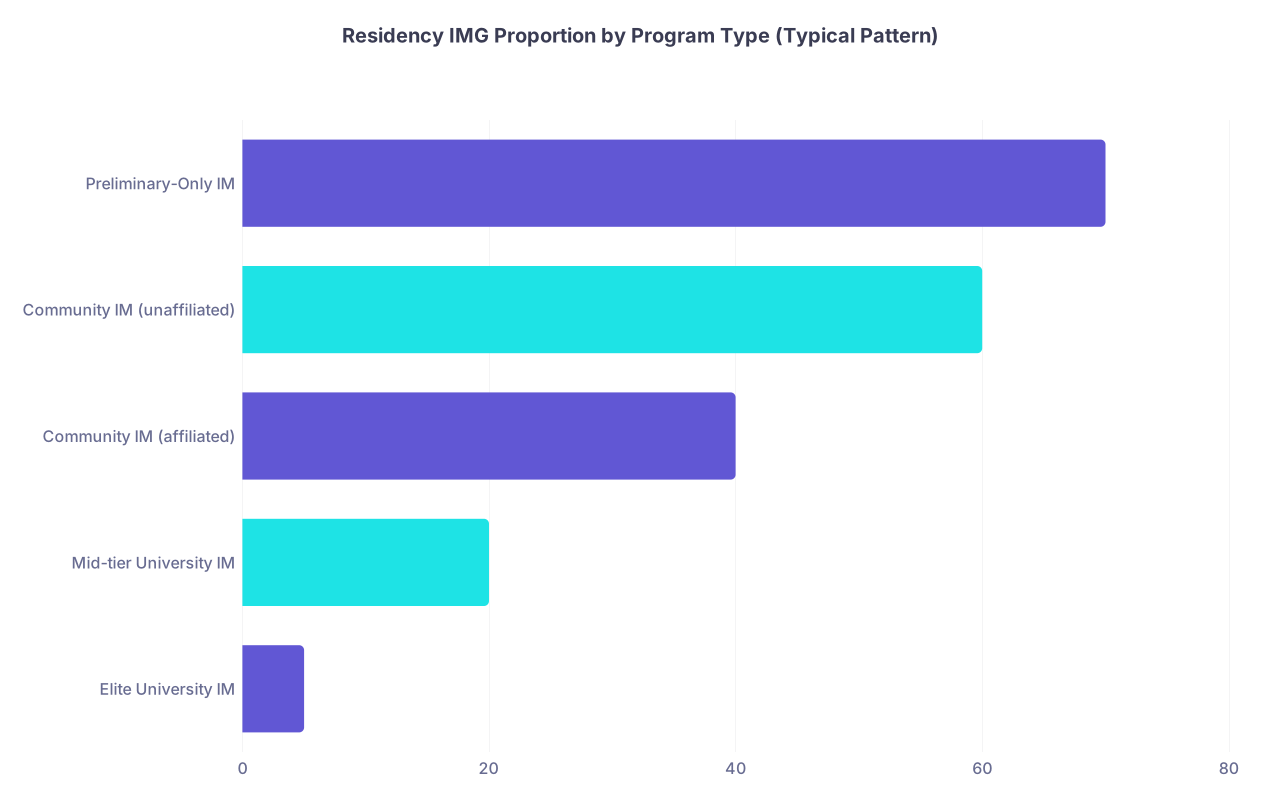
| Category | Value |
|---|---|
| Elite University IM | 5 |
| Mid-tier University IM | 20 |
| Community IM (affiliated) | 40 |
| Community IM (unaffiliated) | 60 |
| Preliminary-Only IM | 70 |
These numbers vary, but the pattern is real. PDs know it. They talk about it in exactly these terms:
- “We can’t act like we’re Mass General. We need IMGs to survive.”
- “Our applicant pool is weaker this year. Open up to more international schools.”
So an “IMG-friendly” program, internally, is often one where:
- They’ve accepted the reality that to fill consistently, they must seriously engage with IMGs.
- They’ve figured out how to manage the risk and logistics decently well.
- Their leadership isn’t panicking about the optics of having a lot of IMGs on the website.
Notice what’s missing: any sense of “we’re doing this out of altruism.” This is supply and demand.
The Hidden Academic Criteria: What PDs Actually Worry About
Forget the marketing talk. Here’s what PDs are actually asking when they stare at an IMG’s file:
- “Will this resident pass their in-training exams and boards?”
- “Will they handle the call load without falling apart?”
- “Will I regret this when the CCC (Clinical Competency Committee) meets?”
Once a program already has IMGs and is debating whether they’re “IMG-friendly” for future cycles, they use internal performance data. Not Reddit posts.
I’ve sat in those meetings. The conversation sounds like this:
- “Our last two IMGs from that school both failed Step 3 the first time. Maybe we slow down there.”
- “The Caribbean grads we’ve had usually need heavier remediation on notes and systems. We can handle one or two, but not six.”
- “The Pakistani grads we’ve taken have usually done great—no reason to back off that pipeline.”
What actually sways them:
In-training exam performance of prior IMGs
This matters a lot more than applicants realize. If their last 5 IMGs averaged in the 60–70th percentile on the ITE, they feel safe opening doors. If those residents were at the 10th percentile and struggled to pass ABIM or ABFM, the gate quietly tightens.CCC and remediation workload
Programs track how often they’re putting residents on remediation plans, professionalism watch, or extended training. If IMGs are overrepresented in those categories at a program, whether fairly or due to bias, leadership gets risk-averse.Communication and cultural friction
No one will write this on a website. But in closed rooms, it’s discussed bluntly. Things like:- Accent difficult for patients to understand.
- Struggles with documentation shortcuts, EMR, US-style “customer service.”
- Discomfort challenging attendings or communicating clearly in rapid codes.
If faculty feel drained supervising certain residents, PDs remember that. Programs that handle this well with structured support are more likely to stay IMG-friendly. Programs that get burned once or twice pull back hard.
The Visa Question: The Real Line in the Sand
You want the biggest unspoken divide between “IMG-friendly” and “IMG-neutral”? Visa sponsorship.
Externally programs say: “We sponsor J1” or “We do not sponsor H1B.” Internally, the conversation is much more specific, and often more hostile than you’d like.
Typical backroom comments:
- “H1B is too much of a hassle. No more, unless they’re absolute rockstars.”
- “Legal shot us an email; they want to cut down on H1Bs.”
- “We’ve had visa delays every year with ECFMG; try to rank more green card holders this cycle.”
Visa-friendly programs usually share a few quiet traits:
- A GME office that has done this for years and got good at it.
- An institutional legal department that tolerates or supports H1B/J1 sponsorship.
- Coordinators who know the timelines and don’t panic every time there’s USCIS chatter.
Non-IMG-friendly (in practice) ones:
- Tell you they sponsor J1, but then rank you lower simply because of risk.
- Have had one bad visa experience and now treat all visa cases like they’re toxic.
- Pressure the PD: “Avoid visas unless absolutely necessary; we don’t have bandwidth.”
So from your side, “They say they sponsor visas.” From the inside, “We’ll only actually go for a visa if we love the candidate and have no equally good non-visa option.” This difference kills a lot of IMG dreams.
The Reputation Games: Who They Want to Impress
Another nasty little secret: some programs avoid heavy IMG intake not because of performance, but because of optics.
They’re worried about:
- How they look to medical students rotating there.
- How their resident list appears to hospital leadership.
- How they stack up against competing programs in their region.
In one midwestern IM program, I heard an associate PD say word-for-word:
“Our last three chiefs were IMGs and they were phenomenal. But we’re scaring off US MD applicants. We have to rebalance.”
That’s the ugly side. The PD wasn’t blind to the quality of their IMGs. They were worried about perception and “brand.”
Programs that truly earn the internal label “IMG-friendly” from other PDs are the ones that stop pretending:
- They openly accept that their resident roster will be majority IMG.
- They align their educational structure accordingly (more formal orientation to US systems, early Step 3 push, focused communication support).
- They develop pride rather than shame about training strong IMGs.
If you see a program website with 60–80% IMGs in their residents, and their chief residents include IMGs consistently—that’s a program that’s made its peace with being IMG-heavy. That’s as close to “friendly” as you get.
How PDs Quietly Judge Other Programs on IMGs
Here’s where it gets interesting. PDs rank each other too.
At conferences, in workshops, in hallway conversations, they classify programs in their heads:
- “High-end academic, essentially closed to IMGs except unicorns.”
- “Mid-range university, takes carefully selected IMGs with strong scores.”
- “IMG engine—staffs the whole hospital with them. Some good, some scary.”
- “Desperate not to go SOAP, scoops up whoever’s left.”
When they say “IMG-friendly,” what they often actually mean is:
- They’ve seen that program’s graduates as fellows, and IMGs from there hold up well.
- They know the PD personally and have heard them complain—or praise—their IMG cohort.
- They’re aware that GME or the hospital pressures that program to fill at all costs.
So when you see “IMG-friendly” on a forum, it might actually translate internally to:
- “They’re okay taking IMGs but want 235+ Steps and recent grads.”
or - “They’re drowning and will take anyone with a pulse and a J1.”
Two very different worlds both get labeled with the same lazy term.
How You Should Actually Evaluate “IMG-Friendliness”
You can’t see the committee meetings, but you can infer a lot.
Look for these signals.
Resident roster pattern, not just one year
Check 3–4 years of current residents on the website. Ask:- Are IMGs present every single year?
- Are IMGs chief residents at least some of the time?
- Are there clear pipelines (same overseas schools repeating)?
Leadership composition
If the PD/APDs include IMGs, that program almost always has a more nuanced, less biased view of IMGs.Fellowship outcomes for IMGs
If IMGs from that program match into solid fellowships (cards, GI, pulm, hem/onc, decent university hospital), that means they’re trusted and supported. That’s real friendliness.Visa honesty
During interviews, notice how they talk about visas. Are they confident, specific, and experienced? Or vague, hesitant, and “we think we can”?
Here’s a simple reality check table that matches what PDs privately think with what you can actually see.
| Internal Reality | External Clue You Can Check |
|---|---|
| Needs IMGs to fill and embraces that | 50–80% IMGs on resident roster |
| Has strong track record with IMGs | IMGs listed as chiefs, strong fellowships |
| Wary due to past IMG struggles | Few IMGs despite stating sponsorship |
| Visa-averse institution | Very few or no visa-holding residents |
Inside the Interview Room: How IMGs Are Really Assessed
Once you’ve made it to the interview, “IMG-friendly” stops being about policy and starts being about how comfortable the faculty feel with you as a colleague.
Faculty are thinking:
- “Can I see this person on night float admitting 10 patients with me?”
- “Will language or cultural barriers make my life harder?”
- “Is this someone I would trust on my ICU service at 3 a.m.?”
This is where IMGs win or lose the game. I’ve watched PDs change their mind in both directions:
- File looked marginal → interview was sharp, fluent, humble but confident → “We should move them higher.”
- File was strong → interview was stiff, communication clumsy, poor grasp of US system → “Great scores but I don’t think this will work.”
Programs that are truly IMG-friendly in practice do a few things differently:
- They don’t treat your IMG background as a red flag to be explained. They treat it as neutral and focus on fit.
- They’ve had enough IMGs that faculty can distinguish between language accent vs. true communication gap.
- They’re less obsessed with superficial “American polish” and more with work ethic, teachability, and resilience.
Programs that are IMG-averse, even if they interview you, will do this subtle dance:
- Ask multiple versions of “So why this program?” as if you’re desperate.
- Fixate on “Will you have family support here?” in a slightly patronizing way.
- Keep circling back to how different the US system is, like they’re not convinced you can adapt.
You can feel it in the room.
The Unspoken Truth: IMGs Are the Backbone of Many Programs
Let me be blunt.
A huge number of internal medicine, family medicine, pediatrics, and even some neurology and pathology programs in the US would collapse without IMGs. Clinics would close. Call schedules would implode. Vacant spots would soar.
PDs know this. They don’t always say it out loud, especially not to US MD students touring the hospital. But in private, many will admit:
- “Our hardest-working residents are often IMGs.”
- “We get more gratitude from IMGs who fought their way here than from some US grads who feel entitled.”
- “If we could fix the visa headache, we’d probably take more top-tier IMGs.”
So when you hear “IMG-friendly,” understand what that usually means internally:
- They’ve accepted what the workforce actually looks like.
- They’ve developed enough internal systems to train, support, and advance IMGs without constant chaos.
- They’ve had their share of bad experiences—but have also seen IMGs outperform every expectation.
Your job isn’t to chase the word “friendly.” Your job is to understand how the game is actually played and position yourself as the low-risk, high-upside IMG every PD is quietly hoping to find.
Because they are looking. Even the ones who pretend otherwise.
And once you grasp this, you’re ready for the next level: customizing your application list and strategy based on how PDs in your target specialties really think about IMGs. But that’s a story for another day.
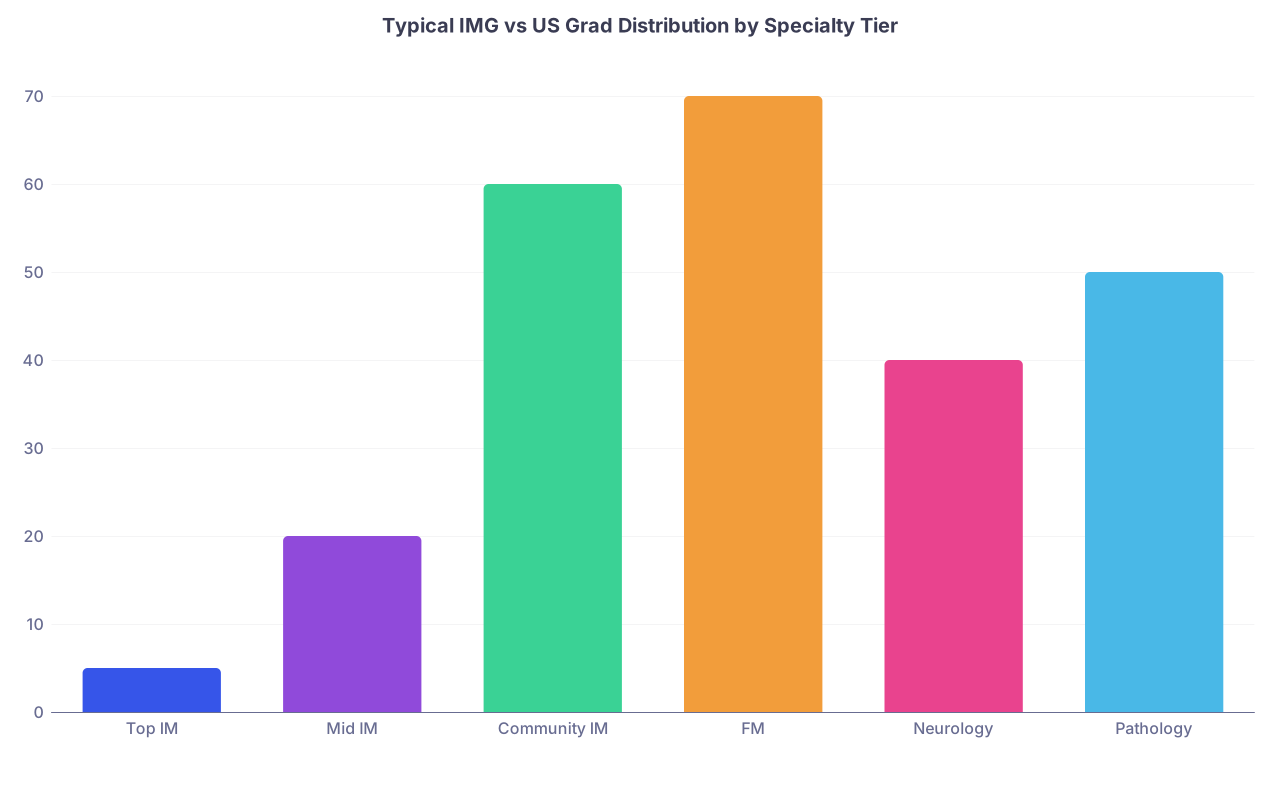
| Category | Value |
|---|---|
| Top IM | 5 |
| Mid IM | 20 |
| Community IM | 60 |
| FM | 70 |
| Neurology | 40 |
| Pathology | 50 |

| Step | Description |
|---|---|
| Step 1 | IMG Application |
| Step 2 | Auto Reject |
| Step 3 | Low Priority Rank |
| Step 4 | Interview Invite |
| Step 5 | High Priority Rank |
| Step 6 | Meets Score and YOG Cutoff |
| Step 7 | Visa Acceptable |
| Step 8 | Good US Letters or USCE |
| Step 9 | Strong Communication and Fit |