
The biggest myth about “IMG‑friendly” programs is that once you match, the hard part is over. It is not. The real gatekeeping happens in one room every few months: the CCC meeting.
Let me tell you what actually happens in those meetings at programs that are truly IMG‑friendly—and how they’re different from the ones that just say they are on their websites.
What the CCC Really Is (Not the PR Version)
The Clinical Competency Committee is not some abstract ACGME construct. It is a small group of people who will quietly decide whether:
- You pass each rotation
- You progress to the next PGY year
- You’re allowed to sit for boards
- You get promoted, flagged, or quietly sidelined
In practice, CCCs are usually 4–10 people: program director, associate PDs, a couple of core faculty, sometimes one or two senior residents. That’s it. A tiny group deciding your fate while you are on night float or in clinic completely unaware they’re discussing you.
At IMG‑friendly programs that are actually decent, those meetings feel very different from the borderline-hostile ones I’ve seen elsewhere. The difference is not the policy document. It’s the culture inside that room.
Here’s the dirty secret: “IMG-friendly” doesn’t mean anything legally. There’s no standard definition. What matters is how you’re talked about—by name—when your slide pops up in the CCC deck.
How CCCs Are Structured Behind the Scenes
Let’s start with the mechanics, because once you see the structure, everything else makes sense.

| Step | Description |
|---|---|
| Step 1 | Collect evaluations |
| Step 2 | Coordinator compiles data |
| Step 3 | Faculty pre-review residents |
| Step 4 | CCC meeting |
| Step 5 | Discuss each resident |
| Step 6 | Agree on milestone levels |
| Step 7 | Set action plans |
| Step 8 | Documentation and follow up |
Here’s what typically happens at genuinely IMG‑friendly programs (I’ve watched this play out at community IM programs, mid-tier academic centers, and even a few big-name places that quietly rely on IMGs):
Pre‑Meeting Data Dump
A week or two before the meeting, the program coordinator sends a massive packet or dashboard: rotation evaluations, mini‑CEX, procedure logs, patient evaluations (if used), in‑training exam scores, duty hour violations, professionalism notes, and sometimes even informal feedback attendings emailed the PD at 2am.
At IMG‑friendly programs that actually want you to succeed, someone—often an APD—takes time to pre‑review the IMGs’ files so they’re not walking into the meeting cold. At less friendly places, they skim your name 30 seconds before discussion and default to stereotypes.
Agenda and Triage
There’s always an agenda: “residents needing extended discussion.” Pay attention: if your name is on that list more than once a year, you’re on someone’s radar.
Genuinely IMG‑friendly programs will ask up front:
“Who needs focused support?”
Not: “Who’s in danger of being a problem?”That sounds subtle. It is not.
Milestones as Weapons or Shields
ACGME milestones are supposed to be developmental. In practice, they’re tools. At IMG‑friendly places, they’re used to defend residents:
“Look, she’s progressing appropriately from level 2 to 3. This is what we expect at this point for someone with her background.”At hostile programs, milestones are used to build a legal case against you:
“He has remained at level 2 in multiple domains, despite repeated feedback.”Same form. Completely different energy.
How IMGs Are Actually Talked About in the Room
This is what you came for. The part nobody says on Q&A panels.
At truly IMG‑friendly programs, the default narrative about IMGs inside CCC is different. Not perfect. But different.
You’ll hear things like:
- “Remember, she had zero US experience before intern year. Look at how far she’s come this year.”
- “He’s improving quickly; communication is solid now. Let’s give him structured feedback, not a formal remediation.”
- “Her knowledge base is strong. Struggles with documentation are system issues as much as anything.”
At other programs, I’ve heard:
- “You know how the IMGs are—takes them longer to get up to speed.”
- “He tested well, but can he function in our system?”
- “We need to document this carefully in case this goes bad.”
Same type of concern (“performance adjustment”), completely different framing.
Here’s the uncomfortable truth: people in CCCs remember stories more than numbers. If your early narrative becomes “hard‑working, cares about patients, good attitude, communication improving,” that story will save you when your ITE score dips or you have one bad rotation.
If your narrative becomes “quiet, uncertain, hard to understand on the phone,” that story will haunt you even when your attendings write decent things.
IMG‑friendly programs are very intentional about how those narratives form. They challenge biased storylines. That’s the difference.
What Data They Review and How It Can Cut for or Against You
Let’s walk through the actual pieces of data that determine how your name is spoken in that room.
| Data Type | How It’s Used in CCC |
|---|---|
| Rotation Evaluations | Core evidence for clinical competence |
| In-Training Exam (ITE) | Knowledge, board readiness, risk prediction |
| Procedures/Logs | Competence, effort, and exposure |
| Professionalism Notes | Promotion risk, behavioral red flags |
| Patient/Peer Feedback | Communication, teamwork, bedside manner |
Rotation Evaluations
This is the backbone. At IMG‑friendly programs, CCC members actually read the comments, not just the numbers.
You might see something like:
“Initially quiet on rounds, but by mid‑rotation was pre‑rounding thoroughly, presenting clearly, and independently following up labs.”
A supportive CCC member will say:
“This is exactly what I want to see in an IMG intern—trajectory is up. Do not flag this as a concern.”
At less supportive programs, the first half of the sentence (“Initially quiet on rounds…”) gets quoted in isolation and used against you.
The trick? Attendings who like IMGs will structure their comments with growth and context because they know CCC will dissect every word.
In‑Training Exam Scores
This is where a lot of IMGs get blindsided. Especially IMGs who did very well on Step 2 and assume that “strong test‑taker” status buys them safety.
It does not.
| Category | Value |
|---|---|
| Above 75th percentile | 10 |
| 25th-75th percentile | 25 |
| 10th-25th percentile | 40 |
| Below 10th percentile | 80 |
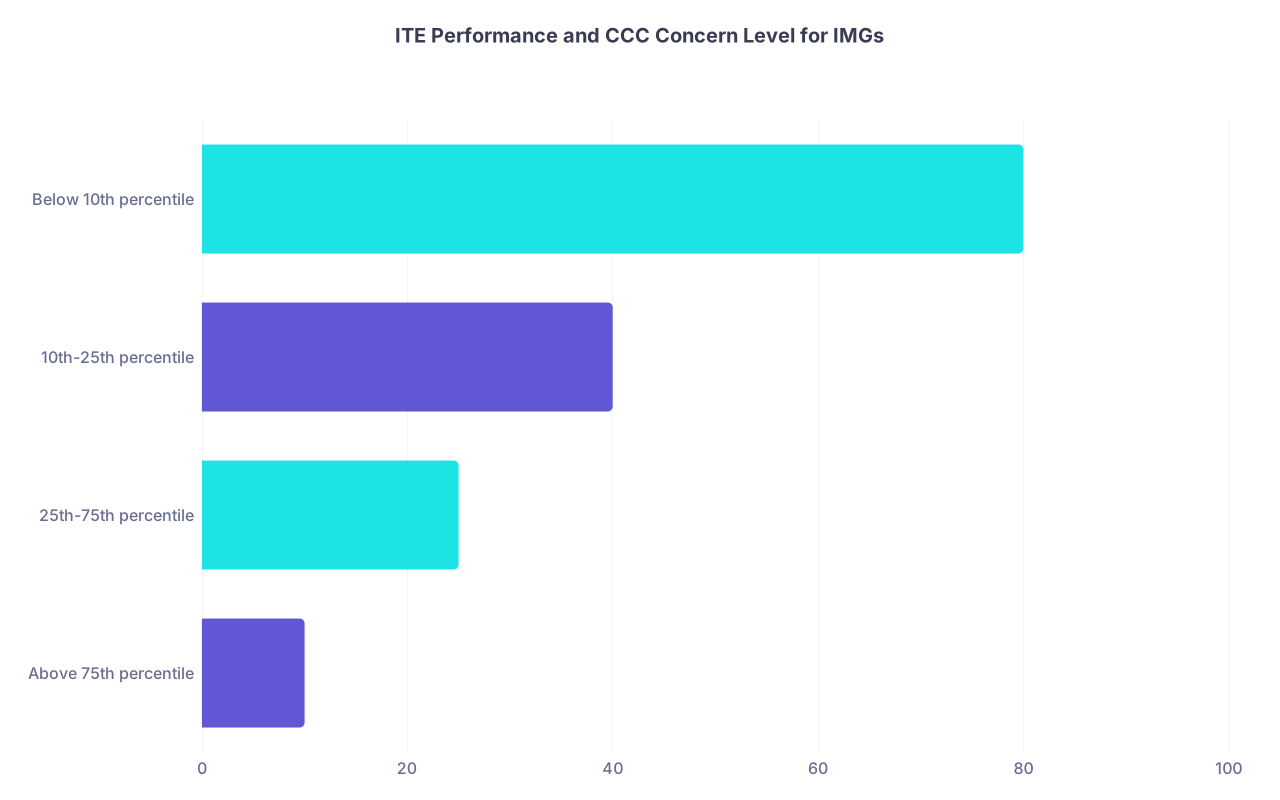
That chart is basically how often I’ve seen CCCs seriously worry at various performance bands (rough estimates, but they’re honest). Below the 10th percentile, your name will be discussed. At some programs, multiple times.
Here’s the key IMG‑friendly move: they contextualize.
- “He’s been out of medical school 7 years; his test‑taking rust is expected.”
- “Look at his improvement from last year’s ITE.”
- “Her clinical evaluations are strong; this discrepancy suggests test strategy issue, not knowledge deficit.”
A truly IMG‑supportive CCC will combine low ITE scores with targeted support, not punishment: paid question bank, protected study time, pairing with a senior resident who crushed the exam.
The Big IMG Triggers Inside CCC
Whether a program is actually IMG‑friendly is obvious if you watch how they respond to three classic “IMG triggers.”
1. Accent and Communication Issues
No one will say this on the website, so I’ll say it here: accents absolutely get discussed in CCC.
At a good program, it sounds like:
- “Some nurses had trouble with his accent on night shift; let’s get him simulated phone scenarios and pair him with a chief who can coach messaging.”
- “Patients rate her highly on compassion; phone communication is the main problem. That’s coachable.”
At bad programs, it sounds like:
- “Families complain they can’t understand him, and that’s a safety issue.”
- “The IMG interns always have phone issues—it’s part of the package.”
Same input, completely different outcome. The supportive CCC asks: “What’s the plan and who’s owning it?” The hostile one just logs “communication concern” and moves on.
2. Documentation and System Navigation
If you trained abroad, EPIC/Cerner/US-style documentation is foreign. Everyone pretends this is no big deal. CCCs know it is.
IMG‑friendly committees say things like:
- “Her notes are long but actually thorough; we can teach efficiency.”
- “He’s over‑documenting because he’s anxious about medico‑legal risk. Let’s normalize expectations.”
In contrast, I’ve seen programs where a single documentation complaint (“always behind on notes”) becomes a permanent label: “slow, disorganized IMG.”
3. Professionalism Flags
This one is huge. A single “professionalism concern” can derail an entire year’s worth of positive evals.
Common IMG‑specific scenarios:
- Argument with a nurse due to miscommunication
- Perceived “disrespect” because you questioned an order more directly than is culturally typical
- Being late a few times due to childcare or transportation issues you’re too scared to explain
In IMG‑friendly rooms, the CCC will dissect context before they stamp you with the “professionalism” brand.
They’ll ask:
- “Is this pattern or one-off?”
- “Has anyone explained expectations clearly?”
- “Is there a cultural component we need to address directly?”
In hostile rooms, the question is:
“How do we document this in case we need to non‑renew later?”
That’s the difference between a teaching culture and a defensive legal culture. You feel it in every sentence.
How Decisions Actually Get Made: Promotion, Warnings, and Support
CCC meetings at IMG‑friendly programs aren’t just complaint sessions. They’re production meetings for your career trajectory.
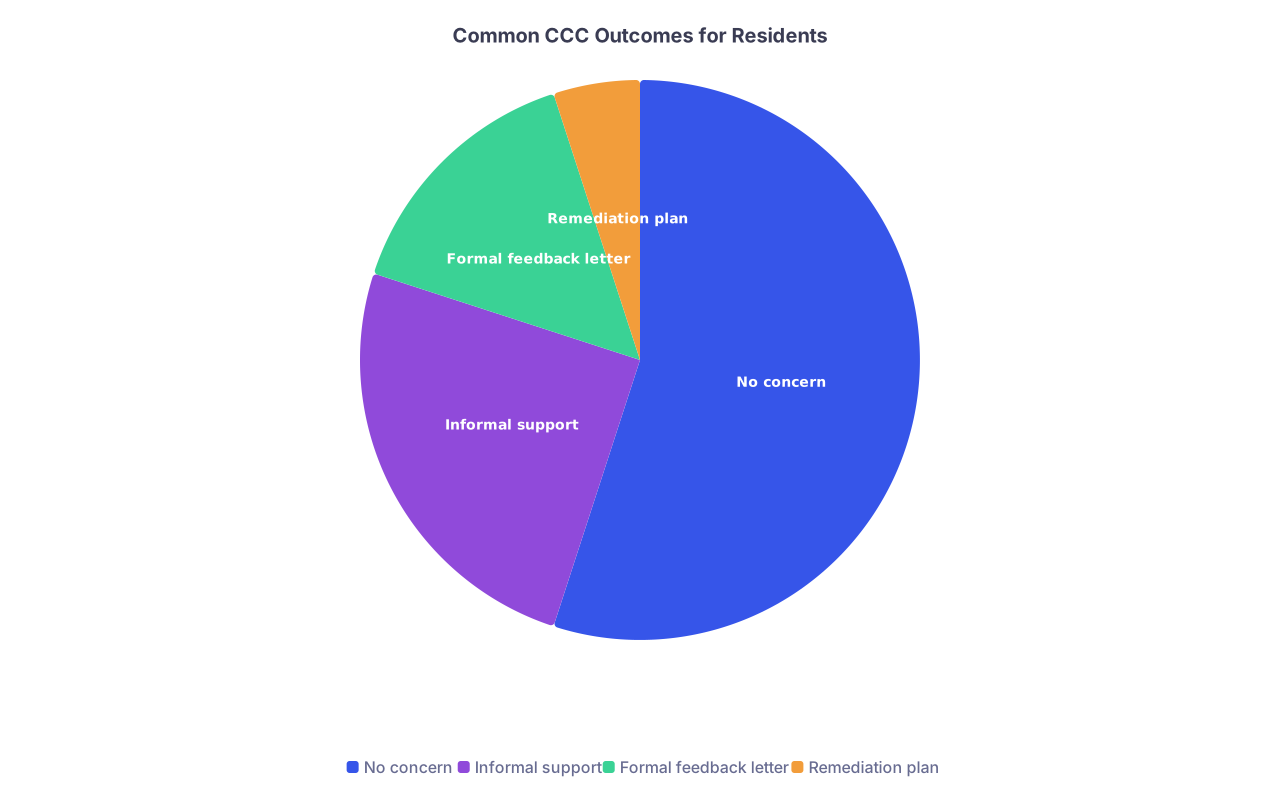
Here’s what they concretely decide for each resident:
- Milestone levels in each competency
- Whether you’re “on track,” “needs focused support,” or “at risk”
- Whether you get a formal letter, an informal warning, or quiet coaching
- Whether to put you on a formal remediation plan
- Whether you’re ready for promotion or board certification sign‑off
| Category | Value |
|---|---|
| No concern | 55 |
| Informal support | 25 |
| Formal feedback letter | 15 |
| Remediation plan | 5 |
In IMG‑friendly programs:
- “Informal support” actually means something. It comes with action items and follow-up, not just vague encouragement.
- “Formal feedback letters” are framed as developmental documents, not veiled threats. I’ve seen PDs say in the room: “We’re writing this because ACGME expects documentation, not because we’re trying to get rid of him.” And they mean it.
- “Remediation plans” have clear goals, timelines, and named mentors. They’re not just a pre‑firing paper trail.
I’ve also seen the opposite: a committee where the unspoken goal is to accumulate enough paperwork to justify removal while pretending to be supportive.
Same word: “remediation.” Completely different agenda.
How You Can Influence What Happens in That Room
You’re never in the CCC meeting. But your fingerprints are all over what’s said.
Here’s the insider playbook for IMGs at programs that are friendly and want you to succeed. If you do these things, you give your advocates ammunition to defend you.
1. Generate Predictable, Boring Professionalism
You do not want to be “interesting” in CCC. You want your name to come up and someone to say:
“Solid. Reliable. No issues.”
And everyone nods and moves on in 20 seconds.
That means:
- Be on time in a way that’s almost obsessive, especially first 3–6 months.
- Communicate upward early about schedule conflicts, fatigue, or life crises. CCC members hate surprises more than they hate problems.
- Reply to emails. I cannot stress this enough. Half the professionalism complaints I’ve seen are “does not respond to communication.”
2. Build At Least Two Real Advocates
At IMG‑friendly places, there are always 1–3 faculty members who get IMGs. Sometimes they’re IMGs themselves. Sometimes they trained at programs built on IMG labor.
You want at least two of them who know you well enough to say, unprompted:
- “I’ve seen her grow on night float—don’t underestimate her.”
- “I’d let him take care of my family.”
Those sentences carry more weight than ten EPIC evaluations. CCC is heavily shaped by whoever speaks first and with conviction.
3. Own Your Narrative Before They Write It for You
If you had:
- A bad rotation
- A conflict with a nurse
- A low ITE year
- A documented incident
You should be meeting with your PD or APD before CCC convenes, saying:
“Here’s what happened. Here’s what I’ve already changed. Here’s what I’m working on next.”
That preempts the “Does he even understand there was a problem?” conversation which is where things often turn ugly.
4. Keep a Personal File
IMGs are often terrified of being “difficult,” so they don’t document anything. Big mistake.
Keep a folder (not on hospital servers) with:
- Email compliments from attendings, nurses, patients
- Screenshots of positive feedback from online evaluation systems
- Notes from meetings with PD/APDs summarizing what was discussed
If your story inside CCC ever starts to tilt the wrong way, a good PD can use that archive to recalibrate:
“Hold on, here’s a pattern of strong performance in these domains.”
How to Tell If a Program’s CCC Is Truly IMG‑Friendly (During Interviews)
You won’t be invited to a CCC meeting before you rank programs. But you can absolutely infer how they run just by asking the right questions.
During interviews or Zoom socials, ask faculty or chiefs:
“How does your CCC handle residents who struggle early, especially those new to the US system?”
Watch for: concrete examples vs vague “we support our residents.”“When was the last time someone was not promoted? What happened and how was it handled?”
Programs that have never had this happen are lying or oblivious. Good programs can describe a case without venom.“Do residents ever get to see or respond to CCC feedback?”
Friendly programs build in dialogue. Hostile ones only communicate when they’re ready to deliver bad news.
And ask current IMGs there, privately:
- “Has CCC ever been used against residents unfairly?”
- “If someone has an accent or documentation problems, what actually happens?”
If they pause too long before answering, pay attention.
One More Hard Truth: IMG‑Friendly Doesn’t Mean Paternalistic
Let me be blunt. A truly IMG‑friendly CCC does not mean “they’ll lower the bar for you.”
If anything, the bar is clearly stated and consistently applied. People defend you when you’re meeting expectations, and they’re honest when you’re not.
The programs that are most dangerous for IMGs are the ones that:
- Say all the right things about “diversity” and “global graduates”
- Never give you direct, critical feedback
- Then one day drop a multi‑page remediation plan on you “based on cumulative CCC concerns”
Nice at the surface. Ruthless underneath.
The places you want are the ones where:
- You hear direct feedback early and often
- CCC outcomes don’t blindside residents
- IMGs are chiefs, fellowship‑bound, and visibly thriving
- The PD can look you in the eye and say, “If there’s a problem, you will hear it from me in time to fix it.”
That’s what IMG‑friendly actually looks like from the inside.
FAQs
1. Can the CCC actually get me fired or non‑renewed as an IMG?
Yes, but not alone. CCC doesn’t usually “fire” you directly; it documents concerns, recommends remediation, and advises the PD. The PD makes the formal decision about non‑renewal or termination. However, when a CCC says “we have serious ongoing concerns across multiple domains,” most PDs will follow that guidance. At genuinely IMG‑friendly programs, non‑renewal is rare and comes only after clear communication and documented attempts to support you.
2. Do CCC members see my immigration or visa status?
Indirectly, yes. They know who is on a J‑1 or H‑1B, especially at IMG‑heavy programs, because it affects contract logistics and, frankly, anxiety levels. In good programs, this awareness actually helps you: they’re motivated to avoid sudden non‑renewals because the consequences for you are severe. In bad programs, I’ve heard people justify extra caution or hesitation about remediation because “immigration makes it complicated,” which is code for “we don’t want the hassle.”
3. Will they judge me for needing more time to adjust as an IMG intern?
They will notice. The question is whether they interpret that adjustment as expected and coachable, or as evidence you “don’t fit” the system. At IMG‑friendly programs, there’s an explicit understanding that the first 3–6 months look different for many IMGs: more help with phone communication, documentation, and team dynamics. CCCs at those places track trajectory—are you getting better month by month? If yes, early struggles rarely become long‑term labels.
4. If I think CCC is being unfair to me, what can I realistically do?
You have more leverage than you think, but it has to be used intelligently. Start by meeting with your PD or APD and asking for specific, written feedback and expectations: “What exactly do I need to show over the next 3–6 months?” Then quietly gather your own documentation of improvement—evaluations, emails, patient compliments. If things escalate, you can involve GME or an ombuds office, but that’s a nuclear option and should come after you’ve tried direct dialogue. In IMG‑friendly systems, if you calmly show insight, effort, and data, there is usually at least one person in CCC who will go to bat for you.
Key takeaways:
CCC meetings are where your real reputation is formed, and IMG‑friendly programs prove themselves in that room, not on their websites. The people who speak for you—faculty advocates, chiefs, your PD—need evidence and a coherent story, and you can absolutely influence both. If you understand how CCCs actually work, you stop being a passive subject and start being a resident whose growth is hard to ignore and even harder to dismiss.