
It’s late January. Rank meeting night. You’re an IMG, sitting thousands of miles away, obsessively refreshing your email while a group of people you’ve never met are deciding if you’re going to be “Ranked to Match” or buried somewhere in the no-man’s-land of “maybe if we don’t fill.”
In that conference room, everyone’s tired. The whiteboard has names, arrows, and cryptic notes: “strong phone rec,” “ask Raj,” “check w/ Dr S (alum),” “good but unknown school.”
This is where IMG alumni networks quietly decide your fate.
Let me walk you through what really happens. Not the polished NRMP survey version. The actual, whispered, text-message, “hey do you know this school?” version.
The First Thing You Need To Understand: PDs Hate Unknowns
Most program directors are not actively anti-IMG. They’re anti-risk.
And for IMGs, the biggest problem isn’t your score or your English. It’s this: the PD, the APD, and the selection committee often have no idea what your training actually means.
They know what a 250 on Step 2 is.
They don’t know what “Faculty of Medicine, X University, Eastern Region Campus” actually produces in the real world.
So what do they do? They reach for the only thing that reduces uncertainty: someone they trust who came from where you came from. Or near enough.
I’ve been in those meetings where an IMG’s name comes up and the PD stops and says one sentence that changes everything:
“Didn’t Farah train at that school? Can someone text her?”
That’s the game. You want to be the file that triggers that sentence.
How Alumni Networks Actually Get Used Behind Closed Doors
Let’s get very literal about this. This is how it looks in real life.
Names are projected. The committee is going down the list. There’s a block of IMGs. Half the room silently braces, because they know this is where the debates start.
Someone reads:
“Applicant 178 – MD, University of X, Step 2 244, 2 US letters, 1 home-country letter, YOG 2021, 1 gap year, did observership here.”
And then, the pivot.
“Do we know this school?”
“Who do we have from there?”
“Is that where Ahmed trained? The PGY3 on nights all the time?”
If the answer is yes, things move fast. Someone pulls up the internal mental (and often literal) list of alumni.
Here’s how they actually use the alumni network:
Quick hallway/WhatsApp verification
A PD will literally step out, text or call an alum:
“You trained at X University right?”
“Yeah.”
“We have a candidate from there. Is that school solid? Similar to you? Any red flags about that place?”That 30‑second exchange can take you from “I don’t know” to “safe to rank.”
Pattern checking
Programs remember where their good IMG residents came from. They won’t always say it on the website, but internally, they think like this:
“We took three people from Universidad X. Two of them are top residents. One average. That school is fine; we can go a little lower on metrics if they’re from there.”
Or the opposite:
“Every time we took someone from Y school, it was a mess. Not doing that again.”Calibration of grades and class rank
A transcript from an unfamiliar international school might mean nothing. But if an alum explains:
“At my school, 80% is top 10% of the class. Getting honors is brutal.”
Suddenly your mediocre-looking 78% and “top quartile” means a lot more than it seems.Character reference by proxy
I’ve literally heard this said:
“If they come from the same system that produced Maria and she speaks well of the school, I’m comfortable ranking this person in our mid tier. We know what we’re getting culturally and academically.”
This is not fair in any pure sense. But it’s absolutely real.
Friendly vs Unfriendly Programs for IMGs: Follow the Alumni Trail
People love to ask, “Which programs are IMG-friendly?” They look for the websites that say it, or the lists on Reddit that are mostly recycled hearsay.
Insider answer? Forget what they say. Look at who’s already there.
If a program has 6–8 IMG residents across PGY1–PGY3, and half of those are from the same cluster of schools or countries, that is not random. That’s alumni network inertia.
They know those schools. They’ve already called there. They’ve already calibrated.
Here’s roughly how PDs stratify IMG-heavy vs IMG-light programs in their heads:
| Program Type | Alumni IMG Pattern | How PD Uses Alumni Network |
|---|---|---|
| Strong IMG history | Multiple current IMGs, repeat schools | Actively text/call alumni, willing to take chances |
| Mixed program | 1–2 IMGs per year, scattered schools | Uses alumni selectively, more score-dependent |
| Rare IMG taker | One IMG every few years | Only considers with strong alumni vouch or exceptional metrics |
| “Once burned” program | Bad past IMG experience | Alumni input may not even rescue borderline applicants |
Programs do not publish this taxonomy. But internally, they absolutely think in these categories.
The friendliest programs for IMGs are not just the ones that already have IMGs. They’re the ones that have clusters of IMGs from similar backgrounds and schools, because that creates a critical mass of alumni opinions PDs trust.
The Phone Call That Changes Your Rank: How PDs Probe Alumni
You need to understand the exact kind of questions PDs and APDs ask alumni about you or your school. It’s not “Are they nice?” It’s more surgical than that.
Imagine a PD calling an alum who graduated from your med school:
“Hey Anil, quick question about University Z. We’ve got an applicant from there – do you feel your training left you behind when you came here? Did you feel underprepared?”
This is what they’re really asking, in disguised form:
- Will this person be unsafe with patients?
- Will they struggle so much that faculty regret taking them?
- Will they survive nights?
- Is the culture there to cut corners, copy notes, fake stuff, or are they serious?
Or, if they have your name directly (because you reached out strategically and that alum knows you):
“Anil, what do you think of this candidate personally? Work ethic? Are they closer to the top or middle of your cohort?”
Alumni know the unsaid scoring rubric. I’ve seen them answer like this:
- “Top 10% kind of person, would absolutely take them here.” → That’s basically a green light.
- “Good, solid, not a superstar but will not embarrass you.” → You probably land in their middle-lower rank tier, which is still alive.
- “Nice person, but I’m not sure they’d keep up with the pace here.” → Kiss that rank spot goodbye.
The alumni input doesn’t replace your application. It colors it. It moves you a tier up or a tier down when you’re sitting in a giant pile of similar-looking IMGs.
Quiet Patterns: How Programs Build Their “Trusted IMG Schools” List
No program director will ever publish this, but almost every IMG-heavy program has a mental (or actual) list that looks something like:
- Schools we love taking from
- Schools that are “fine if strong scores”
- Schools we avoid unless there’s a compelling reason
How does a school end up on one of those lists? Exactly three things:
Past residents
Strong resident from that school → committee remembers.
Weak resident → everyone remembers even more clearly.Alumni feedback over years
People underestimate how much an alum’s long-term success matters. If your alum from University X is now chief resident, then faculty, then APD, that school gets a halo effect for a decade.Consistency of product
If every 2–3 years they take someone from “Universidad ABC” and those residents are consistently prepared, the next applicant from that school gets more benefit of the doubt than someone from “First time we’ve ever seen this place.”
This is why two IMGs with identical Steps and research can have totally different fates. One is from a “trusted school” with three good alumni in the program. The other is a total unknown.
The first one gets ranked in the “We’d be happy if we matched them” zone.
The second one lives or dies on pure metrics and vibe.
Where PDs Actually Look For Alumni Intel (It’s Not Just Formal Channels)
Let me be very blunt: not all of this is formal, documented, or fair. Some of it is borderline gossip. But PDs use what they have.
Here’s the real sourcing:
Current residents
The workhorse of alumni intel. A PD will often say during review:
“Can one of you who trained abroad look at these IMGs and tell me if any schools are familiar or any look sketchy?”
Residents scroll through, circle 4–5 names, send a couple of WhatsApps. That’s it.Recently graduated residents
These people get called and texted way more than you think. Especially if they were stellar.
“You had a friend from your home school who matched in the midwest right? Is that place like ours? Do they handle volume? Did you feel our program was stronger/weaker?”Informal regional familiarity
Example: An APD did a global health elective in Pakistan once. They remember Aga Khan and maybe Dow. Suddenly, applicants from those places feel “less unknown” than some other random names.Friend-of-a-friend PD ad-hoc network
Less common, but it happens:
“Hey, you run an IMG-heavy program in New York. Have you had anyone from XYZ University? Did they do okay?”
This is messy, human, and not standardized. But IMGs either benefit from it or get ignored by it.
How You Can Actually Leverage These Networks (Without Being Annoying)
You can’t control what a PD thinks of your med school history. You can influence who’s available to vouch for you when your file pops up.
Here’s what actually moves the needle.
1. Identify where your school’s alumni actually are
Most IMGs do this lazily. You can do it properly.
- Search current residents pages for your school name and country.
- Use LinkedIn, not just Google. Filter by “Resident Physician,” then your school.
- Ask upperclassmen and recent grads from your school who matched in the US where their friends are.
You’re looking for two things:
Programs with multiple alumni from your school, and standout individuals (chiefs, ICU heavy hitters, research stars).
2. Make real connections before interview season
The PD using alumni input depends on those alumni feeling like they know you even a little. That does not mean begging for a letter out of nowhere.
What actually works:
- Short, respectful email: you’re a current student or recent grad from their school, aiming for the same specialty, asking for 15 minutes to understand their path and what they wish they had known.
- Show up prepared. Have specific questions: “What does your PD care about?” “How do they view our school?” “What mistakes did past grads make when applying there?”
- Follow up once or twice over the year. Share when you get an interview somewhere. Do not spam.
If you eventually get an interview at their program, they’re naturally invested. They may walk into the PD’s office and say, “I talked to this applicant, they’re legit.” That’s gold.
3. Use observerships and externships strategically
PDs trust people they’ve seen in their own building more than anyone else. Yes, USCE matters. But where it happens matters more than most IMGs realize.
If you can get:
- An observership where previous residents from your school trained.
- A sub-I/externship at a program that historically takes your school’s grads.
Then in the rank meeting, the conversation changes from “do we know this school?” to “Dr. S saw them on the wards and thought they were strong.”
The alumni halo plus firsthand observation? Very hard to beat.
4. Don’t force letters from weak alumni
A mediocre letter from an alum in your target program can hurt you. PDs read tone far more than content.
If an alum seems lukewarm, do not push for a letter. Let their contribution stay informal: “Yeah, I talked to them, they seemed normal, motivated, prepared.”
A generic letter that says “hardworking, punctual, pleasant” without conviction kills you more than no letter at all.
What Happens In The Rank Meeting When Your Name Comes Up
Let’s script this out. Because I’ve seen this exact movie many times.
Scenario A: No alumni connection
Your file shows up. IMG. Unknown school. Good but not insane scores. Solid letters from US attendings, “pleasant, hardworking, teachable.”
The questions around the table:
- “Any concerns?”
- “Do we know the school?”
- Silence.
- “Okay, put them in the mid-low tier. If we don’t fill, they’re fine. But not someone we aim for.”
You live or die based on how many US grads and better-known IMGs sit above you.
Scenario B: Clear alumni support
Same file. But this time:
- A senior resident says: “My co-intern from that school was great.”
- An alum you spoke to months ago told the PD, “If they’re like the top half of my class, they’ll do well here.”
- Your interview went well and you referenced that alum organically: “I spoke to Dr. X, who trained here and at my school; they spoke highly of the learning culture.”
Now the conversation changes:
- “We’ve had good luck from that school.”
- “Dr. X liked them?”
- “Yeah, and they did well on Step 2, English is fine, no red flags.”
- “Okay, mid-upper tier. We’d be comfortable matching them.”
Same test scores. Same personal statement. Different alumni context. Different rank number.
Why Some IMGs With Great Scores Still Get Buried
You’ve seen this: someone with a 255+ Step 2, decent research, and clean application goes unmatched. Everyone is shocked.
From the inside, it’s less mysterious.
High scores get you in the conversation. Alumni context decides how much the committee is willing to trust you when there are a dozen other high-scoring candidates with more familiar pedigrees.
I’ve watched PDs do this mentally:
“Okay, we have three IMG applicants with 250‑plus. One from a school we know and have had two good residents from. One from a completely unknown Caribbean place. One from a fairly respected European school where our PD’s colleague trains.”
Guess who gets the highest rank. Scores are the filter. Alumni history is the tiebreaker.
A Hard Truth: Your Country’s Reputation Bleeds Onto You
Even beyond specific schools, PDs use regional patterns heavily. They won’t usually say this on-record, but off-record, they absolutely think in these buckets:
- Countries whose grads are “battle-tested” and used to high-volume, low-resource environments (India, Pakistan, parts of the Middle East, some Latin American countries) often get credit for resilience and work ethic.
- Countries perceived as more exam-oriented but less clinically hands-on need stronger USCE and alumni backing to prove real-world readiness.
- Caribbean schools are judged almost entirely by the program’s historical experience with that specific school’s grads.
Here’s the ugly part: if one or two IMGs from a region flamed out badly or had professionalism issues, everyone behind them from that region pays the price for a few years. I’ve heard it said bluntly:
“We’re not taking anyone from that region this cycle. The last two were headaches.”
Alumni networks are your only way out of that stereotype trap. A respected alum can say, “That was those two people, not the system. This applicant is different. Stronger.”
A Visual Reality Check: Where Alumni Input Matters Most
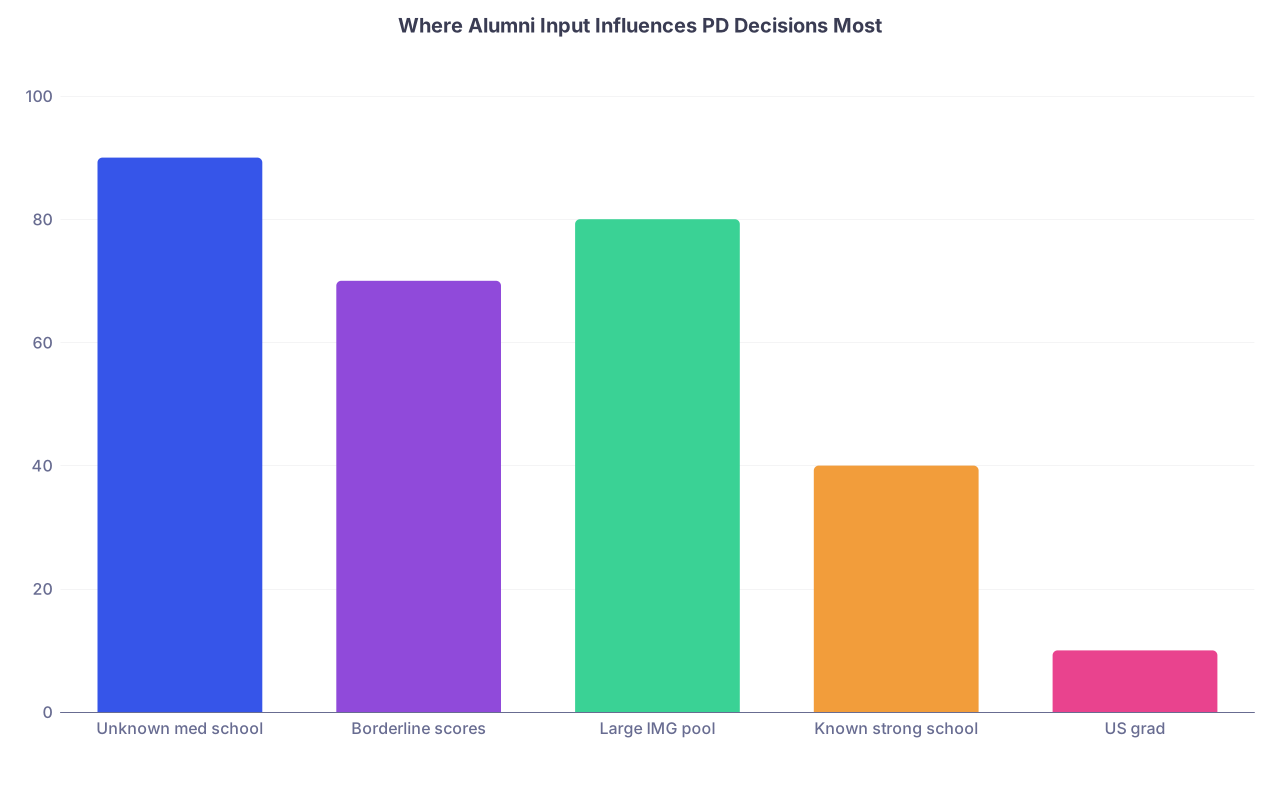
| Category | Value |
|---|---|
| Unknown med school | 90 |
| Borderline scores | 70 |
| Large IMG pool | 80 |
| Known strong school | 40 |
| US grad | 10 |
The less they know about you on paper, the more they lean on alumni voices.
If you’re an IMG from an unknown school in a massive applicant pool, alumni can be the difference between “random name” and “calibrated risk we’re willing to take.”
How To Reverse-Engineer “IMG-Friendly” Using Alumni Patterns
Stop chasing generic IMG-friendly lists. Instead, do this methodically:
- Pick your specialty and region preferences.
- For each program, look at:
- How many IMGs are in current classes.
- Whether any of those IMGs trained at your school or country.
- Make three buckets:
- Programs with multiple residents from your school/region.
- Programs with at least one alum from your school.
- Programs with no visible alumni connection.
Then bias your efforts:
- Extra networking and communication with programs in the first two buckets.
- Apply widely, sure, but emotionally and strategically invest where an alumni multiplier exists.
You’re not just looking for “they take IMGs.” You’re looking for “they have reason to trust people like me.”
One More Behind-the-Scenes Detail: PDs Remember Who Helped Them
A final nuance.
The alumni who give insightful, honest, specific feedback that leads to good matches? PDs remember and trust them more the next time.
The ones who always say “they’re great” about everyone? PDs learn to discount their opinion.
Over time, a handful of IMG alumni become “trusted voices” inside that program. If one of them backs you, your application is judged under a warmer light than you realize.
I’ve seen PDs literally say in front of a committee:
“If Maria says they’re good, they’re good. She has not been wrong yet.”
You want to align yourself, directly or indirectly, with those people.

| Step | Description |
|---|---|
| Step 1 | IMG Application Submitted |
| Step 2 | Initial Screen by Scores |
| Step 3 | File Reviewed in Committee |
| Step 4 | Use Past Experience |
| Step 5 | Ask Alumni or Residents |
| Step 6 | Ranked Higher Tier |
| Step 7 | Ranked Mid Tier |
| Step 8 | Low Rank or Not Ranked |
| Step 9 | Med School Known? |
| Step 10 | Alumni Feedback |