The polite story you hear about IMGs is a lie. Program directors do not “view all applicants equally.” They quietly sort, label, and pre-rank IMG-friendly candidates long before the official rank meeting ever happens.
Let me tell you what actually goes on in those rooms—and how certain IMGs get pulled to the top of the stack while others never make it out of the spreadsheet.
The First Quiet Filter: “Safe IMGs” vs “Project IMGs”
Behind closed doors, PDs and coordinators use language you’ll never see in a brochure.
They divide international graduates into two mental buckets almost immediately:
- “Safe IMGs”
- “Project IMGs”
No one writes that on the whiteboard during rank meetings. But I’ve heard those exact phrases used on internal emails and in hallway conversations.
“Safe IMGs” are the ones who get ranked early, higher, and with less debate. These are the applicants directors feel will:
- Plug in smoothly without hand-holding
- Pass boards on the first try
- Not blow up patient safety, call schedules, or ACGME metrics
Everything else—the emotional stories, “I’ve always dreamed of training in the US,” the adversity—gets processed after those basic instincts are satisfied.
Here’s how they decide, very quickly, which IMGs fall into which group.
The Hidden Sorting Rules They Use Before Interviews
The first real “ranking” of IMGs happens before interviews. It starts with an internal sort that never leaves the program office.
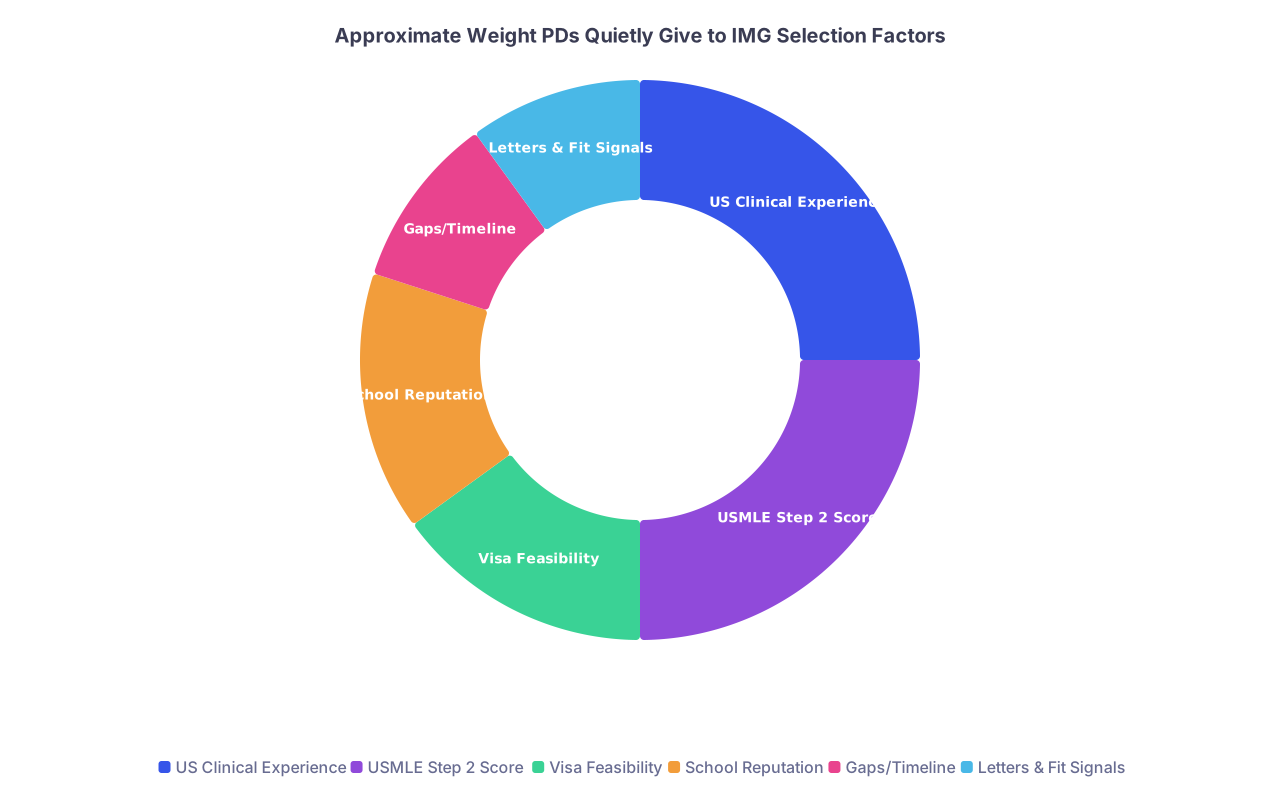
| Category | Value |
|---|---|
| US Clinical Experience | 25 |
| USMLE Step 2 Score | 25 |
| Visa Feasibility | 15 |
| School Reputation | 15 |
| Gaps/Timeline | 10 |
| Letters & Fit Signals | 10 |
Is this exact? Of course not. But it’s close to how discussions actually sound when a coordinator dumps 1,200 applications on a table and the PD says, “Okay, how are we going to cut this down to 200?”
1. US Clinical Experience: The True First Gate
Publicly, programs say: “USCE preferred.” Internally, they say: “No USCE? Put them in the maybe pile. We’ll never get to that pile.”
There’s a quiet hierarchy:
- Hands-on inpatient USCE in the same specialty (sub-I, acting internship, core rotation in the US)
- Hands-on observerships/externships in the US with clear responsibility
- Research-only US experience
- No US experience
At IMG-friendly programs, here’s what actually happens: the coordinator applies an internal filter on ERAS tags, then the PD skims the filtered list and literally says something like:
“Start with IMGs who have at least 2–3 months of US inpatient experience. Same specialty if possible. Then we’ll see how many spots we still have.”
Those applicants become the “priority review” IMG batch. Everyone else is technically “considered,” but practically ignored unless they have off-the-charts scores or a direct connection.
If you’re an IMG without real USCE: you are starting the race in the second wave, not the first.
2. Step Scores: More Blunt Than Anyone Admits
Step 1 going pass/fail did not make things better for IMGs. It just shifted the pressure forward. IMGs get judged more brutally on Step 2 CK than US grads—period.
Direct quote from an associate PD at a mid-tier IM program that takes 50–60% IMGs:
“For our IMGs, Step 2 is our Step 1 now. If they’re not at least mid-230s, we don’t even have the bandwidth to look closely unless they have insane US experience or a letter from someone we know.”
Programs that are openly IMG-heavy still quietly use hard floors. And yes, they’re usually higher for IMGs than for US grads at the same program.
Here’s how that looks behind the scenes.
| Program Type | US MD Floor | US DO Floor | IMG Floor (Unofficial) |
|---|---|---|---|
| Community IM (very IMG-friendly) | ~215 | ~215 | ~225–230 |
| Mid-tier Univ IM (mixed) | ~225 | ~220–225 | ~235–240 |
| Community FM (very IMG-friendly) | ~205 | ~205 | ~215–220 |
Nobody publishes those numbers. But they bounce around on internal emails all the time: “Let’s keep IMGs ≥235 for initial review,” “We can go down to 225 if strong USCE.”
IMGs with scores above those internal floors go into the “safe” bin. Below them, even with some red stars in the file, you’re fighting uphill.
3. Visa Status: The Practical Brutality
You’ll never see a program’s real visa policy on their website. Those are cleaned-up statements. Inside the office it sounds like this:
- “We say we sponsor J-1 and H-1B. This year, realistically, we can probably do 3 H-1Bs max.”
- “Let’s prioritize GC holders and citizens among IMGs, then J-1, then we’ll see if we have bandwidth for an H-1B.”
If you’re an IMG and either:
- You’re already a permanent resident or citizen, or
- You don’t need visa sponsorship at all (Canadian with TN, etc.)
You immediately get labeled lower-risk. You jump lines without ever knowing it.
Among the rest, programs quietly triage:
- J-1: “manageable, standard, ECFMG handles a lot”
- H-1B: “more expensive, more bureaucracy, cap issues, exam timing matters”
If you’re an IMG with strong scores + USCE + no visa headaches, your file naturally floats to the “review first” pile. Not because of merit alone, but because you’re administratively cheap.
The IMG-Friendly Programs Aren’t Random – They’re Systematic
There’s this myth: “Some programs are just nice to IMGs.” No. The IMG-friendliness of a program is the result of pressure, metrics, and survival.
Here’s what you never see on the website.
- Programs who’ve had chronic trouble filling with US grads become structurally IMG-friendly out of necessity.
- Once they succeed with a few strong IMG cohorts, the faculty’s mindset changes from “risky” to “reliable.”
- Then PDs quietly shift their strategy: IMGs become the core of the residency, not a backup plan.
So they create an internal playbook: how to identify the highest-yield IMGs quickly and rank them early.

| Category | Value |
|---|---|
| Univ IM Top 20 | 5 |
| Mid-tier Univ IM | 25 |
| Community IM | 50 |
| Community FM | 60 |
| Rural IM/FM | 70 |
At those 40–70% IMG programs, the PD is not grudgingly accepting IMGs at the bottom of the rank list. They’re strategically building the class around IMGs who:
- Show predictable exam performance
- Adapt well culturally and clinically
- Stay for fellowship or long-term hospital employment
Those applicants rise to the top of the rank list first. Then US grads who are a “maybe fit” fill in the gaps.
How They Quietly Pre-Rank You During Interview Season
By the time interview invitations go out, there’s already an internal “Tier 1 IMG” list. You won’t see it. But you’ll feel it in how your interview day goes.
Here’s the part no one says out loud: at IMG-heavy programs, directors often know their top 20–30 IMG candidates before January. The final rank meeting is mostly confirming and negotiating around that.
The Informal Categories: A, B, and C IMGs
Most programs have some variation of this shorthand in their spreadsheets or notes:
- A IMGs – highly likely to be ranked in the top half
- B IMGs – mid-list, rankable, but not protected
- C IMGs – “rank if we have room,” or “do not rank”
What pushes you from B to A is not some mystical interview charisma. It’s usually three things:
- You match their pattern of prior successful IMGs
- Someone on faculty is willing to go to bat for you
- You signal clear commitment to that specialty and that type of program
Let me break those down.
Pattern Matching: “She Looks Like Our Current PGY-2s”
Directors trust patterns more than they trust essays. When they’ve had four straight cohorts of strong IMGs from X region or Y school profile, they start looking for the same template.
Examples I’ve seen in real conversation:
- “Our best IMGs recently have been from mid-tier Caribbean schools with 1–2 years of US research and >240 Step 2. Let’s keep leaning into that.”
- “The grads from that Eastern European school with extended graduation timelines haven’t done well on boards. Be cautious pulling more from there.”
- “Our last two residents from that specific Indian college were stars—if we see that school again with similar stats, flag them.”
They are literally pattern matching.
If you align with a successful prior profile—same school, similar timeline, similar Step 2 range, similar degree of USCE—you get mentally pre-ranked higher.
If you’re an outlier (older grad, long gap, unusual path), you’re not automatically rejected. But you are not the “first to be ranked” either. Those early ranks go to the program’s comfort zone.
Champions and Whispered Endorsements
This part is brutally real: the single most powerful force in IMG ranking is the quiet “I’d work with them” from someone the PD trusts.
I’ve seen it multiple times at IM and FM programs that take 50–80% IMGs. An attending or chief resident comes out of your interview and says to the PD:
“She’s sharp, and she’ll work hard. I’d be fine being on nights with her.”
Your file jumps. You move into protected territory.
Or on the other side:
“Nice applicant, but I’m not sure he really understands our patient population. Felt a little rigid.”
That one comment nudges you from A to B or B to C. Not because you’re weak on paper, but because you didn’t hit the “I’d share a 28-hour call with this person” instinct.
Programs that are deeply IMG-friendly usually have specific go-to people whose opinions carry serious weight on IMG candidates:
- The senior faculty member who also trained abroad
- The chief resident who’s an IMG and knows what it takes
- The APD who handles remediation and knows what profiles struggle
If those people like you, you get ranked higher, sooner.
What You Say (and Don’t Say) That Moves You Up Their List
IMGs often blow the interview by trying to sound “perfect” and end up sounding fake. Directors are not impressed by generic resilience narratives. They’re trying to answer four specific questions:
- Will you pass Step 3 and in-training exams without drama?
- Will you show up, not melt down, and not cause medico-legal disasters?
- Will you actually want to be here, in this city, with this patient mix?
- Are you going to leave or demand favors the second you get here?
The applicants who quietly move up the rank list are the ones who, through their answers, hit those four points without sounding rehearsed.
I’ve watched PDs after interview day go through notes like:
- “Strong Step 2, already planning to take Step 3 early—good.”
- “Understands volume and acuity here, talked specifically about safety-net populations—good fit.”
- “Spouse already in nearby city, realistic about staying—stable.”
- “Spoke humbly about needing to adapt to US system, but gave concrete examples of past adaptation—safe.”
That candidate gets slotted early when they start drafting the rank list. Not because of one magic phrase, but because every signal said: low-risk, high-yield, stays in system.
The Internal Rank Meeting: How IMGs Get Locked In Early
You imagine rank day as a big democratic debate. It’s not. It’s more like editing a draft that’s mostly done.
At IMG-heavy programs, the PD usually walks into the meeting with:
- A “preliminary rank order” of their top 30–40 IMGs
- A big middle pool of “rankable” IMGs and US grads
- A red zone: applicants they will not rank, often for risk or attitude reasons
They start from the top and work down. And this is what you need to understand: once an IMG is placed in the top part of that list, they’re rarely moved down unless there’s a strong negative.
Negative = the one thing you absolutely don’t want associated with your name:
- Unexplained long gaps they missed previously
- Rumors from another program (“we interviewed them too, came across as entitled”)
- Last-minute fail (CS fail back when it existed, Step 2 retake, professionalism issue)
Otherwise, the top IMG spots are actually very stable.
The PD will say, “This group of IMGs has been fantastic during interviews, strong scores, strong USCE. Unless anyone has serious objections, they’re staying in our top 40.”
No one fights them. Faculty focus their arguments on borderline or controversial candidates, not the solid, safe, IMG-friendly ones who clearly fit the pattern.
That’s how certain IMGs get quietly “protected” high on rank lists.
How You Position Yourself To Be One of Those “Protected” IMGs
You can’t control everything. But you can absolutely align yourself with the patterns PDs are already using.
Here’s the unvarnished version of what works.
Make Yourself Visibly Low-Risk on Paper
That means:
- Strong Step 2 on first attempt, taken as early as reasonably possible
- Clean, well-documented timeline with minimal unexplained gaps
- Multiple months of US inpatient clinical experience, preferably in your chosen specialty
- If possible, ECFMG certification and Step 3 done or scheduled with a realistic plan
Programs love the phrase: “They’re ready to hit the ground running.” If your file screams that, you skip multiple layers of doubt.
Control Your Visa Story
If you need a visa, at least sound like someone who won’t be a disaster.
Direct, calm statements help:
- “I understand the J-1 process; I’ve reviewed the ECFMG guidelines and timelines.”
- “I’m open to J-1 or H-1B as appropriate for the program; my priority is stable training.”
What scares PDs is visa chaos: unclear status, unrealistic expectations, or threatening to leave if they don’t give you what you want. IMG-friendly programs don’t want drama; they want predictability.
Engineer Real Advocates
Do not underestimate this part.
If you do US rotations, it’s not enough to “work hard.” You need at least one person who would, if called or emailed, say:
“Yes, I’d absolutely take this person in our own program.”
That means:
- Asking directly if they’d be comfortable strongly supporting you
- Giving them a concrete, structured CV and talking points
- Staying on their radar close to application season
Many PDs do quietly email or text colleagues: “You wrote a letter for this IMG—would you actually rank them high if you had the spot?” That off-record answer matters more than the glowing prose of the LOR.
The Truth About “IMG-Friendly Policies”
Programs with “friendly policies for IMGs” aren’t acting out of charity. They’ve built systems where IMGs are their most reliable workforce and best future fellows.
The “friendly” part is that they:
- Actually read IMG applications in detail
- Systematically prioritize certain IMGs for early ranking
- Maintain realistic, not hostile, visa sponsorship options
- Have success stories of IMGs in academic, hospitalist, or fellowship roles
But inside, the decision-making is ruthlessly practical. They rank IMG-friendly applicants first because:
- Those IMGs have already proven they match the program’s successful pattern
- They present low academic, cultural, and administrative risk
- They’re more likely to stay, work hard, and help the program’s metrics
If you want to be in that quiet first-ranked group, you stop thinking like a generic applicant and start thinking like a program director who’s trying to protect their residency from chaos.
If you remember nothing else:
- Programs don’t randomly “like” IMGs. They favor specific, low-risk IMG profiles that have worked for them before—and they rank those applicants first.
- Your Step 2 score, USCE, visa clarity, and timeline don’t just “matter”; they decide whether you’re in the safe IMG bucket or the project IMG bucket.
- The IMGs who rise to the top of the rank list have one consistent advantage: someone inside or adjacent to the program is willing to quietly say, “Yes, I’d work with them tomorrow.”