
Ranking residency programs without knowing their fellowship support is how IMGs sabotage their future.
You are not “just” ranking places to survive residency. You are choosing who will—or will not—stand behind you when it is time to match into fellowship. A lot of very bright IMGs learn this the hard way. Three years later. When it is far too late.
Let me say this bluntly: some programs are happy to use you for service, but will not lift a finger to get you into cardiology, GI, heme/onc, or any other competitive fellowship. They will smile during interviews, call everyone “family,” and then quietly rank their own graduates behind U.S. grads from name‑brand places.
You must not rank those programs highly. Here is how people get trapped—and how you avoid it.
The Core Mistake: Treating “Any Residency” As Good Enough
I keep seeing the same pattern.
An IMG with solid scores and a decent CV builds a rank list based on three things:
- Where they felt “welcomed”
- Location and visa promises
- How desperate they feel to just match somewhere
Fellowship support? Checked once, maybe: “Do you have cardiology fellows?” If the answer is yes, they assume they will be supported. That is naive.
The damaging assumption:
“If I work hard and score well, I will be judged fairly when I apply for fellowship.”
No. Not in every program. Not as an IMG.
There are programs where:
- Fellowship PDs never call for IMGs from their own residency
- Letters are generic and weak, even for top resident IMGs
- The culture explicitly favors U.S. grads for any competitive fellowship spot
Residents there only realize the trap in PGY‑2 when fellowship match lists come out and they notice a pattern: the IMGs are not going to cards, GI, or heme/onc. They are going to hospitalist jobs or less competitive fellowships—if anything at all.
By the time you see that pattern from the inside, your options are limited. You already ranked them. You already matched.
Red Flags: Programs That Will Not Back You for Fellowship
You need to assume nothing. You need evidence. There are clear warning signs if you know where to look.
1. No transparent fellowship match list
If a program cannot show you a 3–5 year list of where their residents matched into fellowship, and who actually matched, you should be suspicious.
Bad signs:
- “We do not have that compiled, but our residents do fine.”
- “We are working on a list.”
- They show a slide with logos (Cleveland Clinic, Mayo, etc.) but do not list years, names, or whether those people were IMGs vs AMG.
You want to see details, not marketing.
| Program Type | Fellowship Data Shown | Level of Trust |
|---|---|---|
| Strong | 3–5 year list, names removed but clear IMG/AMG, specialties, institutions | High |
| Mediocre | Single slide with logos, no specifics | Low |
| Weak | Verbal claims only, no document or slide | Very Low |
If they are proud of their outcomes, they track them. If they are hiding weak IMG outcomes, they obscure them.
2. All the “big” fellowships go to AMGs
Pay attention during interview day and Q&A with residents. Ask very specifically:
- “In the last 5 years, which IMGs from this program matched into cardiology, GI, heme/onc, pulm/crit, or nephrology?”
- “Were they J‑1 / H‑1B or green card / citizen?”
If the room suddenly gets vague:
- “We had someone several years ago…”
- “Most of our IMGs like hospitalist work.”
Translation: this program does not consistently back IMGs into competitive fellowships.
A healthy program can immediately name a few recent IMG successes.
3. Fake reassurance from leadership
Listen carefully to what program leadership says when you raise fellowship concerns.
Strong answer:
- “We have a dedicated fellowship mentorship structure starting PGY‑1.”
- “Here is our last 3 years of matches broken down by IMG vs AMG.”
- “I personally call PDs for any resident who earns that support.”
Weak answer:
- “If you work hard, you will be successful anywhere.”
- “We do not differentiate between IMG and AMG.” (nice line, often untrue in practice)
- “Our job is to train good internists; what you do next is up to you.”
That last one sounds philosophical. It is actually a warning: they do not see helping you match fellowship as their responsibility.
The Hidden System: How Programs Actually “Back” You
You will not see this in any brochure, but here is how fellowship support actually works at good programs.
Support is not just “we let you apply.” It includes:
Strategic exposure
You get rotations with big‑name attendings in your field of interest. They put you on key services where you will be seen by the people who matter.Real mentorship
Not “my door is always open.” Actual standing meetings with someone who knows the fellowship landscape and is willing to tell you which programs are realistic for you as an IMG.Protected time and structure
- Research time that is real, not “you can do it on nights and weekends”
- Abstract and manuscript support (statistics, IRB help)
- Clear deadlines and expectations for fellowship apps and letters
Active advocacy
This is the part most IMGs underestimate. At strong programs, PDs and big attendings:- Pick up the phone and call fellowship PDs they know
- Email directly to push your file to the top of a big pile
- Phrase your letters so strongly that they override bias against IMGs
Programs that truly back you will talk about these mechanisms. Programs that do not will talk in vague motivational slogans.
IMG‑Specific Pitfalls That Get Ignored on Rank Lists
You are not playing the same game as a U.S. grad from a top‑20 med school. Pretending you are will get you burned.
1. Overvaluing “IMG friendly” and ignoring “fellowship friendly for IMGs”
Programs advertise “IMG friendly” because they accept many IMGs. That does not mean they promote them to competitive fellowships.
Common trap:
An IMG‑heavy community program with:
- 70–90% IMG residents
- 0–1 IMG cards / GI / heme‑onc match in 5 years
You see lots of faces like yours and think, “I will be supported here.” In reality, you have entered an all‑service machine where everyone wants fellowship and only 1–2 per class get real backing.
You need both:
- Residency IMG friendly
- Fellowship outcomes IMG friendly
Those are not the same.
2. Ignoring visa bias in fellowship outcomes
Fellowships vary widely in how they treat visas. Your residency program knows this. Some help you navigate it. Some do not bother.
If you are J‑1 or need H‑1B, you must ask:
- “Which J‑1 / H‑1B residents matched into fellowship in the last 5 years?”
- “Did the program help with waiver jobs after fellowship?”
If answers are murky or they avoid specifics, you are walking into a black hole as a visa‑requiring applicant.
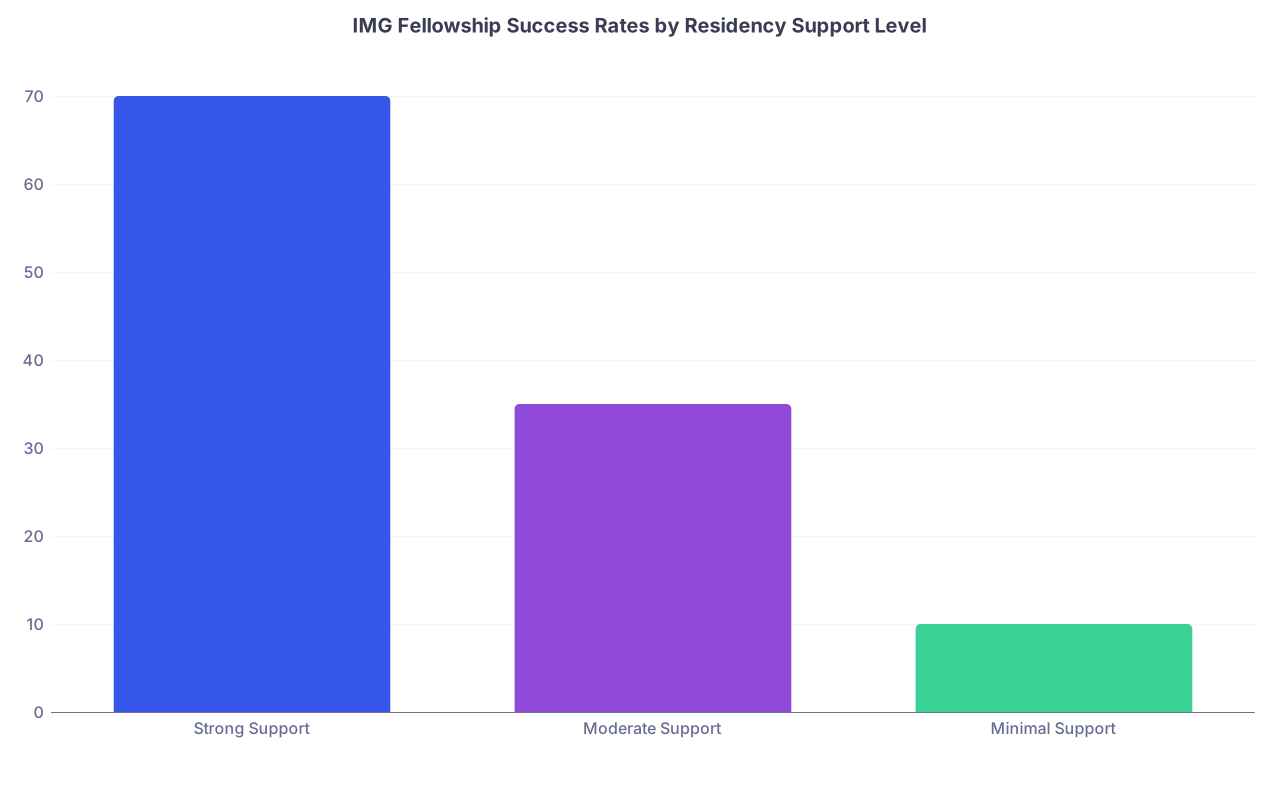
| Category | Value |
|---|---|
| Strong Support | 70 |
| Moderate Support | 35 |
| Minimal Support | 10 |
At places with strong structural support, even visa‑requiring IMGs can hit 60–70% fellowship match in competitive fields. At places with minimal support, the rate can drop to single digits. Same applicant quality. Different institutional backing.
3. Believing that research “opportunities” automatically mean research outcomes
Every program swears they have “tons of research.” That means nothing. You need to discriminate between:
Opportunistic research:
You chase busy faculty, beg for scraps of projects, do data entry at 1 a.m. on nights, and maybe get your name as 6th author on a poster.Structured research:
There is a clear pipeline:- Projects listed
- Mentors assigned
- Support for stats / IRB
- Strong expectation that residents present and publish before graduation
As an IMG, you are frequently starting behind U.S. grads in network and familiarity with the system. Without structure, you get left out.
Good question to ask:
- “How many residents, specifically IMGs, presented at national meetings last year? In which specialties?”
- “How many had first‑author publications before fellowship application?”
If they cannot answer those two, do not assume research will magically happen.
How to Evaluate Programs Before You Rank Them
You can avoid most of these traps with a deliberate strategy. This takes work. It is still easier than climbing out of a bad program later.
Step 1: Pre‑interview research (do not skip this)
Do not just skim the website. Go hunting.
- Look for a “Recent Graduates” or “Fellowship Matches” page
- Check residents’ LinkedIn pages or PubMed for their names + institution
- Note: How many recent grads from that residency appear in cardiology, GI, heme/onc, pulm/crit, etc.?
If you cannot find a single IMGs‑to‑competitive‑fellowship example in 3–5 years, that is not an accident.

| Step | Description |
|---|---|
| Step 1 | Shortlist Programs |
| Step 2 | Check Online Fellowship Outcomes |
| Step 3 | Mark as High Risk |
| Step 4 | Prepare Targeted Questions |
| Step 5 | Ask During Interview |
| Step 6 | Contact Current IMG Residents |
| Step 7 | Rate Fellowship Support Level |
| Step 8 | Finalize Rank List |
| Step 9 | IMGs in Competitive Fellowships? |
Step 2: Ask the right questions on interview day
You are not there to impress them only. You are there to interrogate the environment you might be stuck in for 3 years.
For PDs / APDs:
- “Over the past 5 years, how many IMGs from this program have matched into cardiology, GI, heme/onc, pulm/crit, or nephrology?”
- “Do you track IMG vs AMG outcomes? Can I see that data?”
- “How do you support residents who are IMGs and want competitive fellowships?”
- “Who are the strongest fellowship mentors for IMGs here?”
For current IMG residents:
- “Have any IMGs from your program gotten into the fellowship you want?”
- “Do attendings here actually call PDs and advocate for IMGs?”
- “How hard is it to get research that leads to publications, not just data work?”
- “If you could re‑rank today knowing what you know now about fellowship, would you rank this place as high?”
Watch how long they pause. Watch their eyes. Their tone will tell you more than the words.
Step 3: Follow up after interviews with targeted emails
If outcomes are unclear, you can still press.
Email chief residents or fellows:
- Ask: “Can you share, in general terms, how prior IMGs from your residency have fared in fellowship applications?”
- Ask fellows from your home country background if there are silent barriers.
If you get no response or get generic PR lines, treat that as data.
Rank List Strategy: Avoiding the “Service Trap” as an IMG
By the time you build your final rank list, you should not be guessing which programs will back you.
Here is where IMGs mess up: they overweight “I liked the people” and underweight “Will anyone here pick up the phone for me in 3 years?”
You need to prioritize:
Track record of fellowship matches for IMGs
Not one superstar exception. A pattern.Explicit structures for mentorship and research
Regular meetings, documented pathways, not inspirational speeches.Clear culture of advocacy
The PD, APDs, and key attendings talk like they see your fellowship as their success too.
And you need to de‑prioritize:
- Fancy hospital name without proof of IMG fellowship success
- Places that rely on “we are a family” instead of real outcomes
- Programs that take many IMGs but have weak or opaque fellowship lists
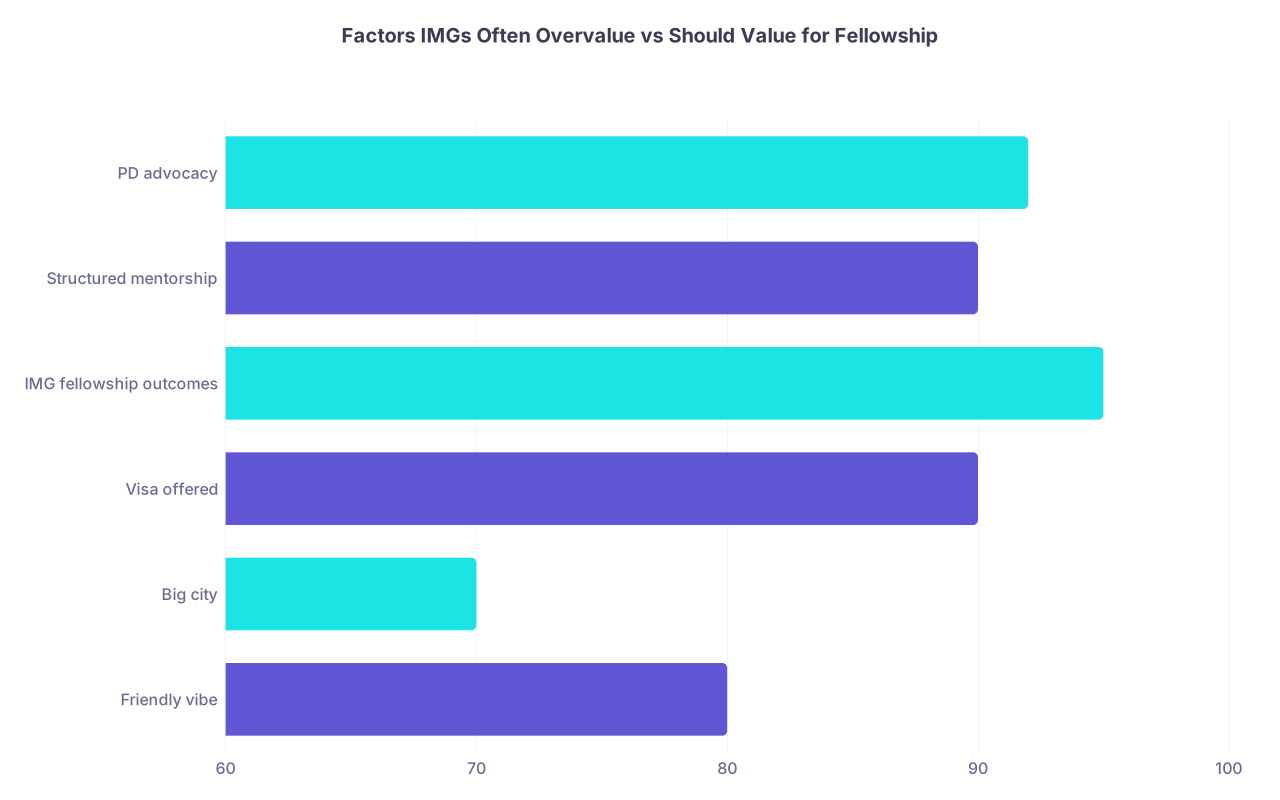
| Category | Value |
|---|---|
| Friendly vibe | 80 |
| Big city | 70 |
| Visa offered | 90 |
| IMG fellowship outcomes | 95 |
| Structured mentorship | 90 |
| PD advocacy | 92 |
You still care about location, salary, schedule. Of course. But if you want fellowship, those cannot outrank the single most important variable: will this program actually launch me to the next step?
Concrete Examples of Programs to Be Wary Of
I am not going to name specific institutions, but watch out for these profiles:
Large community internal medicine program
- 60+ residents, mostly IMGs
- Advertises “strong hospitalist training” but vague about fellowship
- No public fellowship match list
- Research “available” but all attending‑driven QI with no real publication track
University‑affiliated but not university‑owned program
- Uses the university brand name on slides
- In reality, its residents rarely match into that same university’s own fellowships
- IMGs get filtered toward community fellowships or hospitalist roles
Newly accredited or rapidly expanding programs
- Fellowship relationships not yet built
- No track record for IMGs because the first classes are still in training
- You become the experiment class
If you still want to rank those programs, fine. But do it fully awake, knowing the risk.
Quick Comparison: Strong vs Weak Fellowship Support
| Feature | Strong Support Program | Weak Support Program |
|---|---|---|
| Fellowship match list | Detailed, 5+ years, includes IMGs | Vague, partial, or nonexistent |
| IMG in competitive fellowships | Regular, multiple per year | Rare or “one a long time ago” |
| Research structure | Organized, mentored, protected time | Ad hoc, nights/weekends only |
| PD advocacy | Explicit, calls/emails for residents | “We treat everyone the same” line |
| Visa‑requiring IMG outcomes | Can give recent examples | Avoids answering, “case by case” |
If you cannot clearly place a program in the “strong” column for at least 3 of these, do not rank it at the top if fellowship is your goal.
Do Not Outsource This To “Future You”
The last mistake is a psychological one. I see this constantly:
“I just need to match. I will worry about fellowship later.”
Future you will not magically have better options if you pick a program that will not stand behind you. Future you will be overworked, in a system that is indifferent to your goals, applying for fellowship with weak letters, minimal mentorship, and a CV that looks mediocre next to U.S. grads from stronger programs.
You are not being “picky” or “ungrateful” by expecting a residency program to back you for fellowship. You are asking them to do the job they claim to do: train and launch physicians into the next stage of their careers.
If a program bristles when you ask about that, or tries to guilt‑trip you for caring, that is your sign to move them down your list.
FAQs

1. If I have average scores as an IMG, should I still worry about fellowship support, or just try to match anywhere?
You should worry more, not less. Average‑score IMGs need institutional backing even more than the 260‑score superstar. A strong program can compensate for a non‑perfect test record with strong letters, visible research, and PD advocacy. A weak program will simply let you blend into the background. If you truly do not care about any fellowship and just want a job as a hospitalist in a specific location, fine—optimize for that. But if there is any chance you will want cardiology, GI, heme/onc, pulm/crit, or even a solid academic general internal medicine fellowship, you cannot afford to ignore a program’s track record with IMGs.
2. Is it safer to pick a weaker university program over a strong community program for fellowship chances?
Do not be fooled by the word “university.” Some “university‑affiliated” residencies have worse fellowship outcomes for IMGs than well‑structured community programs with aggressive mentorship and research. What matters is not the branding. It is:
- How many IMGs they have placed into solid fellowships in the last 5 years
- Whether their own subspecialty fellowships actually accept their residents
- Whether faculty have real relationships with fellowship PDs
If a community program can show repeated IMG matches into good fellowships and a small, tight‑knit mentorship culture, it can easily beat a second‑tier “university” label that treats residents as service labor.
3. If a program has its own cardiology / GI / heme‑onc fellowship, does that automatically help me as an IMG?
No. That is another common trap. Having in‑house fellowships can be a double‑edged sword. Internal fellowships sometimes:
- Prefer their own AMGs and marginalize IMGs
- Use their own residents for cheap labor but give interview spots to external candidates with stronger pedigrees
- Fill most spots with U.S. grads from bigger names to boost prestige
You need to ask explicitly: “How many residents from this program, especially IMGs, matched into your own cardiology / GI / heme‑onc fellowship in the last 5 years?” If they cannot point to multiple recent examples, treat “we have in‑house fellowships” as marketing, not a guarantee.
4. If I am already matched into a weak fellowship‑support program, is there anything I can do to improve my chances?
Yes, but it will be an uphill climb. You will have to manufacture what your program fails to provide:
- Seek external research collaborations (multi‑center projects, remote research with other institutions)
- Attend national conferences early, network aggressively with subspecialty attendings from stronger centers
- Ask for rotations or electives at institutions with the fellowship you want
- Identify at least one or two attendings in your program willing to write truly strong, specific letters and advocate for you
You might also adjust your target: some fellowships are more open to IMGs from weaker residencies than others. But do not sugarcoat it: it would have been far easier to choose a more supportive residency up front. That is exactly why you must not make that ranking mistake now.
Key points to remember:
- Do not rank programs highly if they cannot show a clear, recent track record of IMGs matching into strong fellowships.
- Vague promises, “family” talk, and “we treat everyone the same” are not substitutes for real mentorship, research structure, and PD advocacy.
- Your rank list is not about surviving 3 years. It is about whether doors will open—or stay permanently closed—when you apply for fellowship as an IMG.