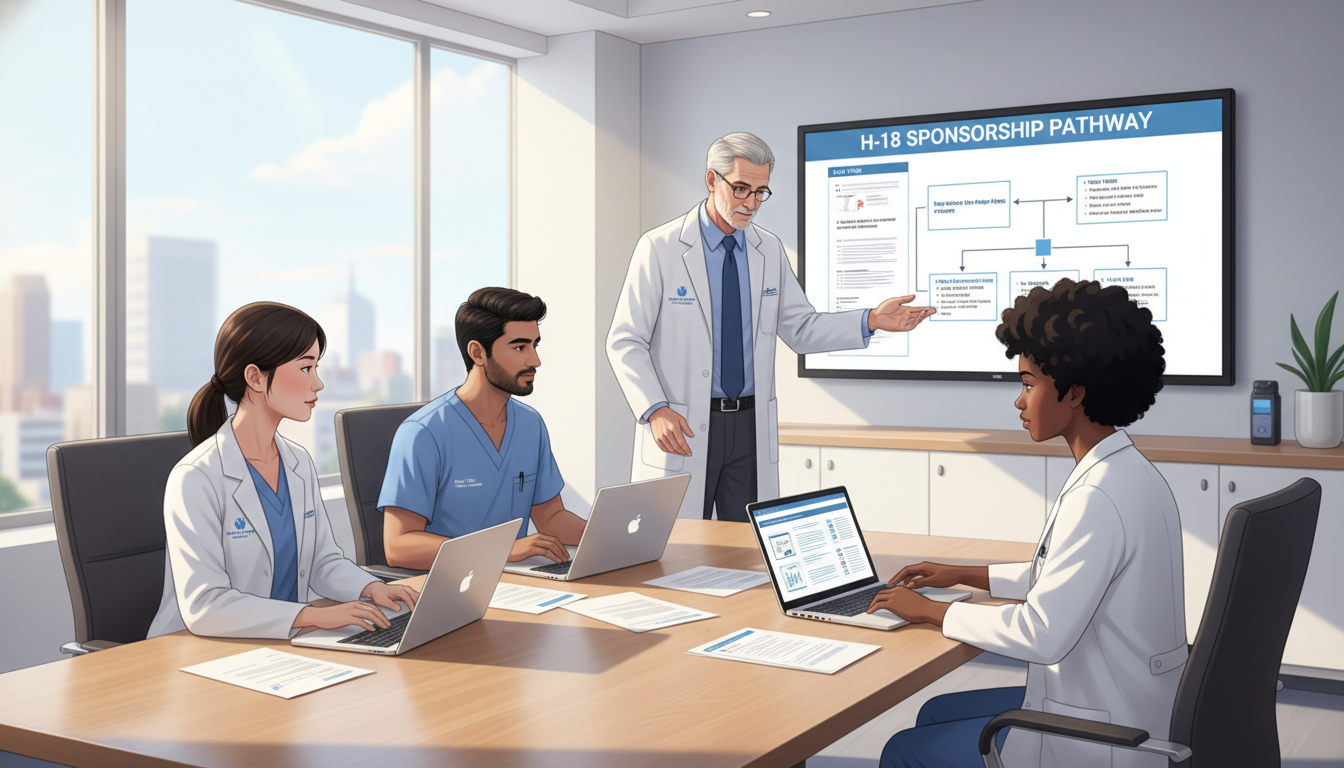
Why H‑1B Sponsorship Matters for Non‑US Citizen IMGs in Urology
For a non‑US citizen IMG interested in urology residency, understanding H‑1B sponsorship is not just “nice to know”—it can completely reshape your match strategy. Urology is already one of the most competitive specialties in the US. Layer on visa constraints, and the challenge becomes even more complex.
Many foreign national medical graduates naturally default to the J‑1 visa, which is widely used and reasonably straightforward. However, the H‑1B visa offers distinct advantages that can be especially attractive for long‑term careers in a procedural specialty like urology, where fellowship training and early practice decisions often depend on visa freedom.
This article will walk you through:
- The basics of H‑1B versus J‑1 for urology residency
- How the urology match timeline interacts with visa processing
- Identifying H‑1B residency programs and interpreting the “H‑1B sponsor list”
- Strategic steps to strengthen your application as a non‑US citizen IMG
- Practical examples of application strategies and common pitfalls to avoid
Throughout, the focus is on actionable advice tailored to international graduates seeking urology residency positions with H‑1B sponsorship.
Understanding H‑1B Sponsorship in Urology Residency
H‑1B vs J‑1 for Urology: What’s the Difference?
J‑1 visa (ECFMG-sponsored physician visa)
- Most common visa pathway for IMGs in residency.
- Requires you to return to your home country for 2 years after training (unless you obtain a waiver).
- Waiver jobs are often in medically underserved or rural areas, which may not always align with your preferred practice or fellowship options.
- Administrative process largely handled through ECFMG + program, less employer paperwork.
H‑1B visa (employer-sponsored specialty occupation visa)
- Program (hospital/university) is the direct sponsor and employer.
- Typically no 2‑year home-residency requirement, giving more flexibility for fellowships and early practice jobs.
- Requires all USMLE Steps including Step 3 to be passed before the visa petition is filed.
- Involves more institutional legal work, filing fees, and documentation—so many programs only sponsor J‑1 or avoid visas entirely.
For a non‑US citizen IMG in urology, the H‑1B path is attractive because:
- Urology often involves subspecialty fellowships (oncology, female pelvic, endourology, pediatrics). H‑1B can keep these pathways open without the complication of waivers.
- You may transition more smoothly from residency to urology practice without mandatory home-country return.
- Many academic centers that are H‑1B cap exempt can easily extend H‑1B time through fellowships or junior faculty roles.
However, the number of urology residency programs that routinely sponsor H‑1B is limited, and competitiveness is high. Your application strategy must be extremely focused and realistic.
Key Requirements and Timelines for H‑1B in Urology
The Urology Match Timeline and Why It Matters for Visas
Urology uses a separate match system (currently through the AUA/SAU and ERAS/NRMP integration), with an earlier match date than most other specialties. While the details change slightly year to year, the general structure is:
- ERAS application opens: September
- Interview season: roughly October–December
- Rank list deadline and match: usually in January
- Residency start: July 1
H‑1B processing typically involves:
USMLE Step 3 completion and reporting
- You must have passed Step 3 before the H‑1B petition filing.
- For urology, this compresses your Step 3 schedule because of the early match. Many states also require results to be reported to a US State medical board prior to visa filing.
State medical licensure or training license documentation
- Some states require at least a training license as part of the H‑1B package.
- Timelines vary widely by state and board.
USCIS H‑1B petition filing
- Academic hospitals often file under H‑1B cap exempt category (because they are affiliated with universities or nonprofit research institutions).
- This means they do not compete in the standard H‑1B lottery and can file throughout the year.
- Standard processing can take 2–4 months; premium processing (15 calendar days) is often used for incoming residents if time is tight.
Because of the early urology match, a foreign national medical graduate aiming for H‑1B should plan to complete Step 3 as early as possible (ideally by the summer or early fall before match season).
Practical Implication for Non‑US Citizen IMGs
If you want H‑1B sponsorship:
- Treat USMLE Step 3 as a pre‑requisite, not an afterthought.
- Begin exploring state board requirements for the states where you’ll apply—some require more documents from IMGs (translations, verifications, etc.).
- Ask every urology program of interest early and clearly whether H‑1B is possible and what their internal deadlines are.

How to Identify H‑1B-Friendly Urology Residency Programs
Is There an Official H‑1B Sponsor List for Urology?
There is no single official, up‑to‑date H‑1B sponsor list specifically for urology residency programs. Instead, you’ll need to piece together information from multiple sources:
- Program websites (GME or urology department pages)
- AUA/SAU program directories
- FREIDA (AMA’s residency database)
- Past resident biographies and alumni lists
- Direct email communication with program coordinators
However, certain categories of institutions are more likely to sponsor H‑1B:
- Large academic medical centers affiliated with universities
- Hospitals that already sponsor H‑1B physicians in other specialties
- Institutions clearly labeled as H‑1B cap exempt (e.g., university hospitals, nonprofit research hospitals)
Programs that routinely hire foreign-trained physicians in urology fellowships or faculty roles are also more likely to have infrastructure for H‑1B sponsorship for residents.
Reading Program Websites Critically
When you visit a residency or GME site, look for sections titled:
- “International Medical Graduates”
- “Visa Sponsorship”
- “Eligibility & Requirements”
- “Application Information”
Common visa policy wording and what it usually means:
“We sponsor only J‑1 visas”
- H‑1B not available for residency. You can safely exclude this program from your H‑1B target list unless they make an exception (rare).
“We accept only US citizens or permanent residents”
- No visa sponsorship. Not suitable for non‑US citizen IMGs.
“We sponsor J‑1 and H‑1B visas” or “H‑1B sponsorship is considered on a case‑by‑case basis”
- These should be your primary targets.
- Still confirm by email if H‑1B is truly available for PGY‑1 categorical urology residents, not just fellows or faculty.
“We sponsor J‑1 visas through ECFMG” (no mention of H‑1B)
- Ambiguous; often implies J‑1 only, but it can be worth emailing to clarify, especially if you find H‑1B usage in other departments.
Using FREIDA and Other Databases
On FREIDA:
- Filter for Urology residency programs.
- Check each program’s “Visa” section.
- Some list “H‑1B” explicitly; others only mention J‑1.
- FREIDA is not always updated annually, so verify directly with the program.
Other tools:
- Doximity Residency Navigator, Reddit, or specialty forums sometimes contain anecdotal reports from other IMGs.
- LinkedIn searches for “[Program Name] Urology Resident” can show whether current or past residents are non‑US graduates—an indirect sign that the program may be IMG and visa friendly.
Direct Outreach: Emailing Programs Effectively
A concise, professional email can clarify H‑1B viability and show your seriousness. For example:
Subject: Visa Sponsorship and Eligibility – Urology Residency Applicant
Dear [Coordinator/Program Director Name],
I am a non‑US citizen IMG interested in applying to your urology residency program. Could you please let me know whether your institution sponsors H‑1B visas for categorical urology residents, and if so, whether there are specific requirements (such as USMLE Step 3 completion by a certain date)?
Thank you very much for your time and assistance.
Sincerely,
[Your Name], MD
[Medical School, Country]
Track responses carefully to build your personal H‑1B sponsor list and prioritize those programs when deciding where to apply.
Strategic Planning: Building a Competitive Urology Application as a Foreign National
Urology is one of the highest‑stakes specialties, even for US MD seniors. As a non‑US citizen IMG seeking H‑1B, you’re competing at an even higher bar. Your goal is to offset visa concerns with unmistakable value.
Academic Metrics and USMLE Performance
Typical competitive expectations (approximate, not absolute):
- Step 2 CK: Strongly preferred in the mid‑250s+ for IMGs aiming for urology.
- Step 1: Even pass/fail, but many programs silently consider your numeric score if available; high score is a plus.
- Step 3:
- Should be passed on first attempt before rank list (preferably well before interviews).
- A strong Step 3 performance signals you are “low risk” for licensure and visa paperwork.
Multiple attempts, particularly in Step 2 or 3, can be a serious obstacle for H‑1B‑friendly urology programs, which have plenty of high‑scoring US and IMG applicants to choose from.
Clinical Experience and Letters of Recommendation
US Clinical Experience (USCE)
- In‑person sub‑internships (Sub‑I) in urology are ideal: 1–2 rotations at H‑1B‑friendly institutions if possible.
- If you cannot secure urology Sub‑Is, consider strong rotations in general surgery or related surgical specialties at academic centers.
Letters of Recommendation (LoRs)
For a urology match, aim for:- At least 2 letters from US urologists (ideally from academic programs).
- 1 additional letter from a US surgeon or internist who can speak to your clinical maturity.
- If you trained partly in your home country, you may add one senior faculty letter with a strong title, but US letters carry the most weight.
Demonstrable Interest in Urology
- Urology‑focused research, abstracts, QI projects, or conference presentations.
- Participation in urology interest groups, mentorship programs (e.g., through AUA sections).
- Clear and consistent story in your personal statement tying your experiences and goals together.
Research and Academic Productivity
Urology is research‑dense. Publications can signal:
- Persistence and follow‑through
- Ability to work in academic environments (which are often the same institutions that are H‑1B cap exempt)
- Long‑term fit for a career in academic or subspecialty urology
Actionable tips:
- Join projects early (at least 18–24 months before the match cycle).
- Focus on urology‑related topics: oncology, benign prostatic hyperplasia, kidney stones, reconstructive urology, health services research, etc.
- Use your research links to network with potential mentors at H‑1B‑sponsoring institutions.

Matching Strategy: Programs, Interviews, and Backup Plans
Constructing a Realistic Program List
As a foreign national medical graduate, your program list needs to balance:
- Visa feasibility (H‑1B vs J‑1 vs none)
- IMG friendliness
- Your competitiveness (scores, research, USCE, graduation year)
A common structure:
Core H‑1B Target Programs (Tier 1)
- 10–25 programs (depending on your profile) that explicitly or strongly suggest H‑1B sponsorship for urology residents.
- Mostly academic, university‑based centers.
Mixed Visa Programs (Tier 2)
- Programs that primarily use J‑1 but may sponsor H‑1B case‑by‑case for exceptional candidates.
- For these, you may keep an open mind about J‑1 if H‑1B is not offered.
J‑1‑Only Urology Programs (Tier 3)
- If H‑1B is your preference but not an absolute requirement, including some J‑1‑only programs significantly broadens your options.
- Consider whether you’d accept a urology position on a J‑1 over switching specialties.
Parallel or Backup Specialty (Optional but recommended)
- Many non‑US citizen IMGs planning for urology also apply to another field (e.g., general surgery, internal medicine, preliminary surgery) especially if visa or competitiveness concerns are substantial.
- For this group, consider whether an H‑1B residency in another specialty with a plan to re‑enter urology later (via research or fellowship) fits your long‑term goals.
Communicating About Visas During the Application Process
On ERAS/Applications:
- Be transparent in your application about your citizenship and visa needs.
- You typically do not need to state “H‑1B only” on your personal statement; keep it focused on your passion for urology.
- Some programs have supplemental questions specifically asking about visa needs—answer honestly.
During Interviews:
Avoid opening with visa questions, but do not wait until rank season either.
Near the end of an interview or with the program coordinator, you might say:
“As a non‑US citizen IMG, I wanted to confirm how your institution handles visa sponsorship for urology residents. Are H‑1B visas an option for incoming residents who have completed Step 3?”
Show that you’ve done your homework on timelines and requirements; this reassures programs you won’t cause preventable delays.
Understanding H‑1B Cap Exempt vs Cap Subject
Most residency and fellowship positions at US teaching hospitals are under H‑1B cap exempt status because:
- They are part of, or affiliated with, nonprofit universities or
- They are nonprofit research organizations.
Implications for you:
- You are not competing in the annual H‑1B lottery used for private employers.
- The program can file your petition whenever necessary, and USCIS can approve it outside the usual quota.
- Later, if you join a private practice urology group (cap‑subject employer), you may have to enter the cap lottery at that stage.
During residency and early fellowship years, being in an H‑1B cap exempt environment gives you significant stability and continuity, particularly if you pursue multiple fellowships or academic roles.
Practical Examples of Applicant Pathways
Example 1: Strong IMG Targeting H‑1B Only
- Non‑US citizen IMG, recent graduate, Step 2 CK 260+, Step 3 passed early with high score.
- 2 years of urology research at a major US academic center, 3 American urologist LoRs.
- Strategy:
- Apply to 20–30 urology programs known for H‑1B sponsorship.
- No parallel specialty; fully commit to urology H‑1B path.
- Communicate early with programs about Step 3 completion and visa readiness.
Outcome: This profile is competitive even in H‑1B‑sponsoring programs; real risk still exists, but this is a rational, focused strategy.
Example 2: Mid‑Tier IMG, Flexible on J‑1 or H‑1B
- Non‑US citizen IMG, Step 2 CK 245, Step 3 passed, moderate research with one urology abstract.
- 1 US urology rotation, 1 US general surgery rotation.
- Strategy:
- Apply widely to H‑1B‑friendly and J‑1‑friendly urology programs (35–50+ programs if budget allows).
- Keep an open mind on visa category—prioritize matched urology position over specific visa type.
- Consider a small parallel application to categorical general surgery or prelim positions as backup.
Outcome: Likely better odds of matching into urology overall, though maybe on J‑1. Visa trade‑offs considered acceptable.
Example 3: Late Graduate, Limited Scores, Wants H‑1B
- Graduated >5 years ago, Step 2 CK 235, Step 3 pending, minimal USCE.
- Wants strictly H‑1B urology.
- Strategy:
- First, invest 1–2 years in US research + observerships at H‑1B‑friendly institutions.
- Complete Step 3 before next application cycle.
- Consider whether another specialty with better H‑1B access may be more realistic.
Outcome: Immediate urology H‑1B match is unlikely. Medium‑term strategy can still lead to US training but may require reframing goals.
Frequently Asked Questions (FAQ)
1. Is it realistically possible for a non‑US citizen IMG to get a urology residency with H‑1B sponsorship?
Yes, but it is difficult and highly selective. A small subset of urology residency programs will sponsor H‑1B, and these programs often receive many applications from strong US MD/DOs and highly accomplished IMGs. To be competitive, you typically need:
- Excellent exam scores (especially Step 2 CK, and Step 3 passed early)
- Solid US clinical experience in urology
- Strong US urology letters of recommendation
- Research or academic productivity in urology or related areas
The more of these elements you can demonstrate, the more realistic an H‑1B urology match becomes.
2. Do I absolutely need USMLE Step 3 before applying for urology if I want H‑1B?
You can apply to urology without Step 3 completed, but if you are targeting H‑1B residency programs, it is highly advisable to:
- Complete Step 3 before interviews, or
- At least have a clear plan to take it with results available well before H‑1B filing deadlines.
Many institutions will not initiate an H‑1B petition without a passed Step 3, and tight timelines can jeopardize your start date. From a program’s perspective, a candidate who already has Step 3 is simply less risky.
3. How can I find an accurate, updated H‑1B sponsor list for urology programs?
There is no official, universal list. Instead:
- Use FREIDA to filter urology programs and review visa preferences.
- Read each program’s GME and department webpages carefully.
- Email program coordinators to confirm policies for current cycles.
- Look for signs of previous foreign‑trained residents and fellows in urology at that institution.
- Keep your own spreadsheet of programs that confirm they are willing to consider H‑1B for categorical urology residents.
This personalized “H‑1B sponsor list” will be more current and accurate than any static online list.
4. If I match urology on a J‑1, can I later change to H‑1B during residency?
Sometimes, but it is not guaranteed and can be complicated:
- A J‑1 physician generally becomes subject to a 2‑year home residency requirement.
- Switching from J‑1 to H‑1B often requires a J‑1 waiver, which is competitive and usually tied to working in certain underserved areas after training, not during residency.
- Changing status mid‑residency can be legally complex and may not be supported by the GME office.
If your primary goal is long‑term flexibility and avoiding the home requirement, you should plan your visa strategy before matching, not after.
For a non‑US citizen IMG pursuing urology, H‑1B sponsorship is one of the most challenging but potentially rewarding pathways. By understanding the visa mechanics, targeting the right institutions, and building a truly exceptional application, you can maximize your chances of entering this highly competitive field with the visa support that best aligns with your long‑term career goals.