
The narrative that “IMGs can only match in a handful of desperate specialties” is obsolete. The data no longer supports it.
If you actually read NRMP datasets, ECFMG reports, and specialty match summaries instead of repeating folklore in WhatsApp groups, you see a different picture: some specialties are clearly trending more welcoming to IMGs, others are quietly closing doors, and a few are bifurcating into IMG-heavy community tracks and IMG-light academic cores.
Let me walk you through what the numbers say, not what people say.
1. The Big Picture: Where IMGs Actually Match
Start with the hard numbers. The NRMP “Results and Data” reports show consistent patterns over the last decade:
- IMGs (US and non-US) account for roughly 22–25% of all matched PGY-1 positions.
- But their distribution is wildly uneven by specialty. In some fields, IMGs make up under 5% of matched applicants; in others, they are 40–60% of the incoming class.
Here is a simplified snapshot using recent trends (rounded, combined US-IMG + non-US IMG as “IMG” to focus on friendliness):
| Specialty | IMG Share of Matched PGY-1s |
|---|---|
| Internal Medicine (Categorical) | 45–50% |
| Family Medicine | 35–40% |
| Pediatrics | 15–20% |
| Psychiatry | 25–30% |
| Neurology | 35–40% |
| General Surgery (Categorical) | 10–15% |
No, these are not exact point-estimates for a single year. They are consistent ranges across multiple recent Match cycles. That is the important part for trend analysis.
Now, look at how total IMG matches have shifted:
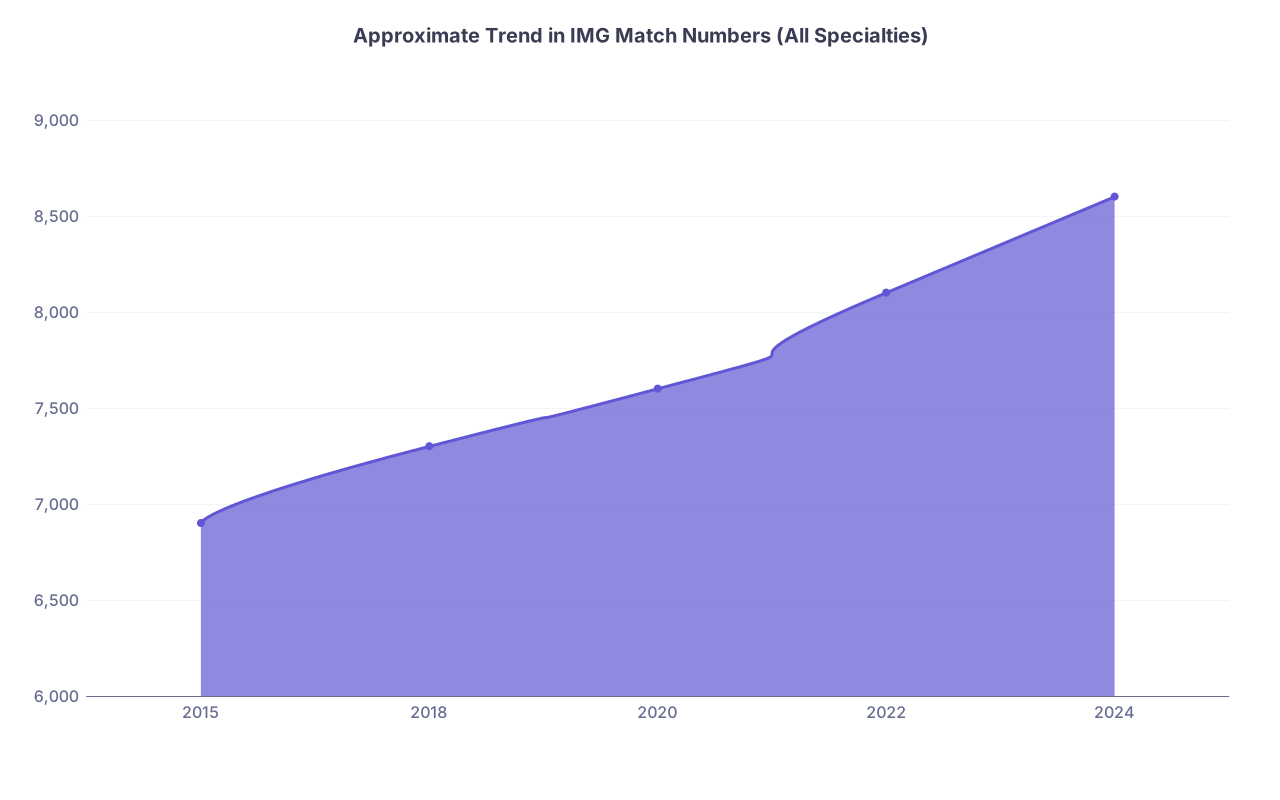
| Category | Value |
|---|---|
| 2015 | 6900 |
| 2018 | 7300 |
| 2020 | 7600 |
| 2022 | 8100 |
| 2024 | 8600 |
Two signals from that chart:
- Absolute IMG matches are rising.
- The growth is not uniform. It is led by a cluster of specialties with workforce shortages and aggressive expansion of community programs.
So the real question for you is not “Can IMGs match?” but “Which specialties are clearly trending more open – and which are tightening?”
2. Clear Winners: Specialties Getting More IMG-Friendly
2.1 Internal Medicine: The Core IMG Engine
Internal Medicine (categorical) is still the backbone for IMG recruitment in the US. That is not changing. What is changing is the volume and structure.
Key signals from recent NRMP/ACGME data:
- IM categorical positions have expanded significantly over the last decade, driven heavily by community and newer university-affiliated programs.
- A substantial percentage of that growth is filled by IMGs, often over 50% in some programs.
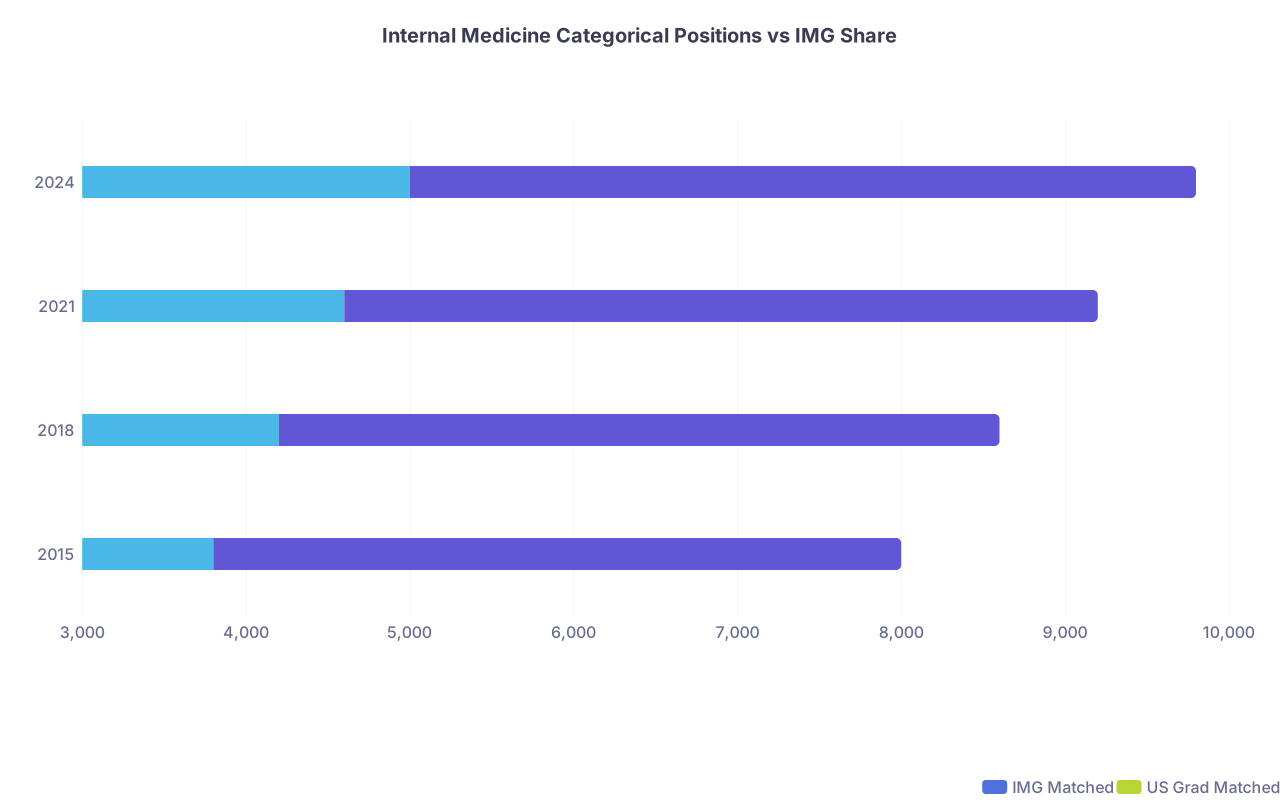
| Category | IMG Matched | US Grad Matched |
|---|---|---|
| 2015 | 3800 | 4200 |
| 2018 | 4200 | 4400 |
| 2021 | 4600 | 4600 |
| 2024 | 5000 | 4800 |
What the stacked bar really tells you:
- Total positions increase over time.
- IMG numbers rise in parallel. Not being squeezed out. Riding the expansion.
Why IM is increasingly welcoming:
- Aging US population and chronic disease burden are pushing demand for hospitalists and outpatient internists.
- Subspecialty pipelines (cards, GI, heme/onc, pulm/crit) rely on a broad IM base. Many fellowships know that the IM workforce is heavily IMG-driven.
- Many community and safety-net hospitals rely on IMG-heavy residencies for service coverage.
Trend verdict: Internal Medicine is not just “IMG-friendly.” It is structurally dependent on IMGs and becoming more so, especially outside the most elite academic centers.
2.2 Psychiatry: One of the Fastest-Warming Specialties
Psychiatry is where the growth signal is almost undeniable.
Look at three metrics:
- Total positions: increased significantly in the last 10 years.
- US seniors: rising interest but not enough to meet demand.
- IMG share: stable to increasing, especially in community and hybrid programs.
Approximate trend:
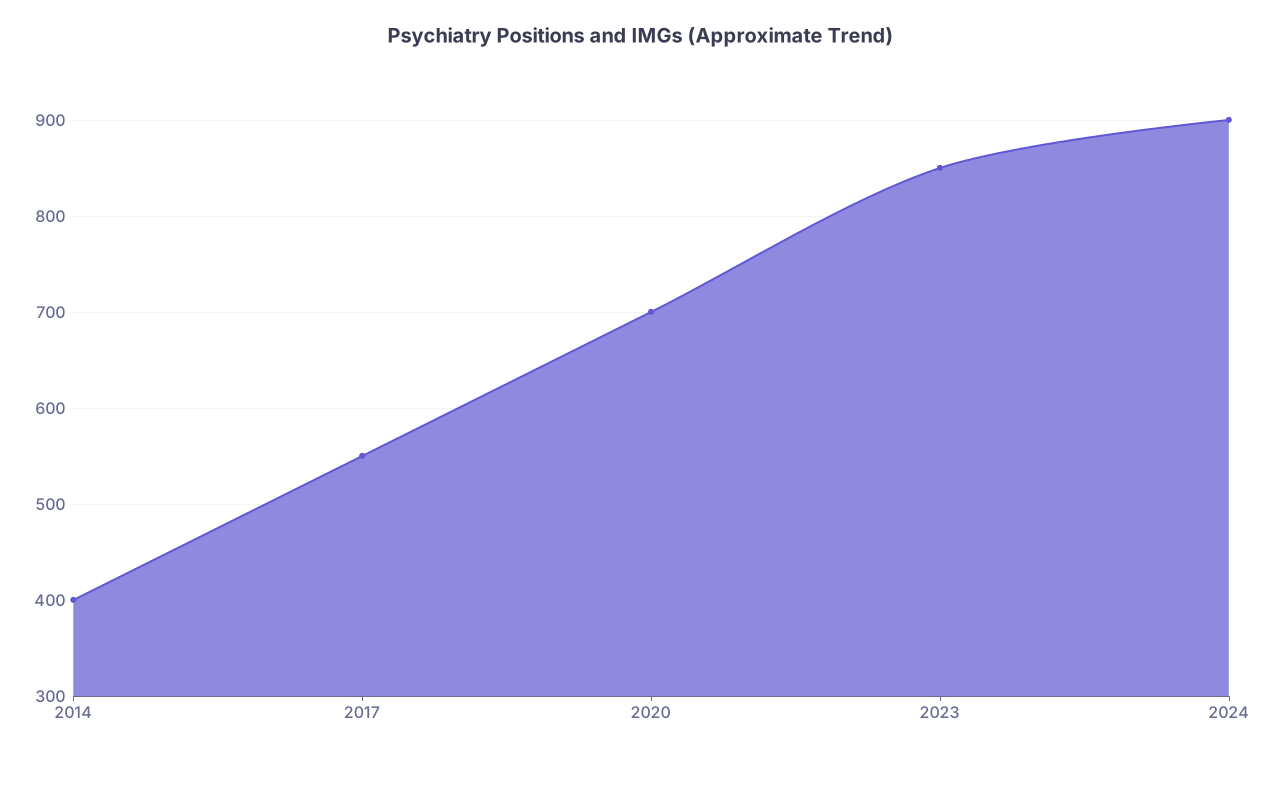
| Category | Value |
|---|---|
| 2014 | 400 |
| 2017 | 550 |
| 2020 | 700 |
| 2023 | 850 |
| 2024 | 900 |
Here, the shaded area represents IMG matches in psychiatry. The values are approximate IMG match counts and clearly rising.
Why this matters:
- Massive shortage of psychiatrists, especially in rural and underserved areas.
- Significant increase in residency positions, but US MD/DO interest still does not fully saturate supply.
- Programs that historically matched mostly US grads are now opening doors to well-qualified IMGs, provided strong Step scores and demonstrated interest (psych rotations, research, relevant LORs).
Trend verdict: Psychiatry has shifted from cautiously IMG-accepting to actively IMG-recruiting in many regions, especially in states with severe workforce gaps (Midwest, South).
2.3 Neurology: Quietly Becoming an IMG Stronghold
Neurology used to be niche and relatively less popular. That is changing, and IMGs are a major part of the workforce increase.
Reality:
- IMGs already make up ~35–40% of many neurology match classes.
- Several large academic centers with strong stroke/epilepsy/neurocritical care programs recruit IMGs aggressively.
Why the opening continues:
- Explosion in neuro-interventional, stroke systems of care, and neurocritical care units.
- Rising prevalence of neurodegenerative diseases with aging population.
- Limited number of US grads who want a cognitively heavy, moderately paid, often complex-special-needs field.
Trend verdict: Neurology is not as saturated as IM and not as brutally test-score-driven as derm or plastics. Statistically one of the highest-yield “specialist” options if you are an IMG with solid scores and decent research.
2.4 Family Medicine: Stable but Still a Workhorse for IMGs
Family Medicine has been IMG-friendly for years. The interesting part is how it is evolving.
Recent patterns show:
- FM positions have grown, but US MD/DO interest also rose modestly.
- IMG share remains high (often 35–40% of matched positions), especially in community, rural, and unopposed programs.
Family Medicine is not exploding in IMG-friendliness the way Psychiatry is, but it is holding a consistently open stance. Especially:
- Programs in Midwest, South, and less urban regions.
- Sponsoring more visas because they urgently need long-term primary care physicians.
Trend verdict: Not a “new” welcoming specialty, but still a core high-probability pathway for IMGs, especially those willing to work in underserved settings.
3. Mixed Signals: Specialties Where IMG Access Depends Heavily on Context
3.1 Pediatrics: Stable but Relatively US-Focused
Pediatrics sits in the middle. You can match as an IMG, but the field is more US grad-dominant than IM, FM, or Neurology.
Data patterns:
- IMG share in peds tends to hover around 15–20%.
- Positions are growing, but so is US MD/DO interest.
- Some community and newer programs are noticeably IMG-friendly; many big-name children’s hospitals remain heavily US-graduate focused.
Who does well:
- IMGs with strong scores, US clinical experience in pediatrics, and at least some academic output.
- Those targeting community or regional academic programs rather than top 10 children’s hospitals.
Trend verdict: Slightly more welcoming over time due to position expansion, but not a “growth hotspot” for IMGs. More of a stable mid-tier opportunity.
3.2 General Surgery (Categorical): Slowly Improving, Still Tough
The brutal truth: General Surgery categorical is still a difficult match for IMGs. But not impossible, and the data suggests a slow, cautious thaw.
Signals:
- A small but real increase in IMG matches in general surgery over the past decade.
- Many IMGs still enter through prelim pathways and then convert to categorical.
- US MD/DO seniors still dominate categorical slots, especially in big academic centers.
There is a quiet structural shift:
- Newer, community-centric surgery programs sometimes recruit IMGs more openly.
- Programs with heavy service burden and trauma call are more likely to use IMG residents to keep coverage stable.
Trend verdict: Slight upward trend in openness, but still a high-risk option. You need strong scores, substantial surgery exposure, and often US-based research. This is not an “IMG-friendly” specialty in the same way as IM or psych, even if the numbers have improved.
4. Clear Losers: Specialties Tightening or Remaining Hostile
Let’s be blunt. Some specialties are not trending friendlier. At all.
4.1 The Hyper-Competitive Electives
Dermatology, plastic surgery, neurosurgery, ENT, orthopedics, radiation oncology. If you are an IMG, the odds are brutally low unless you have:
- Top-tier Step 2 scores
- US-based, high-quality research
- Strong connections / mentors in the US system
- Often, visa independence (green card / US citizen)
NRMP data year after year shows:
- Single-digit numbers of IMGs matching in many of these specialties.
- Many programs that do not even consider IMG applications.
Trend verdict: Static or even less open over time, especially as US MD/DO interest intensifies and total spots remain relatively limited. Planning on these as an IMG is more lottery than strategy.
4.2 Emergency Medicine: Becoming More Volatile and Less Predictable
Emergency Medicine used to be increasingly IMG-accepting in certain regions. Then the market shifted.
Signals from recent cycles:
- Over-expansion of EM programs → sudden oversupply of residents.
- Some programs struggled to fill, then adjusted strategies.
- Increasing anxiety among US grads about job market saturation.
What happens when a field sees job market uncertainty?
- Programs become more conservative and may bias towards US MD/DOs.
- Some IMG-heavy EM programs still exist but are very region-specific.
Trend verdict: Not a reliable growth area for IMGs. Volatile, with pockets of opportunity but an overall trend toward caution.
5. Visa Sponsorship and Policy: The Hidden Gatekeeper
You can have a specialty that is numerically IMG-friendly but practically inaccessible if programs stop sponsoring visas. That is the under-discussed filter.
Here is how visa behavior actually breaks down in practice:
| Program Type | J-1 Sponsorship | H-1B Sponsorship |
|---|---|---|
| Big-name academic IM/Neuro/Psych | Usually yes | Selectively |
| Community IM/FM in underserved areas | Almost always | Sometimes |
| Highly competitive (Derm, Ortho, etc) | Rare | Very rare |
| Rural or safety-net Psychiatry | Yes, aggressively | Occasionally |
Correlations I see repeatedly:
- Programs in physician-shortage areas (FM, IM, Psych, Neuro) sponsor J-1 enthusiastically and increasingly consider H-1B for strong candidates.
- Programs in oversupplied or “prestige” specialties often either ban IMGs or restrict visas entirely.
If you want something actionable:
- Filter programs explicitly by visa policy and historical IMG match; both are predictive.
- A program that matched >30% IMGs over several cycles and advertises J-1 support is statistically less likely to suddenly shut the door.
6. Where IMGs Should Actually Focus: Data-Driven Targeting
Let me translate all of this into strategy. If you are an IMG looking at the next 2–5 Match cycles, here is where the data suggests your probabilities are best, assuming solid but not insane metrics (Step 2 CK ≥ 240, decent USCE, no major red flags).
Highest-Yield Growing “Welcoming” Specialties
Internal Medicine (Categorical)
- Broadest, deepest IMG market.
- Strong trends in position growth and sustained IMG reliance.
Psychiatry
- One of the strongest upward trends in IMG recruitment due to workforce shortages.
- Good long-term job market.
Neurology
- High IMG share, continued growth.
- Strong fit for academically inclined IMGs interested in sub-specialization.
Family Medicine
- Stable, high IMG representation.
- Most welcoming in underserved regions.
Moderate-Yield, Context-Dependent
Pediatrics
Reasonable but not explosive growth in IMG friendliness. You will need stronger profiles and a smart list.General Surgery (Categorical)
Small upward movement, but still a high-risk play. You need near top-tier stats to be competitive.
Low-Yield for IMGs (Unless You Are an Outlier)
- Dermatology, Plastic Surgery, Neurosurgery, Ortho, ENT, Radiation Oncology, integrated IR.
The numbers are tiny. Every year. IMGs do match, but you should treat these as moonshots, not your main plan.
7. Geographic Effects: Where “Welcoming” Really Means Something
The specialty story is only half the equation. Geography modifies IMG openness dramatically.
Patterns I see in program rosters and match lists:
- Northeast and Midwest community programs: Often heavily IMG-populated across IM, FM, Psych, Neuro.
- Deep South and certain central states: High need, fewer local medical schools → more likely to sponsor visas and recruit IMGs.
- West Coast and some elite Northeast corridors: More US grads competing locally, higher competition, fewer IMG slots except in specific safety-net programs.
Do not underestimate this. An “IMG-friendly” specialty in a large coastal city can still be competitive and visa-stingy. The same specialty in a mid-sized Midwestern city can be aggressively recruiting IMGs every year.
8. Putting It All Together: Data-Backed Application Tactics
If you want to act like a data analyst of your own career rather than a rumor collector, here is what you do:
- Pull at least 3 years of NRMP “Results and Data” for your target specialties. Look at IMG match counts and percentages, not just raw positions.
- Cross-reference program websites and residency explorer-type tools to see:
- Historical IMG percentages per program
- Visa policies stated explicitly
- Cluster specialties into:
- Primary target (where data shows high IMG intake and growth)
- Reach (where IMG access is possible but limited)
- Lottery (where IMG numbers are tiny and concentrated in a few programs)
Then build your ERAS list by:
- Making 60–80% of your applications in specialties/programs with documented IMG-friendly trends (IM, Psych, Neuro, FM, and selectively Peds).
- Limiting “prestige” or hyper-competitive choices to a realistic minority.
This is what high-match-rate IMGs do in practice. They are not guessing. They are reading the trends.
FAQ (5 Questions)
1. Which single specialty is currently the most welcoming to IMGs overall?
Internal Medicine categorical. The proportion and absolute number of IMGs in IM are both high and rising. Many programs have majority-IMG resident bodies, especially in community and safety-net hospitals. The specialty’s workforce dependence on IMGs is structural, not temporary.
2. Has Psychiatry really become more IMG-friendly recently, or is that just anecdotal?
The data backs it. Psychiatry positions have expanded significantly, while US MD/DO interest did not keep pace with the growth. As a result, IMG match counts in Psychiatry have risen across multiple NRMP cycles, and you see more IMG-heavy classes in community and regional academic programs.
3. Are there any surgical specialties that are realistically attainable for IMGs?
General Surgery categorical is possible but difficult; the trend is slightly more open, especially in community programs. Other surgical subspecialties (orthopedics, plastics, neurosurgery, ENT) have extremely low IMG match numbers each year. If you aim for surgery as an IMG, General Surgery categorical or prelim-to-cat routes are the only statistically defensible options for most candidates.
4. How does being a US-IMG (Caribbean graduate) versus a non-US IMG affect specialty openness?
Program directors consistently rate US-IMGs slightly more favorably than non-US IMGs, especially in borderline-competitive specialties. In “growth” specialties like IM, Psych, and Neuro, both groups match in large numbers, but US-IMGs may have easier access to some mid-tier programs. In hyper-competitive specialties, both groups face very low odds.
5. If I need a visa, should I still consider specialties like Neurology or Psychiatry, or stick to Internal Medicine and Family Medicine only?
You should absolutely consider Neurology and Psychiatry. Many Neurology and Psychiatry programs in workforce-shortage regions sponsor J-1 visas and sometimes H-1B, especially for strong candidates. Internal Medicine and Family Medicine have the broadest visa support, but Neurology and Psychiatry are clearly in the “welcoming and growing” cluster for visa-dependent IMGs.
Key takeaways: Specialty openness for IMGs is not uniform, and the data shows clear growth in IMG recruitment in Internal Medicine, Psychiatry, Neurology, and Family Medicine, with Pediatrics moderately open and most surgical/elective subspecialties remaining highly restrictive. Use actual match and visa data, not online folklore, to choose where you focus your applications.