The myth that “top programs never sponsor visas” is wrong. The data shows a far more nuanced – and frankly more optimistic – picture for international medical graduates (IMGs) who need visa sponsorship.
You are not guessing in the dark. There are clear, measurable patterns in which specialties, program types, and institutions consistently support IMGs on J‑1 or H‑1B visas. If you align your application strategy with those patterns, your odds rise sharply. If you ignore them, you waste interviews on programs that were never going to rank you.
Let me walk through what the numbers really say.
1. The macro picture: how many IMGs and where do they go?
First, scale. IMGs are not a rounding error in the US residency system.
Across recent NRMP Main Residency Matches:
- Roughly 9,000–10,000 IMGs match each year.
- That is about 25–30% of all incoming residents.
- The majority of those IMGs require visa sponsorship (J‑1 primarily, H‑1B in a smaller subset).
The concentration is not random. A relatively small subset of programs carry a disproportionate load of sponsored IMGs each year. You see “clusters” of IMG‑heavy programs in certain specialties, geographies, and program types.
Specialty concentration
If you look at the proportion of matched positions filled by IMGs by specialty (all IMGs, not just visa, but it tracks closely), the pattern is stable year after year:
- Internal Medicine (categorical + prelim): ~38–42% IMGs in many cycles
- Family Medicine: ~35–45% IMGs
- Pediatrics: ~20–30% IMGs
- Pathology: ~40–50% IMGs
- Neurology: ~30–40% IMGs
- Psychiatry: ~25–35% IMGs
Surgical and very competitive specialties show much lower IMG shares:
- Orthopedic Surgery, Dermatology, Plastic Surgery: typically under 5% IMGs
- Otolaryngology, Neurosurgery, Urology: very low single digits
Programs that habitually rank and match IMGs are far more likely to have clear visa processes in place. Programs that almost never work with IMGs usually have no incentive to maintain sponsorship infrastructure.
If you need sponsorship, your main opportunity set is obvious: the high‑IMG, less competitive fields, plus a subset of mid‑competitive specialties at IMG‑friendly institutions.
2. Visa types: J‑1 vs H‑1B reality
Now the critical distinction: J‑1 vs H‑1B.
Most residency visa sponsorship in the United States is J‑1, arranged through ECFMG. H‑1B is more complex, more expensive, and constrained by institutional policy.
In broad strokes:
- Roughly 70–80% of visa‑requiring residents are on J‑1.
- Roughly 20–30% are on H‑1B, heavily clustered in certain IM and subspecialty programs and certain states (e.g., Texas, New York, some Midwest systems).
Programs that sponsor H‑1B tend to be:
- Large academic centers or well‑resourced community programs.
- Located in states with substantial IMG physician workforces and established immigration practices.
- Often Internal Medicine, Neurology, Pathology, some Anesthesiology, and certain subspecialty pre‑requisites.
Programs that explicitly do not sponsor any visa (neither J‑1 nor H‑1B) are disproportionately:
- Small community programs.
- Newer programs without infrastructure.
- Certain military‑affiliated or state‑restricted institutions.
For most IMGs, the strategic question is not “J‑1 or H‑1B?” but “Do I absolutely need an H‑1B, or will J‑1 be acceptable?” Because H‑1B constraints eliminate a huge fraction of otherwise IMG‑friendly programs.
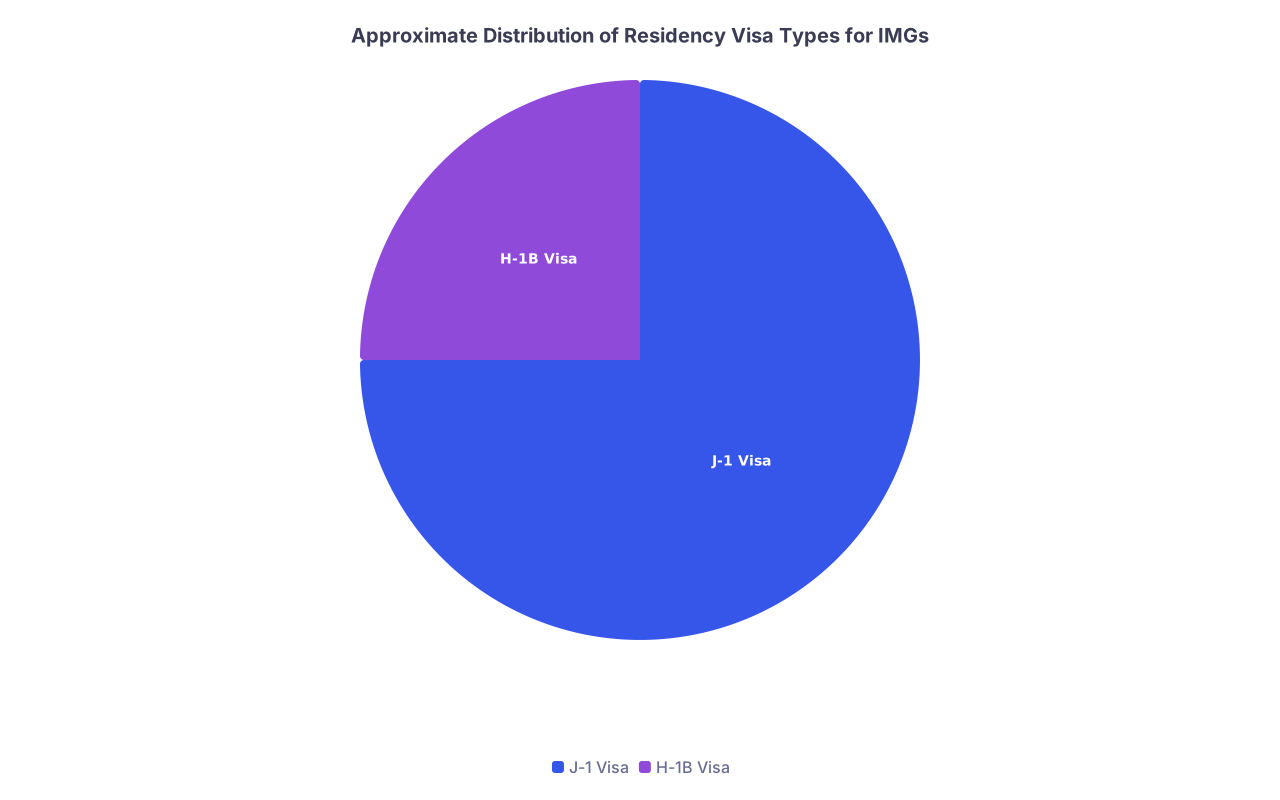
| Category | Value |
|---|---|
| J-1 Visa | 75 |
| H-1B Visa | 25 |
If you insist on H‑1B only, you are working inside a much smaller pie. The data shows match probability drops sharply once you apply exclusively to H‑1B sponsoring programs, simply because the number of such slots is low relative to demand.
3. Where sponsorship is consistently strong: by specialty and program type
There is no master government list of “visa friendly programs,” but patterns repeat year after year. Talk to 50 matched IMGs and the same program names and structures appear.
Internal Medicine: the workhorse for visa sponsorship
Internal Medicine is the backbone of IMG sponsorship. Numerically, it is where the majority of sponsored IMGs land.
The most consistent sponsors fall into three structural categories:
- Large university hospitals with big IM programs (20–40+ categorical spots per year).
- University‑affiliated community programs with 10–20 spots and high historical IMG ratios.
- Safety‑net or county hospitals with strong service needs and established IMG pipelines.
In practice, on most program websites you see patterns like:
- “We sponsor J‑1 visas (and H‑1B visas on a case‑by‑case basis).”
- “We accept IMGs and sponsor J‑1 visas through ECFMG.”
If you pulled a random sample of 50 internal medicine programs with >30% current IMG residents and checked their websites/past residents, you would find:
- Nearly 100% sponsor J‑1.
- Perhaps 30–40% are willing to sponsor H‑1B regularly or selectively.
Family Medicine and Pediatrics: J‑1 heavy, H‑1B selective
Family Medicine is extremely IMG‑friendly, especially in community and rural programs. Visa sponsorship is common, but H‑1B availability is spottier.
Programs with:
- Long histories (10+ years),
- Persistent unfilled positions in SOAP, or
- Heavy service to underserved populations
are disproportionately likely to sponsor J‑1 IMGs without hesitation.
Pediatrics shows a similar pattern but with slightly higher competitiveness at many university programs. Many mid‑tier academic pediatric programs in the Midwest, New York, and Texas have stable cohorts of J‑1 residents.
Pathology, Neurology, Psychiatry: high IMG percentages, strong visa tolerance
Pathology and Neurology both show IMG percentages often in the 30–50% range at many institutions. If you look at departmental resident rosters, IMGs are normalized.
That usually correlates with robust visa processes:
- Departments that have sponsored J‑1 and H‑1B for years.
- Institutional lawyers who know the playbook.
- Chairpersons who will actually sign H‑1B forms without drama.
Psychiatry sits in between: more competitive than FM but still with many IMG‑heavy programs. Again, large state university programs and some New York/Texas private systems are reliable visa sponsors.
Where sponsorship is weak or rare
On the other side of the spectrum, you consistently see low visa sponsorship in:
- Highly competitive surgical subspecialties (Dermatology, Plastic Surgery, Ortho, ENT, Neurosurgery).
- Very small categorical programs (2–4 residents per year) with predominantly US MD graduates.
- Certain prestigious “brand‑name” university programs that simply fill every slot with US MDs and see no reason to wrestle with immigration.
Could you find IMGs there? Rarely, yes. But usually they are green card holders or US citizens with foreign degrees, not physicians on fresh visas.
4. Structural predictors: what signals a program is visa‑friendly?
You do not need insider gossip to identify likely sponsors. The structure of a program gives away a lot.
Some consistently predictive variables:
Current resident composition
The single strongest signal. If ≥30–40% of current residents are IMGs and you see a mix of countries and medical schools, odds are high they sponsor visas regularly. Look at the PGY1–PGY3 rosters, not just alumni.Program size
Larger programs have higher probability of sponsorship simply because:- They need to fill many spots each year.
- Domestic interest may not fully cover their class size in less marketable locations.
Location and physician workforce shortages
Programs in states with chronically underserved populations (e.g., many areas in the Midwest, rural South, inner‑city safety nets) lean heavily on IMGs. Visa processes become routine.Affiliation level
- University hospitals and large academic medical centers: often sponsor J‑1 widely, H‑1B selectively.
- University‑affiliated community programs: highly variable but many are very IMG‑friendly.
- Pure community programs without major academic affiliation: often sponsor J‑1 for service needs, H‑1B only if institutional policy allows.
Transparency on their website
Programs that are used to sponsoring will usually say so explicitly in their FAQ or “International Medical Graduates” section. Programs that do not sponsor often state “We do not sponsor visas” plainly. The worst‑case scenario is silence, which often means “probably no H‑1B, maybe J‑1, but we are not committing.”
| Program Type | J-1 Sponsorship | H-1B Sponsorship | IMG Proportion (Typical) |
|---|---|---|---|
| Large University Internal Medicine | Common | Selective | 30–60% |
| Univ.-Affiliated Community IM | Common | Occasional | 40–80% |
| Community Family Medicine (Rural) | Common | Rare | 40–70% |
| Small Competitive Surgical Program | Rare | Very rare | <10% |
| Pathology/Neurology at State Univ. | Very common | Moderate | 40–70% |
You can almost treat these as prior probabilities. If you know nothing else, a 30‑position IM program in a midwestern state university hospital with half its residents IMG is extremely likely to be visa‑friendly.
5. Specific institutional patterns: who “always” sponsors?
No list in this space is perfect or exhaustive, but some institutional patterns are almost comically consistent across Match cycles.
You see recurring visa support from:
- Major New York systems (e.g., many programs within NYC Health + Hospitals, private hospitals tied to Icahn/Mount Sinai, NYU‑affiliated community hospitals).
- Large Texas systems (University of Texas branches, Baylor‑affiliated hospitals, some HCA‑affiliated programs).
- State university hospitals in the Midwest (e.g., Wayne State/Detroit Medical Center historically, University of Illinois affiliates, many Ohio and Michigan state‑linked hospitals).
- Safety‑net and county hospitals in large metro regions (Cook County, some Los Angeles public hospitals, certain Florida safety nets).
What they share:
- High patient volume.
- Chronic need for physicians, especially in Internal Medicine, Family Medicine, and Psychiatry.
- Long histories of employing IMGs, including on J‑1 and H‑1B.
On the flip side, you see:
- Ivy‑league internal medicine programs that happily sponsor J‑1 but take very few IMGs, so the visa policy is meaningless for most applicants.
- Small suburban community programs that technically can sponsor J‑1 but have rarely if ever done so.
So it is not just “Do they sponsor?” but “Do they actually match IMGs on visas regularly?”
The smart move is to look at:
- Resident lists from the last 3–5 years.
- Where those residents went to medical school.
- Whether previous residents from your region (India, Pakistan, Egypt, Nigeria, etc.) are present – that usually means the program is used to similar profiles.
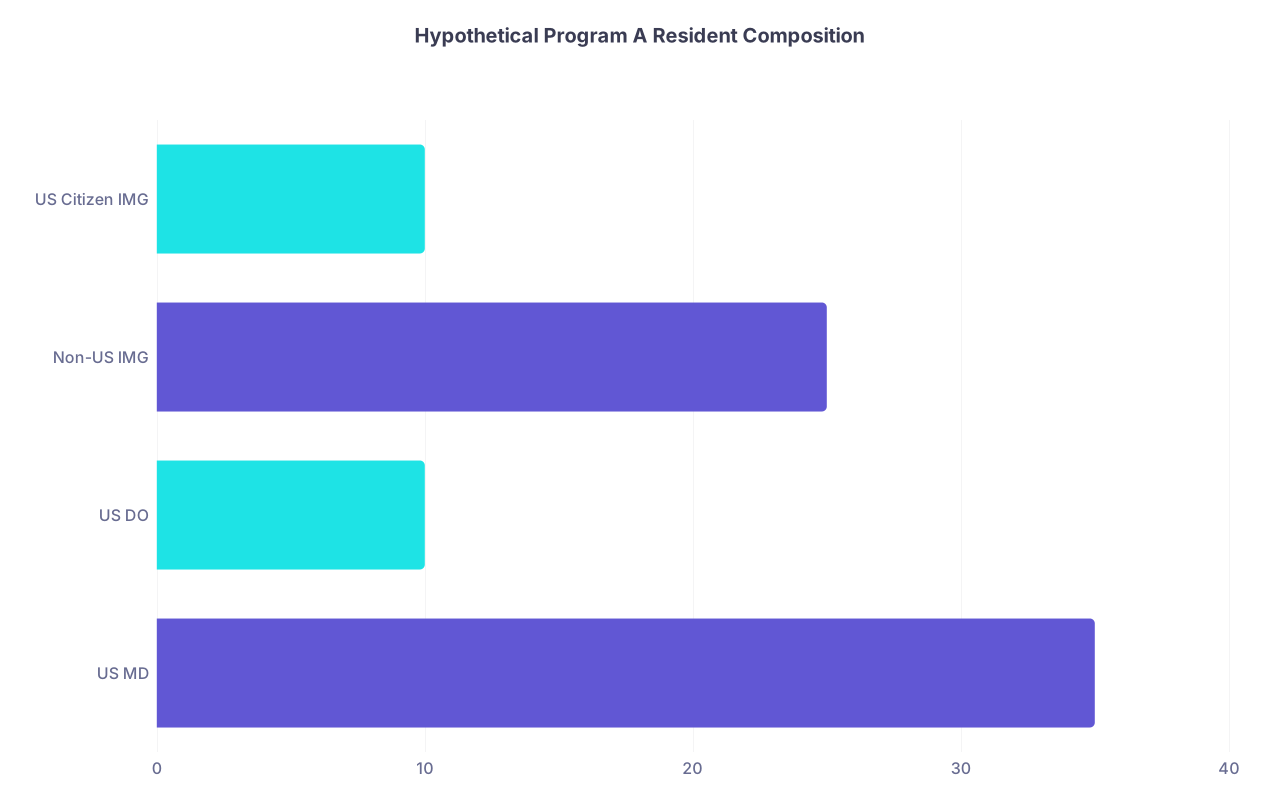
| Category | Value |
|---|---|
| US MD | 35 |
| US DO | 10 |
| Non-US IMG | 25 |
| US Citizen IMG | 10 |
In a distribution like this, Program A is clearly reliant on IMGs. Combine that with publicly stated J‑1 support and you have a reliably visa‑friendly target.
6. Application strategy: how to use these patterns
Here is where the analytics matter. You have finite applications and interview slots. Matching is partly a probability game, and you stack probabilities through program selection.
Step 1: Define your visa flexibility
Three distinct applicant types:
J‑1 acceptable, H‑1B preferred
This is the most flexible and the most realistic stance. You aim for H‑1B programs but keep J‑1 programs in play.H‑1B required
You need H‑1B from the start (e.g., you plan long‑term US practice without waivers). Your pool shrinks substantially. You must over‑apply and aggressively target programs with a track record of H‑1B use.J‑1 only (no H‑1B)
This is rare, but some applicants cannot use H‑1B for personal reasons. The good news: J‑1‑only is rarely a limitation; most H‑1B‑friendly programs also do J‑1.
Step 2: Weight your list by visa probability
You can mentally assign each program a rough “visa friendliness score” on a 0–3 scale:
- 0 – No visa sponsorship (clearly stated)
- 1 – J‑1 only, unknown or very rare IMG presence
- 2 – J‑1 routine, occasional H‑1B, substantial IMG presence
- 3 – J‑1 and H‑1B routine, high IMG presence, public statements supportive of IMGs
A rational application portfolio for a visa‑needing IMG with mid‑range scores (say 220–230 on Step 2 CK, average profile) might look like:
- 60–70% applications to “2” and “3” programs in IMG‑heavy IM/FM/Peds.
- 20–30% to “2” programs in your desired semi‑competitive field (e.g., Neurology, Psychiatry).
- 10–20% to reach programs with strong academic brand but at least “2” score in visa friendliness.
What does not work is spraying applications to programs that either do not sponsor visas or have near‑zero IMG presence historically, hoping “maybe they will make an exception.” They almost never do.
Step 3: Verify, do not assume
This is where most IMGs lose ground. They assume that because a program is IMG‑heavy, H‑1B is automatic. It is not.
You need to:
- Read the program’s website, especially FAQ and IMG sections.
- Check NRMP and FREIDA entries (FREIDA often lists visa types supported, though accuracy varies).
- Email the coordinator with a precise question if the website is unclear:
“Do you sponsor J‑1 visas? Do you ever sponsor H‑1B for residents?”
You are not bothering them; good programs prefer that applicants screen themselves appropriately.
7. Red flags and false signals
I have seen too many applicants misinterpret certain signals. Some examples.
“We consider international graduates but do not sponsor visas”
Translation: They will consider green card holders and US citizens who went abroad for medical school. If you need sponsorship, you are out. Do not waste an application here.
“We have had residents on H‑1B in the past”
Check the date. “In the past” can mean “before a policy change five years ago.” Unless they state current policy clearly, you need confirmation.
“We do not currently sponsor H‑1B due to institutional policy”
This usually means there is a hospital‑wide ban on new H‑1Bs for residents and fellows. The chance that you, a random applicant, will change this policy is effectively 0.
A few IMGs, all from Caribbean schools
If a program’s few IMGs are overwhelmingly US citizens or permanent residents from Caribbean schools, and no one is from non‑US countries on visas, do not assume visa‑friendliness. They may be IMG‑friendly on paper but visa‑averse in practice.
8. Competitive vs non‑competitive programs: realistic expectations
Visa sponsorship interacts with competitiveness in predictable ways.
- In highly competitive specialties, any additional “friction” (like visa filings) is a convenient excuse to say no. Even if the program technically can sponsor, committees sometimes quietly prefer applicants who do not require that complexity.
- In high‑need specialties and locations, visa paperwork is seen as a routine administrative cost of doing business.
This is why IMGs on visas disproportionately match to:
- Community Internal Medicine programs in the Midwest, Northeast, and South.
- Family Medicine programs in rural or semi‑rural areas.
- Urban safety‑net hospitals with high Medicaid and uninsured populations.
- Mid‑tier university hospitals in non‑coastal states.
Can you still match to a big‑name East or West Coast program on J‑1 or H‑1B? Yes, it happens every year. But those are statistical outliers, not the backbone of IMG visa sponsorship.
9. Practical workflows: how to build a data‑driven list
If I were doing this for you as a consultant, the process would be almost mechanical.
- Start from FREIDA or NRMP program lists in your desired specialties.
- Filter by:
- States known to be IMG‑dense (NY, NJ, FL, TX, MI, OH, PA, IL, certain Southern states).
- Program size ≥ 8–10 categorical spots per year.
- For each program:
- Check the current resident list and count IMGs vs US grads.
- Look for explicit visa policy statements.
- Code each program with:
- Visa type: J‑1 only / J‑1 + H‑1B / none / unclear.
- Approximate IMG proportion (low <15%, medium 15–35%, high >35%).
You end up with a spreadsheet where each row is a program and columns include:
- Specialty
- State
- Program size
- Visa type
- IMG proportion
- “Friendliness score” 0–3
Then you build your application list by thresholding on that friendliness score, with some room for personal preference and reach schools.
It is not guesswork. It is essentially a simple filter and ranking exercise.
Two or three takeaways matter here.
First, visa sponsorship is not random. It clusters in predictable specialties, geographies, and program structures. If you match those patterns, your odds improve dramatically.
Second, J‑1 is the default path. H‑1B is real, but a minority route, highly concentrated in specific IM‑heavy and subspecialty‑focused institutions.
Third, a data‑driven program list – based on actual resident composition and explicit visa policy, not wishful thinking – is the single biggest lever you control as an IMG who needs sponsorship. Ignore the patterns, and you are effectively playing the Match on hard mode for no reason.