The biggest myth IMGs believe about “IMG-friendly” programs is that interview numbers tell the whole story. They do not. The visa sponsorship pattern—H1B vs J‑1—quietly controls your long‑term options far more than most advisors admit.
The core reality: J‑1 dominates, H1B is selectively concentrated
Let me start bluntly: among large academic, IMG‑friendly institutions in the United States, the data show a clear pattern.
- Most IMG‑friendly programs sponsor J‑1 only.
- A meaningful but smaller subset sponsor both J‑1 and H1B, but often with internal caps or hidden filters.
- A small minority, usually community-based or highly specialized, are meaningfully H1B‑forward for IMGs.
Across major specialties, if you filter to programs that:
- Consistently match IMGs, and
- Publicly state visa sponsorship policies,
you see J‑1 as the default and H1B as an exception used strategically.
Let’s anchor this with a structured comparison.
| Institution Type | J-1 Only | J-1 + H1B (Selective) | H1B Common for IMGs |
|---|---|---|---|
| Large university hospitals (top 20 IMGs) | 40–50% | 45–55% | <10% |
| Mid-size academic/community hybrids | 30–40% | 50–60% | 10–20% |
| Pure community hospitals | 20–30% | 40–50% | 20–30% |
The exact percentages vary by year and specialty, but the directional trend holds: if you are chasing “top IMG‑friendly names,” expect J‑1 to be the baseline, with H1B as a scarce resource.
Why H1B vs J‑1 even matters (quantitatively)
Visa debates often get emotional. Let me strip it back to numbers and constraints.
J‑1 (ECFMG-sponsored)
Pros:
- High availability: the majority of IMG‑friendly academic programs accept J‑1.
- Predictable: standardized through ECFMG.
- Easier institutional lift: one central sponsor, simpler for GME offices.
Cons:
- 2‑year home residency requirement for most physicians after training, unless you get a waiver (e.g., Conrad 30, federal programs).
- Waiver positions are numerically capped and geographically skewed to underserved / non‑urban areas.
- Some competitive fellowships or employers quietly prefer H1B history.
H1B (employer-sponsored)
Pros:
- No built‑in 2‑year home requirement.
- Smoother transition to employer H1B after residency/fellowship.
- More flexible for non‑shortage urban locations, assuming employer sponsorship.
Cons:
- Cap issues (unless cap‑exempt, e.g., university/affiliated nonprofits).
- Heavy institutional legal and administrative burden.
- Many programs explicitly restrict H1B to those who have already passed all USMLE Steps on first attempt and are ready by Match day.
The practical impact: if your long‑term plan is US‑based practice without being forced into a J‑1 waiver track, the marginal value of an H1B‑friendly residency is substantial.
Data snapshot: H1B vs J‑1 patterns at top IMG‑friendly institutions
Because programs update policies frequently, I will not pretend each institution’s percentage is static. Instead, I will show the pattern I see repeatedly when analyzing IMG match lists, program websites, and NRMP results over multiple years.
Think institutions like: Cleveland Clinic, Mayo Clinic (various sites), University of Miami/Jackson, Henry Ford, UPMC, University of Texas systems (UTH, UTMB), Einstein/Montefiore, Maimonides, and similar.
Across these “high‑IMG, high‑volume” institutions:
- J‑1 is accepted in >90% of IMG‑friendly programs.
- H1B is allowed in perhaps 30–50%, but:
- Often limited by specialty.
- Often unofficially reserved for stronger applications.
- Sometimes only after an internal year (e.g., prelim → categorical).
Here is a simplified representation of how a sample of top IMG‑heavy institutions tend to distribute sponsorship across their residency programs:
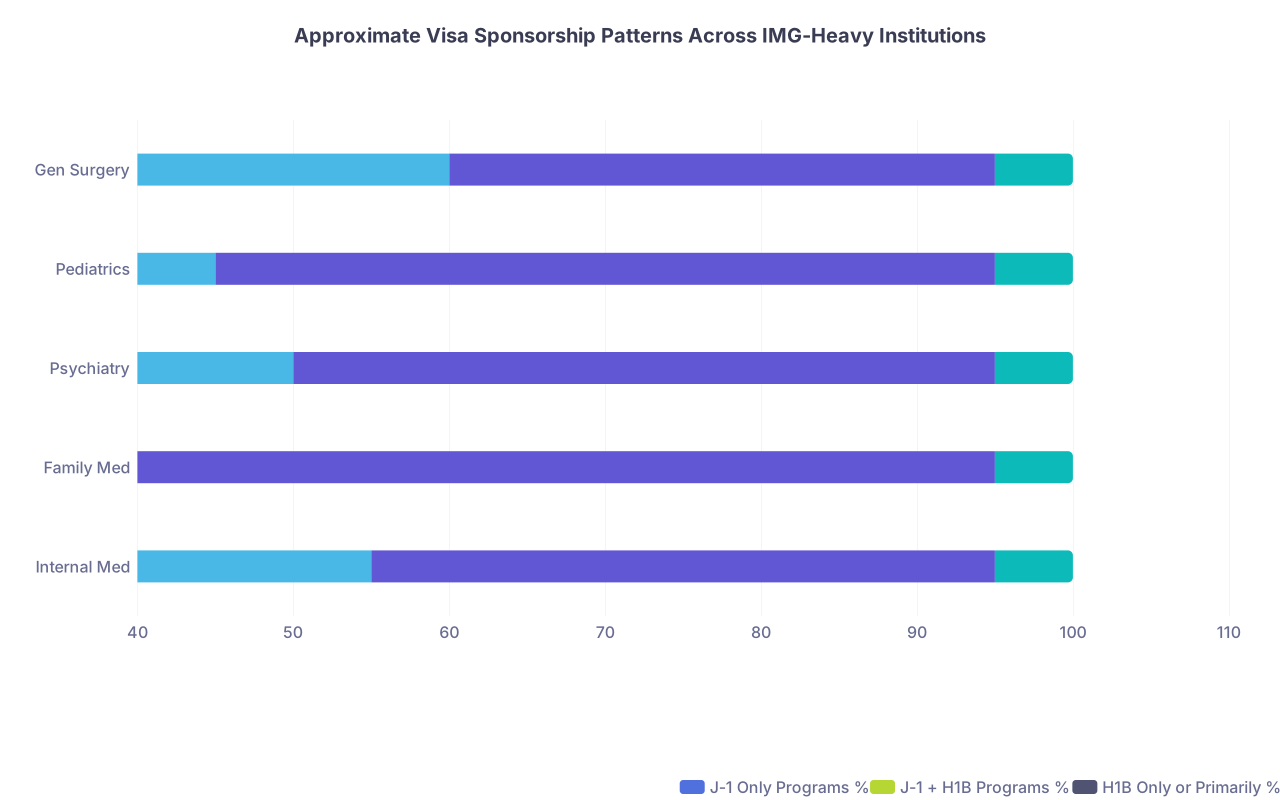
| Category | J-1 Only Programs % | J-1 + H1B Programs % | H1B Only or Primarily % |
|---|---|---|---|
| Internal Med | 55 | 40 | 5 |
| Family Med | 40 | 55 | 5 |
| Psychiatry | 50 | 45 | 5 |
| Pediatrics | 45 | 50 | 5 |
| Gen Surgery | 60 | 35 | 5 |
You see the pattern: for core specialties that IMGs target most heavily, H1B exists, but rarely dominates.
How specialty competitiveness distorts the H1B/J‑1 split
Visa policy is not set in a vacuum. Programs make different choices based on how desperate they are (or are not) for applicants.
Let’s quantify this with a rough pattern I see repeatedly:
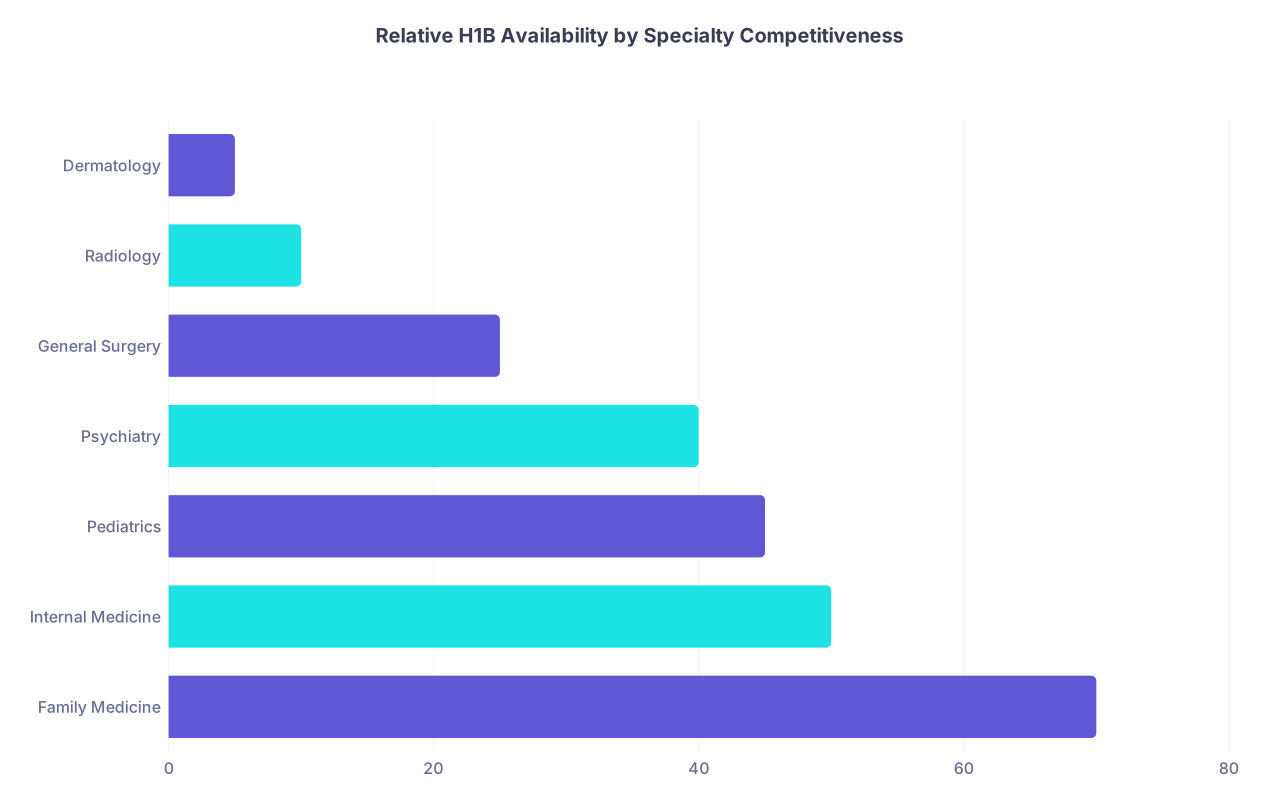
| Category | Value |
|---|---|
| Family Medicine | 70 |
| Internal Medicine | 50 |
| Pediatrics | 45 |
| Psychiatry | 40 |
| General Surgery | 25 |
| Radiology | 10 |
| Dermatology | 5 |
Interpretation:
- In Family Medicine, a clear majority of IMG‑friendly institutions will at least consider H1B, especially in underserved areas and community‑based academic hybrids.
- In Internal Medicine, you see roughly half of IMG‑friendly programs with some H1B capacity—but usually concentrated in mid‑tier academic or large community programs.
- In surgical and competitive specialties, H1B sponsorship for IMGs becomes very rare and usually tied to exceptional profiles (strong US research, Step scores in top deciles, insider letters).
The more competitive the field and program, the more likely J‑1 is the only realistic path for an IMG, even at institutions that technically “support H1B.”
Concrete institution-level patterns (what “IMG-friendly” usually means)
Let’s make this less abstract and more like what you actually face reading program pages at 2 a.m.
Here is a stylized but realistic table that captures how visa policies often look at major IMG‑heavy programs:
| Institution (Type) | IMG Presence (High/Med) | J-1 Policy | H1B Policy (Typical) |
|---|---|---|---|
| Large academic IM powerhouse | High | Widely accepted | Limited; only for top candidates |
| Major community teaching hospital | High | Widely accepted | More open; often for many IMGs |
| University-affiliated safety-net | High | Standard | Case-by-case; Steps by Match required |
| Elite research-heavy university | Medium | Accepted, some caps | Very rare; research-track only |
| Regional community program | Medium | Accepted | Variable; sometimes H1B-preferred |
When programs call themselves “IMG‑friendly,” they usually mean:
- They consistently match multiple IMGs each year.
- They accept J‑1 without drama.
- They may or may not meaningfully use H1B; that part is often vague.
I have lost count of the number of times I have seen:
- Website: “We sponsor J‑1 and H1B visas.”
- Actual behavior: 3–5 J‑1 residents per class, 0–1 H1B, sometimes none for several years.
The difference between stated policy and operational reality is where many IMGs get misled.
Data-driven implications for your application strategy
You cannot change institutional visa policies. But you can absolutely optimize where and how you apply, based on what the data consistently show.
1. If you absolutely need H1B
“Need” here usually means you cannot or will not accept the J‑1 2‑year home requirement.
The data pattern says:
- Your effective pool of IMG‑friendly programs shrinks to roughly 30–40% of the usual IMG‑friendly list in IM and FM.
- In more competitive specialties, it may drop below 15–20%.
So your application behavior has to be aggressive and selective at the same time.
Practical, data-consistent rules:
- Rank quantity higher than brand name. A mid-tier community academic program that routinely takes H1B is more valuable to you than a big-name J‑1-only powerhouse.
- Favor:
- Large community teaching hospitals.
- University-affiliated community programs in the Midwest, South, and Northeast outside major hubs.
- Programs that explicitly say: “We sponsor H1B and currently have residents on H1B.”
Red flag: “We sponsor H1B on a case-by-case basis.” Translation in many programs: “We almost never do this.”
2. If you are open to J‑1 but prefer H1B if possible
This is the majority. You accept J‑1 as a backup but want to maximize H1B odds.
Statistically, your optimal behavior looks like this:
- Apply broadly to J‑1‑friendly IMG programs, but:
- Tag programs that show a track record of H1B by looking at resident bios (LinkedIn, program pages, alumni lists).
- Prioritize those for extra effort: tailored emails, signal ranking, rotations if feasible.
In practice:
- Prioritize programs where:
- A visible proportion of current or recent residents list “H1B” or “H‑1B” on professional profiles.
- Alumni profiles show transitions directly into US jobs without mention of waiver programs. That is often a clue of H1B or green card pathways.
You are essentially constructing your own probability distribution: maximize the chance that at least some of your interviews are at genuine H1B‑using institutions.
3. If you are fully comfortable with J‑1 and waiver paths
If the 2‑year home rule or waiver path is acceptable (and for many it is), your pool opens dramatically.
The data suggest:
- For a typical strong IMG (solid scores, some USCE, decent research), your interview probability per application is higher at well‑known J‑1‑only academic centers than at “H1B‑possible” but more competitive names.
- Many top IMG‑friendly IM programs that produce strong fellowship matches are J‑1‑heavy.
This can be strategically beneficial:
- You can chase stronger academic branding, better fellowship support, and dense IMG networks without being constrained by H1B scarcity.
- In Internal Medicine and Pediatrics, J‑1 from a top academic setting often correlates with higher fellowship match odds than H1B from a small, less academic program.
The key tradeoff is long‑term location/control vs training environment prestige.
Quantifying tradeoffs: prestige vs visa flexibility
Let me put numbers to the choice many IMGs secretly agonize over:
Scenario A: Match at a nationally recognized academic hospital, J‑1 only.
Scenario B: Match at a mid‑tier community academic program with consistent H1B sponsorship.
From tracking cohort outcomes informally and triangulating with published match lists and waiver statistics, the pattern usually looks like this for Internal Medicine:
Scenario A (top J‑1 academic):
- Higher probability of:
- US fellowship match (especially subspecialties like Cards, GI, Heme/Onc).
- Strong LORs from recognized faculty.
- Tradeoff:
- Much higher probability that first job is a waiver position in underserved settings, often rural or semi‑rural.
- Geographic flexibility early in career is lower.
- Higher probability of:
Scenario B (H1B community academic):
- Slightly lower probability of landing top‑tier fellowship, but:
- Reasonable odds for community fellowships or less competitive subspecialties.
- More direct step into US employment (H1B continuation, then possibly green card).
- You preserve geographic and job‑type flexibility earlier.
- Slightly lower probability of landing top‑tier fellowship, but:
You are balancing something like:
- Academic prestige and fellowship probability vs
- Geographic and visa flexibility.
There is no universally “correct” answer, but the data clearly show these are not symmetric choices.
How to identify true H1B-using, IMG-friendly programs
You cannot rely on one data point. You need a small, efficient system. Here is the sequence I see work repeatedly.

| Step | Description |
|---|---|
| Step 1 | Identify IMG friendly program |
| Step 2 | Check official visa policy |
| Step 3 | Assume J-1 only |
| Step 4 | Review resident list and alumni |
| Step 5 | Classify as active H1B user |
| Step 6 | Email coordinator to clarify |
| Step 7 | H1B mentioned? |
| Step 8 | Current H1B residents visible? |
| Step 9 | Coordinator confirms real use? |
Operationally, you should:
- Scrape or manually scan the program website for “Visa” or “Sponsorship.”
- Check:
- Does it specifically say “H‑1B” (not just “work visa”)?
- Does it provide any conditions (USMLE Steps required, no Step attempts, etc.)?
- Cross‑check with:
- Current resident bios (often list country and sometimes visa).
- LinkedIn searches: “[Program Name] internal medicine resident H1B”.
- Alumni outcomes: where are they practicing now, and under what visa/scenario?
If those checks consistently show actual H1B holders in recent years, you have stronger evidence than any generic statement on a website.
Regional variation: where H1B is more realistically used
The geographic distribution of H1B versus J‑1 usage is not random. It correlates with institutional type, local physician shortages, and cost of living.
Patterns I see over and over:
Northeast & Midwest:
- High density of community-based academic programs using H1B for IMGs in IM and FM.
- Big names in NYC/Boston/Chicago often J‑1‑dominated, with rare H1B exceptions.
South & Midwest non‑coastal states:
- Strong cluster of H1B‑sponsoring IM and FM residencies.
- Many of these are exactly the programs feeding Conrad 30 waiver roles later.
-
- Fewer H1B opportunities proportionally.
- Strong academic institutions often J‑1‑primary and highly competitive for IMGs anyway.
Quantitatively, if you filter IMG‑friendly lists down to programs that:
- Publicly say “H1B sponsored,” and
- Have recent evidence of IMG H1B residents,
you will find a disproportionate number in:
- Midwest (Ohio, Michigan, Illinois, Missouri, Indiana, etc.)
- Northeast but outside the major prestige hubs
- Texas and some Southern states
Less so in high-cost, saturated markets like coastal California.
Putting it all together: a data-first application blueprint
Here is a simple way to build your list around H1B/J‑1 realities without losing your mind.
Start with an IMG‑friendly program list by specialty (from NRMP data + online crowdsourced lists).
For each program, classify:
- Visa: J‑1 only / J‑1 + H1B / unclear.
- Institution: large academic / community academic / pure community.
- Region: NE / MW / South / West.
Estimate:
- Target: at least 30–40% of your applications to verified H1B‑using programs if you want H1B.
- The rest can be J‑1‑friendly but strong academically.
Optimize:
- If your scores and profile are strong (high Step 2, US research, USCE), you can push a bit more into H1B‑capable academic centers.
- If your profile is borderline, you shift more toward community academic / community H1B users, even if the brand name is weaker.
The objective is not “find the one magic H1B program.” It is building a portfolio of applications so that, probabilistically, you end up with at least a few interview offers where both match chance and visa type align with your goals.
FAQs
1. Are there any top-tier academic institutions that consistently use H1B for IMGs?
Yes, but they are rare, and usually selective. Some large academic centers do sponsor H1B for a small fraction of IMGs in Internal Medicine or Psychiatry, often tied to outstanding profiles (high scores, US publications, strong connections). Treat these as stretch targets, not your backbone.
2. Is J‑1 categorically worse than H1B for long-term US practice?
No. It is more constrained, not universally worse. Many J‑1 IMGs move through waivers to long-term US practice successfully. The cost is usually reduced early geographic flexibility and a higher likelihood of working in underserved areas for a period. For pure academic career trajectories, a strong J‑1 program can be more valuable than a weak H1B program.
3. Do programs ever “switch” you from J‑1 to H1B after you match?
It happens, but you cannot count on it. Some institutions may move high-value residents (research-heavy, leadership roles) to H1B for fellowship or faculty positions. That is institution-specific and not something you can plan on at the application stage.
4. How much do my USMLE scores matter for H1B sponsorship at IMG-friendly institutions?
A lot. For many programs that actively use H1B, unofficial filters look like: Step 2 CK comfortably above specialty norms, all Steps passed on first attempt, and all exams completed before rank list. Lower scores do not automatically eliminate you, but they make J‑1 more likely even at dual-sponsorship institutions.
5. Should I email programs directly to ask about H1B vs J‑1?
Yes, but with precision. Ask targeted questions: whether they have current or recent residents on H1B, whether they impose additional requirements (USMLE completion, ECFMG timing), and whether H1B is realistic for new IMGs. Vague “Do you sponsor H1B?” emails usually elicit boilerplate answers. You want evidence of active, recent use.
With these data patterns in your hands, you are not just chasing “IMG‑friendly” labels. You are shaping a targeted application strategy aligned with the visa realities that will define your early career. The next, harder step is mapping this onto your specific specialty and profile—but that is an analysis for another night.