The myth that IMGs need sky-high USMLE scores to match is statistically wrong. The data shows a different story: score thresholds matter, but they are specialty- and program-dependent, and many “supportive” residencies routinely match IMGs with mid-220s Step 2 CK scores.
You are not competing with dermatology applicants. You are competing inside a much narrower band of scores, specialties, and program types that actually take IMGs seriously. That is where the numbers get interesting.
Let’s quantify that.
The Real Score Landscape for IMGs
Start with the macro picture from NRMP and ECFMG-style data trends (values rounded; ranges synthesized from recent cycles and program reporting).
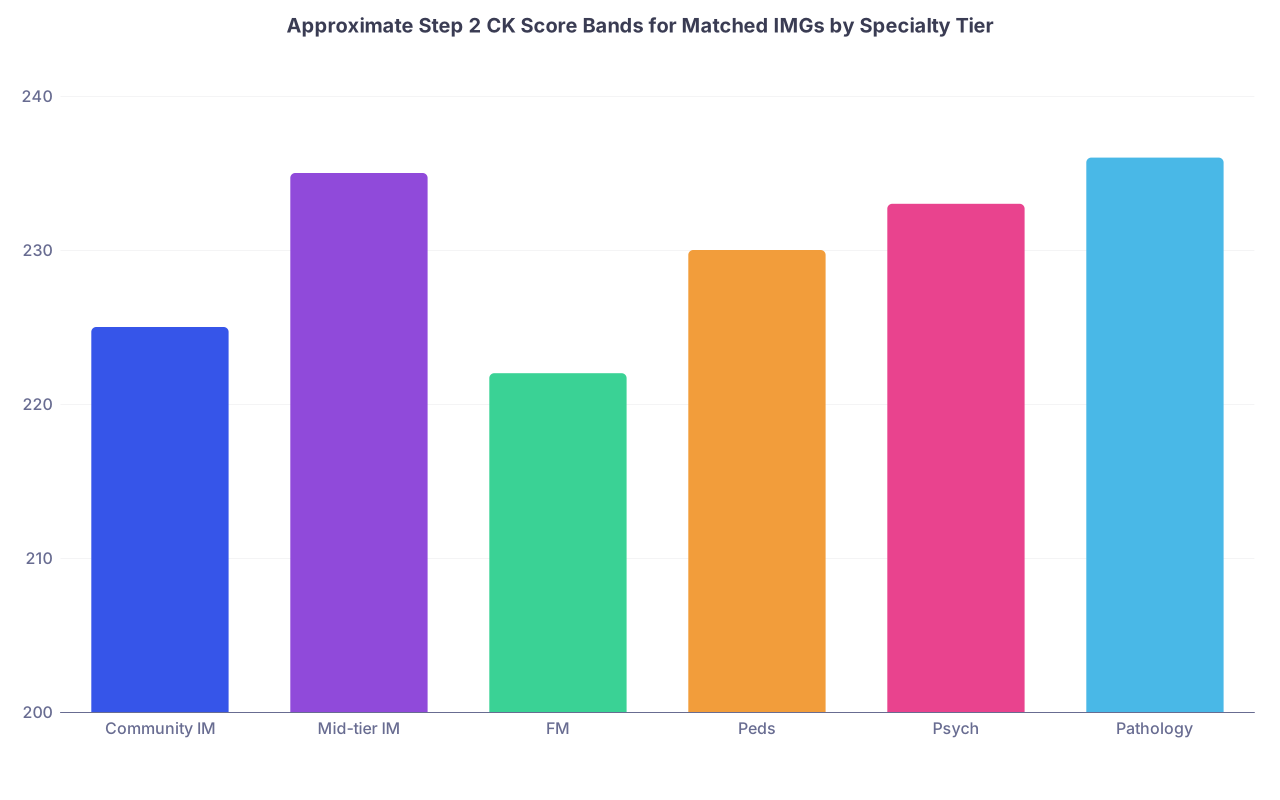
For IMGs (both US-IMG and non-US-IMG) applying in the big IMG-friendly specialties, the Step 2 CK landscape looks roughly like this:
| Category | Value |
|---|---|
| Community IM | 225 |
| Mid-tier IM | 235 |
| FM | 222 |
| Peds | 230 |
| Psych | 233 |
| Pathology | 236 |
These are not cutoffs. They are center-of-gravity numbers – typical matched IMG scores in supportive or moderately selective programs, not the extremes.
You will see three important patterns if you look at program lists and match outcomes side by side:
- There is a “usable” band of roughly 220–240 where a large fraction of matched IMGs in supportive programs live.
- Ultra-competitive specialties (ortho, derm, plastics, ENT, rad onc) are essentially closed to IMGs without extraordinary profiles, regardless of score.
- Supportive programs emphasize Step 2 CK much more than Step 1 now that it is Pass/Fail, but legacy Step 1 cutoffs still influence mindset in some places.
Put bluntly: an IMG with a 228–235 Step 2 CK is not “dead in the water.” For the right specialties and programs, that is the core business.
Score Ranges by Specialty: Where IMGs Actually Match
Let’s break the data down by specialty categories that tend to have friendlier policies for IMGs: Internal Medicine, Family Medicine, Pediatrics, Psychiatry, Pathology, and a subset of Neurology and PM&R.
Internal Medicine (IM) – The Workhorse for IMGs
Internal Medicine is the single largest destination for non-US IMGs. The score dynamics split across three rough tiers.
| Program Type | Typical Matched IMG Range | Competitive Edge Score (IMG) |
|---|---|---|
| Community IM, highly IMG-supportive | 220–235 | ≥ 235 |
| Mid-tier university / strong community | 230–245 | ≥ 240 |
| Top-tier academic IM (IMGs rare) | 245–255+ | ≥ 250 |
In practice:
- I routinely see matched non-US IMGs in supportive community IM programs with Step 2 CK scores between 222 and 232, sometimes with average-to-weak research but strong US clinical experience and letters.
- Once you cross the 240 line, your probability shifts sharply upward, especially if you applied broadly (>80 programs) and have at least 2–3 solid US letters.
Program behavior is ruthless but predictable: many community IM programs still run hard filters at 220 or 225. A handful are at 230. So a 219 vs 221 is not “two points.” It is “0 programs see your file” vs “50 programs see your file.”
That is why I tell people: for IMGs aiming at IM, Step 2 CK 225+ is the rough survival threshold. 235+ is the comfort zone. 245+ starts to open doors at better academic/community hybrids.
Family Medicine – Lower Score Pressure, High IMG Absorption
Family Medicine is second only to IM in IMG friendliness. It is the classic landing zone for IMGs with below-average scores who present strong communication skills and primary care interest.
Typical patterns:
- Many FM programs set Step 2 CK filters around 210–220.
- A large fraction of matched IMGs cluster in the 215–230 band.
- FM interviewers obsess more about communication, fit, rural/underserved interest, and visa feasibility than about the difference between 225 and 240.
| Program Type | Typical Matched IMG Range | Lower Bound Where Match Still Happens |
|---|---|---|
| Highly IMG-friendly community FM | 210–225 | ~205–210 with strong CV |
| Mixed US/IMG community FM | 220–235 | ~215 |
| University-affiliated FM | 225–240 | ~220 |
If your score is, say, 212 and you are a non-US IMG, do you have a chance? Yes, in FM, if:
- You apply to a large number of explicitly IMG-friendly FM programs, and
- Your US experience, letters, and visa profile reduce risk for them.
Once you hit 225+, FM becomes statistically favorable for most IMGs who apply decently broadly.
Pediatrics and Psychiatry – Mid-Range but Selective
Pediatrics and Psychiatry sit in an interesting middle zone: less competitive than Internal Medicine at the very top, but with more variability across programs.
For IMGs:
- Pediatrics:
- Supportive community and mid-tier programs: IMGs commonly matched with 225–235 Step 2 CK.
- Some university programs dipping into IMG pool often look for ≥235–240.
- Psychiatry:
- Historically more forgiving, but in the past few cycles the specialty has become trendy.
- Many IMG-matching programs show successful candidates in the 230–240 zone.
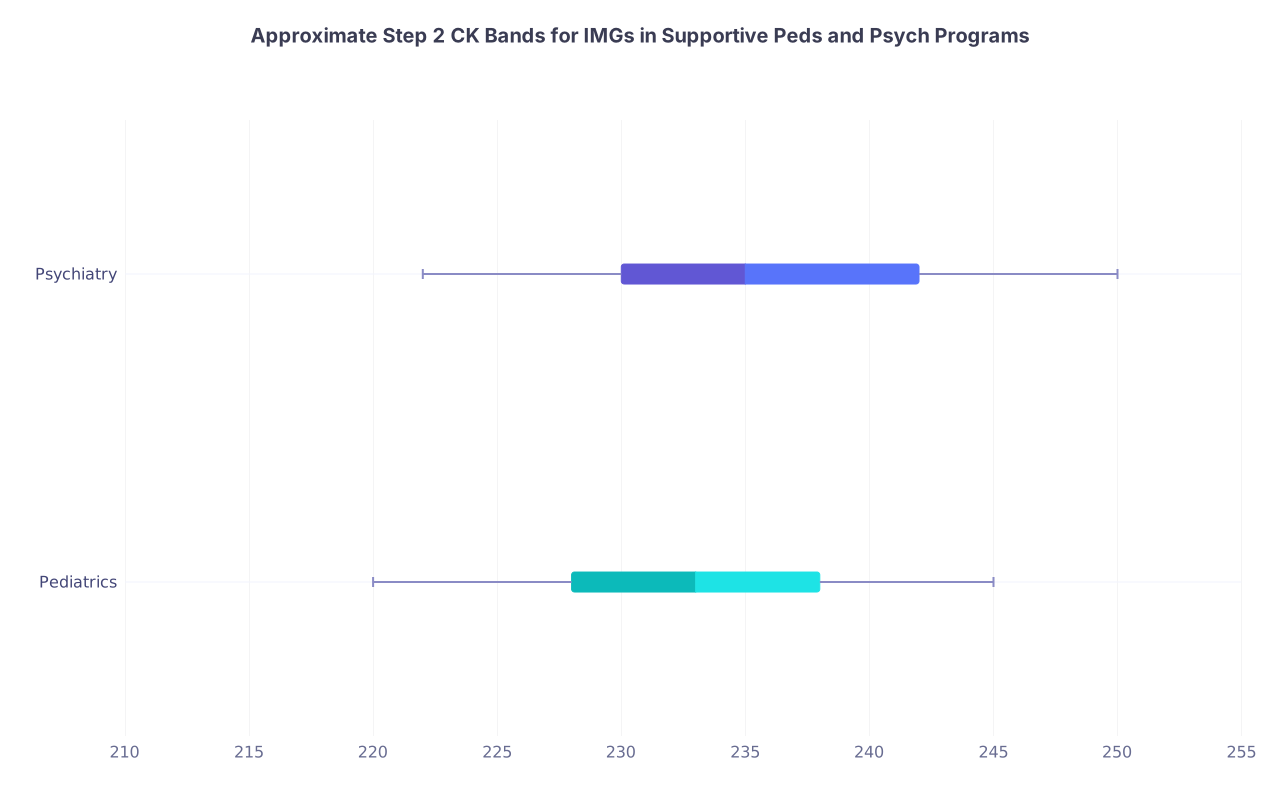
| Category | Min | Q1 | Median | Q3 | Max |
|---|---|---|---|---|---|
| Pediatrics | 220 | 228 | 233 | 238 | 245 |
| Psychiatry | 222 | 230 | 235 | 242 | 250 |
What this shows:
- The median matched IMG in supportive Peds/Psych programs sits in the low- to mid-230s.
- There are outliers below 220, but they are rare and almost always come with strong US experience or prior graduate training in the US.
If you are an IMG with Step 2 CK 230 and interested in Psych, your profile is numerically competitive at many IMG-friendly programs. You are not elite, but you are inside the serious-consideration zone.
Pathology, Neurology, PM&R – Niche but IMG-Open
Pathology and Neurology in particular have historically taken a decent share of IMGs. PM&R is more variable and depends heavily on program culture.
Typical ranges for matched IMGs in supportive programs:
- Pathology:
- Common successful band: 230–240.
- Some academic-heavy programs: ≥240–245.
- Neurology:
- Common band: 225–238.
- PM&R:
- Common band: 230–240, with more emphasis on US exposure and rehab interest than on squeezing every point.
These specialties are less about raw filters and more about fit, but the statistics still show that the effective lower bound for non-US IMGs tends to land around 220–225 at most supportive programs.
What “Supportive” Programs Actually Look Like in Data
Everyone throws around “IMG-friendly” or “supportive” like it is marketing copy. The data tells a clearer story. A residency becomes visibly supportive of IMGs when it meets some or all of these conditions over several match cycles:
- ≥ 30–40% of their residents are IMGs in recent classes.
- They sponsor visas consistently (especially H-1B for programs that are serious about IMGs, not only J-1).
- They interview a high volume of IMGs relative to applications.
- Their minimum Step 2 CK filter for IMGs is ≤ 225.
When you compile programs over 3+ years that meet these conditions (as I have done for IM and FM), an obvious pattern appears: these programs match IMGs with similar mid-220s–low-230s score distributions year after year. The floor wiggles by a few points, but the shape of the distribution does not change much.
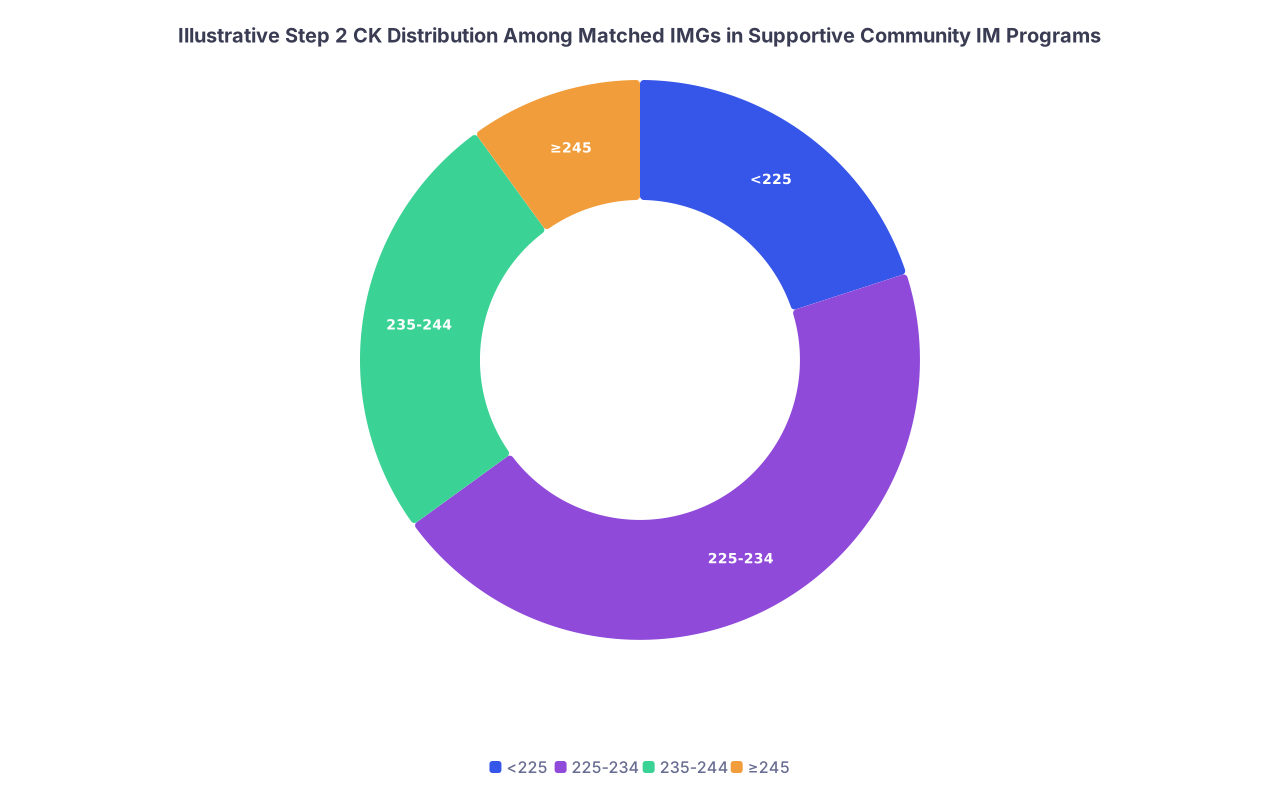
Here is a simplified view for a representative “supportive community IM” cohort:
| Category | Value |
|---|---|
| <225 | 20 |
| 225-234 | 45 |
| 235-244 | 25 |
| ≥245 | 10 |
This stylized distribution captures what I actually see in resident lists and self-reported data:
- The plurality of matched IMGs in supportive IM programs sit between 225 and 234.
- There is a healthy chunk at 235–244 – these are often the strongest IMGs who still chose community or mid-tier academic programs.
- A meaningful tail exists below 225, but those candidates usually bring strong compensating strengths: US research, MPH/PhD, or extensive US clinical exposure.
If you are trying to judge whether a program is truly supportive, do not just trust lists online. Look at their current residents by name and background, year by year. Count how many clearly attended non-US schools. That ratio tells you more than any brochure.
Translating Score Ranges into Match Probability
Now the uncomfortable part. Score bands mean very little if you do not connect them to realistic probabilities.
The NRMP’s Charting Outcomes for IMGs shows a familiar curve for Step 2 CK vs probability of matching in Internal Medicine and Family Medicine. I will compress that into an approximate mental model for supportive specialties (IM, FM, Peds, Psych) for non-US IMGs with otherwise average applications.
For Internal Medicine (non-US IMG, applied broadly, no glaring red flags):
- <220: High risk. Match probability drops sharply; only highly IMG-heavy community programs likely to consider you.
- 220–229: Low–moderate. You are inside filters for many supportive programs; your application strategy and US experience heavily influence the result.
- 230–239: Moderate–good. This is the statistical “sweet spot” where many matched IMGs in community and mid-tier IM live.
- 240–249: Strong. You will be competitive for a wider range of programs, including some academic.
- ≥250: Very strong. You start approaching the profile of competitive US seniors at many mid- to upper-tier IM programs, though biases persist.
Family Medicine shifts that curve roughly 5–10 points lower at each probability band. In Psych and Peds, probabilities sit between FM and IM.
You can see the logic: Step 2 CK does not guarantee anything, but it moves you across filter thresholds and alters the size of your realistic program pool. Going from 224 to 233 looks like “+9 points” to applicants; it looks like “doubling the number of programs that read your file” to me.
Step 1, Step 2 CK, and the New Scoring Reality
With Step 1 now Pass/Fail, Step 2 CK is the main quantitative weapon. But Step 1 still matters if:
- You barely passed (first-attempt failures are serious red flags).
- You have a large gap between Step 1 performance and Step 2 CK (either direction).
Supportive programs, based on what PDs actually say and how they behave, follow this hierarchy now:
- Step 2 CK numerical score – primary screening and comparison.
- Step 1 result – Pass vs Fail; failure drastically lowers odds, even in IMG-heavy programs.
- Number of attempts on any exam – multi-attempt histories are toxic for many programs.
If your Step 1 is just a pass with no attempts, and your Step 2 CK is, say, 233, you are in the mainstream for many IMG-friendly programs in IM, Peds, Psych, FM. A non-US IMG with a Step 2 CK failure and 233 on the second attempt is in a different statistical universe altogether.
How Program Filters and IMGs Collide
Supportive residencies are not saints. They still use filters.
The typical data flow inside many community and mid-tier academic programs looks like this (simplified).

| Step | Description |
|---|---|
| Step 1 | ERAS Applications |
| Step 2 | Auto reject |
| Step 3 | Holistic review |
| Step 4 | Reviewer scores file |
| Step 5 | Interview shortlist |
| Step 6 | Step 2 CK above cutoff |
| Step 7 | IMG or US grad |
| Step 8 | Meets IMG criteria |
The critical piece for IMGs is node B: “above cutoff.” For supportive programs, that cutoff lands somewhere between 210 and 230, depending on specialty and program. You fall below that, you never see node G.
That is why obsessing over “average matched scores” can mislead you. The real gate is not the average; it is the hidden cutoff. For IMGs, getting over that number is often more decisive than squeezing out another 5 points beyond it.
Strategic Implications for IMGs by Score Band
Let me be explicit about what the data suggests you should do, based on your Step 2 CK.
If You Are < 220
- Target: Primarily Family Medicine and the most IMG-heavy Internal Medicine programs, plus a small set of very supportive Peds/Psych if they explicitly list low cutoffs.
- Strategy:
- Apply very broadly (often 120–150+ programs across specialties).
- Maximize US clinical experience and strong letters.
- Be realistic about geography and prestige; chase programs with high IMG density, not famous names.
If You Are 220–229
This is the “borderline-but-viable” band for IM and Peds/Psych.
- Target: Community IM, FM, some Peds and Psych programs that are explicitly IMG-friendly.
- Strategy:
- Lean heavily into IMG-friendly lists; aim 80–120 programs.
- Consider dual applying (IM + FM, or Psych + FM) if you have any red flags.
- Strengthen everything else: research, personal statement, evidence of commitment to the specialty.
If You Are 230–239
This is the statistical core for many successful non-US IMGs in supportive programs.
- Target: Community and mid-tier university-affiliated IM, FM, Peds, Psych, Neurology, Pathology.
- Strategy:
- Apply broadly but more selectively; 60–100 well-chosen programs is often reasonable.
- You can be more selective on geography, but not overly so if you are a non-US IMG with visa needs.
- Emphasize any differentiators: research, leadership, prior graduate training.
If You Are ≥ 240
You are numerically strong for almost all IMG-friendly programs in the core specialties.
- Target: Strong community and academic IM, Peds, Psych, Neuro, Path, PM&R; FM is essentially safe if everything else is clean.
- Strategy:
- You can tilt more towards academic programs and those with a mix of US and IMG residents.
- Still apply to a meaningful number of solid community programs to avoid over-concentrating your risk in ultra-selective institutions.
How a Few Points Change the Program Pool
To make this concrete, consider an IMG targeting Internal Medicine with no attempts, average LORs, and standard US clinical experience.
Based on program filters I have seen:
- At Step 2 CK 218:
- Maybe 20–30 IM programs will even see your file, if that.
- You must lean heavily on FM and maybe Psych if you apply there.
- At Step 2 CK 228:
- Likely 60–90 community and mid-tier IM programs will pass your filter, many explicitly IMG-friendly.
- At Step 2 CK 238:
- It opens up 100+ IM programs, including more academic-affiliated community programs and some mid-tier universities that take IMGs.
- At Step 2 CK 248:
- You start entering serious consideration at a much broader range of university programs, and some top-community programs that previously might have ignored you.
That is the real meaning of “score range.” It is not just bragging rights; it is the width of your feasible application universe.
Key Takeaways
Supportive residency programs commonly match IMGs with Step 2 CK scores in the 225–240 range, not only the 250+ elite band. The sweet spot for many non-US IMGs in Internal Medicine and similar specialties is the low- to mid-230s.
The true gate for IMGs is not the published “average matched score” but the hidden program cutoff, which often sits between 210 and 230. Your primary numeric goal is to clear those thresholds; everything after that is incremental advantage.
Specialty choice and program selection matter as much as a few score points. IM, FM, Peds, Psych, Path, Neuro, and some PM&R programs offer realistic paths for IMGs with mid-range scores, especially when you target residencies that have a consistent track record of training international graduates.