
The public signals programs give IMGs are mostly theater. The real truth about whether a residency is actually supportive of international medical graduates lives in the backchannels—what gets said off-mic, how people behave when you are not in the room, and which patterns quietly repeat year after year.
Let me walk you through what program directors, chiefs, and coordinators actually look like when they genuinely support IMGs… and what they look like when they only want you as cheap labor.
First: Ignore the Website, Watch the Patterns
Residency websites lie by omission. Every program now has a DEI statement and some smiling group photo with “diversity.” That tells you nothing.
Here’s what PDs and selection committees actually look at when deciding whether to open their doors to IMGs:
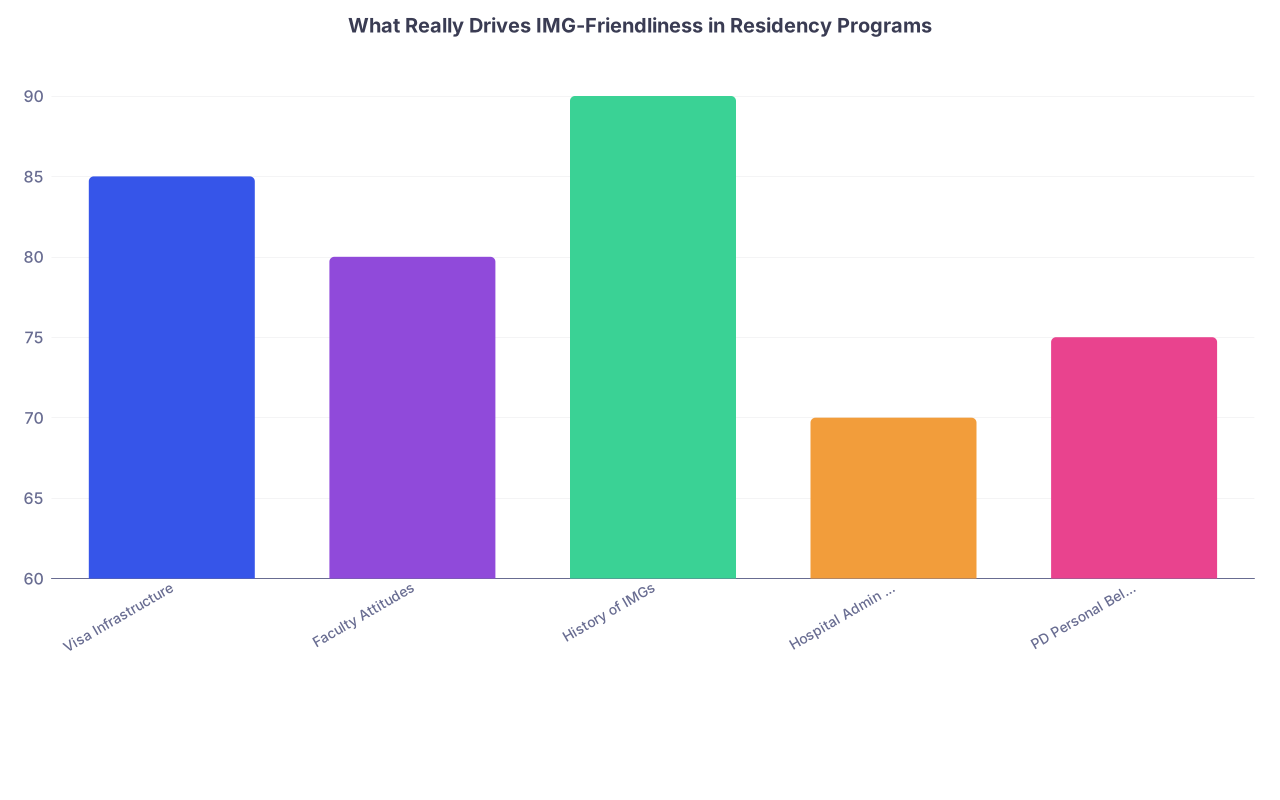
| Category | Value |
|---|---|
| Visa Infrastructure | 85 |
| Faculty Attitudes | 80 |
| History of IMGs | 90 |
| Hospital Admin Support | 70 |
| PD Personal Beliefs | 75 |
You do not see this in any brochure. You see it in behavior and history.
The first backchannel rule: history beats promises
If a program has matched IMGs consistently for 5–10 years, that is not an accident. It means:
- Administration has already fought the GME and legal battles around visas.
- Faculty have already adjusted to non-US accents, different schooling styles, and varied clinical backgrounds.
- The PD has taken political hits for “taking too many IMGs” and kept going anyway.
You can talk to ten PDs who “love IMGs,” but the one that has 6–8 current IMGs per class and has been doing it for a decade? That program is truly IMG-friendly. Everyone else is still in “we’ll consider” fantasy land.
Backchannel Signal #1: How They Talk About Visas When You Push Them
This is the one thing they almost never say plainly on the website, but talk about very honestly behind closed doors.
Supportive programs treat visas as logistics. Unsupportive programs treat visas as a burden.
A PD who is truly IMG-supportive will say things like:
- “We sponsor J-1 and H-1B. We’ve done both many times.”
- “Our GME office has an immigration attorney they work closely with.”
- “We’ve never had a resident lose their position because of a visa delay—we build extra time in.”
The fake-friendly ones sound like this:
- “Historically we’ve mostly had J-1s.” (Translation: we do the bare minimum ECFMG requires and avoid extra work.)
- “We’re open to sponsoring H-1B on a case-by-case basis.” (Translation: almost never.)
- “We have to see the candidate pool first.” (Translation: if US grads fill our spots, you’re gone.)
Here’s what I’ve seen on the inside. At one midwestern internal medicine program, the PD told us explicitly in ranking meetings: “If they need H-1B, put them in a separate bucket. I’ll talk to GME later.” The “later” never came. Every year, that H-1B list quietly slid down the rank list.
Truly supportive programs do the opposite. They solve the visa question before ranking, not after.
The subtle visa questions you should ask current residents
You do not ask, “Do you support visas?” Everyone says yes. Ask this instead:
- “Did any resident ever lose their position because of visa issues?”
- “How early did the program start your visa paperwork?”
- “Who handled it—GME, outside attorney, or were you on your own?”
- “Do they ever discourage people from switching from J-1 to H-1B or going for waiver jobs?”
Real supportive programs have specific answers and a clear process. Weak programs give vague stories. If one senior says, “I had to fight for my H-1B; it was very stressful,” that’s a red flag. The process shouldn’t depend on you being aggressive.
Backchannel Signal #2: Where Their IMGs End Up (Not Just That They Exist)
Having IMGs in the program is step one. Where they land after residency is the truth.
I’ve sat in faculty lounges where the PD bragged, “We match lots of IMGs,” but when you actually look, those IMGs all ended up in undesirable, low-paying community jobs in visa-waiver deserts because the program never lifted a finger to help them.
A genuinely supportive residency shows this pattern:
- IMGs getting decent fellowships, not just prelim or dead-end positions.
- IMGs matching in subspecialties from that same program (not from back-home contacts only).
- Graduated IMGs placed in academic or leadership roles, not just service-heavy community slots.
You can even map this out yourself by stalking alumni pages and LinkedIn.
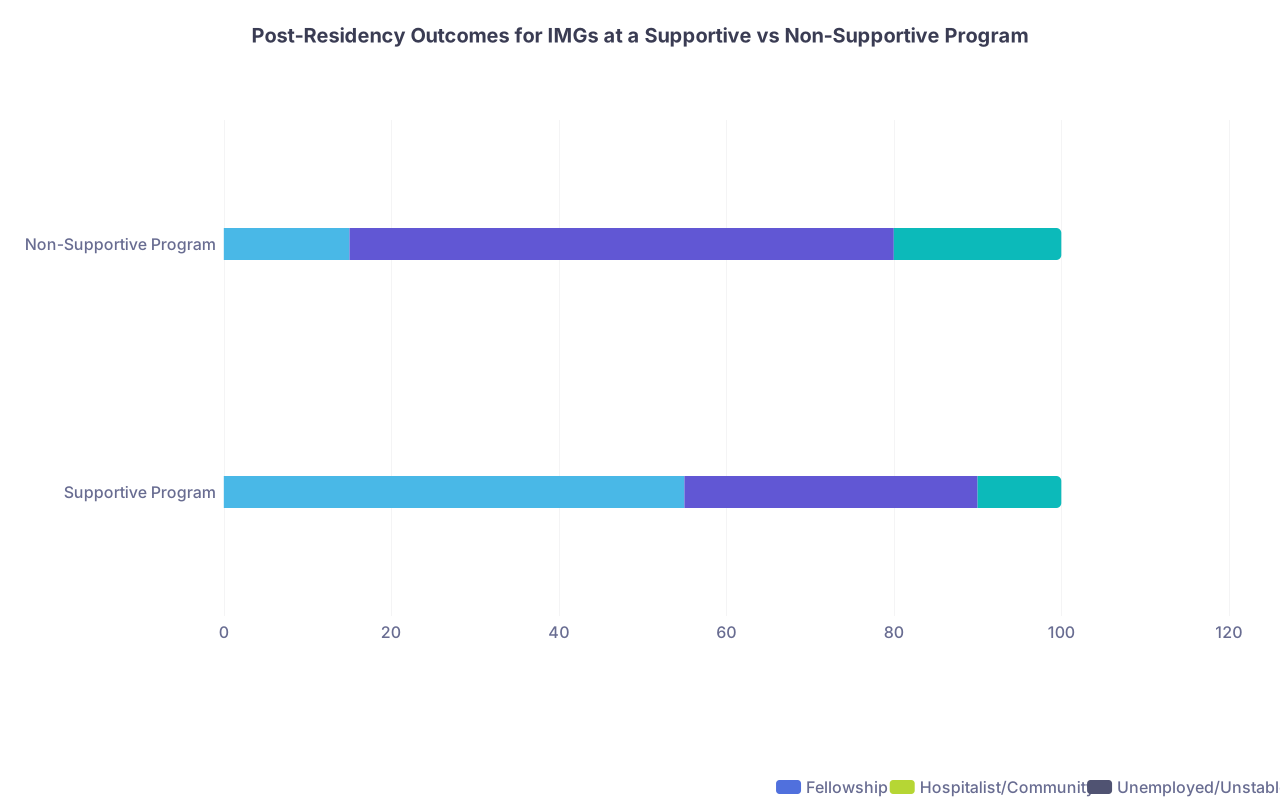
| Category | Fellowship | Hospitalist/Community | Unemployed/Unstable |
|---|---|---|---|
| Supportive Program | 55 | 35 | 10 |
| Non-Supportive Program | 15 | 65 | 20 |
The supportive program doesn’t just “use” IMGs for service. It invests in their futures.
How to extract this information quietly
You never ask “How supportive are you to IMGs?” That’s amateur hour.
You message recent IMG grads and ask:
- “Where did people from your program go after graduation?”
- “How helpful were attendings in writing strong letters for fellowship?”
- “Did you feel disadvantaged as an IMG when applying to fellowships or jobs compared to US grads in your program?”
The answers tell you instantly whether there’s a two-tier system.
If you hear, “US grads went to card/nephro, most IMGs stayed as hospitalists,” that’s not a coincidence. That’s invisible hierarchy.
Backchannel Signal #3: The Way They Talk About Communication and Accents
This one is subtle, but I’ve heard it in real ranking meetings.
Some attendings are fine with IMGs… as long as they “sound American.” They won’t say that to your face, but they’ll say things like:
- “I worry about this candidate’s communication with patients.”
- “We need residents who can communicate clearly in high-stress situations.”
- “I’m not sure they’ll fit our patient population.”
Sometimes this is a legitimate concern. Often, it’s coded language for “accent” or “cultural difference.”
Supportive programs handle this differently. They already expect a range of accents and backgrounds. They support, train, and integrate. They don’t punish.
In a supportive place, you’ll hear residents say:
- “Attendings give constructive feedback on communication, not just ‘speak better.’”
- “They helped me with documentation phrases and how to talk to nurses.”
- “They never made me feel small because of my accent.”
In a hostile place, you’ll hear:
- “I was told multiple times my English wasn’t good enough.”
- “Nurses bypass me and go to US grads for orders.”
- “Patients complain about my accent and nobody backs me up.”
That last one is the real test. When a patient says, “I want a doctor who speaks better English,” a supportive program backs you, not the prejudice.
Ask current IMGs bluntly: “What happens when patients complain about your accent?” The tension or calm in their answer tells you the culture.
Backchannel Signal #4: Schedule, Coverage, and Who Gets Sacrificed
Every residency has “holes” in the schedule. Extra calls. Extra nights. Extra weekends. Someone has to fill them.
In IMG-supportive programs, the allocation of misery is fairly distributed.
In IMG-exploitative programs, IMGs absorb more of the pain:
- Extra night floats because “you do not have family here.”
- Being assigned more cross-cover or brutal rotations.
- Being expected to “help out” disproportionately since “you’re so grateful to be here.”
I’ve heard chiefs literally say: “He’s on a visa, he won’t complain.” That’s exploitation, not support.
Ask residents privately:
- “Who tends to get last-minute coverage requests?”
- “Do you feel IMGs and US grads are treated equally when it comes to schedule favors?”
- “Who gets lighter electives or better research blocks?”
If IMGs always seem to be the ones covering, but US grads mysteriously get lighter months and prime vacation slots, that’s your answer.
Backchannel Signal #5: Their Relationship With Step Scores and “Red Flags”
Here’s something PDs will rarely say out loud: some programs use IMGs as their “risk” bucket.
Meaning: they’ll take the IMG with a 250+ Step score, but not the one with 225 and an attempt, even if clinically strong. Or they love IMGs only when they’re perfect on paper. That is not true support; that’s score-mining.
Supportive programs understand:
- Many excellent IMGs have gaps, delays, or attempts because of systemic differences.
- Clinical strength and bedside manner can’t be captured solely by Step.
- It’s hypocritical to claim “we believe in diversity” but only take 260s.
This doesn’t mean they’ll ignore a 200 with multiple fails. No one will. But look at their current residents. Do they have:
- A mix of IMG backgrounds, not just Caribbean and not just top European schools?
- A few residents who openly mention a prior attempt and are still valued?
| Program Type | IMG % in Class | Visa Types Supported | Typical Step 2 Range | IMG Fellowship Rate |
|---|---|---|---|---|
| Truly Supportive | 30–60% | J-1 and H-1B | 220–255 | 40–60% |
| “Score Mining” Program | 10–25% | Mostly J-1 | 245–265 | 20–35% |
| Token IMG Program | 0–10% | Rare J-1 only | 240–260 | <20% |
That “Score Mining” row is exactly what many IMGs mistakenly call “IMG-friendly.” It’s not. It’s just high-score friendly.
Backchannel Signal #6: Who Sits on the Selection Committee
This is where the real decisions are made, and most applicants never see it.
In internal meetings, if every voting member is a US MD or DO who trained in the US, with no IMG faculty voices, the bias is baked in even if they mean well.
Supportive programs do something subtle but powerful: they put successful IMGs on interview and rank committees. Former IMG residents who are now core faculty. Chiefs who are IMGs. A PD or APD who’s an IMG.
Those people change the conversations. I’ve watched it happen.
Example: At one East Coast community program, a US-trained cardiologist attendings said, “This candidate’s English feels rough.” An IMG faculty member responded, “His English is better than mine when I started, and I turned out fine. He’ll grow. His letters are outstanding.” That candidate got ranked higher. Without that voice, he’d have dropped.
How do you detect this?
During the day, you casually ask:
- “How many faculty on your selection committee are IMGs themselves?”
- “Do any of your APDs or chiefs come from international schools?”
Watch the reaction. Programs that truly support IMGs are almost proud of it. They’ll name them. Tell you their paths. The others will mumble something vague.
Backchannel Signal #7: How They Integrate You Socially and Professionally
Many IMGs don’t realize how isolating residency can be until they’re in it. A supportive program doesn’t just tolerate that you’re from another system—it actively pulls you into the center.
Here’s what that looks like backstage:
- Chiefs deliberately pair new IMGs with senior residents who are either IMGs or truly supportive US grads.
- Intern orientation includes explicit guidance about “how things work in the US system,” not just EMR training.
- Faculty normalize asking questions and comparing systems instead of mocking “how things are done in your country.”
At a good program, I’ve seen chiefs pull a new IMG aside and say, “Rounds here are faster, nurses expect more autonomy from you, and documentation is a beast. You’ll feel behind the first month. That’s normal. Here’s how we’ll help you catch up.” That’s real support.
At a bad program, you just drown and get labeled “slow” or “not a good fit.”
Ask:
- “Did you feel supported your first 3–6 months?”
- “Were your mistakes treated as learning or as incompetence?”
- “Did anyone take ownership of helping you adapt to the US system?”
If IMGs describe being thrown into the deep end with no structure, the program does not truly understand what you need.

Backchannel Signal #8: The Hospital’s Real Attitude Toward IMGs
Sometimes the PD is on your side, but the hospital isn’t. That’s when things get ugly.
Signs the institution is anti-IMG, even if the PD is trying:
- GME repeatedly pushes back on H-1Bs as “too expensive” or “too complicated.”
- Legal drags visa paperwork out and blames delays on “new interpretations” every year.
- HR is quick to remind IMGs “your visa status does not guarantee renewal” when negotiating contracts or discipline.
I’ve seen entire classes reshaped because an incoming CEO decided, “We don’t want to be seen as an IMG-heavy program,” and quietly leaned on the PD.
To detect this, you ask residents:
- “Did the hospital ever try to reduce visa sponsorship?”
- “Has anyone had contract or renewal issues related to visa rather than performance?”
- “Over the past few years, has the percentage of IMGs gone up or down?”
Trends matter more than a single year snapshot.
Backchannel Signal #9: How They Handle Mistakes and Struggles for IMGs
Every resident struggles at some point. The difference is how much “benefit of the doubt” you get.
Programs that secretly distrust IMGs do this:
- One complaint from nursing = “probation discussion.”
- Charting delay = “concern about competence.”
- Communication misunderstanding = “you might not be safe on nights.”
Programs that support IMGs do this:
- They give structured remediation, not instant punishment.
- They contextualize your struggle: “You’re still adjusting from a different system, let’s support you.”
- They track progress rather than using the first issue to justify their own bias.
Ask current IMGs:
- “Has anyone ever been put on probation? Do you know why?”
- “When people struggle, what does the program actually do?”
- “Do you feel you’re watched more closely than US grads, or the same?”
If the answer sounds like: “We walk on eggshells, one mistake and it’s over,” that’s not a safe space.
Putting It All Together: A Realistic Backchannel Checklist
You’re never going to get a program to confess, “We’re not great for IMGs.” But you can triangulate the truth.
Think of your decision process like this:

| Step | Description |
|---|---|
| Step 1 | Identify Programs With IMGs |
| Step 2 | Check 5-10 Year IMG History |
| Step 3 | Low Priority |
| Step 4 | Ask Residents About Visa Process |
| Step 5 | Evaluate Post Residency Outcomes |
| Step 6 | Probe Culture - Schedules, Support |
| Step 7 | High Priority Program |
| Step 8 | Consistent IMG Intake? |
| Step 9 | Smooth and Structured? |
| Step 10 | Strong Fellowships or Jobs? |
| Step 11 | IMGs Treated Equally? |
By the time you’ve spoken to 2–3 IMGs at a program and mapped their history and outcomes, you’ll see the pattern.
The truly supportive programs are not shy. Their history, alumni, and current residents give them away.
Quick Reality Check: Some Big Names Are Quietly Terrible for IMGs
One last uncomfortable truth. Prestige and IMG support are often inversely related.
Many big-name university programs:
- Take 1–2 IMGs per class at most.
- Use them in the heaviest rotations.
- Offer little leverage or support afterward because “you’re lucky to be here.”
Some mid-level community programs:
- Take 50–70% IMGs.
- Have battle-tested visa processes.
- Place IMGs into solid fellowships and jobs every year.
If you chase brand name blindly and ignore backchannel signals, you can land in a program that looks shiny on your CV but quietly undermines you for three years.
Be honest about what you need: real support, or pure prestige. Because very few places give you both.

FAQs
1. How many IMGs in a program is “enough” to call it IMG-friendly?
There’s no magic cutoff, but patterns matter. If a categorical program has 12 residents per year and 4–7 are IMGs consistently over many years, that’s a strong sign. If it’s 1–2 IMGs and they rotate which year “happens” to have more, it’s tokenism. Also check where those IMGs are from—if it’s only one or two specific feeder schools, they may not be broadly IMG-friendly, just comfortable with that pipeline.
2. Is an H-1B–supporting program automatically better for IMGs than a J-1–only program?
No. Some J-1–only programs genuinely support IMGs with strong education, great mentorship, and aggressive help finding waiver jobs after residency. Some H-1B programs are nightmares administratively and emotionally. H-1B is a good sign of institutional commitment, but it’s not enough by itself. You still need to ask about alumni outcomes, culture, schedule fairness, and how they handle residents in trouble.
3. What’s the single strongest green flag that a program is truly IMG-supportive?
If you force me to pick one: successful IMG alumni who still speak well of the program and stay connected. When graduates who are now attendings, fellows, or hospitalists still recommend that program to newer IMGs—and do so privately, not just in official videos—that’s gold. It means the support didn’t end on Match Day; it showed up in their careers. Programs can fake websites. They cannot fake a decade of grateful, successful IMG graduates.
Years from now, you will not remember exactly which interview dinner had better food or nicer hotel rooms. You’ll remember whether your program had your back when the visa office delayed your paperwork, when a patient complained about your accent, or when you reached for a fellowship that felt just out of reach. Listen carefully now to those backchannel signals—because they’re the quiet preview of how your next three years will feel, every single day.