
The programs that call themselves “IMG‑friendly” are often the ones that grill IMGs the hardest behind closed doors.
Let me tell you what really happens in those rooms.
Program directors and faculty at so‑called friendly programs have developed a separate script for IMGs. They will never admit this in public, and it’s not written in any handbook. But when that door closes, the questions change. The tone shifts. And the red flags they’re hunting for are not the same ones they look for in US grads.
You need to recognize those questions the second you hear them, understand what’s really being tested, and answer in a way that calms the specific fears they have about hiring you as an IMG.
That’s what we’re going to do here.
The Hidden Agenda Behind “Friendly” Programs
A program that takes many IMGs is not automatically your ally.
Most “IMG‑friendly” internal medicine, family, psych, and even some community surgery programs are friendly for one core reason: they need labor. They are short on applicants, or they struggle to recruit US grads consistently. So they open the doors to IMGs.
Inside those programs, there are two competing groups:
- Faculty who genuinely appreciate IMGs, have trained them for years, and know they can be excellent.
- Faculty and PDs who tolerate IMGs but are anxious about visa issues, communication, clinical judgment, and “cultural fit.”
When an IMG applicant sits down, the second group takes over the questioning. They’ve been burned before—by someone who struggled with notes, or who froze on nights, or who left mid‑year when a visa fell through. So they’ve built a set of “safety” questions they only pull out for you.
They call it “making sure the candidate will succeed.”
What it really is: a red‑flag screening.
You will hear some of these even at the friendliest names on your list: places like large community IM programs in the Midwest, NY/New Jersey safety-net hospitals, Southern community programs where 60–80% of categorical residents are IMGs.
They won’t be written anywhere, but they’re remarkably similar across institutions.
Category 1: The “Are You Going to Struggle Here?” Questions
This is the biggest bucket. At IMG‑heavy programs, faculty have a quiet mental list: language issues, EMR problems, notes, US system understanding, autonomy, and hierarchy.
They won’t say: “We’re not sure you’ll be safe on nights.”
Instead, they ask:
1. “Tell me about a time you had difficulty understanding a colleague or patient in English.”
You will almost never hear this asked of a US MD. For IMGs, it’s common.
What they’re really asking:
Are you going to misunderstand orders, phone calls, nurse requests, or critical values? Are patients going to complain they “can’t understand your doctor”?
Red flags they’re listening for:
- You brag that “My English is perfect, I have no problems” — that actually scares them. Overconfidence with zero self‑awareness is a red flag.
- You admit to ongoing problems with accents, fast conversations, or phone communication without a clear plan you’ve used to handle it.
- You show frustration or blame the system instead of showing adaptability.
How a strong answer actually sounds in the room:
You briefly acknowledge a specific past challenge (e.g., first clerkship in the US, different accent), then show a concrete adjustment strategy: asking for repetition once, confirming critical information in the chart, using “teach back” with patients, slowing down and summarizing. You end by tying it to positive feedback you’ve already received on communication during a USCE.
The PD is thinking: “OK, they’ve already had this problem and figured out a solution before they get to us.” Relief.
2. “How comfortable are you with the US healthcare system? What would be the steepest learning curve for you?”
This sounds gentle. It is not. This is a trap if you answer lazily.
What they’re really asking:
Are you going to show up Day 1 and have no clue how orders, consults, pages, case management, or discharge planning work? Are you going to be “dead weight” for six months?
Red flags:
- You talk vaguely: “I know it’s a bit different but I’m a fast learner.”
- You clearly have no US clinical experience but try to pretend you “know the system” from YouTube or observerships.
- You say you don’t expect any learning curve. Unrealistic = unsafe.
The attendings on these committees remember specific IMGs who, for example, had no idea how to place admission orders, how to call a rapid, or how insurance and social work impact discharge. They’re screening to avoid a repeat.
What impresses them:
You show that you know there’s a learning curve and you already started climbing it. You reference explicit experiences: observing or doing pre‑rounding, using Epic or Cerner, seeing how attendings coordinate with pharmacy and social work, understanding prior auths, SNF placement, etc. Then you pick one realistic challenge (like navigating insurance/placement) and mention how you’ve started to prepare (podcasts, shadowing case managers, etc.).
They stop worrying that they’ll spend 3 months explaining what a prior auth is.
3. “You’ve trained in a different system. How do you handle being supervised by someone younger than you?”
This one is aimed squarely at older IMGs or those with prior residency abroad. They won’t ask this of a 26‑year‑old US MD.
What they’re really asking:
Are you going to fight your senior residents? Ignore them? Undermine them because you were an attending in your country?
Red flags:
- “Age doesn’t matter, but if someone is less experienced I’d probably suggest…” → the second you sound like you’ll “guide” your PGY‑2s, the committee freaks out.
- You emphasize what you used to be able to do (surgeries, independent practice) more than your readiness to be taught again.
- You hint that you think US grads are less clinically strong.
I’ve sat in rank meetings where one bad answer to this question tanked an otherwise solid IMG.
What they want to hear:
A clear, humble acceptance of the hierarchy. You can mention your prior experience, yes, but as an asset that helps you support the team and pick up tasks efficiently, not as a reason you should be above the system. The committee wants one sentence that tells them: “I know exactly where I fit in a US residency chain of command, and I respect it.”
Category 2: The “Will You Stay, or Are We Just Your Visa Stop?” Questions
Programs that sponsor a lot of J‑1s or H‑1Bs are suspicious by default. Not because they hate you, but because they’ve been burned by mid‑residency transfers, non‑renewals, and candidates lying about long‑term plans.
These questions show up disproportionately for IMGs, even at places that loudly advertise “full visa support.”
4. “Where do you see yourself practicing long‑term? Would you be open to staying in our region?”
This one sounds innocent. It is not. It’s a red‑flag probe.
What they’re really asking:
Are you going to use us for three years, then disappear the second you’re board‑eligible? Will you bolt to a coastal city or a big-name fellowship and never look back?
For many community programs in the Midwest, South, and Rust Belt, retention is survival. They subtly prioritize candidates who might actually stay.
Red flags:
- “I’m open to everything, maybe fellowship, maybe moving to California or New York.” That’s basically code for “I’m out as soon as possible.”
- You talk only about academic medicine, NIH grants, or top‑tier institution dreams when you’re interviewing at a 450‑bed community hospital with no R01 funding.
- You clearly know nothing about the city or region and have done zero homework.
What calms them down:
You don’t have to swear eternal loyalty to the cornfields. But you need a plausible narrative that makes staying there sound rational: family ties in the US, friends in nearby states, liking mid‑sized cities, enjoying community‑based patient care, being open to hospitalist roles in similar settings, etc.
They want to feel like recruiting you isn’t a 100% guaranteed short‑term loss.
5. “If there were issues with visa processing or delays, how would you handle that stress during residency?”
US grads almost never hear this. IMGs hear versions of it constantly at “friendly” programs.
What they’re really asking:
Are you emotionally stable enough to handle the chaos of immigration bureaucracy while doing residency? Or are you going to melt down, threaten to quit, or become nonfunctional on rotations?
Red flags:
- You say, “I’d be very stressed; my whole future depends on it,” and stop there.
- You blame institutions or government with visible anger.
- You show that you haven’t thought about contingencies or support systems.
These PDs have lived through residents getting letters from USCIS mid‑rotation, administrative delays, and last‑minute emergencies. They’re not just evaluating your CV; they’re evaluating how you function when the floor moves under you.
What they want:
Emotional regulation. You acknowledge the reality—that visa stuff is stressful—but you anchor yourself in past examples where you handled severe uncertainty and still performed (Step delays, family crises, COVID disruptions). You mention support structures: mentors, family, your ability to compartmentalize, use institutional GME/immigration offices, etc.
They need to believe you won’t implode the first time USCIS sends a confusing notice.
Category 3: The “Are You Actually Trainable?” Questions
This is where the academic culture difference comes in. Too many IMGs have shown up rigid, guideline‑dated, or resistant to feedback. PDs at friendly programs have the scars.
So they ask questions that test how moldable you really are.
6. “What’s the biggest piece of clinical feedback you’ve received in the US that changed how you practice?”
US grads get, “Tell me about a time you received feedback.” IMGs get this version with the “in the US” spike added.
What they’re really asking:
Have you really worked with US attendings, and did you adjust your style? Or are you just memorizing UpToDate and regurgitating it?
Red flags:
- You can’t name a specific feedback moment from USCE. Huge red flag: it tells them your US experience was either minimal, fake, or not reflective.
- You give a generic answer about “communicating better” with no concrete example.
- You sound defensive about the feedback.
I’ve watched PDs scribble “no real feedback story” and move on.
What a strong answer does:
You pick one specific time: maybe an attending told you your presentations were too lab‑heavy and not problem‑based, or your notes were too long, or you needed to speak up more with your assessment/plan. Then you show how you changed and how that improved your performance and the team’s trust in you. The key: you make it crystal clear you like feedback and implement it quickly.
That is what they’re buying.
7. “You’ve already graduated X years ago. Why now? And how have you kept your clinical skills current?”
This is asked disproportionately to IMGs with graduation gaps. For a US grad with 1–2 gap years, it’s a soft question. For an IMG with 5–10 years out, it’s a landmine.
What they’re really asking:
Are your knowledge and skills stale? Are you here because every other door closed? Are you too far removed from structured training?
Red flags:
- You talk mainly about studying for exams, not about real clinical work or clinically adjacent roles.
- Your explanation for the gap is vague: “family issues,” “personal reasons,” with no structure, no growth.
- You sound apologetic and defeated.
At IMG‑heavy programs, they’ve been burned by candidates who looked strong on paper but were clinically rusty and slow. A long gap without convincing activity is almost an automatic downgrade unless your answer is excellent.
What saves you:
You frame your gap as actively used time: research with real responsibilities, consistent clinical exposure (even if observerships, telemedicine, or supervised practice abroad), teaching roles, continuous CME, locally relevant practice. You emphasize that your knowledge is current—with specifics: new CHF guidelines, recent sepsis changes, newer anticoagulants, etc.—and that your mind is still in clinician mode.
They need to know you’re not trying to restart an engine that’s been off for a decade.
Category 4: The “Are You Going to Be a Problem on the Floor?” Questions
These questions are about one thing: are you going to make their lives harder? On nights, with nurses, with documentation, with professionalism.
These are often the most subtle, and IMGs often miss the signal.
8. “Tell me about a disagreement you had with a nurse or another team member in the clinical setting.”
US grads get this sometimes. IMGs at “friendly” programs get it almost every time.
Why? Because nurses complain about doctors. And historically, IMGs get more complaints if they don’t adjust quickly to US norms.
What they’re really asking:
Do you respect nurses, or do you carry hierarchical habits from elsewhere that will blow up on our wards? Will you argue over pages? Will you talk down to them?
Red flags:
- You pick a story where “the nurse was wrong and I was right” and you make the nurse the villain.
- You sound like you view nurses as subordinate workers, not colleagues.
- You don’t mention communication, listening, or compromise.
Faculty remember the IMG who yelled at a charge nurse over paging, who refused to clarify an order, who ignored a concern. They are allergic to repeating that story.
What reassures them:
You give a story where you show curiosity first, not ego. You emphasize that even when you disagreed, you listened, clarified, and were willing to reassess the patient. You acknowledge that nurses often see things first. You may mention how, in the US system, nursing input is critical for safety and flow, and that you consciously lean into that partnership.
They want to hear humility without you sounding weak.
9. “What has been the hardest part of documentation or using the EMR for you?”
Again, asked almost exclusively to IMGs. US grads basically grew up on Epic.
What they’re really asking:
Are your notes going to be a disaster? Are attendings going to spend half their day fixing your documentation? Are coders going to complain? Are you going to miss critical signouts in the EMR?
Red flags:
- You say you have no issues at all with EMRs if you’ve never actually used one as a primary writer.
- You admit you’ve never even documented in English before without a clear plan to catch up.
- You show that you don’t understand the legal or billing importance of documentation.
Behind the scenes, programs have gotten burned by IMGs who write narrative notes with no structure, miss ROS/PE, or forget time-stamps and billable components. That creates liability.
What works:
You show you’ve touched real EMRs—Epic, Cerner, Meditech, even if only in observerships—and you’ve practiced using templates and note structures on your own devices or in sandbox modes. You admit a learning curve but frame it as something you’re actively working on, not vaguely “I’ll learn when I get there.”
The phrase that makes committees relax? Something like: “I know documentation is a major part of safe and billable care in the US, and I’ve been very intentional about learning structured problem‑based notes.”
Category 5: The “Are You Hiding a Problem?” Questions
Finally, there’s the group of questions that sound generic but are delivered differently to IMGs. The underlying assumption: gaps, attempts, failures, or unexplained moves might be covering something serious.
10. “Walk me through your path from medical school to now—no gaps.”
When they say “no gaps,” that’s not casual. That’s a PD who has seen too many patchy timelines.
What they’re really asking:
Did you get dismissed from a prior residency? Did you fail licensing exams multiple times? Were you sitting at home for three years doing nothing? Are you lying on your application?
Red flags:
- You gloss over dates. “Then I did some research” with no specifics.
- You change your story slightly from what’s in ERAS.
- You look uncomfortable with a particular time period.
- You clearly haven’t prepared a coherent, chronological explanation.
Program coordinators often pre‑flag IMGs for “inconsistent timeline” before interviews. This question is the PD’s chance to see whether that concern is fatal.
What protects you:
Radical clarity. You don’t need to overshare personal trauma, but you need a clean, chronological story. If you had exam failures, limited research, family illness, or non‑clinical work, you own it and show growth, not excuses. You connect the dots to why now you’re a stronger candidate, not a desperate one.
You’d be surprised how many committees will accept imperfect histories if they trust you’re telling the truth.
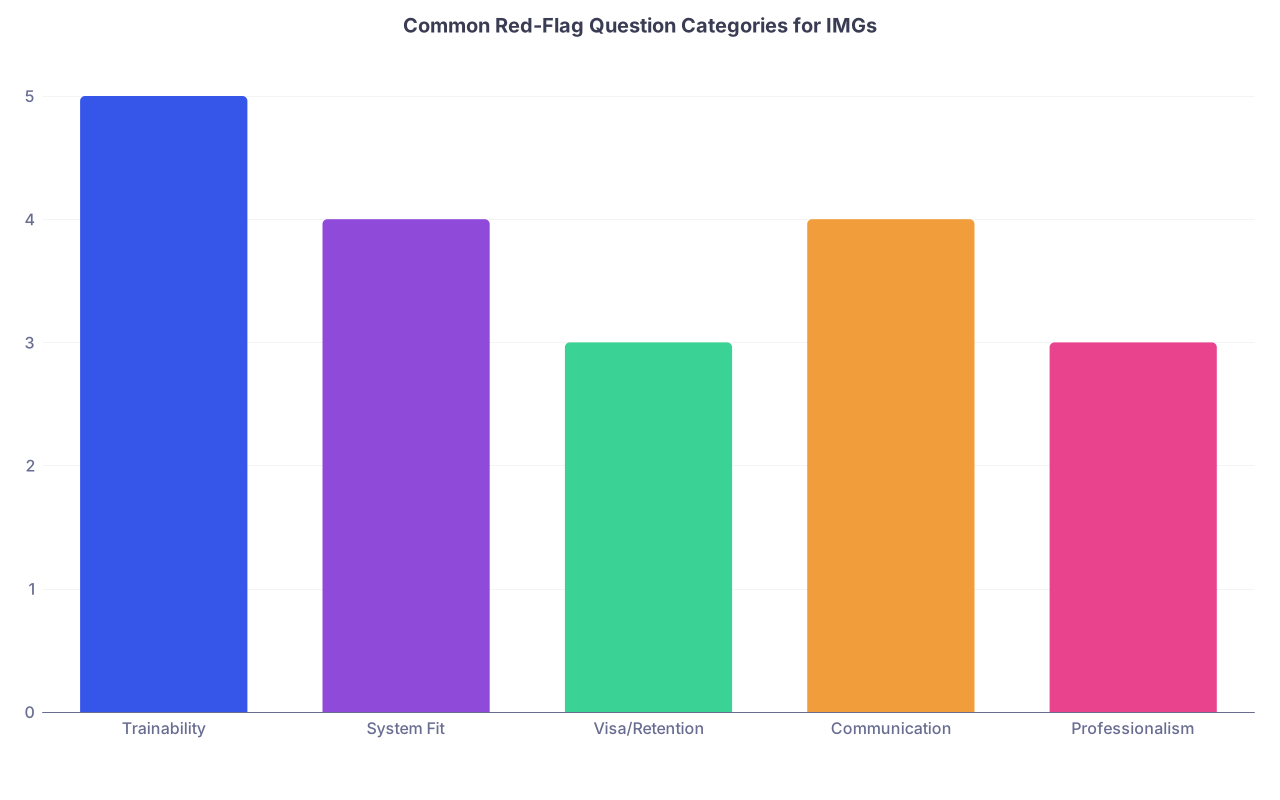
| Category | Value |
|---|---|
| Trainability | 5 |
| System Fit | 4 |
| Visa/Retention | 3 |
| Communication | 4 |
| Professionalism | 3 |
What PDs Say About IMGs When You Leave the Room
This is the part no one tells you.
After a full interview day at an IMG‑heavy “friendly” program, the ranking discussion usually sounds like this:
- “Great scores, but I’m worried he hasn’t really worked in the US system. His answers about feedback were vague.”
- “She’s smart, but I don’t think she understands how hard nights are going to be. She’s never placed orders. That could be dangerous.”
- “I liked him, but his story from 2018 to 2021 isn’t adding up. What was he really doing?”
- “Visa will be fine, but he sounds like he’s leaving the minute he’s done. We need people who might stay local.”
No one in that meeting is saying, “But we’re IMG friendly, let’s just take a chance.” That’s not how it works. Being “friendly” just means you’re in the room. Once you’re there, they scrutinize you even harder on these specific axes than they do US grads.
I’ve watched very good IMGs slide down the rank list because they misunderstood what those questions really meant. They answered literally, not strategically.
The secret is simple: every red‑flag question has a hidden concern behind it. Your job isn’t to sound clever. It’s to identify the concern and neutralize it.


| Interview Question Snippet | Hidden PD Concern |
|---|---|
| Difficulty understanding English? | Safety and communication errors |
| How well do you know US healthcare? | Orientation time and workload |
| Would you stay in our region? | Retention after residency |
| Feedback that changed your practice? | Trainability and ego |
| Walk me through your path, no gaps | Dishonesty, hidden problems |

How You Should Actually Prepare for These Questions
Do not memorize lines from a blog. Faculty can smell scripted answers.
Instead, you prepare by doing something almost no IMG does seriously: you write down, in advance, 2–3 honest examples or stories for each category of concern:
- One about adapting to the US system and EMR.
- One about receiving and using feedback.
- One about handling stress/uncertainty (visa or otherwise).
- One about working with nurses and team hierarchy.
- One about your timeline and graduation gap.
Then you practice telling these stories in a calm, confident, non‑defensive tone. If you can, practice with someone who’s actually been in US training—resident, fellow, or attending—who can tell you whether you sound like trouble or like a safe bet.
Remember this: at “friendly” programs, you’re not just competing with other IMGs. You’re competing with the ghosts of every problematic IMG they’ve ever trained. Those red‑flag questions are about exorcising those ghosts.
Your answers need to say, clearly and calmly:
“I’m not that story. I’m the one that will make you glad you stayed IMG‑friendly.”
Three things to keep in your head on interview day
- Every odd‑sounding question is anchored in a specific fear: safety, trainability, stability, or professionalism. Identify which one and answer directly to that fear.
- Honesty beats perfection, but only if it’s organized, mature, and shows growth, not chaos.
- “IMG‑friendly” just gets you in the building. Decoding these red‑flag questions is what gets you on the rank list where it matters.