
Does USMLE Step Cutoff Matter Less at IMG-Friendly Residencies?
71% of “IMG‑friendly” internal medicine programs still had an effective Step 1 cutoff in the NRMP charting outcomes data – they just did not advertise it.
So no, the cutoff does not magically vanish just because a program matched a lot of IMGs last cycle. The game changes, but it does not disappear.
Let’s rip this apart properly.
The Myth: “IMG‑Friendly = Low or No USMLE Cutoffs”
I keep hearing some version of this in advising sessions and Telegram groups:
“Bro, don’t worry about your 212. Just target IMG‑friendly programs. They don’t care as much about scores.”
That is fiction.
Here’s what actually happens.
Programs fall roughly into three buckets:
- Rigid cutoffs, openly stated
- Rigid cutoffs, not stated but enforced
- Flexible or holistic review, especially for certain candidate groups (including some IMGs)
IMG‑friendly programs tend to have more flexibility, not zero thresholds. There’s a difference between:
- “We will not look at any application below X”
versus - “We’ll look below X if there’s something compelling to compensate.”
IMG‑friendly does not mean scores do not matter. It usually means this: they’re willing to consider IMGs at comparable score levels to U.S. grads, and sometimes a bit below, provided other parts of your application are strong.
And there’s a brutal floor below which nearly everyone – AMG or IMG – gets filtered out.
Let’s put some structure to it.
| Program Type | Step 1 (Old Numeric) | Step 2 CK Screen Range |
|---|---|---|
| Big-name university | 230–240+ | 240–250+ |
| Mid-tier university/affil. | 220–230 | 230–240 |
| Community, IMG-skeptical | 215–225 | 225–235 |
| Community, IMG-friendly | 205–215 | 215–225 |
Are there exceptions? Sure. But I’ve watched hundreds of real applications go through ERAS filters, and this table is closer to reality than the fantasy being sold on some forums.
What the Data Actually Shows About Cutoffs and IMGs
Let’s anchor this in real numbers, not vibes.
From recent NRMP Charting Outcomes and other publicly available data (Step 1 numeric era, but patterns still hold):
- Matched IMGs in internal medicine often had Step 1 means around the 220s and Step 2 CK mid‑220s to 230s.
- For more competitive specialties, the bar is considerably higher – even at “IMG‑friendly” programs.
- Programs rarely state cutoffs publicly, but match lists and program statistics expose an obvious reality: low 200s is already fragile, below 200/just-pass is usually lethal, even at community hospitals.
Here’s the thing programs will not say out loud but behave as if they believe:
If you cannot clear a basic test bar, they assume you will struggle with in‑training exams, board pass rates, and maybe day‑to‑day work.
Residency is under pressure for board pass rates. Program directors lose sleep – and sometimes accreditation standing – over this. So they do not treat exams as optional.
Even if they’re “IMG‑friendly.”
To visualize the difference between “friendly” and “not friendly,” think like this:
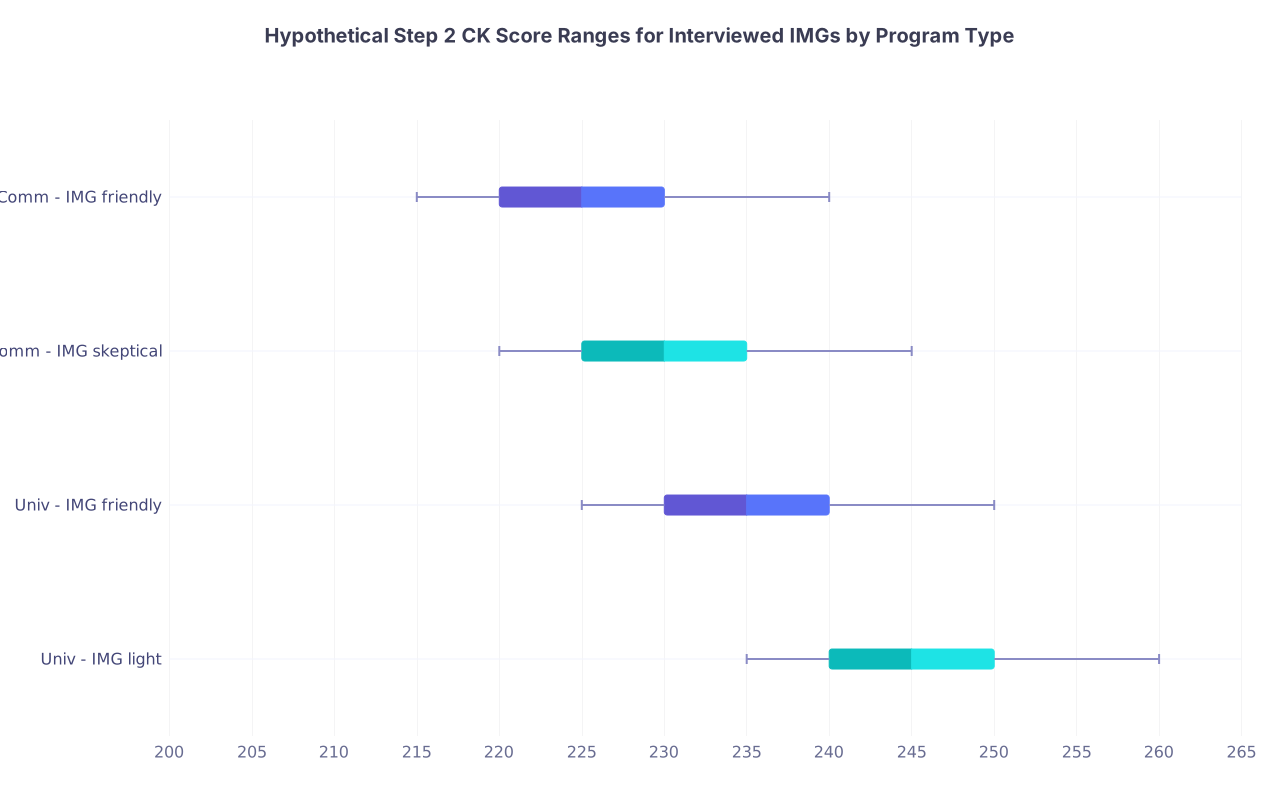
| Category | Min | Q1 | Median | Q3 | Max |
|---|---|---|---|---|---|
| Univ - IMG light | 235 | 240 | 245 | 250 | 260 |
| Univ - IMG friendly | 225 | 230 | 235 | 240 | 250 |
| Comm - IMG skeptical | 220 | 225 | 230 | 235 | 245 |
| Comm - IMG friendly | 215 | 220 | 225 | 230 | 240 |
Notice what changes: the median and the spread dip lower at IMG‑friendly programs. But nobody is interviewing Step 2 CK 205s in large numbers. Friendly means “more forgiving,” not “anything goes.”
The Hidden Reality: Explicit vs Implicit Cutoffs
The biggest misunderstanding is how cutoffs actually work.
You imagine some PD typing “220” into ERAS and deleting everyone below that. Sometimes that happens.
But more often, this is the process:
- Coordinator or PD sets initial filters: “Only complete apps, no fails, Step 2 CK ≥ X.”
- They get an unmanageable number of applications anyway.
- They mentally stratify: high scores = safe, mid scores = maybe, lower scores = only if something stands out (U.S. clinical experience, strong letters, visa‑independent, prior training, etc.).
“IMG‑friendly” programs tend to:
- Set X a little lower
- Pull more people up from the “maybe” and “lower” piles if other strengths exist
- Be more willing to contextualize gaps (older grad, exam retake, non‑linear path)
They do not:
- Ignore that a 190 or marginal pass is predictive of future exam problems
- Spend time reading 1,000 personal statements from people who failed Step 2 CK twice
Programs don’t have the time, and they don’t have the appetite for risk.
I’ve literally heard a PD at a so‑called IMG‑friendly community program in New Jersey say in a meeting:
“We don’t publish a cutoff, but practically if they’re below 215 on Step 2 we almost never rank them. We just don’t have the remediation infrastructure.”
There’s your “friendly.”
Step 1 Pass/Fail: Did That Help IMGs?
Another comforting myth: Step 1 going pass/fail means scores matter less and IMGs have a better chance.
Reality: the pressure moved to Step 2 CK. Hard.
Programs lost a key numeric screen, so they doubled down on the remaining one.
Before P/F Step 1:
- Step 1 = first sort
- Step 2 CK = confirmation and tie‑breaker
After P/F Step 1:
- Step 2 CK = first sort, second sort, and often final sort
- Step 1 pass = minimum bar, but not a differentiator at all
So if you’re an IMG who thought “I can just pass Step 1 and coast into IMG‑friendly programs with a mediocre Step 2 CK,” you misread the room.
For many programs – especially ones flooded with IMGs – Step 2 CK score is the new unofficial filter. Some will even say it bluntly on their website: “Step 2 CK minimum 230 preferred for IMGs.”
“Preferred” here often behaves like “required in practice unless you bring something exceptional.”
Where IMG-Friendliness Actually Helps You
Despite all this, IMG‑friendly programs are different. But not in the fairy‑tale way most students imagine.
They’re different in these ways:
They are used to training IMGs.
They know IMGs can be excellent residents. They’ve seen them match into cards, GI, hospitalist jobs. So they’re less biased by your “IMG” label when your scores are competitive.
They are a bit more flexible around red flags.
Failed Step 1 once but then 240+ on Step 2 CK? A university program might still toss you. An IMG‑friendly community program might actually read your letter from that U.S. attending who says you’re outstanding.
They appreciate U.S. clinical experience more.
At these programs, a rock‑solid letter from a community attending who calls you “top 5% in medical knowledge and work ethic” can compensate somewhat for being 10–15 points below their typical interview range.
They understand visa logistics.
They don’t automatically bin anyone needing H‑1B or J‑1. They have systems in place, and they’ve done it many times.
But none of those things erase the fact that you’re competing in a crowded pool. In some specialties, that pool is almost entirely IMG.
Look at internal medicine or family medicine in certain states: hundreds, sometimes thousands, of IMG applications for a couple dozen interview slots. They still need a triage tool. Scores are the fastest one.
When Scores Start to Matter Less – And What Replaces Them
Here’s the part people really misunderstand: there is a score threshold above which other factors dominate.
Rough heuristic I’ve seen across programs:
- Below 215 Step 2 CK: scoreboard problem. You’re fighting to even be seen.
- 215–230: your application is judged, but with caution; you need strengths elsewhere.
- 230–245: your score is “good enough” for many IMG‑friendly programs; now rotation letters, interviews, and fit matter most.
- 245+: now you’re being taken seriously almost everywhere that considers IMGs at all, provided you are not full of red flags.
For IMG‑friendly programs, once you’re above their comfort zone (say 225–230 CK for many community IM/FM programs), this happens:
- They no longer care whether you’re 231 or 245; both are “safe.”
- They care: Who worked with you clinically? What do your attendings say? How were you on U.S. soil? Are you teachable? Do you speak clear, understandable English with patients? Are you normal to be around at 3 a.m.?
At that stage, yes, the “cutoff” matters less. But you had to cross it first.
Think of it as clearing the minimum altitude to even start flying. Above it, your maneuvering matters. Below it, you’re crashing into the mountain.
Specialty Differences: Not All “IMG-Friendly” Labels Are Equal
Slapping “IMG‑friendly” on a specialty doesn’t mean the same thing across the board.
In internal medicine and family medicine, IMG‑friendly often means:
- A large portion of current residents are IMGs
- They routinely sponsor visas
- Their historical match lists show dozens of IMGs across cycles
Your Step 2 CK cutoffs are softer here, but still real.
In general surgery, neurology, psych, anesthesia, and especially things like radiology or neuro, “IMG‑friendly” might only mean:
- They occasionally take an IMG
- That IMG had stellar scores, U.S. research, and often a U.S. degree or dual status
I’ve seen “IMG‑friendly neurology” lists where the “friendly” programs had average Step 2 CK for IMGs in the 245+ range and required months of U.S. research. Friendly in that they do not flatly ban you. Not friendly in the fairy‑tale sense.
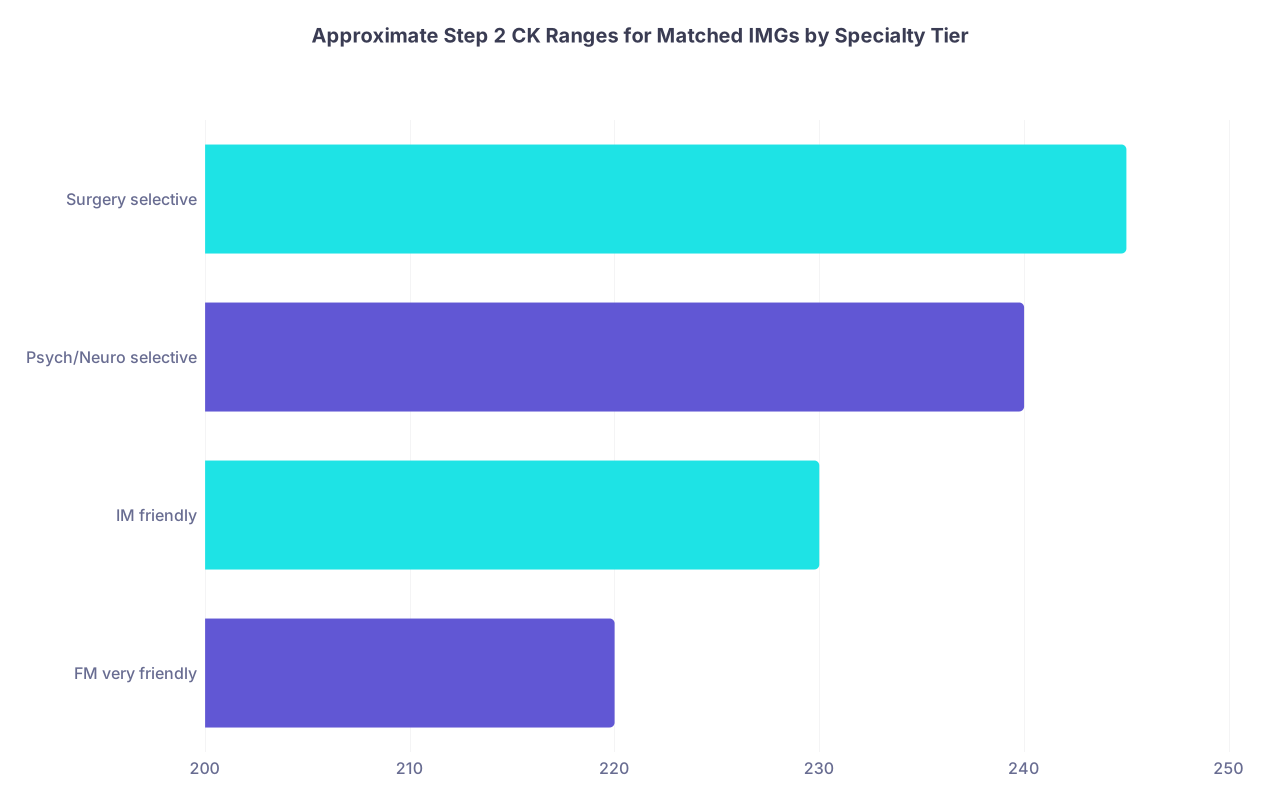
| Category | Value |
|---|---|
| FM very friendly | 220 |
| IM friendly | 230 |
| Psych/Neuro selective | 240 |
| Surgery selective | 245 |
If you’re going into a supposedly IMG‑friendly specialty and you’re under those ranges by 20+ points, a program’s “open to IMGs” line on their website is not going to save you.
So What Should You Actually Do If You’re an IMG?
Let me be blunt.
If your Step 2 CK is:
Below ~215: You’re fighting uphill even at IMG‑friendly programs. You must stack serious strengths: U.S. hands‑on experience, strong letters, no professionalism concerns, and apply very broadly, often across multiple cycles. You may need to reset expectations on specialty and geography.
215–230: Target true IMG‑heavy community programs, heavy U.S. clinical experience, and absolutely no weak letters. Think volume: 150–200+ applications in IM/FM/psych. Your personal statement and letters must scream reliability, not brilliance.
230–245: This is where IMG‑friendliness finally starts working for you instead of just “not excluding” you. You’re now in the common range for many solid community and some university‑affiliated programs that like IMGs.
245+: You’ve removed score as your main barrier. Your challenge shifts to: visa, recency of grad, U.S. experience, and networking. Now, IMG‑friendly programs will often prefer you because you boost their exam stats.
What you absolutely should not do is this:
Look at an “IMG‑friendly programs” PDF, see a list of 40 internal medicine programs, and apply to only those with a 208 and two observerships, then be “shocked” when results are grim. I’ve seen that story too many times.
You need to map your actual score to the realistic tier inside that so‑called friendly universe.

| Step | Description |
|---|---|
| Step 1 | Know Step 2 CK score |
| Step 2 | Apply broadly to FM and IM, 200+ apps, heavy USCE |
| Step 3 | Focus on IMG heavy IM/FM, 150+ apps, strong letters |
| Step 4 | Target mix of community and university affil IMG friendly |
| Step 5 | Above 245 |
| Step 6 | Include selective programs that consider IMGs |
| Step 7 | Below 215 |
| Step 8 | 215 to 230 |
| Step 9 | 230 to 245 |
The Real Answer: Does the Cutoff Matter Less?
So, does USMLE Step cutoff matter less at IMG‑friendly residencies?
Only in a narrow, specific sense:
- They’re more likely to review borderline scores if you have compensating strengths.
- Their practical cutoffs tend to be 5–15 points lower than IMG‑skeptical programs in the same specialty.
- Once you’re above their comfort zone, they actually weigh your non‑score strengths more fairly than some big‑name places that worship numbers.
But a cutoff – explicit or implicit – still exists. It might be softer. It is not gone.
If you take nothing else from this:
- “IMG‑friendly” means more flexible and more experienced with IMGs, not “scores don’t matter.”
- Step 2 CK is now the main gatekeeper; you must clear a realistic floor before friendliness helps you.
- Above that floor, what separates you isn’t another 5 points – it’s U.S. experience, letters, communication, and being someone they can trust at 3 a.m.
Treat “IMG‑friendly” as a small advantage layered on top of a hard reality, not a magic key.