
The myth that “IMG‑friendly” means “age‑friendly” is wrong. Flat‑out.
If you’re an older international medical graduate, you’ve probably heard some version of: “Just target IMG‑friendly programs, they don’t care about age.” That advice sounds comforting. It’s also incomplete and, in a lot of cases, misleading.
Let me be direct: age itself is rarely the problem. The problem is what usually comes with age—long graduation gaps, no recent US clinical experience, dated exam scores, visa headaches, and a narrative that doesn’t convince anyone you’re still all‑in. Even at the so‑called IMG‑friendly places.
What Programs Actually Look At (Spoiler: It’s Not Your Birth Year)
Residency programs in the US don’t have an “age” column on ERAS. There’s no dropdown for “too old.” What they do see, and absolutely care about:
- Year of medical school graduation
- USMLE/COMLEX scores and pass attempts
- Gaps and what you did during them
- Recency and quality of clinical work
- Visa status
- Letters of recommendation and how current they are
Your date of birth is technically visible in your application packet, but when I’ve sat with faculty screening applicants, they never say, “This person is 38, reject.” What they say is, “Graduated 2015, no recent clinical work, step scores from years ago, no US letters. Hard pass.”
Older and younger applicants both get screened on the same visible proxies: recency, performance, risk.
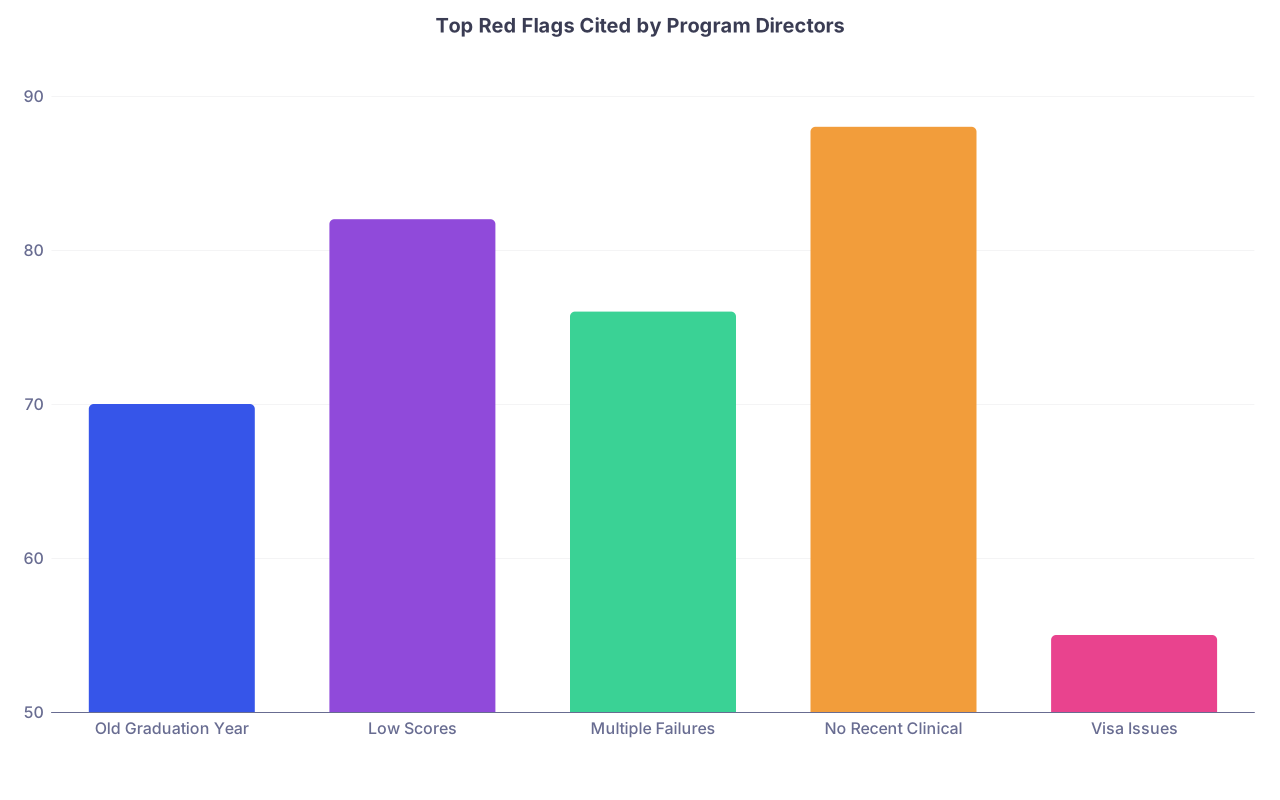
| Category | Value |
|---|---|
| Old Graduation Year | 70 |
| Low Scores | 82 |
| Multiple Failures | 76 |
| No Recent Clinical | 88 |
| Visa Issues | 55 |
That bar chart matches what PD surveys have shown for years: “time since graduation” and “no recent clinical experience” are much bigger issues than “age” itself. People mix these up constantly.
Programs worry about three things:
- Can you safely and efficiently function as an intern on day one?
- Are you likely to finish the program without burning out or failing exams?
- Are you going to be a headache—compliance, visa, professionalism, communication?
If your application signals “yes” to #1 and #2 and “no” to #3, most programs—IMG‑friendly or not—do not care whether you’re 26 or 42.
The Harsh Reality About “IMG‑Friendly” Programs
“IMG‑friendly” is one of the most abused labels in the residency game.
You see lists online: “Top 50 IMG‑friendly Internal Medicine Programs.” Older graduates look at those lists and think, perfect, they’ll take me. That’s not how it works.
Usually “IMG‑friendly” just means one thing: they take a decent percentage of IMGs. It does not mean:
- They ignore year-of-graduation cutoffs
- They’re comfortable with long gaps
- They’ll sponsor every visa under the sun
- They’re OK with multiple attempts or old exam failures
Here’s what I’ve watched happen on actual selection committees:
Program director scrolls the ERAS filter list:
“US grad vs IMG? Open to both. Filter: Step 2 > 220. Year of graduation 2019 or later. No failed attempts. Sort by Step 2 score.”
Notice what’s missing? Age. Notice what’s included? Year of graduation.
Older graduates get chopped right there. Not because of age, but because “2014 grad” falls outside a hard filter. The program can still be “IMG‑friendly” by percentage while quietly killing off older grads with that one criterion.
| Program Type | Year-of-Grad Filter | USCE Requirement | Visa Attitude |
|---|---|---|---|
| Community IM #1 | 2018 or later | 3 months recent | J-1 only |
| Community IM #2 | No formal cutoff | 1 month recent | J-1 or H-1B |
| University IM (IMG%) | 2016 or later | Strongly preferred | J-1 only |
All three may advertise themselves as IMG‑friendly. Only one is actually “older‑grad‑tolerant.” If you don’t separate those two ideas, you’ll keep applying to black holes and then blame your age, when the real issue was the hidden year-of-grad filter.
What the Data Actually Shows About Years Since Graduation
Let’s talk numbers, not folklore.
NRMP Program Director surveys (for multiple cycles) keep showing the same pattern: “time since graduation” matters. A lot. But again: that’s not your age. That’s how rusty they think you are.
The pattern is roughly:
- 0–3 years since graduation: Fully competitive range
- 4–5 years: Noticeable drop, but still many matches, especially for IMGs with strong scores and recent USCE
- 6–10 years: Significantly fewer matches, but not zero—now you need a very tight story and strong recent work
10 years: Very uphill outside a few niches (prelim spots, some community programs, rare “second career” success stories)
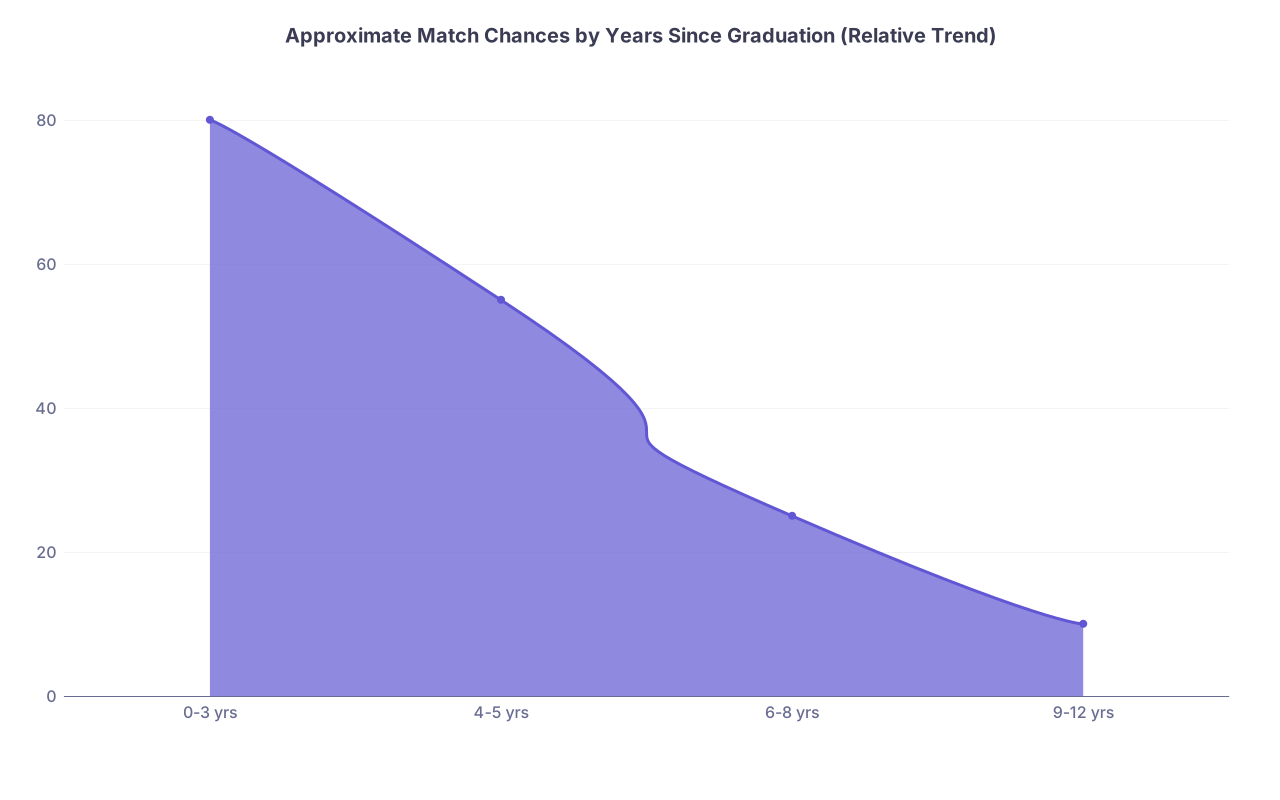
| Category | Value |
|---|---|
| 0-3 yrs | 80 |
| 4-5 yrs | 55 |
| 6-8 yrs | 25 |
| 9-12 yrs | 10 |
Those percentages aren’t official NRMP numbers; they’re a reality-based sketch of what any seasoned advisor sees each cycle.
Key detail: US grads with long gaps also suffer. An American MD who finished in 2012 and then disappeared for a decade? Same problem. Age is correlated with these issues, but not the driving variable.
Programs ask: “Can this person step into a 2026 hospital, with 2026 EMR, 2026 guidelines, 2026 inpatient complexity… and not crash?” If your last real medicine was 2015, they get nervous. That’s it.
Older grads who’ve been clinically active—hospitalist in another country, recent research with patient exposure, up-to-date CME—are in a different category than someone who did nothing clinical for 7 years.
Where Being Older Actually Hurts – Even at IMG-Friendly Places
Let’s stop pretending there’s no age effect at all. There is. It’s just not how people think.
Here’s where being an older graduate does quietly hurt you, even at IMG‑heavy community programs:
1. Program Directors Worry About Stamina and Adaptation
No one will write this in a requirement list, but I’ve heard it verbatim in meetings:
- “He’s 45, did residency already abroad; I’m not sure he’ll put up with night float and q4 call.”
- “She’s been an attending for 10 years in her country. Will she accept being an intern here?”
- “Older applicants sometimes struggle more with new EMR systems and documentation demands.”
Are these stereotypes? Yes. Do they factor into marginal decisions between two applicants with similar stats? Also yes.
You counter that not by arguing about discrimination, but by demolishing the assumptions in your application: recent intense clinical work, comfort with technology, clear reasons you want the grind again.
2. The “Will They Stay?” And “Will They Pass Boards?” Concerns
Programs invest in residents for three years. They’re scared of:
- Someone already financially stretched who quits midway
- Someone whose last real exam was a decade ago and now fails Step 3 or ABIM/ABFM
Older grads, especially those with families or other careers, get extra scrutiny on those points. Again, not formally. But in the back-room discussions, this absolutely plays a role.
You fight this with:
- Fresh exam performance (strong Step 2 CK, Step 3 if you can)
- A cohesive, realistic explanation of your path and long‑term goals
- Evidence that you can and do study seriously at your current life stage
3. Logistic Headaches: Visas + Licensing
Visa + age is a bad combination for some programs.
If you’re an older grad needing H‑1B, many IMG‑heavy community hospitals will quietly move you lower on the list. Not because of your age alone, but because: older, non‑US citizen, needing H‑1B, long gap, older scores = risk cocktail.
Some states also have licensing rules that make very old graduation or long gaps a bureaucratic nightmare. Few PDs want to fight that battle.
Where Age Actually Helps You
Now for the part most people ignore.
In certain contexts, being older is an advantage, and the more honest PDs will admit it.
1. Maturity With Patients and Teams
Nurses, attendings, social workers—many of them trust older interns faster. I’ve heard, “That 40‑year‑old PGY‑1 from abroad? Patients love him. He talks like a grown-up.”
For specialties heavy on communication and disposition—internal medicine, family medicine, psych—that matters. At IMG‑friendly community hospitals with lots of vulnerable or complex patients, emotional maturity is a plus.
2. Procedural and Workflow Experience
If you’ve done real medicine abroad—running codes, managing wards, making triage decisions—you walk in with instincts that many 26‑year‑old interns simply do not have yet.
You have to be humble about it—no one wants the “I was an attending back home” speech in every conversation—but when framed right, that prior experience is a selling point.
3. Reliability and Professionalism
Programs burned by flaky residents often shift in the other direction: they start appreciating the 35‑year‑old with a family and a stable life more than the 25‑year‑old who still parties like it’s finals week.
I’ve seen PDs say, “She’s older, has three kids, and has kept a job for years. She’ll show up. She’s not going to disappear after a bad shift.”
How to Tell If a Program is Truly Older-Grad-Friendly
Here’s where people get lazy: they look at one spreadsheet that says “40% IMGs” and call it a day. You can do better.
Look at:
- Current residents’ graduation years. Scroll every PGY class on the website. If PGY‑1s are all 2021–2023 grads, and you’re 2015, that’s a clue.
- Residents’ ages by photo and bios. It’s not perfect, but if everyone looks 26, patterns exist. If you see several obvious second‑career people, good sign.
- State and program‑reported year‑of‑grad limits. Some are posted openly on FREIDA or program sites. Many aren’t, but if you see nothing older than 5 years in any class, you’ve got your answer.
- Alumni stories. Programs that truly embrace older grads often brag about them: “Former cardiologist from India now thriving in our program,” etc.

| Step | Description |
|---|---|
| Step 1 | Find IMG Friendly List |
| Step 2 | Check Resident Grad Years |
| Step 3 | Low Priority |
| Step 4 | Check Web Bios |
| Step 5 | Medium Priority |
| Step 6 | High Priority |
| Step 7 | Any >5 yrs From Grad? |
| Step 8 | Any Second Career Paths? |
If you don’t see any evidence of older grads in their current or recent residents, assume you’re fighting upstream there.
Strategies That Actually Move the Needle for Older IMGs
Being older doesn’t automatically kill your chances, but you can’t play the game like a fresh grad, either.
1. Maximize Recency: Clinical, Not Just Observerships
IMG‑friendly programs care far more about recent clinical exposure than your calendar age.
You need, ideally:
- US clinical experience within the last 12 months
- At least one letter from someone who can say, “I saw this doctor recently manage patients competently”
Observerships are better than nothing, but hands-on, supervised roles (in any country) with clear start/end dates trump “I helped my uncle at his private clinic.”
2. Strong, Recent Exam Performance
If your Step 2 is from eight years ago, that’s a red flag in 2026. If you can, take (and crush) Step 3 close to application time. It proves your brain still works at test speed, which reassures jittery PDs.
3. Ruthless Program Targeting
You don’t have the luxury of wishful thinking.
- Focus heavily on community IM, FM, psych, prelim IM, prelim surgery
- Prioritize states and hospitals that already have older IMGs in their resident photos
- De‑prioritize academic university programs that only use IMGs as filler on prelim tracks
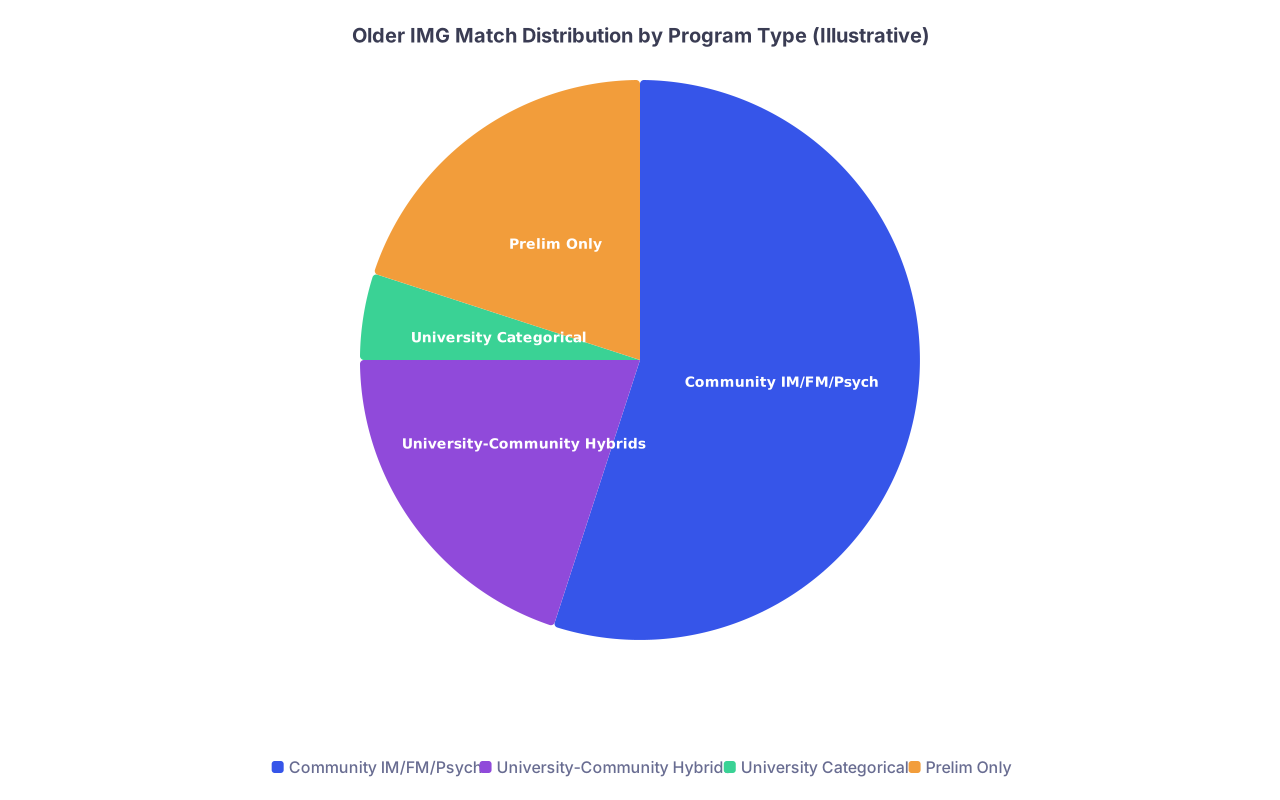
| Category | Value |
|---|---|
| Community IM/FM/Psych | 55 |
| University-Community Hybrids | 20 |
| University Categorical | 5 |
| Prelim Only | 20 |
Again, that distribution is reality-informed, not official NRMP data—but it matches what you see if you actually map where older IMGs end up.
4. A Coherent Story That Explains the Gap Without Sounding Defensive
This matters more than people admit.
Programs don’t like mystery. If you graduated in 2014 and are applying in 2026, you need to give them a crisp, believable arc:
- What you did
- What you learned
- Why US residency now
- Why you’re not going to bail halfway through
Write like a grown-up who has thought hard about this, not like someone throwing darts because every other path failed.
So, Does Being an Older Graduate Hurt You Even at IMG-Friendly Programs?
Yes—if you conflate “IMG‑friendly” with “forgives long gaps, old scores, and unclear trajectories.”
No—if you show recent clinical ability, strong exams, logistical simplicity, and a clear reason for your path that makes you look like a valuable, motivated adult, not a risk.
The blunt truth:
- Programs don’t care about the number of candles on your cake; they care about how long it’s been since you actually practiced and studied medicine seriously.
- “IMG‑friendly” doesn’t automatically mean friendly to older grads. You have to target the subset of programs that demonstrably take people like you.
- Older IMGs do match every year—but the ones who succeed treat their age as a factor to manage strategically, not a curse or a secret weapon.