The idea that “IMG-friendly programs don’t care about research or publications” is wrong. Not slightly off. Just wrong.
They care. They just care differently than the prestige-obsessed echo chamber of Reddit and WhatsApp groups wants to believe.
If you’re an IMG banking on the myth that research “doesn’t matter” for community or IMG-heavy programs, you’re playing with fire. You might still match. But you’re stacking the odds against yourself in a game where you already start behind.
Let’s walk through what the data and actual program behavior show—separated from the comforting stories applicants tell themselves.
What Programs Actually See When They Look at Your Application
Programs don’t open ERAS and see “IMG” and then toggle research visibility off. That’s fantasy.
They see a grid of applicants. Columns: school, USMLE, attempts, gaps, visa need, scholarly output. Then they filter.
The NRMP’s “Charting Outcomes in the Match” (yes, the boring PDF everyone pretends to have read) tells the same story every cycle: more research output, on average, correlates with higher match rates—across almost every specialty. That correlation doesn’t magically stop at the door of “IMG-friendly” programs.
Here’s a reality check using broad trends from US and IMG data reported by NRMP and ERAS over recent years:
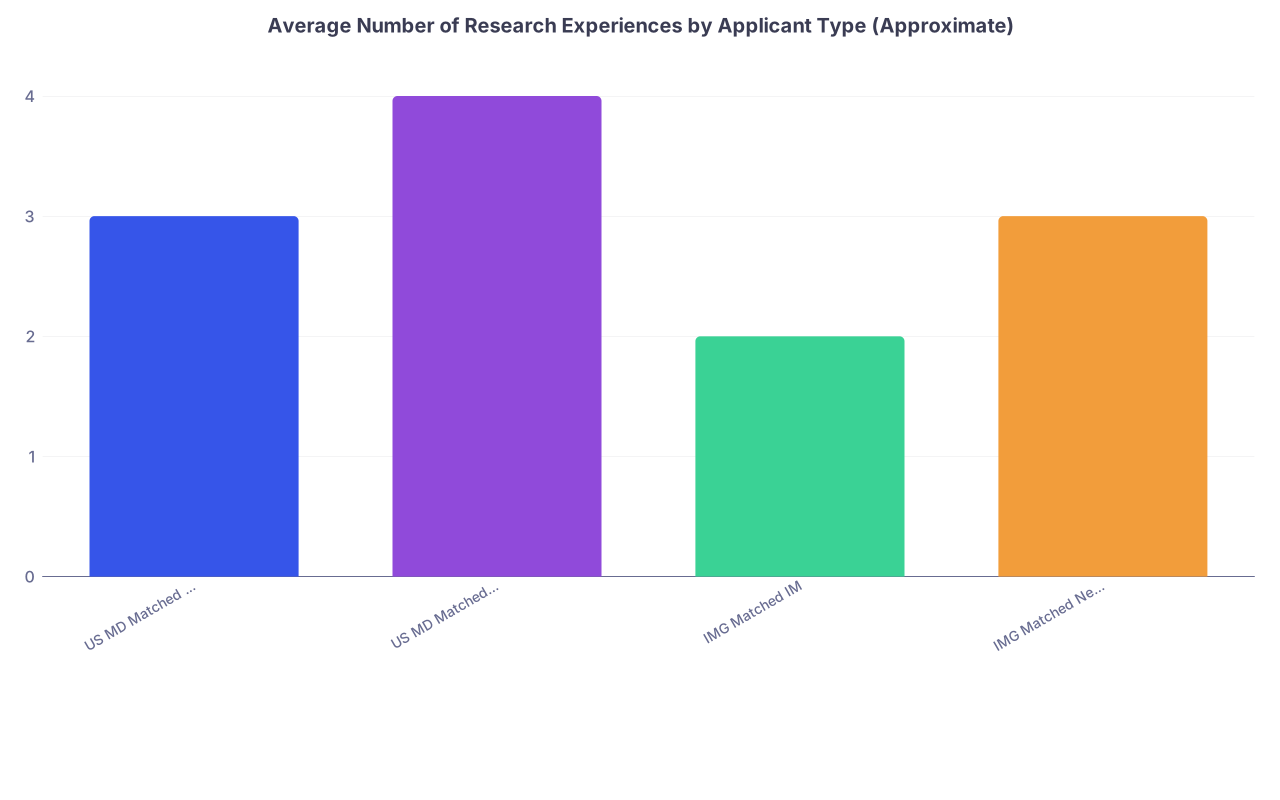
| Category | Value |
|---|---|
| US MD Matched IM | 3 |
| US MD Matched Neuro | 4 |
| IMG Matched IM | 2 |
| IMG Matched Neuro | 3 |
The exact numbers change slightly year to year, but the pattern is consistent: matched applicants—US and IMG—tend to have non-trivial research involvement, even in supposedly “IMG-friendly” fields like internal medicine and neurology.
Do programs sit there and say, “We love IMGs, so research doesn’t matter”? No. They say: “We like IMGs, we’re more flexible on pedigree and Step 1 school name, but we still need evidence this person is serious, reliable, and can think beyond memorization.”
Publications and research are one of the easiest ways to show exactly that.
Where the Myth Comes From (And Why It’s Comfortable)
I’ve heard this line from IMGs a hundred times during application season:
“Sir, that program is community, they don’t care about research at all. They just want hard workers.”
You know who says that? Usually someone with:
- Low or borderline scores
- No US research
- Maybe observerships, maybe not
- A lot of anxiety looking for a reason not to feel behind
So they create a narrative: “Those other things don’t matter where I’m applying.”
Reality: community and IMG-heavy programs may weigh research differently, but they absolutely use it as a sorting tool when they’re staring at a list of 5,000 applications for 10 spots.
I’ve seen this happen in selection meetings at community internal medicine and neurology programs:
- Two IMGs with similar Step 2 scores
- Both need visas
- Both from mid-tier foreign schools
- One has 0 publications, one has 2 case reports and 1 poster at a regional conference
Who gets the interview? Almost always the one who has shown they can start and finish academic work. Even if the conference is “small.” Even if the journal is not JAMA.
Does that mean research is more important than Step scores? No. If your Step 2 is 205, ten case reports will not save you. But pretending research plays no role is delusional.
“IMG-Friendly” Doesn’t Mean “Low Standards”
IMG-friendly usually means some combination of:
- They regularly sponsor visas
- They routinely take IMGs (10–80% of residents, depending on specialty and region)
- They’re less hung up on US MD/DO pedigree
It does not mean:
- They ignore red flags
- They do not care about academic engagement
- They view “no research” as neutral
In fact, for IMGs, the bar on “proof of effort” is often higher, not lower. You’re an unknown quantity to them. They don’t know your school grading rigor. They haven’t rotated with you for years. They have no home program whispering, “Yes, she’s good. Take her.”
So they look for:
- US clinical experience
- Consistent timeline (no unexplained multi-year gaps)
- And yes—any sign you’ve engaged in scholarship, quality improvement, audits, presentations, or publications
Let me put it bluntly: in a pile of applications from IMGs, completely blank “Scholarly Activities” sections scream one thing—minimal initiative.
If they can pick between someone who used 6–12 months to do research or QI and someone who did nothing except “prepare for exams,” you know how this ends.
But I’ve Heard Community Programs “Don’t Do Research”
Sure. Many community programs don’t have massive NIH funding or basic science labs. That’s not the same as “they don’t value scholarly output at all.”
Look at almost any ACGME program requirements. Internal medicine, family medicine, neurology, psychiatry, surgery—they all have some version of:
- Participation in scholarly activity
- QI projects
- Journal clubs
- Case presentations or posters
Now ask yourself: who is more attractive to such a program?
- The IMG who has never written so much as a case report, never submitted a poster, and has a blank section under research, or
- The IMG who has a small but genuine track record: a case report, a poster at ACP, a QI project at a US hospital?
Programs don’t require your name on a randomized controlled trial in NEJM. But they do like people who’ve shown:
- Ability to work with a team
- Follow-through from idea to output
- Basic familiarity with how academic medicine functions
Even community programs care about accreditation. When the ACGME site visitor asks, “Show me evidence your residents do scholarly activity,” they’re not going to say, “We only recruit people who hate research, so we skipped that part.”
What the Data Actually Suggests About IMGs and Research
The NRMP has shown repeatedly that:
- Higher scholarly output (publications, abstracts, posters, presentations) tracks with higher match rates—even after you control for USMLE to some extent.
- For competitive specialties (radiology, anesthesia, EM, anything surgical), research is functionally mandatory unless you’re an outlier on scores or connections.
- For so-called “IMG-friendly” specialties (internal medicine, family, psych, neuro), the people who do match from the huge IMG applicant pool aren’t usually the ones with blank CVs.
Look at the rough relationship:
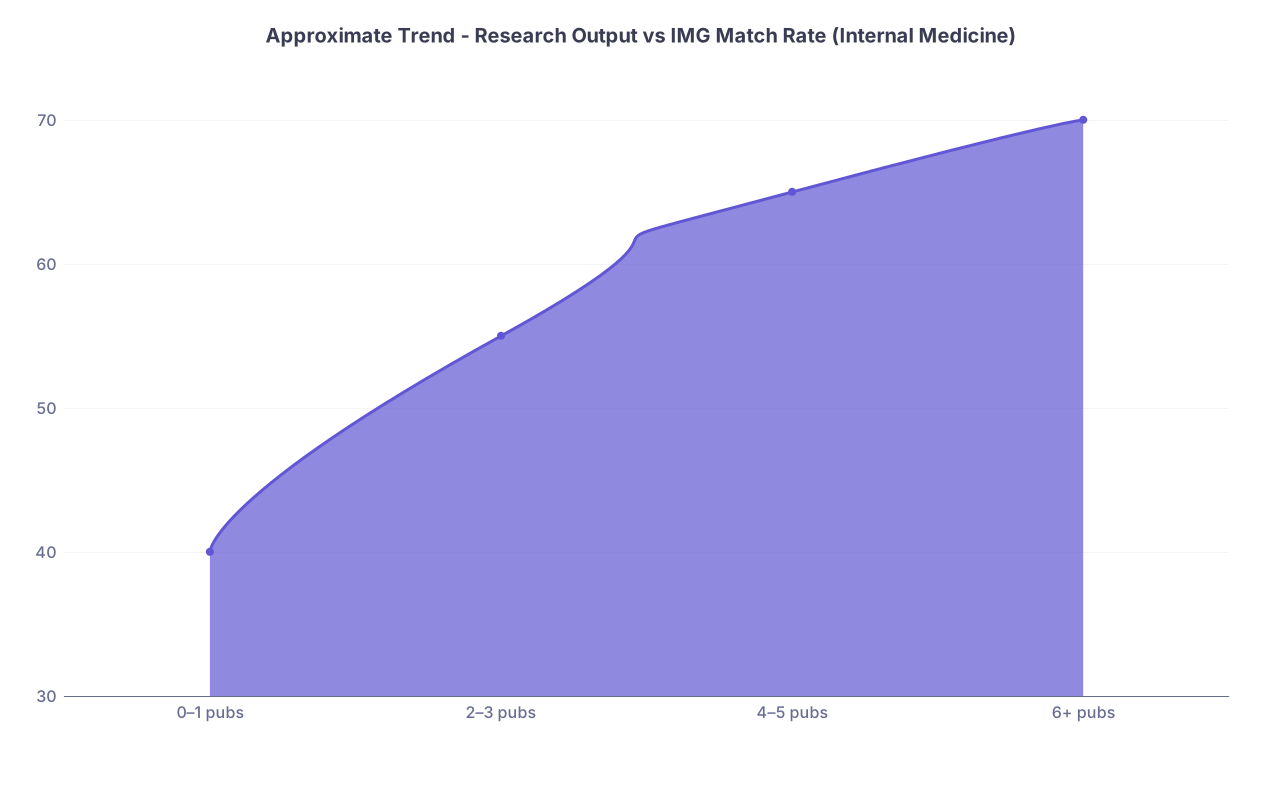
| Category | Value |
|---|---|
| 0–1 pubs | 40 |
| 2–3 pubs | 55 |
| 4–5 pubs | 65 |
| 6+ pubs | 70 |
These are directional, not exact numbers, but the message is simple: once scores are acceptable, every extra sign of academic productivity improves your odds.
Programs never say, “We are IMG-friendly and do not care about research at all.” They say, “We are IMG-friendly, but we still get far more qualified applicants than positions. We will favor those who show more commitment and productivity.”
How Programs Actually Use Research in Screening
Let’s demystify this. Research is rarely the first filter. But it’s an important tiebreaker and context amplifier.
Typical hierarchy for many IMG-heavy internal medicine or neurology programs:
Automatic screens
- Failed Steps? Repeated attempts? Out.
- No Step 2 score yet? Often out.
- Massive graduation gap (8+ years) without explanation? Often out.
Score thresholds and visa
- Step 2 below a certain cutoff? Reduced priority or automatic rejection.
- Need visa? Some programs say no outright. Others accept but tighten thresholds.
Within the “viable” pool – competitive sorting
- US clinical experience
- LORs from US attendings
- Evidence of professionalism, no red flags
- And yes: research, QI, academic output
It’s at step 3 that research can rescue you—or sink you quietly.
Two IMGs with:
- Step 2 = 232 vs 235
- Both need J‑1
- Both with 3 months USCE
Applicant A: 0 posters, 0 case reports, 0 anything
Applicant B: 1 poster at a local hospital symposium, 1 case report in a modest journal
You know who gets pulled from the chaos of a 5,000-applicant ERAS bin and turned into an interview invite. It’s not the one with the nicer personal statement. It’s the one with something extra they can point to.
“But My Friend Matched With No Research”
Yes. And someone wins the lottery every week too.
Anecdotes are seductive because they’re simple. The problem is survivorship bias. You’re hearing from the IMGs who matched despite flaws, not the thousands who didn’t match with similar profiles.
If your benchmark is: “Is it possible to match into X with no research?”—the answer is usually yes for IM and FM, and sometimes psych and neuro.
If your benchmark is: “Is it wise to skip research because someone else matched without it?”—the answer changes. Dramatically.
Here’s the honest framing: skipping research might not kill your chances. But it almost never helps them. And in a hyper-competitive IMG pool, voluntarily giving up a positive differentiator is a bizarre strategic choice.
What Type of Research Actually Matters for IMG-Friendly Programs
Here’s where a lot of people overcomplicate things. IMG-friendly programs generally don’t care if your project is:
- Multi-center
- RCT vs retrospective
- NEJM vs random open-access journal
They care about signals:
- Did you work with others in a structured academic setting?
- Can you complete a project to the point of presentation or publication?
- Does your work connect to clinical medicine, QI, or education?
For IMGs, realistic and useful targets usually look like:
- Case reports (yes, they still count, despite the online sneering)
- Small retrospective chart reviews
- Quality improvement projects in a US hospital
- Posters at ACP, AAN, APA, AAFP, CHEST, local state or regional meetings
- Simple educational projects with measurable outcomes
Stop obsessing over “impact factor” and “tier.” For most IMG-friendly programs, demonstrated effort > theoretical prestige.
How Much Research Is “Enough” for an IMG?
There’s no magic number, but there are tiers of credibility.
| Profile | How It Often Reads to Programs |
|---|---|
| 0 activities, blank section | No initiative, missed opportunities |
| 1–2 small case reports/posters | Basic engagement, shows effort |
| 3–5 outputs, mix of QI/posters | Stronger signal of academic commitment |
| 6+ with US-based work | Clearly serious, especially for IMGs |
For internal medicine / family / psych / neuro at IMG-friendly programs:
- 1–2 decent outputs already help a lot compared with zero
- 3–5 thoughtful, real activities put you in a much stronger lane
- Anything involving US mentors or institutions is disproportionately valuable
Again: this sits on top of acceptable scores. Research is not a cosmetic patch for bad exams.
The Harsh Truth: Research Is One of the Few Things You Can Still Improve
Scores are often locked. School name is fixed. Graduation year is fixed. Citizenship is fixed.
What’s left that you can still upgrade?
- US clinical experience
- Letters
- Personal statement
- And research / scholarly activity
That’s why the “IMG-friendly programs don’t care about research” myth is not just inaccurate—it’s dangerous. It convinces people to neglect one of the only levers they can still realistically pull.
You don’t need to spend three years in a lab. But 6–12 months of focused, realistic, clinically-oriented research or QI can:
- Get you US mentors who will vouch for you
- Populate your ERAS with concrete outputs
- Give you interview talking points that aren’t “I worked hard and love internal medicine”
If you’re planning a research year or QI/publication push, think in simple terms:

| Step | Description |
|---|---|
| Step 1 | Decide to Improve CV |
| Step 2 | Find US mentor or institution |
| Step 3 | Join ongoing project or QI |
| Step 4 | Produce poster or case report |
| Step 5 | Submit to conference or journal |
| Step 6 | Update ERAS and CV |
| Step 7 | Use experience in interviews |
Not elegant. But it works.
The Myth, Busted
Let me strip this down to the essentials.
IMG-friendly ≠ research-blind. These programs may be more flexible on pedigree and Step worship, but they still use research and scholarly activity as a real selection signal—especially to sort among IMGs.
Zero research is almost always a disadvantage. You can still match without it in some fields, but you are choosing to remove one of the few controllable strengths from your application.
You don’t need glamorous research. You need real output. Case reports, QI, small posters, regional conferences—especially in US settings with US mentors—carry more weight than you think.
If you’re serious about matching as an IMG, stop repeating the myth that “those programs don’t care about research.” Start asking a better question:
“Given my scores and background, how much evidence of scholarly effort can I realistically add before I apply—and why on earth would I choose to add none?”