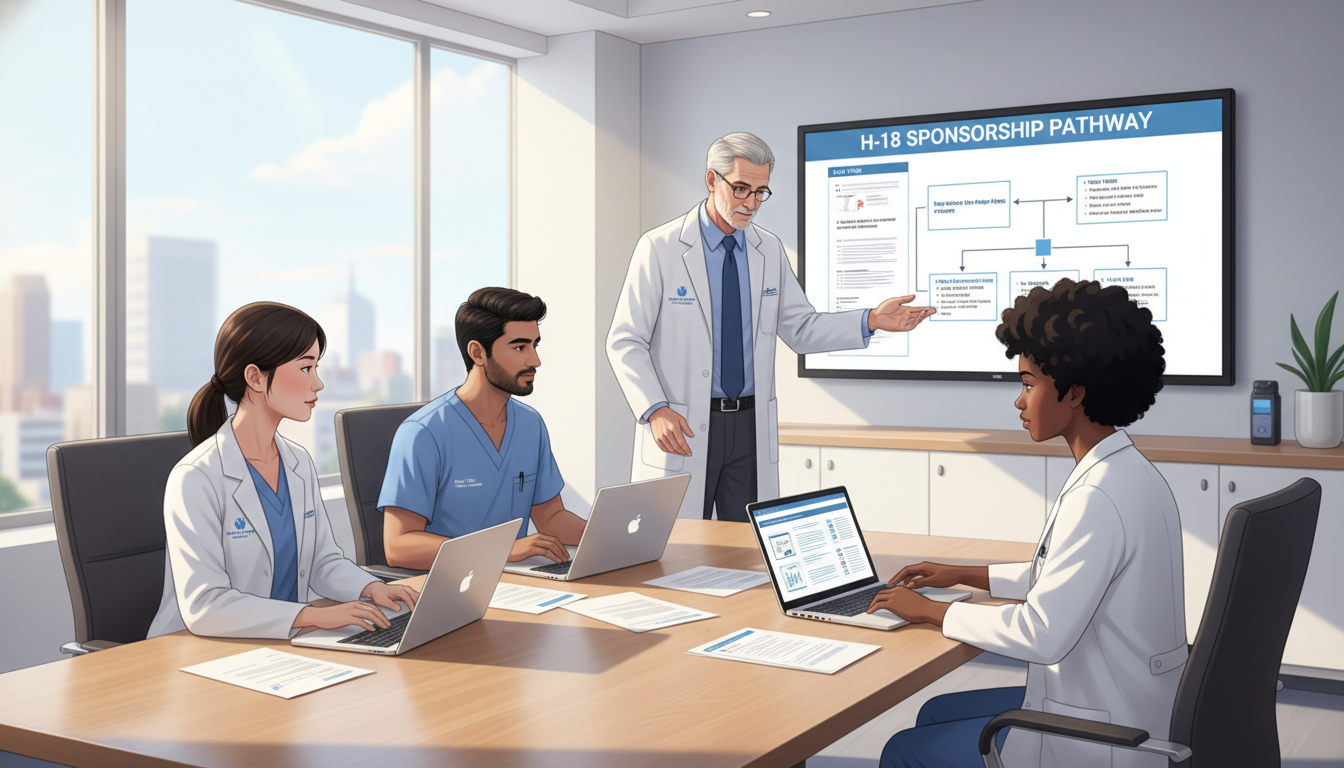
The Research Triangle in North Carolina—anchored by Raleigh, Durham, and Chapel Hill—is one of the most exciting regions in the United States for an international medical graduate (IMG) pursuing residency. For IMGs who prefer or require H‑1B sponsorship instead of a J‑1 visa, understanding which programs are willing to sponsor, how H‑1B rules work, and how to plan strategically is critical.
This IMG residency guide focuses on H‑1B sponsorship programs in the Research Triangle (NC), with special attention to Duke residency programs, UNC, and regional community hospitals. It will help you understand your options, optimize your application strategy, and avoid common pitfalls as an IMG seeking H‑1B support.
Understanding H‑1B for Residency: Core Concepts for IMGs
Before you look for a specific H‑1B sponsor list or decide which North Carolina residency programs to target, you need a clear understanding of how H‑1B actually works in the context of GME (graduate medical education).
What is the H‑1B for Residents?
For residency training, the H‑1B is a temporary employment visa that allows U.S. teaching hospitals to employ foreign physicians. Key features relevant to IMGs:
- Employer‑sponsored: You cannot apply for this visa on your own; the residency program (hospital) is your petitioner and sponsor.
- Specialty occupation: Residency in accredited programs is recognized as a specialty occupation requiring at least a medical degree.
- Time limit: Typically up to 6 years in total (including any prior H‑1B time in the U.S.), usually granted in 1–3 year increments.
- Dual intent: Unlike J‑1, H‑1B allows “dual intent,” meaning you can pursue permanent residency (green card) without violating your status.
This makes H‑1B attractive to many international medical graduates who want to stay in the U.S. long-term or wish to avoid the J‑1 two‑year home residency requirement.
H‑1B vs. J‑1 for IMGs in Residency
Most U.S. residency positions for IMGs are still funded under J‑1 exchange visitor visas. Comparing them:
J‑1 (via ECFMG)
- Sponsored by ECFMG, not the hospital.
- Requires return to home country for two years after training (unless you obtain a waiver).
- More widely accepted and administratively simpler for many programs.
- Usually does not allow moonlighting outside your primary training site.
H‑1B (via hospital)
- Sponsored directly by the residency program/hospital.
- No automatic two‑year home rule (though other home‑country obligations may still apply).
- Can transition more smoothly to employment and green card sponsorship.
- More paperwork, legal cost, and institutional risk for the employer—so fewer programs are willing to do it.
Many Research Triangle institutions support both options but may have department‑specific policies that differ even within the same university or hospital system.
Cap‑Subject vs. H‑1B Cap‑Exempt for Residents
For residency positions, the question of H‑1B cap‑exempt status is crucial:
- Cap‑subject H‑1B: Most private employers must enter the H‑1B lottery, which has far fewer visas than applicants.
- Cap‑exempt H‑1B: Certain employers are not subject to the lottery; they can file at any time of year.
In the Research Triangle, most large academic health systems are H‑1B cap‑exempt because they are:
- Nonprofit organizations affiliated with a university (e.g., academic medical centers); or
- The universities themselves.
This cap‑exempt status is one of the biggest advantages for an IMG targeting North Carolina residency programs in the Triangle: it significantly reduces uncertainty and timing issues that plague cap‑subject H‑1B paths.
Major H‑1B Sponsorship Opportunities in the Research Triangle
In the Research Triangle, the most relevant institutions for an IMG seeking H‑1B residency programs are:
- Duke University Hospital / Duke Health
- University of North Carolina Hospitals (UNC Health)
- WakeMed Health & Hospitals
- UNC Rex Healthcare and other UNC-affiliated community sites
- VA Medical Centers and some regional partners used as training sites
Below is an overview of how H‑1B sponsorship typically plays out at each of the major players. Policies can change annually, so always verify on the program’s official website or by contacting their GME office.
1. Duke Residency Programs (Durham, NC)
Duke is a leading academic medical center and one of the premier destinations in the Southeast for an international medical graduate. It is also a cap‑exempt H‑1B employer, given its nonprofit academic status and close university affiliation.
General stance on H‑1B for IMGs
Duke residency programs vary in how IMG-friendly they are and whether they will sponsor H‑1B visas. In broad terms:
- Duke has a long history of training international medical graduates.
- Many departments accept J‑1 and H‑1B, especially for highly competitive candidates.
- Some smaller or resource-limited departments may prefer J‑1 only, especially for preliminary or transitional years.
To find the most accurate information:
- Check each specific Duke residency program website (e.g., Internal Medicine, Anesthesiology, General Surgery).
- Look under “Eligibility & Visa” or “International Applicants” sections.
- If unclear, email the program coordinator asking directly about H‑1B sponsorship for categorical IMGs.
Common patterns at Duke
- Internal Medicine, Anesthesiology, Radiology, Pathology, and Neurology at many large academic centers (including institutions like Duke) are more likely to consider H‑1B sponsorship for strong candidates.
- Preliminary-only positions may be less likely to spend the cost and administrative effort on an H‑1B, preferring J‑1.
- Research‑heavy programs may look favorably at IMGs with prior U.S. research experience or PhDs, which can strengthen the H‑1B case.
Practical steps for IMGs targeting Duke on H‑1B
- Narrow to specific programs (e.g., Duke Internal Medicine, Duke Pediatrics) and read their IMG visa policy.
- Ensure you meet common H‑1B prerequisites:
- ECFMG certification in time for rank order list.
- USMLE Step 3 passed by a defined deadline (often before match or before visa filing).
- If you’re an exceptionally competitive candidate, consider explicitly mentioning your preference for H‑1B in your ERAS personal statement or a follow‑up communication—after confirming the program is open to it.

2. UNC Residency Programs (Chapel Hill, NC)
The University of North Carolina at Chapel Hill and UNC Health represent another major hub of residency opportunities in the Triangle. Like Duke, UNC is a cap‑exempt H‑1B employer, providing a major advantage for IMGs.
H‑1B and IMG friendliness at UNC
- UNC is generally IMG‑friendly in several programs, especially in fields like Internal Medicine, Family Medicine, Pediatrics, and Psychiatry.
- Policies may differ by department. Some may sponsor only J‑1; others may be open to both J‑1 and H‑1B.
- UNC’s strong public mission and ties to state funding sometimes influence visa choices, especially around long‑term workforce needs in North Carolina.
As with Duke residency, consult each program’s website for visa policy details and H‑1B eligibility requirements.
UNC’s advantage: Statewide network and community sites
UNC residents often rotate at community hospitals or affiliated sites (e.g., UNC Rex Healthcare, Chatham Hospital, and others). Most of these are connected through UNC Health, which typically shares central GME policies.
For an international medical graduate, this means:
- You may get community hospital experience while still holding a university-based H‑1B.
- No additional visa sponsor is required for short-term rotations, as long as they are part of your approved training program.
3. Community and Regional Hospitals in the Triangle
Beyond Duke residency and UNC residency programs, the Research Triangle includes important community systems:
- WakeMed Health & Hospitals (Raleigh, NC)
- UNC Rex Healthcare (Raleigh, NC)
- Durham VA Medical Center (often used as a training site by Duke)
- UNC and Duke community affiliates throughout the region
The key point: many of these hospitals are training sites for academic residencies rather than independent residency sponsors. For visa purposes:
- Your primary residency sponsor (e.g., Duke or UNC) usually files and maintains your H‑1B.
- Your rotations at affiliate hospitals are part of your training plan, not separate H‑1Bs.
A few community hospitals may run their own accredited residency programs (particularly in Family Medicine, Internal Medicine, Transitional Year, or Psychiatry). Their H‑1B policies can vary:
- Some do not sponsor H‑1B at all due to cost and administrative complexity.
- Others may sponsor H‑1B selectively or only if J‑1 is not possible.
For each such program, read their GME page and, if needed, email the program coordinator to ask:
“Do you sponsor H‑1B visas for international medical graduates entering PGY‑1 categorical positions?”
Eligibility Requirements for H‑1B Residency Sponsorship
Even in IMG‑friendly and H‑1B‑friendly programs, not every international medical graduate will qualify for H‑1B. Programs in the Research Triangle (NC) and beyond tend to have similar minimum standards.
1. ECFMG Certification
Nearly all programs require:
- Valid ECFMG certification by the time residency starts (or often by rank list deadline).
- Completion of USMLE Step 1 and Step 2 CK.
- For some candidates trained in English or certain countries, the OET (replacing Step 2 CS) requirements as determined by ECFMG.
Without ECFMG certification, you will not be eligible for most H‑1B‑sponsoring residencies.
2. USMLE Step 3: A Major Gatekeeper
The single biggest extra condition for H‑1B compared with J‑1 is Step 3:
- Most H‑1B residency programs insist you pass USMLE Step 3 before H‑1B petition filing.
- Practical deadline: Step 3 result available by March–May before July 1 start, depending on each institution’s timeline.
In the Research Triangle, Duke and UNC residency programs typically follow this pattern. That means:
- If you are applying this year for residency starting July next year, schedule Step 3 well before December of the application year.
- Allow room for potential retake; many IMGs plan Step 3 6–9 months before Match Day.
Programs know that Step 3 is challenging for many international medical graduates, so passing it early strongly strengthens your H‑1B case and your overall competitiveness.
3. Medical School and Degree Requirements
To qualify for H‑1B in a physician role:
- Your medical school must be recognized and listed appropriately in World Directory of Medical Schools.
- You must hold an MD, MBBS, or equivalent acceptable to state licensing boards.
Each program must also ensure you meet North Carolina Medical Board requirements for a training license or limited license. IMGs coming from non‑English medical instruction may have to provide evidence of language proficiency.
4. Licensing and GME Sponsorship Rules
Residency programs in the Research Triangle must ensure you:
- Qualify for a training license in North Carolina.
- Are covered under institutional guidelines for supervision and progressive responsibility.
In some cases, institutions restrict H‑1B to categorical positions only, avoiding issues with short preliminary contracts that might not justify visa processing.
Finding and Evaluating H‑1B Residency Programs in the Triangle
There is no single official “H‑1B sponsor list” that covers all residency programs, but you can assemble your own strategy tailored to the Research Triangle.
Step 1: Build a Targeted Program List
Start with the main GME institutions:
- Duke University Hospital / Duke Health GME
- UNC Hospitals / UNC Health GME
- WakeMed and other ACGME‑accredited regional residencies
For each specialty (e.g., Internal Medicine, Pathology, Family Medicine):
- List all programs in the Research Triangle (Raleigh, Durham, Chapel Hill, nearby towns).
- Visit each program’s webpage and look for:
- “International Medical Graduates”
- “Visa Sponsorship”
- “Eligibility Requirements”
Note whether they explicitly say:
- “We sponsor H‑1B and J‑1 visas”
- “We only sponsor J‑1 visas”
- Or whether they are silent (in which case, email them).
Step 2: Directly Confirm H‑1B Policies
Send concise, professional emails to program coordinators:
- Introduce yourself as an international medical graduate.
- State your interest in the specific residency program.
- Ask:
- “Do you sponsor H‑1B visas for categorical IMGs?”
- “Is USMLE Step 3 required for H‑1B consideration, and by what date?”
This not only yields critical information but also shows your professionalism and planning.
Step 3: Evaluate Fit and Competitiveness
Some H‑1B residency programs in the Triangle will receive many more IMG applications than they can accommodate under H‑1B. To strengthen your chances:
- Highlight U.S. clinical experience, especially in North Carolina or the Southeast.
- Show research or quality improvement projects, particularly if they align with Duke or UNC’s academic strengths.
- Emphasize strong communication skills, as many programs worry about language barriers with H‑1B candidates.
If your profile is borderline for a top‑tier academic program, consider applying to both H‑1B‑friendly and J‑1‑friendly options to maximize your overall chance of matching.

Strategic Advice for IMGs Seeking H‑1B in the Research Triangle
Many IMGs want H‑1B residency at Duke or UNC but underestimate how much planning is required. The following strategy can significantly improve your chances.
1. Think in Timelines, Not Just Steps
Work backward from a typical July 1 start date:
- July–September (application year): ERAS submission; interviews begin.
- October–January: Interviews; programs decide on which IMG candidates to consider for H‑1B.
- March: Match Day.
- April–May: H‑1B petition filing and processing for July start (for cap‑exempt institutions).
- July 1: Start of residency.
To be ready for H‑1B, you should aim to:
- Pass Step 3 by December–January of the application cycle at the latest.
- Have ECFMG certification complete by January–February.
- Gather necessary documents (diploma, transcripts, prior visa records, etc.) early.
2. Decide Early: H‑1B vs. J‑1 Strategy
Some IMGs strongly prefer H‑1B; others are open to both. Consider:
- If you have government funding or obligations that may restrict J‑1, then H‑1B might be your only realistic option.
- If your long‑term plan is permanent settlement in the U.S. and easy job transitions, H‑1B is attractive.
- If your profile is mid‑range and you care most about simply matching, you may broaden your list to J‑1‑friendly programs as well.
In the Research Triangle, you can often prioritize H‑1B programs at Duke and UNC while still ranking J‑1‑only positions lower on your list if J‑1 is acceptable for you.
3. Strengthen Your Application for Top Academic Centers
Duke residency and UNC residency are highly competitive. IMGs can stand out through:
- High USMLE scores, particularly Step 2 CK and Step 3.
- Meaningful U.S. clinical experience, ideally with letters from faculty at academic centers.
- Research publications or posters, especially in high‑impact fields relevant to the specialty.
- Evidence of leadership (e.g., chief resident abroad, teaching roles, volunteer leadership).
Mention, in an appropriate way, your interest in practicing in North Carolina, serving diverse or underserved populations, or engaging in research that aligns with the institution’s mission.
4. Budget and Practical Considerations
H‑1B petitions are expensive for hospitals (legal fees, government filing fees), and they take institutional time. To show you understand and respect that:
- Be prepared to provide documents quickly and accurately when requested.
- Respond promptly to any GME office or HR queries.
- Do not negotiate aggressively for H‑1B if the program has clearly stated J‑1 only; instead, focus on those willing to support H‑1B.
Some institutions may ask residents to cover certain optional costs (e.g., premium processing, dependent visa fees), though base filing fees are typically paid by the employer. Clarify these details after you have an offer, not during the interview.
Frequently Asked Questions (FAQ)
1. Are all Duke and UNC residency programs H‑1B friendly for IMGs?
No. While many Duke residency and UNC residency programs are IMG‑friendly and cap‑exempt, H‑1B sponsorship decisions are made at the program and institutional level. Some departments only sponsor J‑1, some sponsor both J‑1 and H‑1B, and a few may not sponsor any visas. Always confirm on the program website or with the coordinator.
2. Do I absolutely need USMLE Step 3 for H‑1B residency in the Research Triangle?
In almost all cases, yes. For an international medical graduate, passing Step 3 is a standard prerequisite for H‑1B sponsorship for residency, including at Duke, UNC, and most other North Carolina programs. There are rare exceptions or unique institutional policies, but you should plan as if Step 3 is mandatory and complete it well before Match Day.
3. Are H‑1B residency positions in the Research Triangle subject to the H‑1B lottery?
Generally, no. Major academic centers in the Triangle—such as Duke University Hospital and UNC Hospitals—are H‑1B cap‑exempt employers. That means your residency H‑1B petition does not go through the annual H‑1B lottery, and can be filed at any time of year. This is a major advantage compared with private, non‑academic employers.
4. What if I match to a J‑1‑only program in North Carolina but later want to switch to H‑1B?
If your residency is funded on a J‑1 visa, you are typically bound by the J‑1 rules, including the two‑year home residency requirement, unless you obtain a waiver. Converting from J‑1 to H‑1B without fulfilling or waiving the two‑year rule is difficult. Some physicians later obtain J‑1 waiver jobs (often in underserved areas) and then move to H‑1B status, but this is separate from residency. If avoiding the J‑1 two‑year requirement is very important to you, target H‑1B‑sponsoring programs from the beginning.
By understanding the structure of H‑1B residency programs in the Research Triangle (NC), clarifying Duke and UNC’s policies, and positioning yourself early with ECFMG certification and Step 3, you can significantly improve your chances of securing an H‑1B‑sponsored position as an international medical graduate. Use this IMG residency guide as a starting point, then build a tailored, up‑to‑date list of programs and contacts to support your path to training in one of the most vibrant medical regions in the United States.