Understanding H‑1B Sponsorship for Non‑US Citizen IMGs in Houston
If you are a non‑US citizen IMG hoping to train in Houston, understanding H‑1B sponsorship is essential. Houston combines one of the largest medical complexes in the world—the Texas Medical Center—with a large immigrant physician community, making it an attractive destination for foreign national medical graduates. But H‑1B residency programs can be competitive and procedurally complex.
This guide focuses specifically on H‑1B sponsorship programs for non‑US citizen IMGs in Houston: what H‑1B means in the residency/fellowship context, which types of Houston residency programs are more likely to sponsor, how to strengthen your candidacy, and how to strategically approach the H‑1B sponsor list and visa discussions with programs.
Throughout, terms like “non‑US citizen IMG” and “foreign national medical graduate” refer to graduates of medical schools outside the US (and often outside Canada) who do not hold US citizenship or permanent residency.
J‑1 vs H‑1B: What It Means for Your Training in Houston
Before focusing on specific Houston residency programs, you need to be very clear on the difference between J‑1 and H‑1B for graduate medical education.
Core Differences Between J‑1 and H‑1B
J‑1 (ECFMG-sponsored clinical visa)
- Sponsor: ECFMG (not the hospital directly)
- Typical use: Most IMGs in residency and fellowship
- Home-residency requirement: Usually a 2‑year return-home rule after training (or waiver needed)
- Flexibility: Easier for programs administratively; no prevailing wage determination; familiar path for GME offices
- Cap: Not subject to H‑1B lottery because it’s not an H‑1B category at all
H‑1B (temporary worker in a specialty occupation)
- Sponsor: The specific institution/hospital
- Requirements:
- USMLE Step 3 passed before petition filing (and often before ranking/interview)
- Full, unrestricted state license OR at least temporary training license/permit eligibility
- Prevailing wage and institutional HR/legal approval
- Home-residency requirement: No J‑1 2‑year rule
- Cap status: Most teaching hospitals (especially in the Texas Medical Center) are H‑1B cap exempt because they are nonprofit or affiliated with universities
Why Many Non‑US Citizen IMGs Prefer H‑1B
Non‑US citizen IMGs often see H‑1B as the more attractive option because:
- No mandatory 2‑year home-residency return requirement
- Smoother transition to work visas, waiver jobs, or permanent residency afterwards
- More straightforward path to continue working in the US immediately after training, often with the same employer
- Perceived as more stable and predictable for long‑term US career planning
However, you pay for these advantages through higher requirements and stricter screening. Many Houston programs will say “We accept J‑1; H‑1B considered in exceptional circumstances,” and in practice that means:
- Very strong application (scores, clinical experience, research, etc.)
- Clear communication about your visa needs
- Early completion of Step 3 and Texas licensure requirements
Houston as a Destination: Why It Matters for H‑1B‑Seeking IMGs
Houston is uniquely important for international physicians and non‑US citizen IMGs looking for H‑1B residency programs:
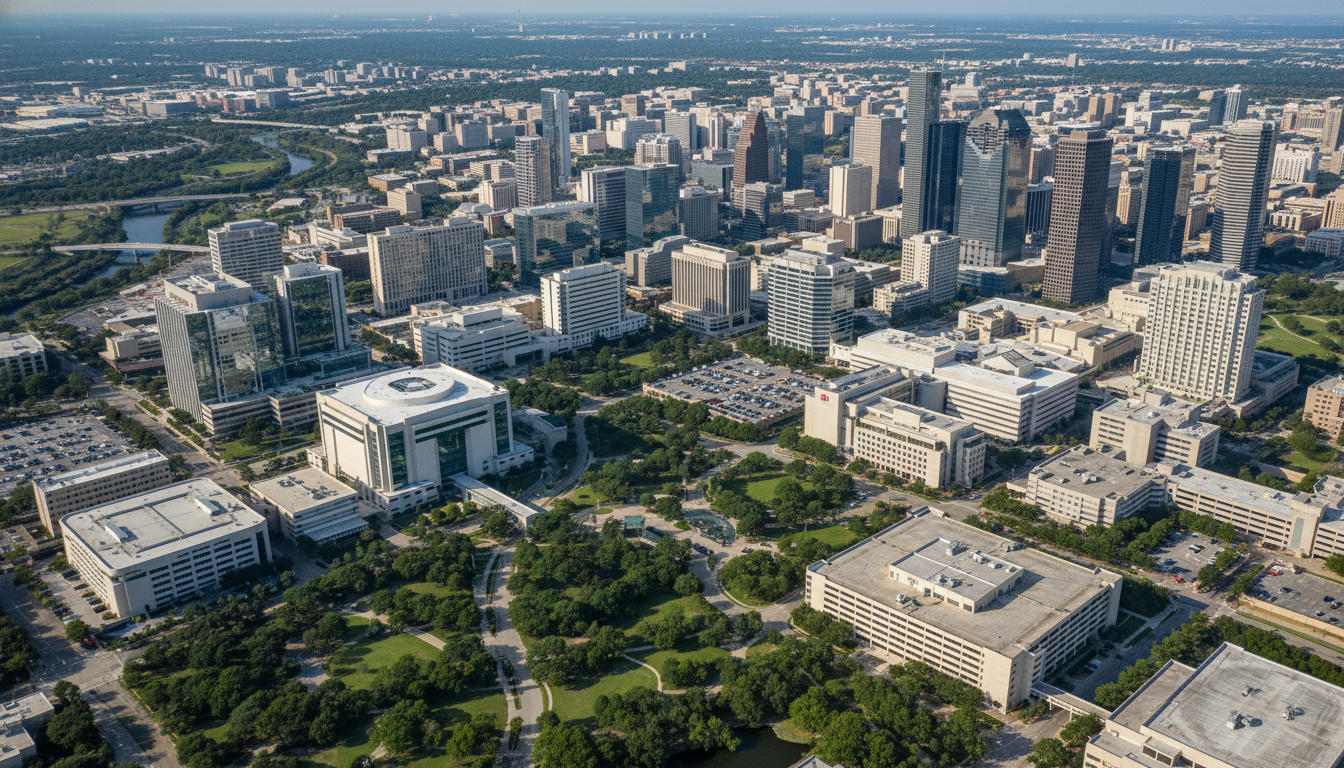
Texas Medical Center (TMC)
- World’s largest medical complex: >50 institutions, multiple academic health systems
- Home to major IMGs‑friendly institutions (e.g., UTHealth Houston, Baylor College of Medicine affiliates, MD Anderson Cancer Center, Houston Methodist, etc.)
- Many of these institutions are nonprofit, university-affiliated, and therefore H‑1B cap exempt
Cap‑Exempt Status and Why It Matters
Residencies at most major teaching hospitals in Houston are under cap‑exempt employers, meaning:- They can file H‑1B petitions any time of year (no April lottery)
- You can change employers within the cap‑exempt universe more flexibly (e.g., from one academic hospital to another)
- Once you move to a purely private practice or non‑academic group, you may hit the H‑1B cap, but you can often stay cap‑exempt as long as you remain affiliated with a qualifying institution
Large and Diverse IMG Community
- Houston’s physician workforce includes many non‑US citizen IMGs from Latin America, South Asia, the Middle East, and beyond
- This history tends to make GME offices and program directors more experienced with visa issues and more open to H‑1B in the right circumstances
Strong Demand for Physicians in Texas
- Rapid population growth and underserved communities mean demand for physicians is high
- This can translate into more opportunities for waiver jobs and long‑term employment after training, especially for those on H‑1B transitioning to permanent residency
How H‑1B Sponsorship Works in Houston Residency Programs
For a non‑US citizen IMG, the question is not just, “Does this program accept IMGs?” but “Will this program sponsor H‑1B, and under what conditions?” Understanding the process helps you navigate Houston residency programs strategically.
Typical Requirements for H‑1B Residency Sponsorship
While each institution has its own policy, most Houston‑area H‑1B residency programs expect the following from a foreign national medical graduate:
USMLE Step 3 Completed Early
- Many programs require Step 3 to even consider H‑1B
- Some want Step 3 passed before ranking you; others may accept a pass before contract signing or H‑1B petition filing
- To be safe as a non‑US citizen IMG: aim to pass Step 3 before the start of interview season (ideally by September of the application year)
ECFMG Certification
- Must be fully ECFMG-certified by rank list or contract signing
- Timely ECFMG certification is especially critical if you are asking a program to go beyond their standard J‑1 pipeline
Texas Medical Board (TMB) Eligibility
- For H‑1B, you typically need to be eligible for at least a training permit from the Texas Medical Board
- Requirements include primary medical qualification, verifications, and, for many training programs, at least 1–2 years of prior training for full licenses (though training permits are more flexible)
- Start Texas licensure/permit paperwork early because TMB processing can take months
Institutional and GME Policy
- Some institutions in the Texas Medical Center have explicit written policies:
- “J‑1 only”
- “We sponsor both J‑1 and H‑1B”
- “H‑1B in limited cases, at program and GME discretion”
- The H‑1B sponsor list often comes from GME or HR, not from individual programs, but PDs can sometimes request exceptions
- Some institutions in the Texas Medical Center have explicit written policies:
Financial and Legal Clearance
- H‑1B is more expensive for the institution (filing fees, attorney fees) and requires compliance with Department of Labor wage requirements
- Programs must justify your H‑1B request within existing institutional budgets and GME caps
Cap‑Exempt H‑1B: A Key Concept in Houston
Most Houston academic hospitals and Texas Medical Center residency programs are H‑1B cap exempt because they qualify as:
- Nonprofit hospitals affiliated with universities or
- Governmental or educational institutions
For you as a non‑US citizen IMG, this means:
- Your H‑1B is not subject to the annual national H‑1B lottery
- Start dates can align with the normal GME calendar (July 1)
- Extensions and transfers within the cap‑exempt environment are usually straightforward
This cap‑exempt status is a major advantage of choosing Houston and other large academic centers for your training.
Types of Houston Programs More Likely to Offer H‑1B
Not every residency in Houston is equal when it comes to H‑1B. As an aspiring resident, you should look at institution type, specialty, and historical patterns.
1. Large Academic Medical Centers
Institutions embedded in the Texas Medical Center and major university-affiliated hospitals are the most common sources of H‑1B sponsorship for IMGs. Examples include (without commenting on individual policies, which can change):
- University‑affiliated hospitals linked to UTHealth Houston
- Baylor College of Medicine training programs and their affiliated hospitals
- Major specialty centers within the TMC (e.g., cancer centers, heart and vascular hospitals)
Common characteristics:
- Large GME offices, often with dedicated visa specialists
- Established legal counsel for immigration matters
- Clear, published policies about H‑1B vs J‑1 on their websites
- More familiarity with the needs of non‑US citizen IMGs
Within these institutions, look at internal medicine, pediatrics, family medicine, psychiatry, neurology, and anesthesiology as core programs that often have experience with visa sponsorship.
2. Community‑Based Programs with University Affiliation
Some Houston‑area hospitals outside the main Texas Medical Center still have strong university collaborations. These may:
- Rely mostly on J‑1 for IMGs
- Offer H‑1B to a limited number of candidates, often those with strong research ties, advanced qualifications, or special skills
- Be more flexible if they struggle to fill positions in certain specialties
These are worth targeting, especially if they explicitly list H‑1B under their visa policies in the FREIDA database or on their websites.
3. Subspecialty Fellowships
In the Texas Medical Center, many subspecialty fellowships—cardiology, hematology/oncology, pulmonary/critical care, GI, nephrology, etc.—are more open to H‑1B because:
- Fellows are further in their training and more likely to be immediately employable post-fellowship
- Many have strong research portfolios and connections to faculty laboratories
- Institutions may see fellows as long-term recruits for faculty positions or hospitalist roles
If your plan is to do J‑1 residency then H‑1B fellowship, Houston can be a very strategic location to make that transition.
Building a Competitive H‑1B‑Friendly Application as a Non‑US Citizen IMG
Because H‑1B residency programs are more selective, you must position yourself as a high‑yield candidate for any Houston program willing to sponsor.
1. Prioritize Step 3 and Strong USMLE Scores
For Houston programs that consider H‑1B:
- Step 3 is non‑negotiable:
- Schedule it early (ideally within 6–12 months before the ERAS opening)
- Make a detailed study plan so that you pass on the first attempt
- Strong Step 1/Step 2 CK scores (or Pass with excellent CK) help PDs justify the institutional effort for H‑1B sponsorship
Action steps:
- Register for Step 3 as soon as you are ECFMG certified and meet eligibility
- Use dedicated resources and timed practice blocks; treat this as “H‑1B ticket” rather than just another exam
- Mention “Step 3: Passed” clearly on your ERAS application and CV
2. Documented US Clinical Experience (USCE)
Houston programs, especially in the Texas Medical Center, are busy academic services; they want residents who can adapt quickly.
Strengthen your H‑1B case by having:
- Hands‑on USCE in teaching hospitals (subinternships, acting internships)
- At least 2–3 strong US letters of recommendation from academic faculty
- Experience with US documentation (EPIC or similar EMRs), team rounding, and interdisciplinary communication
For a non‑US citizen IMG, robust USCE reduces perceived risk and increases the likelihood that a program will invest in H‑1B processing for you.
3. Research and Academic Output
Many Houston programs—especially at research‑heavy centers in the Texas Medical Center—value academic productivity:
- Publications, posters, and abstracts presented at US conferences
- Involvement in QI projects, clinical trials, or translational research
- An explicit research interest that aligns with the program’s strengths (e.g., oncology, cardiology, global health, health disparities)
Research is not mandatory for every specialty, but if you’re asking for H‑1B sponsorship in a competitive Houston program, it can tip the scales in your favor.
4. Clear, Professional Communication About Visa Needs
You need a plan for how to discuss H‑1B without making it the only topic. Some key points:
In your ERAS application:
- Answer visa questions honestly
- If asked, specify that you are a non‑US citizen IMG and will require visa sponsorship
- Emphasize early Step 3 completion and eligibility for H‑1B
Before interviews:
- Check each program’s website for visa policies
- If a program states “J‑1 only,” do not expect them to make an exception unless you have a pre‑existing relationship
During the interview/after:
- If the program lists both J‑1 and H‑1B, you can ask:
- “I am a foreign national medical graduate requiring visa sponsorship and I have passed Step 3. Does your program sponsor H‑1B for residents, and are there any additional requirements I should be aware of?”
- Be concise, respectful, and clearly informed
- If the program lists both J‑1 and H‑1B, you can ask:
Programs will appreciate that you’ve done your homework and understand the basics of H‑1B.
Practical Strategy: Identifying and Approaching H‑1B‑Friendly Programs in Houston
You will not find a perfect, official “H‑1B sponsor list” for Houston alone, but you can build a practical, up‑to‑date picture using multiple sources.
1. Use Public Databases and Program Websites
- FREIDA (AMA Residency & Fellowship Database)
- Filter by “accepts IMGs” and look at “Visa policy” or comments sections
- Identify programs that explicitly state “J‑1 and H‑1B considered”
- Program websites
- Search for “visa,” “international medical graduates,” or “H‑1B” on each Houston program’s page
- Many Texas Medical Center residency pages list their visa categories explicitly
Build a spreadsheet that includes:
- Program name (e.g., “Internal Medicine – UTHealth Houston”)
- Institution type (academic vs community)
- Stated visa policy
- Notes on whether they previously matched non‑US citizen IMGs on H‑1B (if visible in alumni lists or LinkedIn)
2. Network with Current and Former Residents
Personal experiences often reveal more than official documents:
- Use LinkedIn to search “[Program Name] residency Houston H‑1B”
- Contact alumni or current residents who are clearly foreign national medical graduates
- Ask targeted, respectful questions, for example:
- “I’m a non‑US citizen IMG considering your internal medicine program in Houston. Does the program currently sponsor H‑1B, and are there specific expectations (e.g., Step 3 timing) I should be aware of?”
This informal H‑1B sponsor list, built from real people’s experiences, can be extremely valuable.
3. Understand Specialty‑Specific Patterns
In Houston and across the US:
More likely to consider H‑1B:
- Internal medicine
- Pediatrics
- Family medicine (in some programs)
- Psychiatry
- Neurology
- Pathology
- Anesthesiology
Less likely or more restricted (but not impossible):
- General surgery
- Some surgical subspecialties
- Emergency medicine (varies)
- Radiology (varies by institution)
For each Houston specialty, try to identify at least a few programs in the Texas Medical Center or surrounding region that have historically taken H‑1B candidates.
4. Time Your Application Around Key Milestones
As a non‑US citizen IMG targeting Houston H‑1B residency programs:
12–18 months before ERAS opens
- Plan and schedule Step 3
- Apply for Texas Medical Board training permit (if timing allows)
- Begin or continue US clinical experience and research
6–9 months before ERAS
- Aim to have Step 3 passed
- Finalize letters of recommendation from US faculty
- Refine your personal statement to highlight why Houston and the Texas Medical Center fit your goals
During application season
- Apply broadly to both H‑1B‑friendly and J‑1 programs in Houston and beyond
- Do not restrict yourself to a short, “imagined” H‑1B sponsor list; include backup options
- Use interviews to clarify each program’s actual practice, not just their website text
5. Have a Plan B: J‑1 or Mixed Pathways
Even with careful planning, H‑1B is not guaranteed. Many strong non‑US citizen IMGs train on J‑1 and later transition to:
- J‑1 waiver jobs in underserved areas (e.g., Conrad 30 programs in Texas and other states)
- H‑1B in their first job after training
- Permanent residency via employment‑based pathways
You might also pursue:
- J‑1 for residency, H‑1B for fellowship (common for many subspecialties in Houston)
- H‑1B for residency, J‑1 fellowship (less common but possible, depending on your long‑term goals)
Build flexibility into your long‑term immigration strategy, while still targeting H‑1B residency programs as your first choice.
FAQs: H‑1B Sponsorship Programs for Non‑US Citizen IMGs in Houston
1. Do most Houston residency programs sponsor H‑1B for non‑US citizen IMGs?
No. Many Houston programs—especially those with large IMG populations—primarily sponsor J‑1 visas because it is administratively simpler. However, several Texas Medical Center residency programs and major university‑affiliated institutions are open to H‑1B sponsorship, particularly if you have Step 3 completed and a strong application. Policy varies by program and year, so always confirm directly with the program.
2. Is Step 3 absolutely required for H‑1B residency sponsorship in Houston?
Practically speaking, yes. For foreign national medical graduates, almost all H‑1B residency programs in Houston require Step 3 before they can file your H‑1B petition, and many expect it to be passed before ranking you. If you are serious about H‑1B in Houston, treat early Step 3 completion as mandatory rather than optional.
3. Are Houston residency H‑1B positions subject to the H‑1B cap and lottery?
Typically no. Most Houston academic hospitals and Texas Medical Center residency programs are H‑1B cap exempt due to their nonprofit or university affiliation. This means you avoid the national H‑1B lottery and can start on the usual GME timeline. However, if you later move to a purely private employer without such affiliations, that new H‑1B could be subject to the cap.
4. How do I find a reliable H‑1B sponsor list for Houston residency programs?
There is no official, centralized H‑1B sponsor list specifically for Houston. Instead, you should:
- Check FREIDA and program websites for visa policies
- Build a personal list of programs that explicitly mention H‑1B
- Network with current and former residents in Houston programs to verify real‑world practice
- Keep a living spreadsheet with notes on each program’s stance and any communication you have with their GME office
Policies can change year to year, so always confirm during the application season and remain flexible with backup J‑1 options.
By understanding how H‑1B works in the Houston context, preparing early (especially with Step 3 and Texas licensure), and strategically targeting Texas Medical Center residency programs and other cap‑exempt institutions, you can significantly increase your chances of securing an H‑1B‑sponsored position as a non‑US citizen IMG.