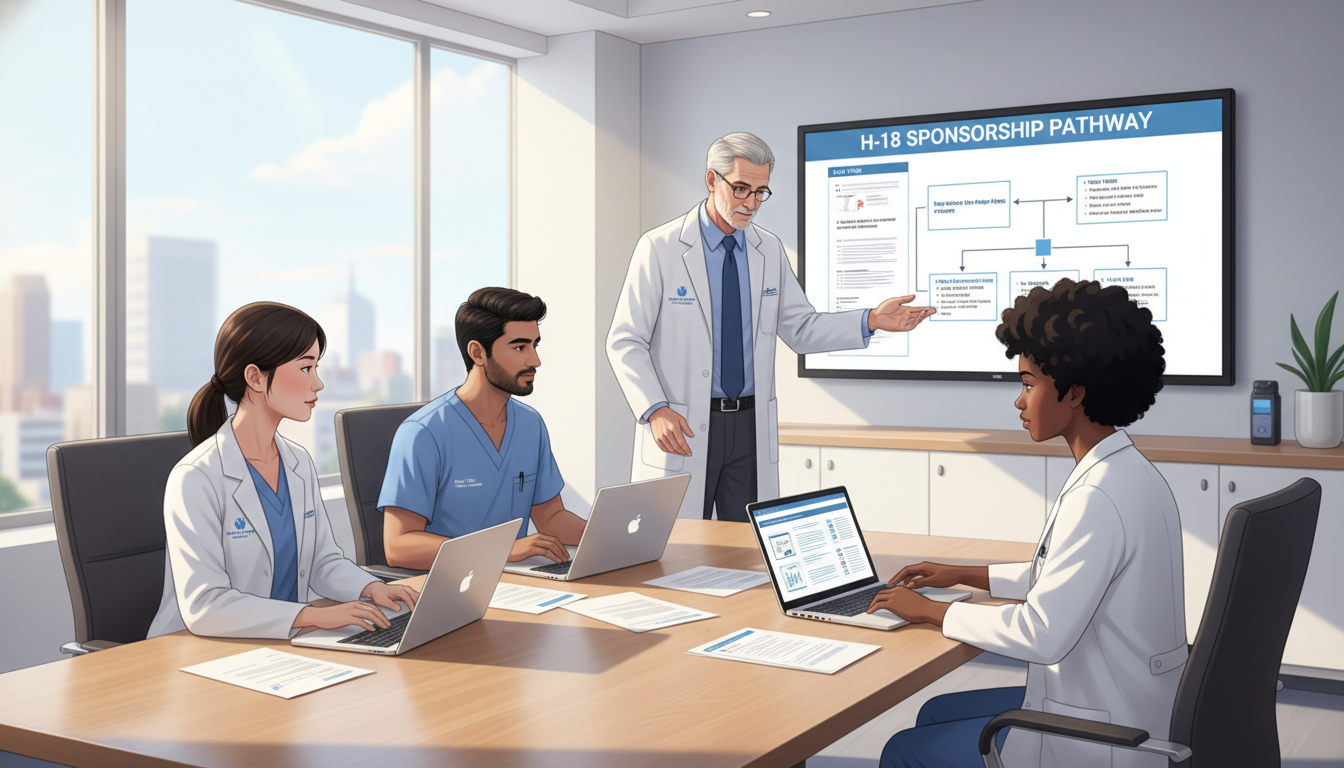
Understanding H-1B Sponsorship in Community Hospital Residency Programs
H-1B sponsorship is one of the most powerful tools a Caribbean IMG can use to build a long‑term medical career in the United States—especially if you hope to work in academic or non‑underserved settings after training. Yet most information online is fragmented, biased toward large university hospitals, or focused on non-clinical jobs.
For Caribbean IMGs—especially graduates of schools like SGU, AUC, Ross, Saba, and others—community hospital residency programs can be both accessible and supportive. Many such programs quietly sponsor H-1B visas every year, but you need to know how to identify them, how the H-1B cap and exemptions work, and how to present yourself as a low‑risk H-1B candidate.
This article breaks down the process step by step, with a special focus on:
- Community hospital residency and community-based residency options that sponsor H-1B
- How H-1B cap-exempt status works for residency programs
- How Caribbean medical school residency applicants can prioritize H-1B friendly programs
- How to strategically approach SGU residency match and other Caribbean IMG pathways
H-1B Basics for Caribbean IMGs in Residency
Before you dive into lists and program emails, you need a clear mental model of what H-1B sponsorship actually means for a resident.
What Is an H-1B for Residency?
In residency, an H-1B is a temporary work visa that allows you to train as a resident or fellow. Key points for Caribbean IMGs:
- It is employer-sponsored (the residency program/hospital is the petitioner).
- It is specialty occupation–based, so you must be doing work that requires your MD/MBBS.
- It typically covers residency plus fellowship if done correctly and extended.
- It is dual intent (unlike J-1), meaning you can pursue a green card during or after training.
For many Caribbean IMGs, especially those who may not want the J-1 two-year home residency requirement, H-1B is highly attractive.
How Is Residency H-1B Different from Corporate H-1B?
Many IMGs confuse standard corporate H-1B rules with residency-specific rules. The two biggest differences:
H-1B Cap vs. Cap-Exempt
- Regular employers (tech companies, private clinics) are subject to the annual H-1B lottery cap (65,000 + 20,000 for US master’s).
- Many teaching hospitals and academic medical centers are H-1B cap exempt, meaning:
- No lottery.
- Can file year-round.
- Many community hospitals that sponsor residency are also cap-exempt if:
- They are non-profit, affiliated with a university, OR
- Classified as a non-profit or governmental research/education institution.
Duration and Purpose
- For residency: H-1B is usually granted in blocks (often 3 years, then extended).
- For post-training jobs: You may move to a cap-subject H-1B (lottery) if the employer is not cap exempt.
Understanding H-1B cap exempt status is crucial, because community programs with this designation are usually more comfortable sponsoring IMGs repeatedly and reliably.
Community Hospital vs. University Programs: What It Means for H-1B
Caribbean medical school residency applicants often fixate on big-name university hospitals, assuming that’s where H-1B sponsorship lives. In reality, community hospital residency and community-based residency programs are often more IMG-friendly and can also be H-1B sponsors.
What Is a Community Hospital Residency?
A community hospital residency is typically:
- Based in a non-university or university-affiliated community hospital
- Focused on high-volume clinical service and hands-on training
- Often smaller and more personable than major academic centers
- Frequently serving diverse and underserved populations
For Caribbean IMGs, these programs often:
- Have a long history of taking IMGs, including Caribbean grads
- Are more flexible in considering Step scores and non-linear pathways
- May be more open to H-1B sponsorship if they already have a track record
Community-Based Residency vs. University-Based Residency
A community-based residency might:
- Be sponsored by a community hospital but affiliated with a medical school (e.g., a university affiliation for teaching, research, or rotations).
- Use multiple clinical sites (community hospitals, clinics, some university rotations).
A university-based residency:
- Is directly sponsored by a university hospital system.
- Often has more research, subspecialty exposure, and academic infrastructure.
- More commonly sponsors H-1B, but also more competitive.
For H-1B sponsorship, community-based programs with a strong academic affiliation can be a sweet spot for Caribbean IMGs: relatively accessible and still H-1B cap exempt in many cases.
How H-1B Sponsorship Works in Community Hospital Residency
Cap-Exempt vs. Cap-Subject in Residency
For your residency H-1B, almost all legitimate sponsoring programs fall into the H-1B cap-exempt category because they:
- Are non-profit hospital systems affiliated with universities, or
- Are explicitly designated as non-profit or governmental research/education institutions.
Why this matters:
- You do not compete in the national H-1B lottery for residency.
- Petitions can be filed when needed (often in late spring) for a July 1 start date.
- This creates a more stable path for Caribbean IMGs relying on H-1B sponsorship.
Later, for your post-residency job, some employers will also be cap-exempt (academic centers, VA hospitals, some large non-profit systems), while private practices and many community groups are cap-subject.
Typical H-1B Requirements for Residency Programs
While each program sets its own rules, H-1B residency programs—especially at community hospitals—commonly require:
USMLE Scores and Attempts
- Many H-1B sponsors prefer:
- USMLE Step 1: Passed (score no longer numeric for most recent takers).
- Step 2 CK: Often > 230 for competitive programs; some community programs accept lower if the rest of the application is strong.
- Step 3: Some community-based residency programs require Step 3 passed before they can file H-1B.
- Multiple attempts are not always disqualifying but make H-1B sponsorship less likely, because the institution is investing extra legal and filing costs.
- Many H-1B sponsors prefer:
ECFMG Certification
- Must be ECFMG certified by the time you start residency.
- Many programs require it at the time of rank list submission if you want H-1B.
Graduation Year
- Community hospital programs with H-1B sponsorship often prefer recent graduates (e.g., within 3–5 years), but some are flexible if you have:
- Recent US clinical experience.
- Ongoing engagement in medicine (research, clinical work abroad).
- Community hospital programs with H-1B sponsorship often prefer recent graduates (e.g., within 3–5 years), but some are flexible if you have:
Licensure Requirements
- Some states require Step 3 for a training license when on H-1B.
- Programs in those states may insist that Caribbean IMGs complete Step 3 before ranking them for H-1B.
Why Some Community Hospitals Prefer J-1 Over H-1B
Many otherwise IMG-friendly community hospitals do not offer H-1B. Common reasons:
- Administrative burden and cost of H-1B filing.
- Preference for a simpler, standardized J-1 route via ECFMG.
- Concern about residents leaving early if they switch employers.
- Institutional policy or past negative experiences.
This is why targeted research and proactive communication are essential if you’re specifically seeking H-1B residency programs.
Building and Using an H-1B Sponsor List for Community Programs
You will not find a single official, complete H-1B sponsor list for residency programs—but you can build a highly effective personalized version.
Step 1: Use Public Databases and Filters
Start with these resources:
FREIDA (AMA Residency & Fellowship Database)
- Filter for:
- “Accepts IMGs”
- “Visa sponsorship” if available
- Many programs indicate J-1, H-1B, or Both.
- Note that FREIDA is not fully up-to-date; you must verify directly.
- Filter for:
Program Websites
- Search for:
- “Visa sponsorship”
- “H-1B”
- “International medical graduates”
- Check:
- FAQ pages
- GME office pages
- Policy documents
- Search for:
State & Regional Patterns
- States with many community and community-based residency programs that commonly sponsor H-1B include:
- New York, New Jersey
- Pennsylvania
- Michigan
- Texas
- Illinois
- This is not universal, but some regions are more accustomed to hiring IMGs on H-1B.
- States with many community and community-based residency programs that commonly sponsor H-1B include:
Step 2: Create a Structured Spreadsheet
Build an organized H-1B sponsor list tailored to your interests:
Include columns such as:
- Program Name
- Specialty (IM, FM, Peds, Psych, etc.)
- Community / Community-based / University
- Visa Policy (J-1 only / H-1B only / J-1 + H-1B)
- Notes from Website
- Notes from Residents/Fellows
- Contact Person (Program Coordinator or GME Office)
- Last Confirmed Year of H-1B Sponsorship (e.g., “Matched H-1B IMG in 2023”)
- Your Competitiveness (High/Medium/Low based on your profile)
This becomes your personalized strategy document for targeting H-1B-friendly community hospital residency programs.
Step 3: Confirm Policies with Direct Communication
Before applying or ranking, always confirm:
- Email the program coordinator or GME office:
- Introduce yourself briefly as a Caribbean IMG.
- Ask clearly whether they sponsor H-1B visas for residency.
- Ask:
- Do you sponsor H-1B for categorical positions?
- Do you require Step 3 before ranking for H-1B?
- Which visa types did your most recent IMG residents hold?
Example Email (Concise, Professional):
Subject: Visa Sponsorship Policy for IMG Applicants
Dear [Coordinator’s Name],
I am an international medical graduate from a Caribbean medical school and I am very interested in applying to your [Specialty] residency program. Could you please confirm your current visa sponsorship policy for IMGs?
Specifically, do you sponsor H-1B visas for categorical residents, and is USMLE Step 3 required before ranking an applicant for H-1B sponsorship?
Thank you very much for your time.
Sincerely,
[Your Name], MD
[Caribbean Medical School Name]
Record the responses in your spreadsheet; this becomes your practical, up-to-date H-1B sponsor list.

Strategic Application Planning for Caribbean IMGs Seeking H-1B
Caribbean graduates—especially those from schools like SGU, Ross, AUC, and Saba—often have broad clinical exposure and US rotations, but must still be strategic to secure an H-1B-friendly community hospital residency.
1. Clarify Your Visa Priority Early
Decide whether H-1B is a must-have or a nice-to-have:
- Must-have H-1B:
- You cannot or do not want J-1 (e.g., home residence rule is a major obstacle).
- You plan for long-term US practice without the J-1 waiver route.
- You accept a potentially more limited list of programs.
- Nice-to-have H-1B:
- You are open to J-1 but will rank H-1B options higher when possible.
- You will apply to both H-1B and J-1 sponsoring programs to maximize match chances.
Your answer dictates how narrow your application list can safely be.
2. Align Your Profile with H-1B Expectations
To be a strong candidate for H-1B residency programs—especially in community-based settings—aim for:
USMLE Performance
- Strong Step 2 CK (particularly if Step 1 is pass/fail and you’re a Caribbean IMG).
- Step 3 completed before interview season if targeting programs that require it for H-1B.
US Clinical Experience (USCE)
- At least 3–4 months of US core or elective rotations.
- Strong letters of recommendation from US attendings, ideally:
- In your target specialty.
- From community or community-based hospitals that understand IMGs.
Clear, Stable Narrative
- Explain your Caribbean medical school journey in your personal statement.
- Highlight:
- Adaptability
- Clinical exposure
- Communication and teamwork
3. Balancing H-1B-Friendly and IMG-Friendly Programs
You want a mix of:
H-1B-friendly programs that:
- Sponsor H-1B regularly.
- Have Caribbean IMG alumni.
- Are community or community-based, not ultra-competitive ivory towers.
Broader IMG-friendly programs (even if J-1 only) to protect your overall match chances.
As a Caribbean IMG, you might structure your list like:
- 30–50%: Programs known to sponsor H-1B (from your sponsor list).
- 50–70%: Strong J-1 programs that are highly IMG-friendly and would still give you a viable path via J-1 waiver or later H-1B.
4. Special Considerations for SGU and Other Caribbean Schools
For an SGU residency match or similar Caribbean matches:
- Many SGU-affiliated hospitals are community-based and often sponsor visas, including H-1B, especially in Internal Medicine, Family Medicine, Pediatrics, and Psychiatry.
- SGU and similar schools maintain internal data on:
- Which hospitals match their graduates.
- Visa types obtained by alumni.
- Use:
- Alumni networks.
- SGU career services and match reports.
- Social media groups for your specific Caribbean school.
Ask alumni specific questions like:
- “Which community hospital residency programs sponsored your H-1B?”
- “Did you have to complete Step 3 beforehand?”
- “Are they H-1B cap exempt?”
This gives you a real-world H-1B sponsor list validated by recent Caribbean IMG experience.
After Matching: Navigating H-1B Logistics in a Community Hospital Program
Once you match into a community hospital residency that agrees to H-1B sponsorship, you will need to move quickly and precisely.
Coordinating with the GME Office
Your program’s GME office (or HR/legal department) will:
- Provide a document checklist (ECFMG certificate, passport, diplomas).
- Initiate the Labor Condition Application (LCA) and H-1B petition.
- Help align state licensing/taining permit timelines with H-1B start dates.
As a Caribbean IMG, your role is to:
- Respond quickly with all requested documentation.
- Clarify any gaps in your CV or immigration history.
- Communicate early if you’re waiting for Step 3 scores or ECFMG certification.
Timing Issues and Start Dates
Common timing considerations:
- H-1B petitions for residency are typically filed in spring (March–May) for a July 1 start.
- Delays in:
- Step 3 scores
- ECFMG certification
- Background check can push the filing date and risk late start.
Some community hospital programs will use premium processing (extra cost but faster adjudication); others may not. Ask your GME office about:
- Whether they routinely use premium processing for incoming H-1B residents.
- What contingency plans exist if approval is delayed (e.g., temporary J-1, delayed start).
Future Planning: Fellowship and Beyond
If you complete residency on H-1B at a cap-exempt community hospital program:
- You can often extend H-1B for fellowship if:
- The fellowship institution is also cap-exempt (often the case at university-affiliated hospitals).
- For attending jobs:
- Academic centers and some non-profit hospital systems remain H-1B cap exempt.
- Private groups and for-profit hospitals will require you to enter the cap-subject H-1B lottery unless you already hold a cap-subject approval from a previous non-exempt employer.
This long-term planning matters if you are choosing between several H-1B residency offers—ask about alumni career trajectories.
FAQs: H-1B Sponsorship for Caribbean IMGs in Community Hospital Programs
1. As a Caribbean IMG, should I always prefer H-1B over J-1 for residency?
Not always. Consider:
- H-1B advantages:
- No J-1 home residency requirement.
- Dual intent (easier to pursue a green card).
- May provide more flexibility in choosing jobs after training (especially if you secure a cap-subject slot later).
- J-1 advantages:
- Far more programs offer J-1, including excellent community hospital residency and community-based residency programs.
- Application process is standardized via ECFMG.
- With a J-1 waiver (often in underserved areas), you can still build a strong US career.
If H-1B is mandatory for personal or legal reasons, prioritize H-1B sponsor programs. Otherwise, keep both pathways open to maximize your match chances.
2. Do all H-1B residency programs require Step 3 before ranking me?
No, but many do—especially at community hospitals with limited administrative bandwidth. Common patterns:
- Some community-based residency programs:
- Will only sponsor H-1B if Step 3 is passed before ranking.
- Others:
- Allow Step 3 completion between Match and H-1B filing, but this is increasingly rare.
Always verify each program’s policy via email or website. If H-1B is your priority, taking Step 3 early is a strategic move.
3. Are community hospital residency programs less likely to be H-1B cap exempt?
Not necessarily. Many community hospitals:
- Are non-profit and affiliate with universities, making them H-1B cap exempt.
- Sponsor multiple IMGs every year, including Caribbean graduates.
However, smaller independent community hospitals that are for-profit or lack educational affiliations may be cap-subject or unwilling to sponsor H-1B. This is why your research and direct inquiry are crucial.
4. How does being a Caribbean graduate (e.g., SGU, Ross) affect my H-1B chances?
Caribbean medical school residency applicants are common in many community and community-based residency programs. For H-1B:
- You are often viewed similarly to other IMGs if:
- Your USMLE scores are competitive.
- You have strong US clinical evaluations.
- You demonstrate professionalism and readiness.
However:
- Some H-1B sponsoring programs may prefer:
- Fewer attempts on USMLE.
- Recent graduation.
- Use your Caribbean school’s network:
- SGU residency match data.
- Alumni contacts in community hospital residency programs.
- School advising offices familiar with H-1B patterns.
If you leverage these resources and target H-1B-friendly, community-based residency programs thoughtfully, being a Caribbean IMG can still align very well with an H-1B residency pathway.
By understanding how H-1B cap-exempt status works, carefully building your own H-1B sponsor list, and aligning your exam timing and application strategy, you can significantly improve your chances of securing an H-1B-supported community hospital residency in the United States as a Caribbean IMG.