
It is late November. You just got an interview invite from a solid internal medicine program in the Midwest. You are an IMG on a student visa, browsing their website at 1 a.m. You see one magical sentence: “The program sponsors visas.”
You exhale, mentally move them up your rank list, and stop reading.
That is the mistake.
Visa policy misunderstandings are one of the most common — and most painful — errors IMGs make during the residency application and match phase. People match to a program that cannot sponsor their visa. Or rank a “friendly” program that actually excludes their specific situation. Or decline better options based on half‑read policy sentences.
I have watched excellent IMGs lose a year over a single misread phrase like “we accept J‑1 applicants” that they assumed meant “we sponsor H‑1B too.” It does not.
Let us walk through the traps so you do not join that list.
1. The Single Dumbest Assumption: “Visa Friendly = Friendly to My Visa”
Programs love vague language. It keeps their website evergreen and noncommittal. You will see all of these:
- “We accept international graduates.”
- “We sponsor visas.”
- “We consider qualified applicants regardless of citizenship.”
- “We have J‑1 and H‑1B residents.”
Too many IMGs read those and mentally translate them to: “I am fine here.” That is wrong more often than you think.
The reality: every phrase above can hide restrictions that quietly exclude you.
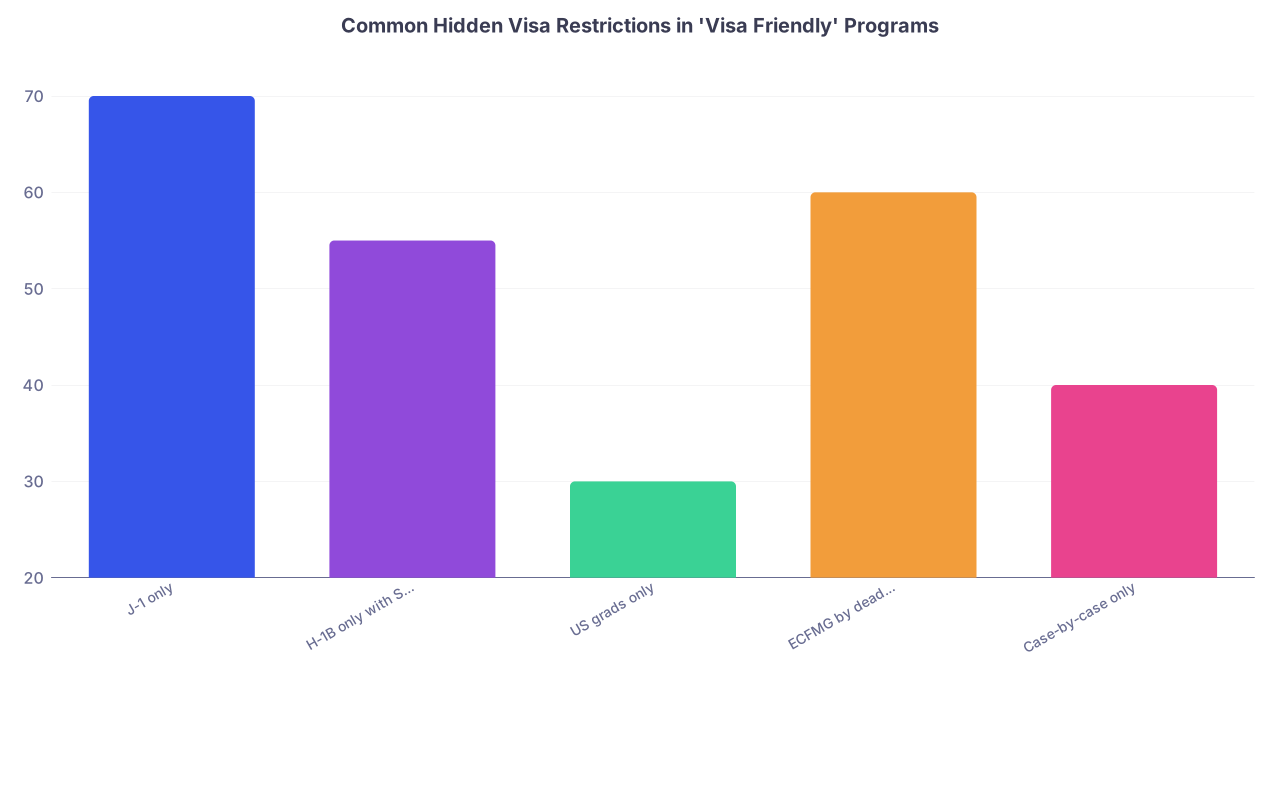
Common hidden limitations behind “visa friendly” language:
- Only J‑1, despite saying “visas” in plural
- Only H‑1B for certain specialties or fellowship‑bound tracks
- Only for US MD/DO grads, not IMGs
- Only if you already have ECFMG certification by a certain date
- Only if you have Step 3 completed before ranking
| Category | Value |
|---|---|
| J-1 only | 70 |
| H-1B only with Step 3 | 55 |
| US grads only | 30 |
| ECFMG by deadline | 60 |
| Case-by-case only | 40 |
Those numbers are approximate, but the pattern is real: “visa friendly” is not a policy. It is marketing.
Red flag behavior: You stop reading after “visa sponsorship available.”
Safe behavior: You look for exactly which visa types, which categories of applicants, and under what conditions.
2. J‑1 vs H‑1B: The Misread That Costs People Years
This section is where people get burned the worst.
The classic misread
Program website sentence:
“Our program participates in the ECFMG J‑1 visa program.”
IMG interpretation:
“Great, they are IMG friendly and sponsor visas.”
Actual meaning:
“We will sponsor only J‑1 visas. No H‑1B.”
If you want H‑1B, or if your long‑term plan clashes with the J‑1 two‑year home requirement, you cannot afford this misread.
Core differences IMGs gloss over
| Feature | J-1 (ECFMG) | H-1B (Employment) |
|---|---|---|
| Sponsor | ECFMG + program | Residency program/employer |
| Step 3 required | No | Usually Yes (before H-1B start) |
| Home return rule | 2-year requirement common | Usually none |
| Flexibility for moonlighting | Limited/variable | Often more flexible |
| Common in which specialties | IM, Peds, FM, Psych | Some IM, Neuro, Path, competitive spots |
Mistakes I see repeatedly:
- Assuming “J‑1 and H‑1B residents are in our program” means:
- They currently sponsor both (sometimes H‑1Bs are historical only)
- They will sponsor H‑1B for categorical IMGs (sometimes only for fellows)
- Believing they can “switch from J‑1 to H‑1B” mid‑residency. Nearly always fantasy.
- Thinking J‑1 waivers are “easy to get later.” That depends heavily on:
- Your specialty
- Your willingness to work in underserved areas
- Your state’s specific waiver rules
Do not make these J‑1/H‑1B errors
- Do not assume “we participate in the ECFMG J‑1 program” implies anything about H‑1B.
- Do not think “we have H‑1B residents” means new IMGs will be offered it.
- Do not rank a J‑1‑only program high if you are trying to avoid the 2‑year home requirement. You will not negotiate that post‑match.
3. Website vs Reality: Outdated, Incomplete, or Intentionally Vague
Here is the ugly truth: many residency websites are stale.
I have seen:
- “We offer H‑1B visas” on a site where the PD told applicants on interview day: “We stopped H‑1B three years ago.”
- “We do not sponsor visas” on a site, while the program quietly started J‑1 sponsorship after being acquired by a larger health system.
- Conflict between the GME office page and the individual program page in the same hospital.

| Step | Description |
|---|---|
| Step 1 | Read Program Website |
| Step 2 | Check GME/Institution Policy |
| Step 3 | Search Recent Resident Lists |
| Step 4 | Email Program Coordinator |
| Step 5 | Ask Directly on Interview Day |
| Step 6 | Confirm Before Ranking |
If you only read one page and build your entire strategy around it, you are gambling.
How IMGs commonly misread websites
- They assume no mention of visa equals “no sponsorship.” Sometimes true, often laziness.
- They treat a single sentence from 2018 as up‑to‑date policy.
- They misinterpret “we do not sponsor visas” at the hospital level as absolute, when the GME office has specific exceptions.
You are not a lawyer. You do not need to become one. But you do need to cross‑check:
- GME / Office of Graduate Medical Education website
- Individual program site (IM, surgery, etc.)
- Recent resident bios (are there foreign medical schools listed?)
- NRMP or FREIDA entries — and then verify, because those get stale too
4. Top 7 Visa Policy Misinterpretations That Blow Up Matches
Let me be blunt. These are the mistakes that cost people actual PGY‑1 positions.
1. Misreading “We accept IMGs” as “We sponsor visas”
Accepting IMGs and sponsoring visas are completely separate.
Some programs:
- Accept US‑citizen IMGs only (no sponsorship)
- Accept Canadian IMGs with special status but not others
- Will rank only permanent residents / green card holders who trained abroad
If the website says:
- “We accept applications from international graduates.”
You must still find:
- “We sponsor J‑1…” or
- “We sponsor H‑1B…” or
- “We do not sponsor visas.”
No explicit sponsorship statement? Treat it as unknown, not friendly.
2. Ignoring Step 3 language for H‑1B
“Step 3 required for H‑1B” is code for:
- If you do not have Step 3 before contract / visa filing time, they:
- Will not file H‑1B
- May force you to J‑1 (if they also sponsor J‑1)
- May drop you entirely
Too many IMGs read:
“We sponsor J‑1 and H‑1B visas. Step 3 required for H‑1B.”
…and think:
“I will take Step 3 after I match and still get H‑1B.”
No. By the time USCIS deadlines hit, it is too late. If you want H‑1B at those programs, Step 3 should be done and reported ideally before rank order list certification, certainly before contract issuance.
3. Confusing “case‑by‑case” with “probably yes”
Programs love saying:
“Visa sponsorship is considered on a case‑by‑case basis.”
IMGs hear:
“They will probably help me if I am strong.”
Often reality:
“We rarely do this, and only for unicorn cases: US PhD + perfect scores + inside connection.”
Treat “case‑by‑case” as probable no until you see:
- Concrete examples (recent IMGs on H‑1B/J‑1 from similar backgrounds)
- An explicit confirmation from the program that your specific situation is feasible
4. Over‑trusting “past residents” as proof
I have seen people point to a single alum from 2014 on an H‑1B as proof a program “supports H‑1B.” That is like using your grandparent’s medical school tuition bill to estimate today’s costs.
Ask:
- How many H‑1Bs in the last 3–5 years?
- Were they categorical residents or fellows?
- Were they USMD/DO or IMGs?
If all H‑1Bs are:
- Internal US grads, or
- Fellows only
You, as an IMG applying to categorical residency, are not in the same category.
5. Misreading state or institutional bans
Some states or hospital systems have:
- Policies against H‑1B for residents (only staff physicians)
- Requirements that all trainees be on J‑1
- Union or HR constraints that override what the program wants
IMGs see a friendly PD, hear “We would love to have you,” and assume the visa will work out. Then HR says no, and the PD’s hands are tied.
If a program wants to sponsor but institutional policy says otherwise, you are still stuck.
6. Ignoring the timing issue
Even when sponsorship is real:
- H‑1B filings have hard deadlines and limited windows.
- Delays in:
- ECFMG certification
- USMLE score reporting
- Document gathering
can break your timeline.
Some IMGs hear “Yes, we sponsor H‑1B” and assume that is the end of the conversation. It is not. You need to ask about:
- Deadlines for having Step 3
- Deadlines for ECFMG certificate
- Institutional cutoffs for HR processing
7. Assuming rules are more flexible for “top candidates”
They are not. Visa law is not impressed by your 260+ or your eight publications. Programs cannot just bend DHS or ECFMG requirements because they like you.
If a coordinator says “We cannot sponsor H‑1B,” your CV will not magically change that.
5. How “Friendly to IMGs” Programs Still Exclude You
The category you mentioned — residency programs with friendly policies for IMGs — is real. There are many community IM, FM, Peds, and Psych programs that consistently take international graduates.
But “IMG friendly” and “visa workable for you” are not the same.
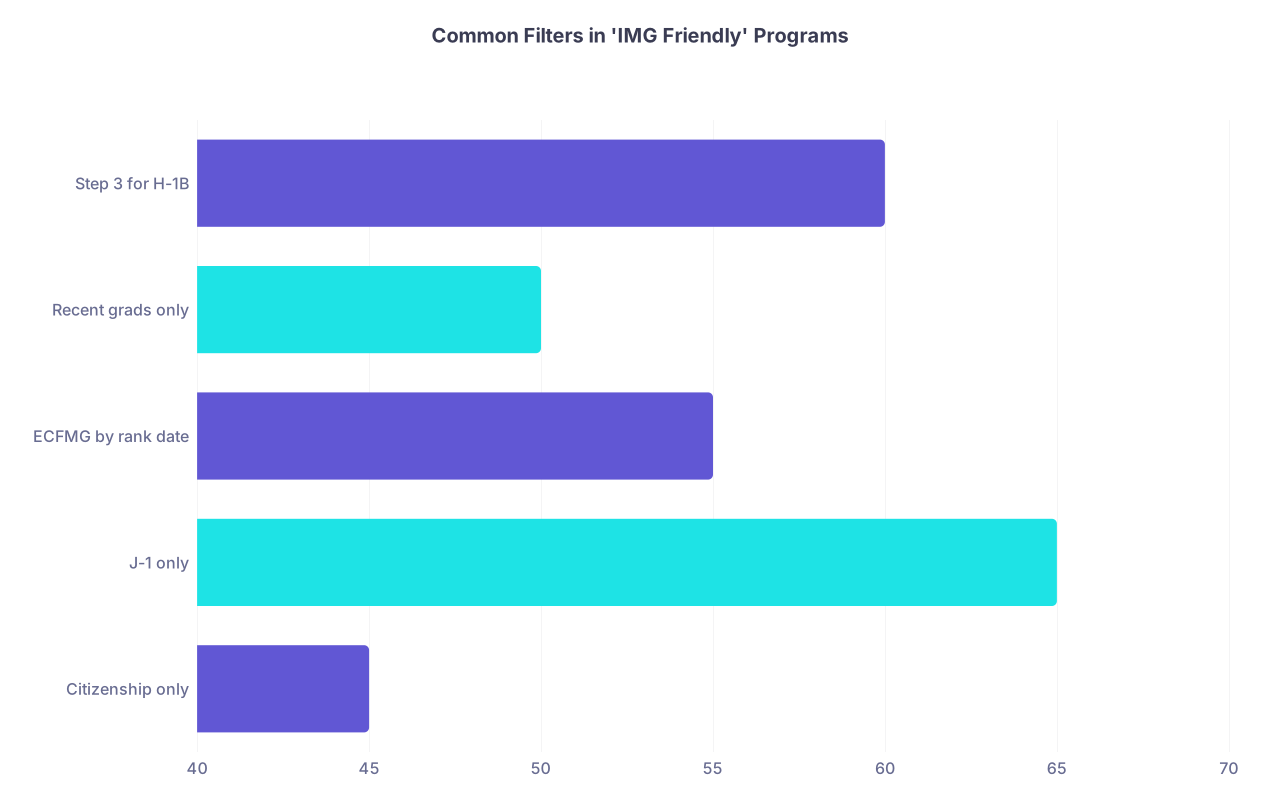
Ways IMG‑friendly programs still block specific IMGs
Citizenship filter
- Accept: US citizens / permanent residents who went to Caribbean or other foreign schools
- Reject: non‑US citizen IMGs needing visas
Visa‑type filter
- Sponsor only J‑1 when you are chasing H‑1B
- Or vice‑versa: program will do H‑1B only, but you were planning on J‑1 for a waiver strategy
Exam timing filter
- Demand:
- ECFMG certification by rank deadline
- Step 2 CK by interview
- Step 3 by contract for H‑1B
Many IMGs misread “we accept ECFMG‑certified applicants” as “you may be certified eventually.” For many programs that means: certified before we rank you.
- Demand:
Recency of graduation
- “We prefer graduates within 5 years” is sometimes actually “we do not rank older grads”
- This matters because older grads often depend more on visa sponsorship. A bad combo.
| Category | Value |
|---|---|
| Citizenship only | 45 |
| J-1 only | 65 |
| ECFMG by rank date | 55 |
| Recent grads only | 50 |
| Step 3 for H-1B | 60 |
If you rely on “IMG friendly lists” online without checking these filters, you will waste applications and interviews on programs that were never viable for your situation.
6. What You Should Actually Do: A Safe, Boring, Correct Process
You want boring here. Boring is how people match and stay.
Step 1: Make a personal visa profile
Write down, clearly:
- Your current status (F‑1, J‑1 research, B‑1/B‑2, etc.)
- Whether you are willing to:
- Accept J‑1 and the 2‑year home rule
- Only accept H‑1B
- Accept either, but prefer one
- Your exam status:
- Step 1 / Step 2 CK / Step 3 done or not
- Your ECFMG certification timeline (exact month you expect it)
You cannot interpret program rules accurately if you do not understand your own constraints.
Step 2: Read all relevant pages for each program
At minimum:
- Program’s own page (FAQ, eligibility, visa policy)
- Institution or GME office “International Medical Graduates” page
- NRMP / FREIDA listing (then treat it as secondary, not primary)
You are looking for exact language like:
- “We sponsor J‑1 visas only.”
- “We sponsor both J‑1 and H‑1B visas for qualified candidates.”
- “We do not sponsor visas for residency training.”
No such sentence? Treat the program as “uncertain” and do not build your strategy around them.
Step 3: Verify via coordinator or GME office
You do not need a long novel. A short, precise email works:
Subject: Residency Application – Visa Sponsorship Clarification
Dear [Coordinator name],
I am an international medical graduate currently on [status]. I am interested in applying to your [specialty] residency program and wanted to confirm your current visa sponsorship policies.
- Do you sponsor J‑1 visas for categorical residents?
- Do you sponsor H‑1B visas for categorical residents, and if so, is Step 3 required before ranking or contract?
Thank you for your time,
[Name, AAMC ID]
If you get a reply like:
- “We sponsor only J‑1 visas for residency,” do not keep arguing about H‑1B.
- “Visa sponsorship is on a case‑by‑case basis,” follow up with:
I understand. Have IMGs requiring visas joined your program in the last 3 years? If so, which visa type did they use?
If they dodge the question, assume risk. High risk.
Step 4: Ask directly on interview day
Do not sit quietly and hope.
Simple, non‑needy phrasing:
- “For IMGs requiring visas, which visas are you currently sponsoring for categorical residents?”
- “Has your H‑1B or J‑1 policy changed in the last few years?”
- “Are there any exam or certification deadlines that affect visa sponsorship?”
Write down what they say immediately after the interview. Your memory will not be accurate in February.
Step 5: Re‑confirm before ranking, especially if you rely on H‑1B
Policies change mid‑cycle. Often due to:
- Institutional budget changes
- HR / legal updates
- Prior bad experiences with a particular visa type
If H‑1B is essential for your plan, send a brief confirmation in late January / early February:
I enjoyed interviewing with your program on [date]. I wanted to confirm that the program is still able to sponsor H‑1B visas for incoming categorical residents for the [year] cycle, provided Step 3 is completed before [date].
If they say “We do not know” or “Policy may be changing,” you need to lower them on your rank list accordingly.
7. Quick Reality Check: When to Walk Away
Some clear situations where you should not rely on a program, no matter how friendly everyone seems.
Walk away (or rank low) if:
- They cannot clearly state whether they sponsor J‑1 or H‑1B.
- They say “we used to sponsor H‑1B but not sure about this year.”
- They rely heavily on “case‑by‑case” language and will not give recent, concrete examples.
- Their resident list shows 0 non‑US‑citizen IMGs in recent years, but they still say “we accept IMGs.”
- Their HR or GME page contradicts what the program told you and nobody can reconcile the difference.
One more harsh truth:
If the visa question is “complicated” and you have other simpler options, choose the simpler options. The match is stressful enough without hoping an HR director you have never met will make an exception for you.
FAQ (Exactly 5 Questions)
1. If a program says “we accept IMGs” but does not mention visas, should I still apply?
Apply only if you are willing to treat it as a long shot. “We accept IMGs” could mean US citizens who studied abroad, not non‑citizen IMGs needing sponsorship. Unless you get written confirmation that they sponsor J‑1 or H‑1B for categorical residents, do not build your strategy around that program.
2. Can I switch from J‑1 to H‑1B during or after residency to avoid the 2‑year home requirement?
Almost never in a way that avoids the rule. If you enter on J‑1 for GME, the 2‑year home residency requirement attaches. Switching to H‑1B later does not erase it. You either:
- Fulfill the requirement in your home country, or
- Get an approved waiver (usually through underserved work or other limited paths).
Do not start J‑1 thinking you will magically escape the 2‑year rule by “converting” later.
3. A program told me they sponsor H‑1B but their website only mentions J‑1. Who should I believe?
Believe neither until you clarify. Ask for written confirmation from either:
- The program coordinator and
- Ideally the GME office.
Policies can lag on websites, but they can also be misrepresented verbally. You want consistency. If GME says “J‑1 only,” trust GME over the enthusiastic assistant who “thought we had an H‑1B once.”
4. If I do not have Step 3 yet, should I still apply to H‑1B‑friendly programs?
Yes, but with realistic expectations. Many H‑1B‑friendly programs will:
- Rank you only for J‑1 if you lack Step 3 in time, or
- Not rank you at all if H‑1B is your only acceptable option.
You must know their rule: is Step 3 required before interview, before ranking, or before contract? If you want H‑1B, aim to have Step 3 done and reported early, not “sometime after I match.”
5. Are “IMG‑friendly program lists” online reliable for visa policy decisions?
They are a starting point, not a decision tool. Those lists typically track:
- Percentage of IMGs
- Total number of IMGs matched
But they rarely distinguish: - US‑citizen vs non‑citizen IMGs
- J‑1 vs H‑1B vs no sponsorship
You can use them to find likely IMG‑heavy programs, then you must do your own deep dive on actual visa rules for your specific situation.
Key points to remember:
- “Visa friendly,” “IMG friendly,” and “we sponsor visas” are vague phrases; you must pin down exact visa types, timelines, and conditions.
- Never assume H‑1B availability, J‑1 flexibility, or exceptions “for strong candidates.” Get specific, recent, and written information from the program or GME office.
- Your strategy should match your personal visa profile; if a program’s rules do not align with your reality, treat it as a risk, not a hope.