
The harsh truth: most IMGs are wasting 20–50% of their residency applications on programs that were never going to look at them. Not “low chance.” Zero.
You cannot afford that mistake.
You’re paying thousands of dollars. You’re staking years of your life. And yet I routinely see IMGs shotgun applications to every big-name program and every hospital in glamorous cities, then act surprised when the interview season is dead silent.
Let me be blunt: “IMG-friendly” is not a vibe. It’s a track record. Programs tell you who they are in their match lists, visa policies, and screening filters. IMGs just don’t look closely enough.
This is the guide I wish someone had shoved in front of every IMG before they clicked “submit” on ERAS.
The Core Mistake: Confusing “Not Explicitly Hostile” With “IMG-Friendly”
Look at how most IMGs build their list:
- They grab some random “IMG-friendly program list” from a forum.
- They filter by specialty and state.
- They glance at a program website that says something vague like “we welcome diverse backgrounds.”
- They convince themselves, “Well, they didn’t say no IMGs, so I have a chance.”
That’s the mistake.
A program that doesn’t explicitly ban IMGs is not automatically IMG-friendly. Or even IMG-neutral. Many programs quietly screen you out before a human ever sees your file.
Here’s what an actually IMG-friendly program usually has:
- Multiple IMGs in their current resident roster (not just one token from 2012).
- A consistent pattern of IMGs in their recent match lists (not a one-off fluke).
- Clear, supportive visa sponsorship (H-1B or at least J-1 with no nonsense).
- Reasonable cutoffs that IMGs can realistically meet.
Compare that with the signs of a program that’s wasting your money:
- Zero IMGs in the last 3–5 years of residents.
- Vague or missing statement about visas.
- “Must be a US MD/DO” hidden in an FAQ.
- Unrealistic USMLE cutoffs + no IMG match history.
You’d be shocked how many IMGs apply to that second category by the dozens.
The Silent Filters That Kill IMG Applications
Let’s talk about the quiet killers. The reasons your application gets rejected before anyone reads your personal statement.
Most programs won’t email you, “We filtered you out because you’re an IMG.” They just never invite you. Or respond. Or acknowledge your existence.
Here are the big silent filters I see over and over.
1. Hidden USMLE Cutoffs That Don’t Match Your Profile
Programs love vague language like “we perform a holistic review” while the software is literally set to auto-reject anything below a certain Step score.
I’ve sat in rooms where coordinators say, “We don’t look at anyone below 220 for IMGs,” while the website just says “competitive applicants typically have strong scores.”
If you’re an IMG with:
- Step 2 CK 220–230
- YOG 5+ years ago
- Minimal US clinical experience
…and you’re applying to programs where the average IMG in their current residents has 245+?
You’re not “reaching.” You’re burning cash.
2. Year-of-Graduation (YOG) Bias They Don’t Advertise
Many programs quietly use YOG cutoffs:
- “We prefer applicants within 3 years of graduation” often means “we rarely rank anyone beyond 5 years.”
- Some programs tell their screeners: “Don’t bother with >7 YOG unless spectacular.”
If you’re 8–10 years out of medical school, you can’t just copy a junior IMG’s list and expect similar outcomes.
3. Visa Type Mismatch
This one kills a horrifying number of applications.
Programs typically fall into buckets:
| Program Type | J-1 Visa | H-1B Visa | IMGs in Recent Classes |
|---|---|---|---|
| Academic, competitive | Yes | Rare | Few |
| Community, IMG-friendly | Yes | Yes | Many |
| Small community with no sponsors | No | No | None |
| VA-heavy or state-restricted | J-1 only | No | Few to some |
If you:
- Need H-1B but apply to mostly J-1-only programs
- Cannot or will not take any visa but see “Citizens or Green Card only” in the fine print and apply anyway
…you’re donating money. Not applying.
Programs are not going to change their institutional policy for you. Not this cycle. Not ever.
4. No US Clinical Experience Requirement
You’d be amazed how many IMGs ignore this line on the website:
“We require at least 3 months of US clinical experience in an ACGME-accredited setting.”
And then apply with just observerships or home-country rotations.
“Maybe they’ll make an exception.”
No, they won’t. At least 90% of the time, they won’t.
Programs that require USCE and don’t see it in your file often never even open the rest.
The Most Common Way IMGs Waste Applications
Let’s cut through the noise. Here are the biggest, recurring, money-draining patterns.
1. Chasing Prestige Over Probability
I see this constantly:
- IMG with Step 2 CK 230
- YOG 6 years
- 1 observership
- No research
Application list: Mayo, Cleveland Clinic, Johns Hopkins, Mass General, big-name university programs in NYC, LA, Boston, Chicago.
Then they throw in a handful of community programs at random.
You’re not being ambitious. You’re being unrealistic.
University programs with 90% US MD/DO intake are not where IMGs with average stats break in. If an IMG matches there, they’ve usually got:
- 250+ scores
- US research in that department
- Multiple glowing US letters
- Recent graduation
Could you be that exception? Possibly. But most people telling themselves that are not.
2. Blindly Trusting “IMG-Friendly Lists”
Those spreadsheets floating around WhatsApp groups? The “IMG-friendly” PDFs? Half of them are:
- Outdated by 5–8 years
- Based on 1 or 2 IMGs having matched there once
- Missing visa policy changes
- Ignoring new program leadership that completely changed the culture
A program that took 1 IMG in 2014 and hasn’t had one since is not IMG-friendly. It’s an anomaly.
3. Overloading on Programs in Glamorous Cities
IMGs pour applications into:
- New York
- California
- Florida
- Texas
- Chicago metro
- Major coastal cities
Because that’s where they want to live.
Those places are:
- Oversaturated with applicants
- Full of stronger US MD/DO competition
- Often more selective for IMGs
Meanwhile, truly IMG-friendly programs in the Midwest, South, or less glamorous areas don’t get enough attention. And yes, those are often the ones that actually sponsor visas and take a bunch of IMGs every year.
4. Ignoring Actual Match Lists
Program websites often have Current Residents or Recent Graduates pages. IMGs rarely study them carefully.
Quick test for any program:
- Look at PGY-1 to PGY-3 residents
- Count how many graduated from non-US schools
- Note where those IMGs trained (country, type of school)
- See how consistent that pattern is over 3–5 years
If a program has:
- 0–1 IMG total across all classes → Don’t call it IMG-friendly.
- 2–3 per class, every year → Now you’re talking.
How To Actually Identify IMG-Friendly Programs (Without Fooling Yourself)
Let me give you a practical, no-BS filter system.
You want to spend your applications where you have real probability, not fantasy.
Step 1: Hard Screen – Eliminate Obvious “No Chance” Programs
Immediately cut programs that:
- Say “We do not sponsor visas” (if you need a visa).
- Say “US MD/DO only” or “Must be LCME/COCA accredited graduate.”
- Have 0 IMGs in any class for the last 5 years.
- Clearly state “No IMGs” or “We only consider US grads.”
Do not argue with reality. Do not think “but maybe I’m special.” This is where a lot of money disappears.
Step 2: Check Real IMG Presence
For the survivors, look for patterns:
- At least 1–2 IMGs in each class, or
- At least 20–30% of residents international graduates
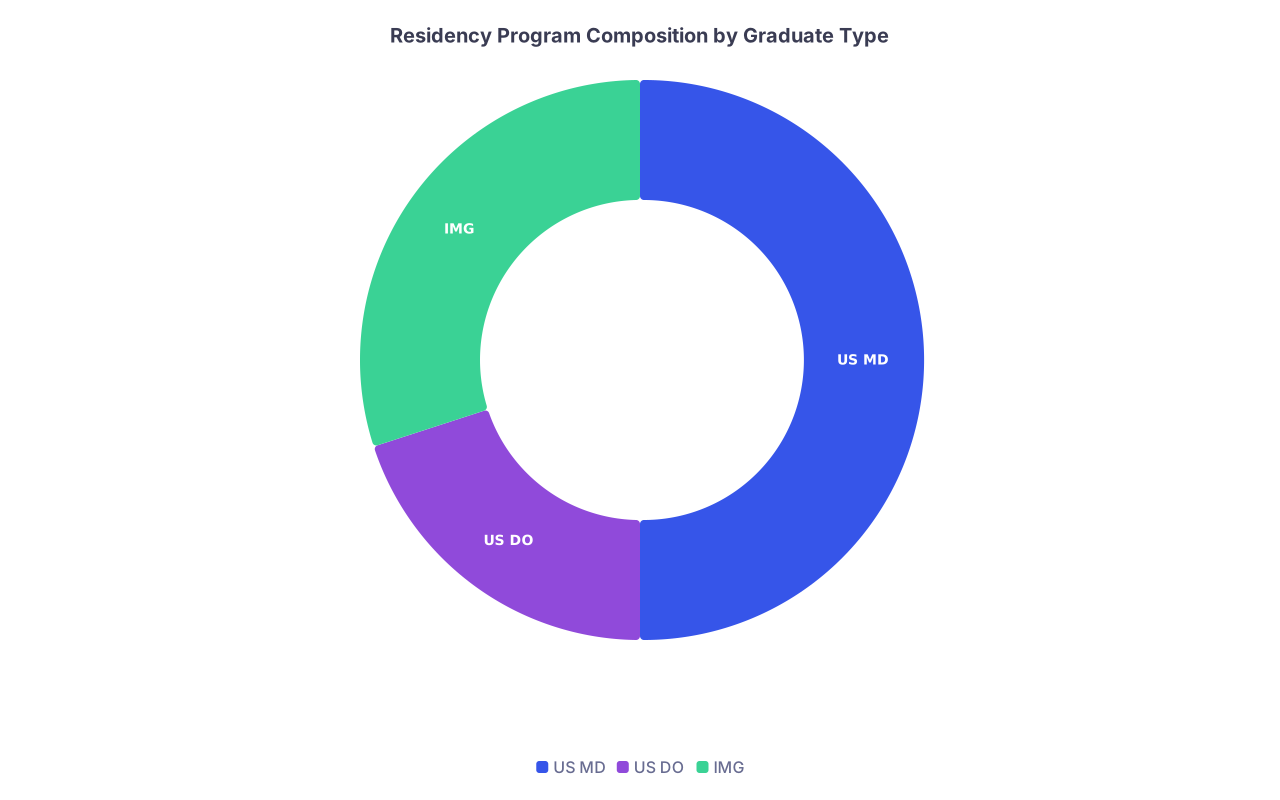
| Category | Value |
|---|---|
| US MD | 50 |
| US DO | 20 |
| IMG | 30 |
That’s the type of distribution where an IMG can actually get a look.
Red flags:
- Only Caribbean grads but no non-Caribbean IMGs
- Only one single IMG across 15 residents
- Last IMG appeared 4+ years ago
You’re looking for consistent evidence that they actually interview and rank IMGs.
Step 3: Align USMLE Scores and YOG With Their Reality
Don’t just ask “Do they accept IMGs?” Ask:
“Do they accept IMGs like me?”
Example:
- Program A: 40% IMGs, but all recent grads within 3 years, most with 240+
- Program B: 60% IMGs, many 5–10 years out, mix of Step 2 CK 220–235
If you’re 7 years from graduation with 225 and no US research, Program B is your lane. Program A is wishful thinking.
Step 4: Visa Sponsorship Consistency
You need to see this combination:
- Visa policy explicitly stated
- Multiple current residents on that visa type
- No recent shift away from your visa type
For example, if you need H-1B:
- Don’t just rely on “We may consider H-1B in exceptional cases.”
- Look at actual residents. Are there any on H-1B now?
If all IMGs are on J-1, you should assume J-1 is the default and H-1B is extremely rare.
Why IMGs Over-Apply Anyway (And How Programs Exploit It)
Let’s be honest: ERAS and programs make serious money off this.
Look at a rough cost breakdown:
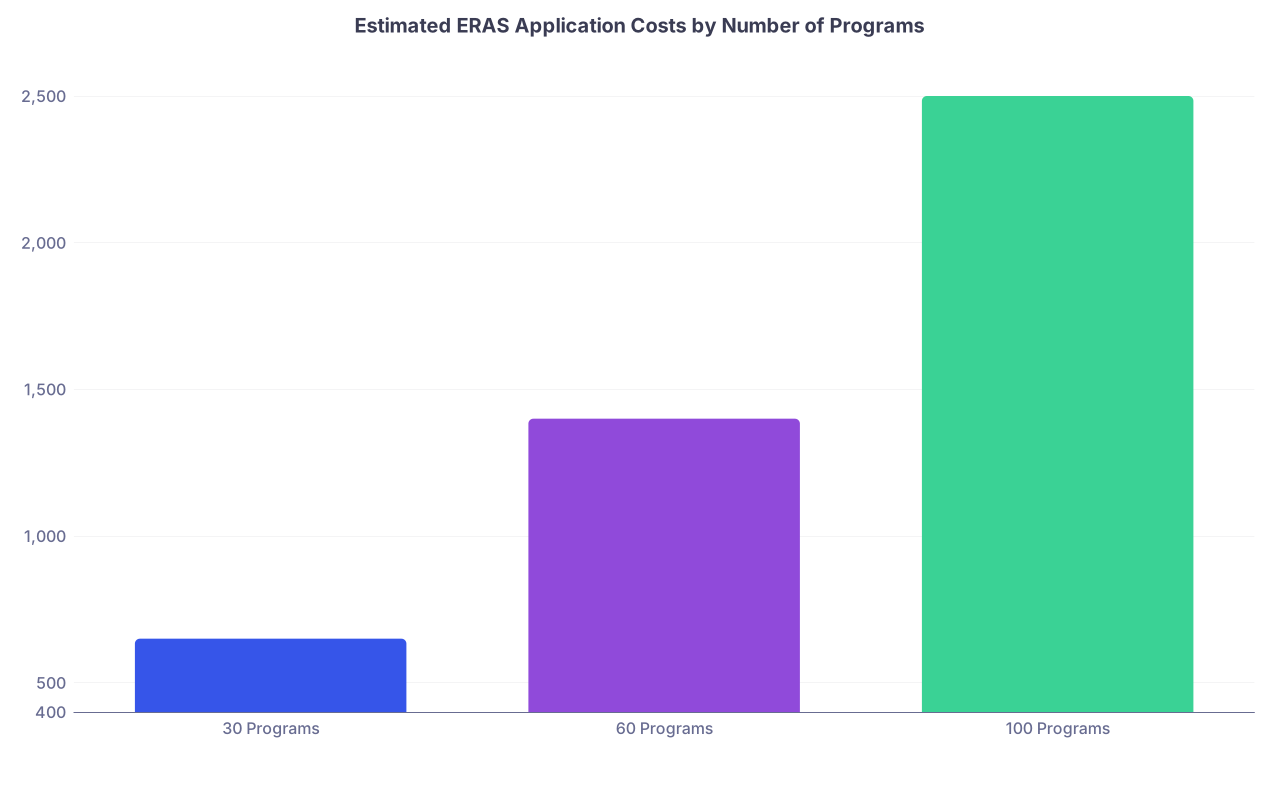
| Category | Value |
|---|---|
| 30 Programs | 650 |
| 60 Programs | 1400 |
| 100 Programs | 2500 |
I regularly see IMGs applying to 120+ programs because they’re terrified.
Fear drives over-application. Over-application drives sloppy list-building. Sloppy list-building sends money to programs that never intended to review IMGs in the first place.
Programs know this. They:
- Don’t bother updating their websites.
- Let myths about “maybe they take IMGs” float around.
- Enjoy the application fees, then auto-filter 70% of applicants.
Your defense is not “apply to more.” It’s “apply smarter.”
A Practical Strategy: How Many “Reach” vs “Realistic” vs “Safety” for IMGs
You should not only apply to “safety” programs. But you also can’t live in reach-land.
Here’s a rough framework that works better than chaos:
| Category | % of Applications | Characteristics |
|---|---|---|
| Realistic | 50–60% | Strong IMG history, your stats similar to theirs |
| Reach | 20–30% | Some IMGs, higher scores than yours |
| Stretch | 10–20% | Rare IMGs, big names, high competition |
- Realistic: Programs where your profile matches their past IMGs. This is the core of your list.
- Reach: Better programs but still demonstrably take IMGs and maybe your numbers are slightly below their average.
- Stretch: The dream ones. Fine to have a few. Just don’t build your entire season on them.
If your list is 70–80% stretch with almost no realistic programs, you’re setting yourself up for disaster.
Red Flags on “IMG-Friendly” Claims
Programs and people misuse this term all the time. Here’s what should raise your suspicion.
1. Program Says “We Welcome Diversity” but Shows 0 IMGs
Diversity statements mean nothing if the resident roster is 100% US MD/DO.
Reality > website words.
2. Old Forum Posts With No Recent Confirmation
If the most recent “I matched here as an IMG” post is from 2015, and nothing since, that’s stale. Leadership changes. PDs retire. Visa policies flip.
You’re not applying in 2015.
3. Only Caribbean IMGs, No Other International Schools
Some programs quietly treat Caribbean grads differently from other IMGs. They may:
- Know those schools better
- Have established pipelines
- Avoid other international schools completely
If their only IMGs are all from 2–3 Caribbean schools, and you went to a different international school, don’t assume you’re in the same category.
How to Quickly Triage Programs Before You Waste an Application
Here’s a rapid, 5-minute system per program.

| Step | Description |
|---|---|
| Step 1 | Open Program Website |
| Step 2 | Check Visa Policy Page |
| Step 3 | Skip Visa Check |
| Step 4 | Remove from List |
| Step 5 | Open Current Residents Page |
| Step 6 | Compare Scores and YOG |
| Step 7 | Classify as Stretch or Remove |
| Step 8 | Classify as Realistic/Reach |
| Step 9 | Visa Needed? |
| Step 10 | Visa Type Matches? |
| Step 11 | Any IMGs in last 3-5 years? |
| Step 12 | Comparable to Current IMGs? |
If at any point you hit a “No visas” or “No IMGs ever,” stop. Don’t rationalize. Move on.
The Emotional Trap: “But I Really Want to Live There”
I get it. You want New York or California. Your cousin is in Houston. You dreamed about Boston since you were 10.
Here’s the thing:
You want to be a doctor first. You can chase geography later.
Successful IMGs often:
- Match in smaller cities or less-famous hospitals
- Build experience, get licensed, improve their CV
- Then transfer, fellowship, or move after residency
Unsuccessful IMGs:
- Over-apply to dream locations
- Under-apply to solid but less glamorous states
- End up unmatched, repeating cycles, or giving up entirely
Use emotion to drive your effort, not to select your programs.
Data Reality Check: Where IMGs Actually Match
You don’t need exact numbers to grasp the pattern: IMGs overwhelmingly match in community programs and less competitive regions.
Think:
- Internal Medicine in midwestern or southern states
- Family Medicine in community hospitals
- Pediatrics in smaller cities
Not:
- Dermatology at a top-10 academic center
- Radiology at brand-name institutions
- Competitive specialties in oversaturated metros
You can absolutely build a great career from a “no-name” program. But you can’t build any career from an unmatched status.
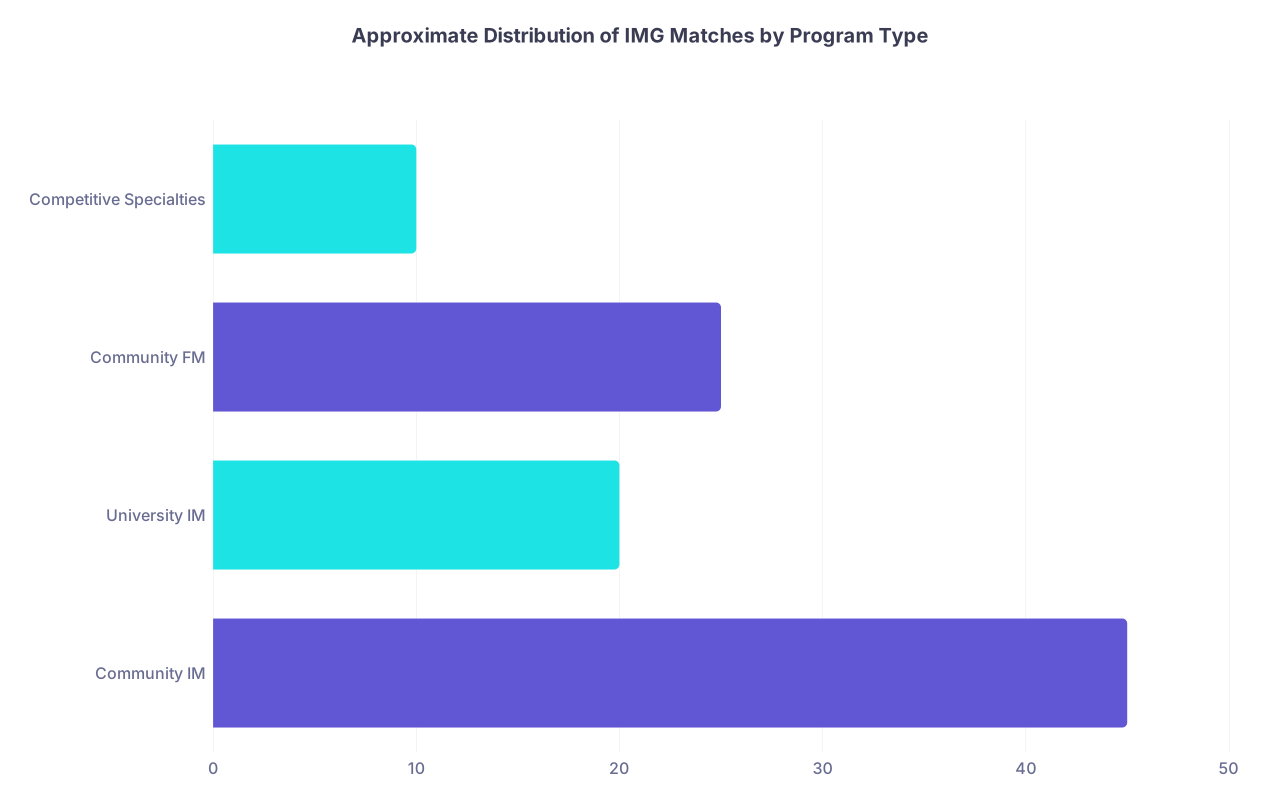
| Category | Value |
|---|---|
| Community IM | 45 |
| University IM | 20 |
| Community FM | 25 |
| Competitive Specialties | 10 |
Look at where people like you actually succeed. Then aim there.
A Smarter Way to Build Your List (That Most IMGs Skip)
Instead of starting with “What are all the programs in this specialty?” start with:
Your profile on paper:
- Step 2 CK
- YOG
- USCE months
- Visa needs
- Red flags (attempts, gaps)
Define your realistic tier:
- Look for programs that have IMGs with similar stats and background.
Build outward:
- From that realistic core, add:
- Some safer programs (more IMGs, lower average stats)
- Some reach programs (slightly higher stats but still IMG history)
- A handful of stretches if you must
- From that realistic core, add:
Most IMGs do the opposite: start with famous names, then sprinkle in a few safety programs at the end when money is running low. That’s backwards.
The Bottom Line: Stop Donating Money To Programs That Don’t Want You
If you remember nothing else, remember this:
IMG-friendly is proven, not promised.
Look at actual residents, visas, and match history. Ignore vague website language.Your profile defines your universe.
Not every IMG is competing for the same subset of programs. Match yourself to programs whose past IMGs look like you on paper.Applications are not lottery tickets.
More is not always better if half your list is fantasy. Every unrealistic application dilutes time, energy, and money that could go to real opportunities.
Protect your chances by protecting your list. Programs are not going to change their filters for you. Your power is in where you choose to apply.
Use it wisely.