
What if the “IMG-friendly” list you’re relying on is the exact reason you don’t match?
Let me be blunt: I’ve watched international medical graduates burn entire application cycles because they trusted a spreadsheet, a Reddit comment, or a consulting company’s “exclusive IMG-friendly list” more than they trusted actual data and critical thinking. The phrase “IMG-friendly” has become a marketing tool, not a guarantee.
If you’re an IMG, you do not get many chances. You cannot afford to make these mistakes.
The Biggest Myth: “IMG-Friendly” = Safe Bet
The first and most dangerous mistake: assuming “IMG friendly” means “you have a good shot here.”
It does not.
At best, “IMG-friendly” usually means: “They took at least one IMG in the last few years.” That is all. It doesn’t tell you:
- How many total spots the program has
- How many of those went to IMGs
- Whether those IMGs were US-IMGs or non-US-IMGs
- Whether those IMGs had 260+ scores and 3 publications
- Whether the program now has new leadership that changed everything
Here’s how this plays out in real life:
You see an “IMG-friendly” list that shows Internal Medicine Program A (categorical, 20 positions). Their current residents page has 1 non-US IMG in PGY-3. So they’re labeled IMG friendly.
That means: 1 out of 60 categorical residents over three classes = 1.6%.
Yet I’ve seen IMGs put Program A in their top 10 “high yield” list purely because of that tag.
This is how you quietly self-sabotage.
To drive home how misleading “IMG-friendly” can be, look at this kind of reality:
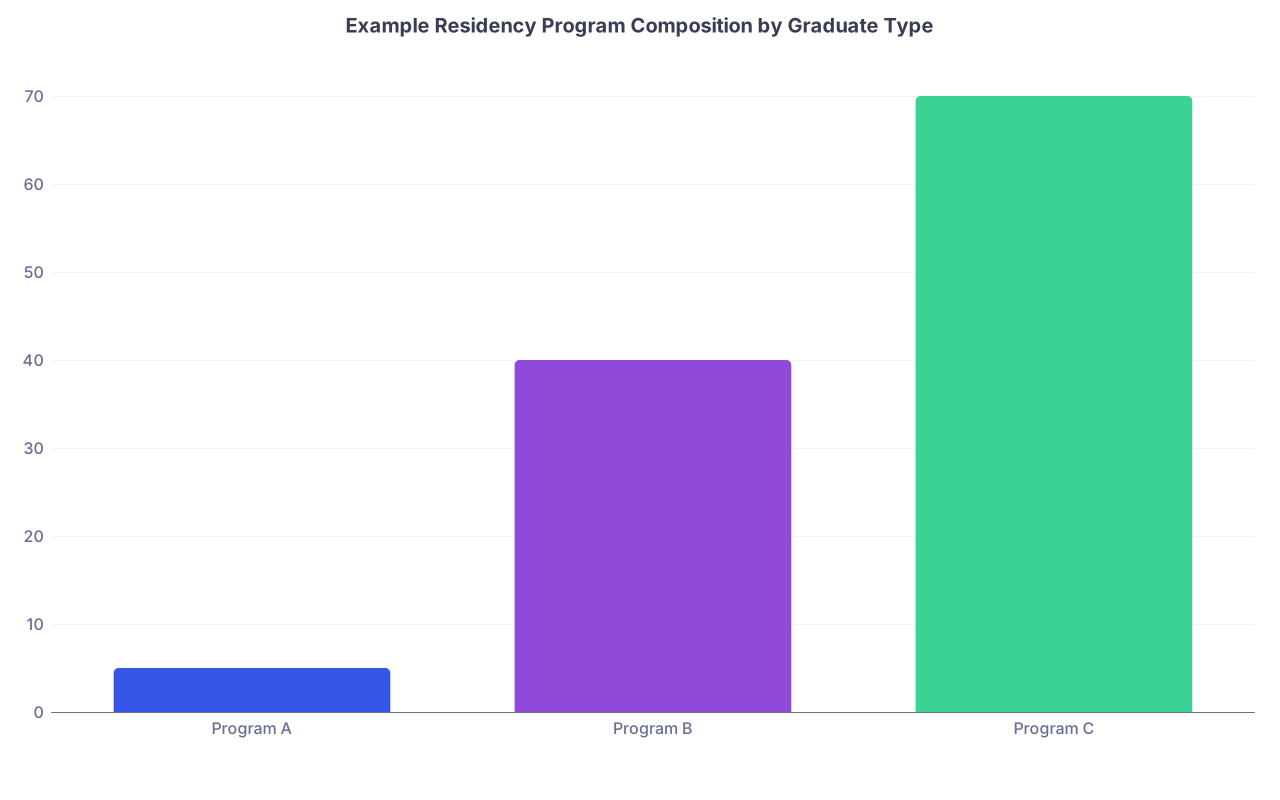
| Category | Value |
|---|---|
| Program A | 5 |
| Program B | 40 |
| Program C | 70 |
Imagine that “IMGs per program” chart is out of 100 total residents:
- Program A: 5% IMGs (but still shows up on an IMG-friendly list)
- Program B: 40% IMGs (genuinely moderate)
- Program C: 70% IMGs (actually IMG-heavy)
If you treat A, B, and C as equally “friendly,” you’re doing yourself harm.
Mistake to avoid: Treating the label “IMG-friendly” like a green light.
Safer approach: Always ask, “How many IMGs? What percentage? US vs non-US? Recent or ancient?” If you can’t answer those, you don’t know if it’s actually friendly.
Blindly Trusting Commercial “IMG-Friendly” Lists
Let me be harsh for a second: a lot of “IMG-friendly program lists” sold by consulting groups are recycled, outdated, and sometimes just speculative.
I’ve seen:
- Lists “updated for 2024” that still included programs that no longer exist
- Programs labeled “IMG-friendly” where the last non-US IMG grad was 2015
- Entire specialties marked as “good for IMGs” based on 1 prelim spot, 5 years ago
Some services literally scrape public data, sort by “number of IMGs ever,” and sell it back to you with pretty formatting.
The danger isn’t just wasting money. It’s worse: you build your entire strategy on flawed assumptions.
You think you’re being smart and targeted. You’re actually filtering out better options and piling applications into low-yield ones.
Here’s what usually goes wrong when you rely on these commercial lists:
- You over-apply to “hot” programs that every IMG list circulates
- You under-apply to solid but less-hyped community programs
- You ignore important filters like visa sponsorship, step attempts, and graduation year

Red flags your IMG-friendly list is trash:
- It doesn’t show the year the data was last updated
- It doesn’t separate US-IMG from non-US IMG numbers
- It doesn’t specify categorical vs prelim positions
- It’s not cross-referenced with official sources like FREIDA or program websites
- Every IMG you talk to “has the same list”
If a list doesn’t show methodology, it’s a marketing brochure, not a tool.
Using Old Data in a Rapidly Changing System
Residency programs change leadership. They change policies. They change their attitude towards IMGs. Quickly.
One PD leaves. Chair changes. New DIO. Suddenly a program that used to take 30% IMGs drops to 0% for three cycles.
I’ve seen IMGs cling to a 2018 SDN post: “This program is great for IMGs, they took half the class from abroad!” Meanwhile, it’s 2025, and their current website shows:
- 0 non-US IMGs in PGY-1, PGY-2, PGY-3
- “US citizenship or permanent residency preferred” in fine print
But the list they bought still has that program colored bright green.
This is the mistake: assuming residency culture is static. It is not.
Here’s how quickly programs can flip:
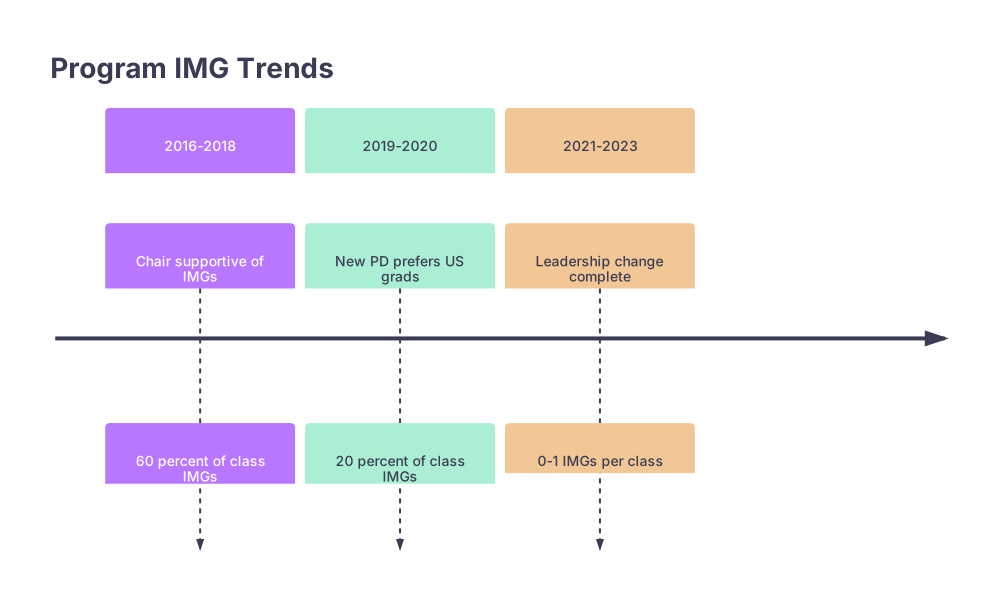
| Period | Event |
|---|---|
| 2016-2018 - Chair supportive of IMGs | 60 percent of class IMGs |
| 2019-2020 - New PD prefers US grads | 20 percent of class IMGs |
| 2021-2023 - Leadership change complete | 0-1 IMGs per class |
If your data ends at 2018, your conclusions are fantasy.
Mistake to avoid: Using historical anecdotes as current truth.
Safer approach: Your default assumption: “If I cannot verify current resident composition from the website or reliable databases, it’s not IMG-friendly—no matter what some PDF says.”
Confusing “Any IMG” with “IMG Like Me”
Here’s a subtle but fatal error: seeing a single IMG at a program and thinking, “That means they like people like me.”
You don’t know that.
You don’t know if:
- That IMG is a US citizen who went Caribbean
- They had 260+ on both Steps, 5 US letters, 3 US publications
- They rotated there as a sub-I and were personally known
- They matched 6 years ago under a completely different PD
If you’re a non-US citizen from a lesser-known school with Step scores around average and minimal US clinical experience, that one IMG at a big-name academic program might be nothing like you statistically.
| Factor | IMG in Program | You (Example) |
|---|---|---|
| Citizenship | US citizen | Non-US citizen |
| Medical school | Known Caribbean | Lesser-known foreign |
| Step scores | 250+ | 225-230 |
| Visa needed | No | Yes (J1) |
| Research | 3+ publications | None |
Both are “IMGs.” Only one is actually similar to your profile.
Mistake to avoid: Assuming all IMGs are treated the same.
Safer approach: Filter not just by “IMGs present” but by:
- Visa sponsorship history
- Known patterns (Caribbean-heavy vs diverse foreign schools)
- Level of competitiveness vs your own application strength
If you’re a non-US IMG with average scores and no research, a “Caribbean-heavy” program that rarely sponsors visas is not “friendly” to you.
Ignoring Visa Reality While Chasing “Friendly” Programs
Another expensive mistake: using IMG-friendly lists that don’t distinguish visa policies.
If a list tells you nothing about:
- J-1 sponsorship history
- H-1B sponsorship frequency
- Programs that prefer US citizens/permanent residents only
…it’s incomplete at best, dangerous at worst.
I’ve seen IMGs waste dozens of applications on programs that haven’t sponsored any visa in years. Why? Because the list only looked at final residency rosters, not citizenship or visa status.
Many US-IMGs on a roster are US citizens. They never needed a visa. Those programs might still be labeled “IMG-friendly,” but they’re absolutely not non-US-IMG friendly.
Look at how quickly this difference adds up:
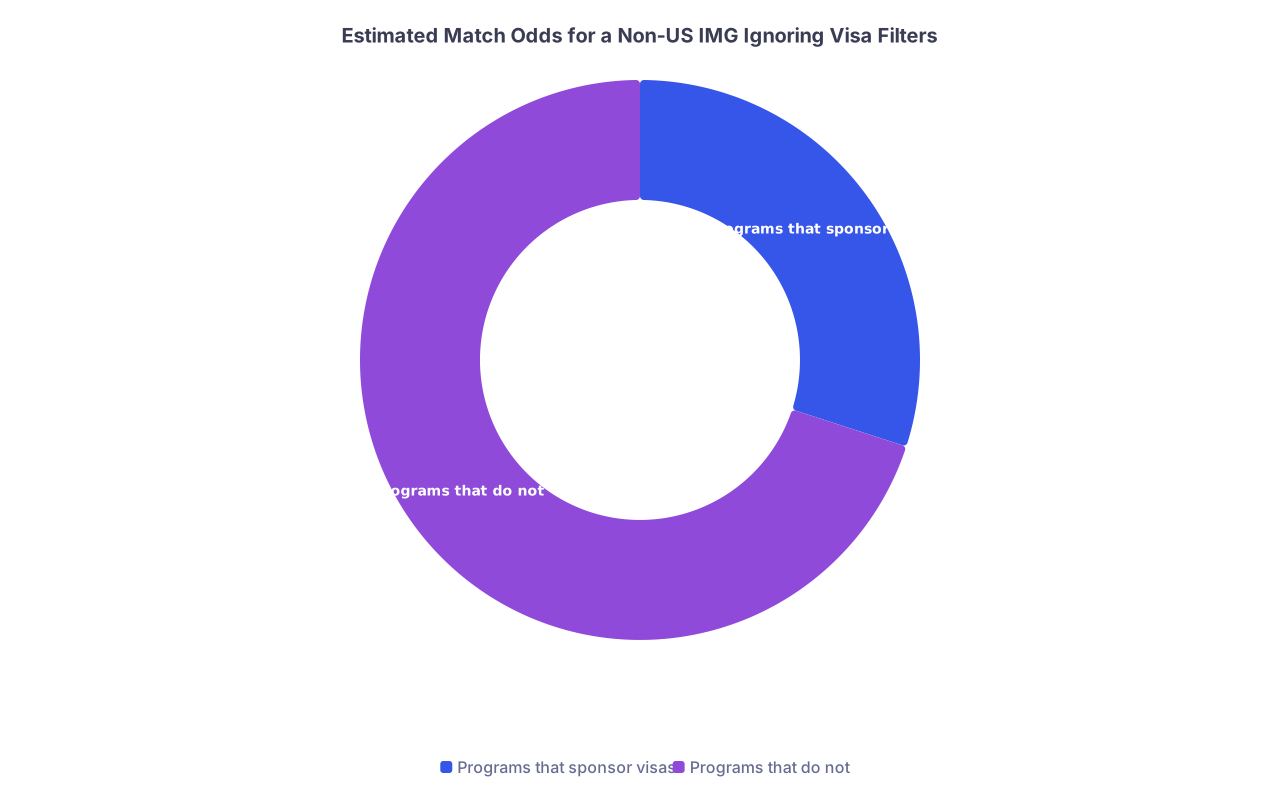
| Category | Value |
|---|---|
| Programs that sponsor visas | 30 |
| Programs that do not | 70 |
If 70% of where you applied doesn’t routinely sponsor your visa, you’ve handicapped yourself before anyone reads your personal statement.
Mistake to avoid: Treating all IMGs as equal despite visa dependency.
Safer approach: Before labeling a program “friendly,” check:
- Does their website explicitly mention sponsoring J-1/H-1B?
- Are there current residents clearly from non-US schools and likely needing visas?
- What do recent, credible applicant reports say (not ancient posts)?
If your list doesn’t track this, it’s incomplete. Adjust your trust accordingly.
Overconcentrating Applications on Popular “IMG-Friendly” Programs
There’s a pattern every cycle: certain programs show up on every IMG’s filtered list. Community IM programs in New York, New Jersey, Michigan, parts of Ohio and Texas. Everyone thinks they’re clever for finding them.
They’re not. Those programs get buried in applications.
If you and thousands of other IMGs are all using the same commercial lists, everyone’s application “strategy” looks identical.
I’ve watched applicants apply to 80–100 programs, but in reality they’re all aiming at the same 40–50 overcrowded places. Then they’re stunned when they get 2 or 3 interview invites and blame their personal statement.
The problem was upstream: poor program selection.
Signs you’re overconcentrating on overfished programs:
- Most of your list is from the same few states (NY, NJ, MI, TX)
- You have very few smaller programs in less popular locations (Midwest, rural South, etc.)
- You recognize 70% of your list from everyone else’s threads
Friendly does not mean less competitive. Sometimes it means “competitive because they are known to be friendly.”
Mistake to avoid: Confusing “IMG-friendly” with “low competition.”
Safer approach: Balance your list:
- Some known IMG-heavy programs
- Some less-talked-about community sites in less “famous” locations
- A realistic mix of long shots, solid targets, and true backups
If your list looks identical to what you see posted on social media, you’re not being strategic. You’re joining a stampede.
Treating Lists as Strategy Instead of Tools
This is the mindset trap: using “IMG-friendly” lists as your strategy instead of one data point in a real strategy.
Lists are static. The match is not. You need to actually think:
- What’s my specialty? (Internal medicine vs surgery vs psych vs FM)
- What’s my profile? (scores, attempts, YOG, USCE, research)
- What’s my visa situation?
- What’s my risk tolerance? (Apply broadly vs target fewer programs carefully)
Most IMGs I’ve seen struggle don’t have a program list problem. They have a strategy problem. The list just exposes it.
Here’s a more sane way to integrate “IMG-friendly” info:
- Start with your honest profile (including weaknesses)
- Use official databases (FREIDA, individual websites) to filter for:
- Accreditation
- Visa sponsorship
- Program size
- Then use IMG-friendly lists as hints: “Worth a closer look? Maybe.”
- Cross-check with:
- Current resident rosters
- Recent match data (NRMP reports)
- Up-to-date applicant experiences
The list should never be your only filter.
Neglecting Official and Primary Sources
One thing that makes me shake my head: IMGs trusting a Telegram screenshot more than a program’s own website.
If your “evidence” is:
- A random Excel file re-forwarded 20 times
- A Google Drive leaked three years ago
- A screenshot of someone else’s “final list”
…you’re trusting the wrong sources.
Look where programs actually tell the truth:
- Their “Current Residents” page
- Their “FAQ for applicants” page
- Their official policies on ECFMG, step attempts, graduation cutoffs, visa sponsorship
- FREIDA (not perfect, but at least has structure and some verification)
Whenever there’s a conflict between:
- A program’s current website
vs - Some “IMG-friendly” spreadsheet
You trust the website. Every single time.
Mistake to avoid: Giving more weight to derivative, secondhand tools than to primary sources.
Safer approach: Use this sequence:
- Find a program on an IMG-friendly list
- Go to FREIDA → confirm basic data
- Go to program website → check:
- Visa sponsorship
- Step requirements
- YOG preference
- Current resident backgrounds
- If they look reasonably open, then you consider it “friendly enough” to apply
Ignoring Your Own Competitiveness While Hiding Behind Lists
A brutal truth: many IMGs use IMG-friendly lists as an emotional cushion so they don’t have to confront how competitive they actually are.
I’ve seen candidates with:
- Multiple Step failures
- 10+ years since graduation
- Minimal USCE
- No research, no networking
…who still heavily apply to “IMG-friendly” university programs with high academic output and US-grad heavy rosters, because “they take IMGs.”
Yes, they do. But look closely at which IMGs they take:
- Recent grads
- High-scoring
- Often with research and US letters
- Known to the department
You don’t fix a weak application with a friendlier list. You fix it with remediation, improving your profile, and being brutally realistic about your tier.

Mistake to avoid: Using “IMG-friendly” as a fantasy that cancels out red flags in your application.
Safer approach:
- Honestly categorize yourself:
- Strong IMG
- Average IMG
- Red-flag IMG (failures, big YOG gap, etc.)
- Match program tiers to your true category, not to your wishlist
If you’re carrying multiple red flags, your safest “IMG-friendly” programs will look very different from someone with a clean, recent, 250+ transcript.
The Most Expensive Mistake: Not Customizing Your List At All
Here’s the pattern that scares me the most: IMGs running the exact same list in multiple cycles, despite previous failure.
“I used this IMG-friendly list last year and got 2 interviews, so I’ll try the same with a few additions.”
No. That’s how you waste years.
If you didn’t match using a heavy IMG-friendly list once, that’s data. It’s telling you your assumptions were wrong:
- Either about your competitiveness
- Or about those programs being truly “friendly” to your type of IMG
- Or about the volume and distribution of applications
Copy-pasting last year’s failed approach is not perseverance. It’s denial.
You should be:
- Removing programs that ghosted you multiple years in a row
- Heavily favoring places that at least sent you interviews before
- Reexamining states, program types, and your balance of academic vs community
Recycling an old IMG-friendly list is the lazy, expensive way to feel “busy” without changing outcome.
What You Should Do Today
You don’t need to throw away every IMG-friendly resource. You need to de-throne them.
Here’s a concrete step you can take right now:
Open your current “IMG-friendly” program list. Pick 5 programs at random. For each one, go to their official website and:
- Find the current residents page
- Count:
- Total residents
- How many clearly non-US IMGs
- Look for:
- Any statement about visa sponsorship
- Any indication of YOG or step cutoffs
Now compare what you just found to why that program was labeled “IMG-friendly” on your list.
If at least 2 out of those 5 look a lot less friendly than advertised, you have your answer: your list is not a strategy. It’s a starting point that needs aggressive verification.
Do that for 20 programs over the next couple of days. Keep notes. Start building your own reality-based IMG-friendly list instead of renting someone else’s fantasy.