
The belief that “friendly” residencies will overlook weak letters is dead wrong—and it’s quietly killing a lot of IMG applications.
You’re told a program is “IMG-friendly,” so you relax about your letters. You accept whatever your attendings hand you. You let generic, late, or irrelevant references ride because “this is a community program, they’re used to IMGs.” That’s the trap.
They may be IMG-friendly. They are absolutely not bad-letter-friendly.
Let me walk you through the reference letter pitfalls that quietly sink IMGs at so‑called friendly programs—and how to avoid stepping on every single one.
The Biggest Lie: “Any US Letter Is Fine for IMG-Friendly Programs”
This is the first and most brutal mistake: assuming that any US letter is better than the best non-US letter.
No. That is not always true.
Here’s what actually happens behind the scenes. I’ve heard versions of this in committee rooms more times than I like:
“We’re fine with IMGs, but this letter doesn’t say anything. Pass.” “If this is their best letter, I’m worried.” “They say she’s ‘hard-working and pleasant.’ That’s a nurse reference, not a residency letter.”
The problem is not that you are an IMG. The problem is that your letters make you look:
- forgettable
- risky
- untested in actual US-style clinical work
Stop assuming “any US letter” is better than:
- a strong home-country supervisor letter
- a detailed research PI letter
- or a department chair from abroad who actually knows you well
Sometimes, a bland US letter written after a 2-week observership is worse than a specific, detailed non-US letter from someone who supervised you for a year.
The dangerous combo I see over and over:
- 1–2 generic US letters from short observerships
- 1 “good” but vague letter from home
- 0 letters that clearly state: “I would trust this person to be an intern here.”
IMG-friendly programs don’t need you to be perfect. But they do need at least one letter that clearly says: this person is safe, reliable, and worth the risk.
Mistake #1: Confusing “Known Faculty” with “Strong Letter Writer”
You chase big names. You ignore who actually knows your work.
Classic scenario. You:
- Find a “famous” attending at a big-name hospital
- Shadow them for 2–3 half-days
- Ask for a letter
- Get a two-paragraph, generic, copy-paste template that says nothing unique about you
Then you attach this to your application and feel proud because “Dr. X is well-known.”
Here’s the harsh truth: committee members can smell template letters from a mile away. They’ve seen that same attending’s vague letter 40 times in 3 cycles. The name might impress outsiders. It doesn’t fool people inside the system.
Compare that to:
- A community hospital attending who worked with you for 8 weeks, saw you call consults, write notes, follow up results
- And then writes: “She handled cross-coverage calls appropriately, recognized a GI bleed, escalated correctly, and stayed late to stabilize the patient.”
Who do you think carries more weight in an IMG-friendly program that actually needs residents who can function?
Friendly programs prioritize content over prestige. You keep making the opposite bet.
How to avoid this
Do not ask:
“Who is the most famous?”
Ask:
“Who has actually seen me take responsibility, show judgment, and act like a real intern?”
If the answer is a less “fancy” name but stronger detail? Take that every time.
Mistake #2: Asking for Letters from People Who Barely Know You
You know the script:
“Dear Dr. Smith, I rotated with you for a week in 2022. Would you be able to write me a strong letter of recommendation?”
You barely spoke. You presented once. They have no idea who you are. But they feel bad and say yes.
So they:
- go to their template
- fill in your name
- add “hard-working and pleasant”
- mention nothing specific to your clinical judgment
- and hit submit 3 days before the deadline
You end up with a letter that’s not negative—but it’s not positive enough to move the needle.
In many committees, this kind of letter falls into a mental category: “faint praise = weak candidate.”
Phrases that should terrify you when they’re the main content of a letter:
- “pleasant to work with”
- “hard-working and punctual”
- “got along well with the team”
- “completed all assigned tasks”
None of those mean “good resident.” They mean “did not scare me.” That’s the floor, not the ceiling.
Safer pattern
The best letters for IMGs in friendly programs usually come from:
- 4–8 week US clinical rotations where you had real responsibilities
- consistent contact with the same attending or hospitalist group
- people who have seen you write notes, present, follow up labs, call consults, and manage day-to-day tasks
If your relationship with the writer is “I was there, they saw me,” that’s not enough. You need “I supervised them and trusted them with real tasks.”
Mistake #3: Ignoring Specialty-Specific Expectations in Friendly Programs
Here’s a subtle one. You’re applying Internal Medicine, but half your letters are from:
- Pediatrics
- Family Medicine clinics with light acuity
- Research mentors not involved in clinical care
IMG-friendly IM programs are not less serious about fit. They still want evidence you can survive their reality: ward months, nights, cross-coverage, older, sicker patients.
They are not comforted by:
- a telehealth clinic letter
- an outpatient-only elective with no real call or inpatient exposure
- a lab PI who never saw you talk to a patient
When you submit letters from the wrong settings, the message unintentionally becomes:
“I couldn’t get strong IM inpatient letters, so I’m giving you whatever I have.”
You think: “But the program is IMG-friendly! They’ll understand I did what I could.”
No. They will think: “Why did no one in actual Internal Medicine want to write for this person?”
The minimum standard you should aim for
For most IMG-friendly IM programs, you should target:
- At least 2 letters from internal medicine attendings who have seen you in inpatient adult care
- Preferably 1 from a US setting (more is better, but quality beats tokenism)
- 1 additional letter that adds something unique: research, longitudinal mentorship, or strong home-country experience
Do not stack your file with “whatever you can get.” Be deliberate.
Mistake #4: Letting Weak Template Language Destroy You
Let’s be blunt. The wrong adjectives can kill you.
There are two categories of disaster letters:
- Soft-kill letters – not obviously negative, but so weak they hurt you silently
- Poison letters – coded negative, using language committees immediately recognize
You’re usually more afraid of the second group, but it’s the first group that ruins most IMG applications in friendly places. Because you never realize they’re bad.
Common soft-kill patterns:
- “I expect they will be successful with continued supervision and guidance.”
- “He completed all tasks assigned to him.”
- “She showed improvement throughout the rotation.”
- “I had limited time with him but he seemed engaged.”
Common poison phrases programs read as red flags:
- “I did not have the opportunity to observe…”
- “To my knowledge, there were no major concerns…”
- “Given the right environment, she may be able to succeed.”
- “At times required more direction than expected for her level.”
You rarely see these letters. But you can predict risk.
High-risk letter-writing situations for IMGs
If any of these are true, be cautious:
- The attending clearly doesn’t remember you and says, “Sure, send me your CV, I’ll put something together” after a long pause
- They ask you to draft the letter and they’ll “sign it,” but they never really worked with you
- They were openly frustrated with your performance, even once, and you felt it
- You missed days, showed up late, or had friction with staff during that rotation
Friendly programs are not hunting for reasons to fail you. But they also don’t want to match into a remediation project they didn’t see coming.
Mistake #5: Mixing Strong and Weak Letters Without Strategy
This one hurts because it’s often avoidable.
Your letter set looks like this:
- 1 fantastic, detailed US inpatient IM letter
- 1 generic “hard-working, pleasant” US outpatient letter
- 1 home-country attending letter that’s long but vague
- 1 research PI letter that doesn’t comment on clinical performance
On paper? “Four letters, multiple settings, US and international. Great.”
In real life? The strong letter is drowned out by mediocrity.
Programs don’t average letters like grades. They look at patterns. And the pattern they see is:
- One person loves you
- Three people can’t commit to saying much
That’s not what helps an IMG break the “risk barrier” in a friendly program that still has dozens of other IMGs applying.
You’d often be better off with:
- 2 strong letters uploaded
- 1 neutral but not harmful third
- And skipping the worst one entirely
ERAS lets you assign which letters go to which programs. Too many IMGs just shotgun everything everywhere. That’s lazy self-sabotage.
Mistake #6: Believing Observership Letters Are Enough for Hard Clinical Fields
This is brutal, but you need to hear it.
If you are applying to Internal Medicine, Surgery, EM, or any field where day-to-day clinical work is intense, observership-only letters are almost always a weak foundation.
I’ve seen this so many times:
- “IMG-friendly IM program + I have 3 US observership letters = I’m good.”
No.
Observerships often:
- Prohibit direct patient care
- Limit your chart access
- Restrict orders, notes, and team roles
So your letter ends up saying:
“He was observant, eager to learn, and asked insightful questions.”
That’s fine for pre-clinical students. It’s not reassuring for someone who’s about to handle 8–12 patients overnight.
IMG-friendly does not mean they are okay guessing whether you can cross-cover a septic patient. They want clues. Observership-only letters rarely give enough of them.
Better alternative, if you can get it
Anything that allows:
- Hands-on inpatient work (externships, sub-I equivalents, supervised note-writing, calling consults with supervision)
- Real responsibility with oversight
- Documentation that you functioned at a near-intern level
One strong letter from that kind of setting can be more valuable than three shiny observership letters that say nothing.
Mistake #7: Timing Your Letters So Poorly You Signal Disorganization
Late letters are louder than you think.
Programs notice when:
- Your file is “incomplete” for weeks after others are ready
- Your letters trickle in October–November
- You clearly scrambled to grab anyone in late September
In more competitive places, that’s deadly. In IMG-friendly programs, it’s still bad. They may be flexible, but they’re also pattern-watchers.
Common perceptions when your letters are late:
- “They didn’t plan well.”
- “They may be disorganized as a resident too.”
- “If they struggled to line up letters, maybe they had trouble finding attendings willing to write for them.”
Sometimes, real life happens. Sickness, family issues, delayed rotations. But if that’s not your situation and your letters are still late, that’s on you.
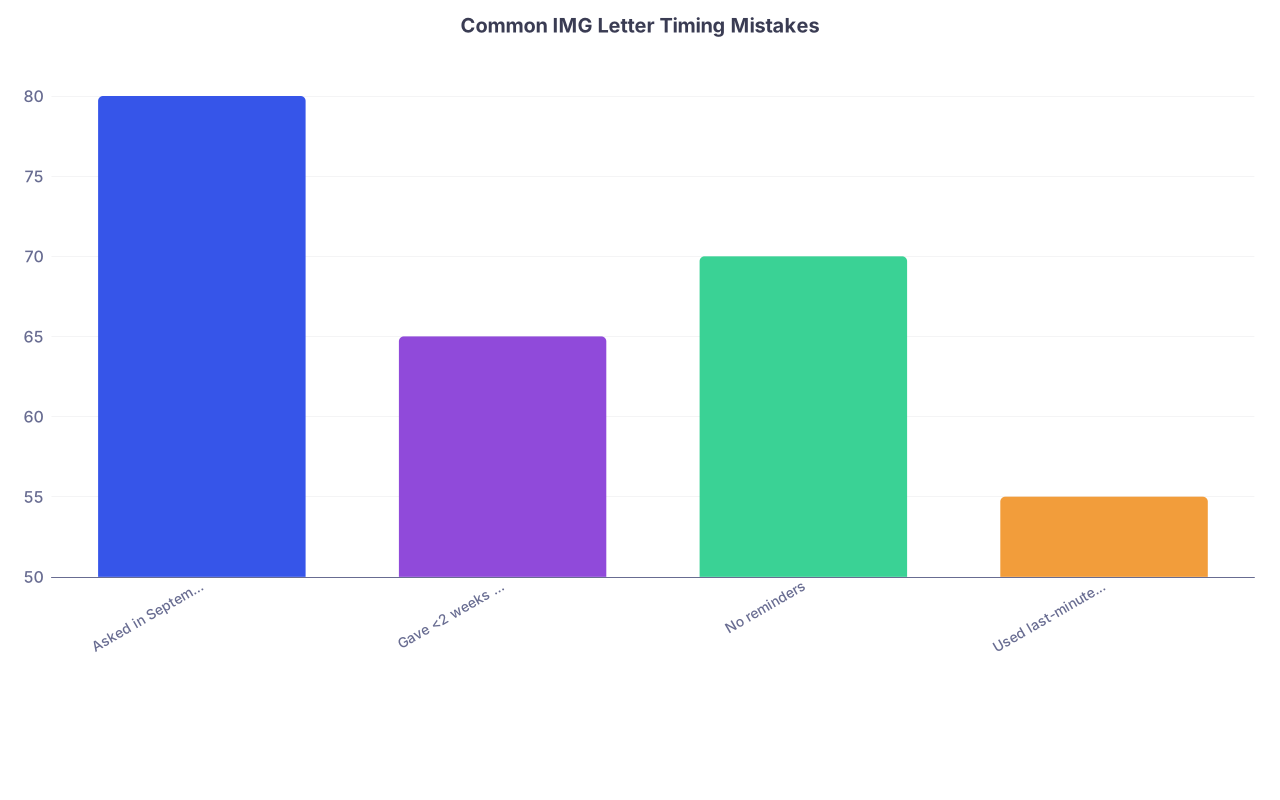
| Category | Value |
|---|---|
| Asked in September | 80 |
| Gave <2 weeks notice | 65 |
| No reminders | 70 |
| Used last-minute writer | 55 |
You avoid most of this by:
- Asking early, clearly, and in person when possible
- Giving a clear deadline 3–4 weeks before you truly need it
- Sending polite reminders, not desperate pleas two days before ERAS opens
Mistake #8: Ignoring Program Culture Signals About Letters
IMG-friendly doesn’t mean they all think the same way.
Different programs emphasize different things:
- Some care a lot about US letters in their specialty
- Some care more about continuity and long-term mentorship
- Some explicitly state: “We prefer at least one letter from US clinical experience”
You know what too many IMGs do? They never read the fine print. They assume “friendly” = “not picky.”
Then they send:
- zero US letters to a program that clearly asked for one
- all non-specialty letters to a program that wants “at least two from core discipline”
- four letters from the same type of setting (all clinic, all research) to a program that lives on the wards
You’re basically saying: “I did not care enough to tailor my application to you.”
In an oversaturated IMG pool, that’s how you become the easy “no.”
| Program Type | What They Quietly Prefer |
|---|---|
| Community IM (high IMG) | Strong inpatient IM letters, reliability |
| University-affiliated community | Mix of US + home letters, some academic exposure |
| Rural IMG-heavy programs | Work ethic, independence, broad clinical exposure |
| Specialty prelim spots | US inpatient letters, ability to survive Q4 call |
Read what they ask for. Then line your letters up accordingly.
Mistake #9: Not Coaching Your Writers (Ethically) on What Matters for IMGs
No, I’m not telling you to write your own letters. That’s a separate ethical minefield.
But there’s a very reasonable middle ground IMGs almost never use: guiding your writers on what residency programs actually care about—especially when you’re an IMG.
Most attendings are busy. Many have never thought about the specific risk calculus for hiring an IMG. They may not realize that:
- vague praise is more harmful for you than for a US grad
- concrete examples of clinical judgment are gold
- simple statements like “I would rank this student in the top 10–20% of students I’ve supervised” carry huge weight
You can (and should) send them:
- your CV
- your personal statement
- a short “bullet list” of things you did on their service that might be helpful to mention
For example:
“During my time on your service, I especially appreciated when you allowed me to:
– manage cross-cover calls with your supervision
– present new admissions and write full H&Ps
– follow an elderly CHF patient over several days and adjust diureticsIf any of this seems appropriate to include, it may help programs understand my readiness for internal medicine residency as an IMG.”
That’s not writing the letter. That’s preventing the usual: “He was pleasant and hard-working” filler that kills your chances.
Mistake #10: Assuming Friendly Programs Will ‘Read Between the Lines’
They won’t. They don’t have time. And they’ve seen too many disasters.
Here’s the uncomfortable truth: as an IMG, you are a higher-investment bet. Even at IMG-friendly places.
- Visa paperwork
- Variable training backgrounds
- Communication differences
- Documentation learning curves
So what do they want from letters?
Clarity. Confidence. Commitment.
They want to see at least one, preferably two letters that basically say:
- “This person functioned at or near an intern level in my setting.”
- “They are safe. They ask for help appropriately.”
- “I would be comfortable having them as a PGY-1 in my hospital.”
When your letters are mushy, vague, late, impersonal, or disconnected from your chosen specialty, you’re asking them to take a blind leap. Most friendly programs won’t. Not anymore. They have too many other IMG applications with stronger evidence.
You think: “But my scores are decent, my CV is solid.”
They think: “If their letters are this weak, maybe there’s something we’re not seeing.”
Do not let letters turn your whole story into a question mark.

| Step | Description |
|---|---|
| Step 1 | Start Planning Letters |
| Step 2 | Identify 3-4 key rotations |
| Step 3 | Prioritize inpatient specialty rotations |
| Step 4 | Choose attendings who supervised closely |
| Step 5 | Ask early for strong letter |
| Step 6 | Provide CV and summary of work |
| Step 7 | Confirm upload and assign strategically |
| Step 8 | Target Specialty Chosen |
FAQ: Reference Letters for IMGs in Friendly Residencies
1. Do IMG-friendly programs really care if I do not have any US letters?
Yes, many do. Some will still consider you strongly with excellent non-US letters, but most IMG-friendly programs feel much more comfortable if at least one person in a US system has seen you clinically and can vouch for you. If you truly cannot get a US letter, then your non-US letters must be detailed, specific, and clearly describe intern-level responsibilities.
2. Is it better to have three average US letters or one strong US letter and two strong home-country letters?
Take the second option every time. Committees don’t grant bonus points for “US” if the letters are bland. A mixed set of strong US + strong international is far better than an all-US set that says nothing specific about your skills.
3. Should I ever waive my right to see the letters as an IMG?
Generally, yes. Waived letters are viewed as more honest. If you don’t trust a writer enough to waive, you probably shouldn’t be asking them. The real solution is not to cling to your right to see a mediocre letter; it’s to only ask people who genuinely know and support you.
4. Can a research letter help me if it’s not clinical?
Yes—but only as a supplement, not a substitute. A research PI who can speak to your reliability, teamwork, communication, and work ethic can strengthen your application, especially for academic or university-affiliated programs. But friendly residencies still want at least 2 letters that say you can function in actual clinical care.
5. How many letters should I assign to each program as an IMG?
Quality over quantity. Three strong letters are better than four where one is weak. Usually 3–4 total is fine; I’d rather you send 3 solid ones than pad your file with a lukewarm fourth that drags the overall impression down. If you know a letter is generic or borderline, do not feel obligated to assign it everywhere.
Remember:
Most IMG-friendly programs are not rejecting you. Your letters are.
Stop treating reference letters as a formality—treat them as the strongest (or weakest) weapon in your application.
And never, ever assume that “friendly to IMGs” means “unbothered by bad letters.” They notice. And they act accordingly.