
The match did not “just get more competitive.” You applied to the wrong places.
If you are an IMG who got rejected everywhere, your problem is almost never that “no one wants IMGs.” The problem is that you targeted programs that were never going to touch your application. The good news: this is fixable. Systematically. On your next cycle.
This is the guide I wish people read before they wasted a season and $3,000 sending ERAS into a black hole.
Step 1: Stop Guessing – Do a Brutal Post‑Mortem
You cannot pivot if you do not know what went wrong. And no, “being an IMG” is not a root cause. That is the lazy explanation programs will never say out loud, and applicants repeat to comfort themselves.
Do this like an attending going through a complication review: cold, honest, specific.
1.1 Quantitative reality check
Write down, in one place:
- Med school: country, language of instruction, year of graduation
- USMLE/COMLEX:
- Step 1: score or Pass, and attempts
- Step 2 CK: score and attempts
- Gaps: any period >6 months with no clear clinical/academic activity since graduation
- US clinical experience (USCE): how many months; observership vs hands‑on externship vs US internship
- Research: number of pubs / posters / abstracts (no, your med school thesis that never saw a journal does not count)
- Visa status: need J‑1/H‑1B vs green card/US citizen
Then compare yourself to realistic IMG benchmarks, not the YouTube success story from the genius who matched derm from overseas.
| Specialty | Step 2 CK Common Range | USCE (Hands-on) | Gap Since Grad | Visa Support Common? |
|---|---|---|---|---|
| Internal Med | 225–245+ | 2–6 months | ≤ 5 years | Yes (many programs) |
| Family Med | 215–235+ | 1–4 months | ≤ 7 years | Yes (many programs) |
| Pediatrics | 220–240+ | 2–6 months | ≤ 5 years | Yes (moderate) |
| Psychiatry | 220–240+ | 1–4 months | ≤ 5 years | Yes (some) |
| Neurology | 220–240+ | 2–6 months | ≤ 5 years | Yes (some) |
If you are far below these in multiple columns, that does not mean “you are done.” It means:
- You must be extremely selective about programs.
- You may need a multi‑year strategy (research/MPH/prelim year) instead of “spray and pray through ERAS again next September.”
1.2 Application pattern autopsy
Pull your ERAS list from last cycle and mark each program:
- How many IMGs in current residents?
- What percentage appear to be from your region (Caribbean, South Asia, Middle East, etc.)?
- Do they sponsor visas?
- Did they require Step 1/2 scores above your level?
- Did they have explicit “no more than X years from graduation”?
If you applied to 120 internal medicine programs and 80 of them had:
- 0–1 IMG in the entire residency
- Or no mention of visa sponsorship
- Or explicit “US grads only” language
You did not “fail the Match.” You never entered the realistic competition.
Step 2: Define “Truly IMG‑Friendly” Correctly
This phrase is abused. “IMG‑friendly” is not:
- A program with one IMG in the last ten years.
- A program that “will consider IMGs” but never ranks them.
- A program whose website says nothing and where people hope IMGs might sneak in.
“Truly IMG‑friendly” means this:
- They match IMGs every single year, not just once in a decade.
- They have a critical mass of IMGs in the current residents – and not only in PGY1 (one‑off experiment).
- They sponsor visas (if you need one), and you can see evidence of J‑1 / H‑1B residents.
- Their filter thresholds (scores, YOG) are compatible with your profile.
- Their leadership is not hostile to IMGs in practice (you see IMGs as chiefs, fellows, faculty).
If your “IMG‑friendly” list does not pass those 5 tests, you are still playing fantasy football, not running a match strategy.
Step 3: Build a Data‑Driven Program List (Not a Fantasy List)
You need a system. Not vibes.
3.1 Target the right specialties
If you got rejected everywhere as an IMG applying to:
- Dermatology
- Plastic surgery
- Ophthalmology
- ENT
- Or even categorical general surgery with mediocre scores
You were trying to solo‑climb Everest without oxygen.
Your most realistic pathways as an IMG, especially with any red flags:
- Internal Medicine
- Family Medicine
- Pediatrics
- Psychiatry
- Neurology
- Prelim medicine or surgery (as a bridge, not the end goal)
Does this mean IMGs never match radiology, anesthesia, or surgery? No. But they match from top‑tier profiles with research, US connections, and often US med schools or US PhDs. If that is not you, stop copying their path.
3.2 Use actual data sources
You want hard numbers, not forum gossip. Combine these:
- NRMP “Charting Outcomes in the Match” – IMG Edition
Shows score ranges, match probabilities by specialty and score. - FREIDA (AMA)
Filter by:- Accepts IMGs (yes/no)
- Requires USMLE
- Visa types sponsored
- Program websites + current resident pages
Count IMGs. Look at med school names and graduation years. - Commercial databases (if you buy them) like Match A Resident / Residency Explorer can help, but do not trust them blindly.
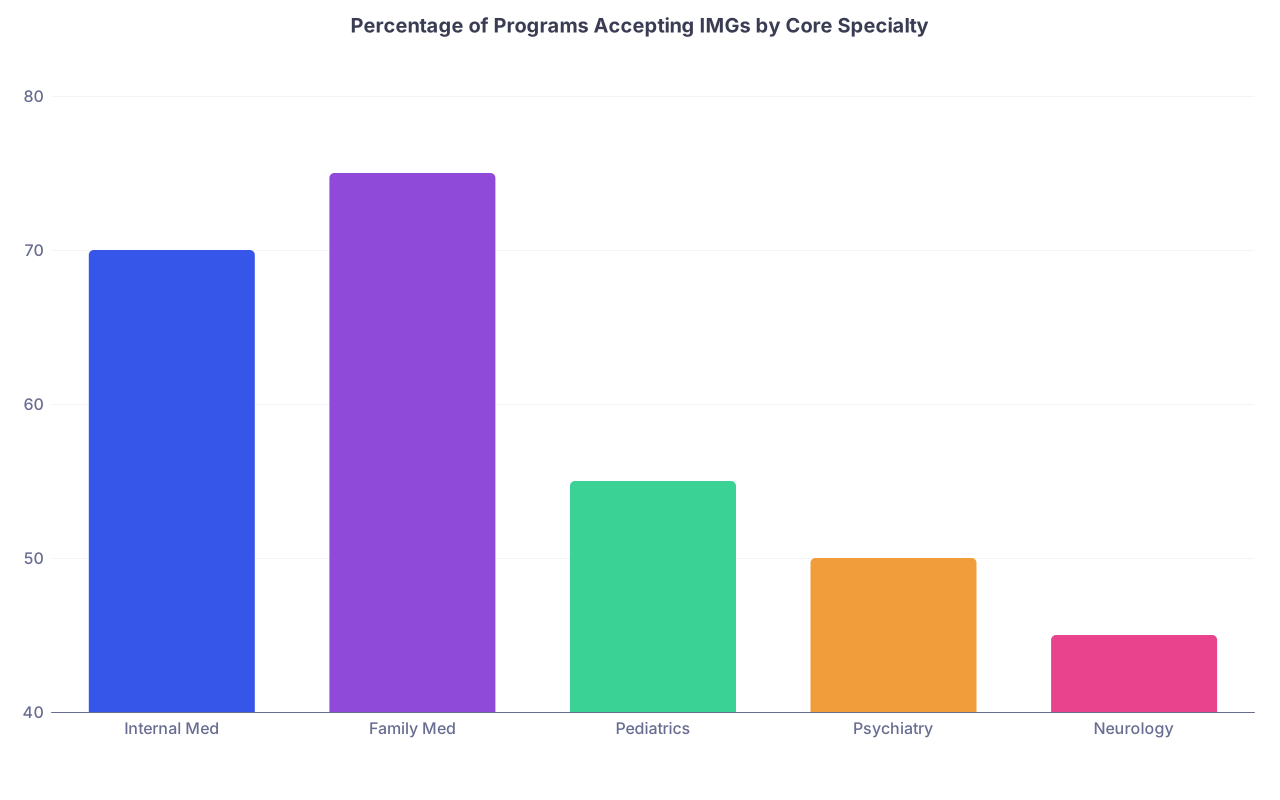
| Category | Value |
|---|---|
| Internal Med | 70 |
| Family Med | 75 |
| Pediatrics | 55 |
| Psychiatry | 50 |
| Neurology | 45 |
These numbers vary over time, but the pattern is stable: IM, FM, and Peds have the broadest IMG acceptance.
3.3 Build a real spreadsheet
Open Excel/Sheets. No excuses.
Columns:
- Program name
- State
- Specialty
- Visa sponsorship (J‑1, H‑1B, none)
- IMGs in current residents (Y/N and approximate percentage)
- IMG med school regions represented
- Minimum USMLE (if stated)
- Max years since graduation (if stated)
- Type: University, community, university‑affiliated community
- Your personal notes (alumni connection, location preference, etc.)
You are going to categorize each program:
- Green: Strongly IMG‑friendly
- Yellow: Moderately IMG‑friendly / mixed
- Red: Realistically hostile or no data
Your final application list should be dominated by green programs, with some yellow, and almost no red. Most IMGs do the opposite.
Step 4: Filters That Actually Matter For IMGs
You want to know which programs will auto‑trash your file before a human sees it. Programs rarely publish all of this, but patterns are obvious if you know what to look for.
4.1 Year of graduation (YOG)
If you graduated more than 5–7 years ago, a lot of programs are done with you before they even look at your personal statement.
- Many community IM programs quietly use:
- YOG ≤ 5 years as green
- 6–10 years as yellow (requires strong justification and active recent clinical work)
10 years as near‑automatic rejection
If you are older YOG:
- Prioritize programs where current residents clearly graduated 7–10+ years before PGY1.
- Prioritize community programs that explicitly say “no max YOG” or “case‑by‑case.”
- You must have recent (last 1–2 years) clinical work, ideally in the US.
4.2 Scores and attempts
Look at Step 2 CK. That is your currency now.
- One failure does not kill you, but it redefines which programs you can target.
- Multiple failures plus old YOG plus no USCE? You are now in “deep rebuild” territory.
Be realistic:
- Step 2 CK < 220 as IMG:
- Forget big university hospitals.
- Focus on smaller community programs that have a long history of IMGs and sometimes lower thresholds.
- Step 2 CK 220–235:
- Community and small university‑affiliated programs are on the table.
- Step 2 CK > 240:
- You can mix in competitive community and some smaller university programs, depending on other factors.
4.3 Visa status
Needing a visa is not a sin. But you must filter by it first, not last.
- If you need H‑1B, your list shrinks dramatically.
- If you can do J‑1, your options multiply.
- If you have green card / citizenship, you remove a major barrier. In that case, programs that “do not sponsor visas” are no longer a red flag.
Step 5: Where Are the Truly IMG‑Friendly Programs Hiding?
I will not give you a fake magic list. The landscape changes every year. But the types of programs that are reliably IMG‑friendly are consistent.
5.1 Community and community‑based university programs
The backbone of IMG‑friendly training.
Characteristics:
- Hospital is not the flagship of a big-name university.
- Often in smaller cities or less glamorous regions.
- Heavy inpatient load. You will work. Hard.
- Program websites often show residents from:
- India, Pakistan, Caribbean schools, Middle East, Eastern Europe, Latin America.
If you open a resident roster and see 60–80% IMGs across all years, you have found gold. Especially if the med schools are similar to yours.
5.2 Geographic patterns
Broad strokes, from what I have seen over the years:
More IMG‑friendly overall:
- Midwest (Ohio, Michigan, Illinois, Indiana, Missouri, Kansas, etc.)
- Some parts of the South (Georgia, Florida community hospitals, Texas community programs that sponsor visas)
- Some Northeast community hospitals (New Jersey, Pennsylvania, New York – but do not assume all of them)
Generally tougher for IMGs:
- West Coast university programs
- Super‑competitive cities (Boston, San Francisco, DC)
- Elite university systems with strong USMD pipelines
Not impossible. Just lower yield. If you have a limited budget or weak profile, you do not start in the lowest-yield regions.
Step 6: Fix Your Application Core Before You Hit Submit Again
If your last cycle ended with zero interviews or 1–2 low‑yield invitations, the problem is not just program selection. You likely have structural weaknesses.
You fix those before you hit ERAS next season, not “as you go.”
6.1 US clinical experience: get hands‑on or close
Programs want to know:
- Can you function in the US system?
- Will you crash on Day 1 because you cannot write notes or call consults?
Weak: 3 months of pure observership where you never touched a patient or wrote a note.
Better:
- 2–4 months of:
- Externships with real responsibilities (even limited)
- US hospitalist shadowing where you clearly participated in presentations, notes, or pre‑rounds
- US research with clinic components
If you are more than 3–5 years from graduation and have no USCE, your first priority is to fix that. Not “send 150 applications again and hope.”
6.2 Letters of recommendation (LORs) that mean something
IMGs waste cycles with:
- Letters from home-country faculty no one in the US knows.
- Generic LORs that might as well have been copy‑pasted.
You want:
- 2–3 recent US LORs (within 1 year of application), ideally:
- From core specialties you are applying to (IM letters for IM, etc.)
- From attendings who work with residents and can compare you to them.
- Content that mentions:
- Work ethic
- Clinical reasoning
- Communication
- Reliability
Ask your letter writers directly:
“Can you write me a strong letter for US residency?”
If they hesitate, thank them and find someone else.
6.3 Personal statement: stop writing your life story
IMG personal statements are often:
- Overly dramatic
- Cliché about “childhood inspiration”
- Completely blind to US training reality
The statement does three jobs for an IMG:
- Confirm that your English is functional and clear.
- Explain briefly any red flags (gaps, failures, career transitions) without excuses.
- Show you understand what US residency is actually like (hard work, teamwork, systems).
One page. Clean. Specific. No grand declarations about “changing global healthcare” when you are trying to get a spot at a 12‑resident community hospital.
Step 7: Build a Tiered Application Strategy
Now we combine your self‑assessment with program types and build a tiered plan, not “apply to 200 places randomly.”
7.1 Define your tiers
For example, as an IMG with Step 2 CK 232, 2020 grad, 4 months USCE, need J‑1, internal medicine:
Tier 1 – High probability (60–80% of your list)
- Community IM programs with >50% IMGs
- Explicit J‑1 sponsorship
- Current residents from similar med schools / countries
- Often in smaller cities / less competitive states
Tier 2 – Reasonable stretch (20–30%)
- University‑affiliated community IM programs
- IMGs present but maybe 20–40%
- Slightly more competitive locations or names
- Score/YOG still compatible
Tier 3 – Moonshots (0–10%)
- Mid‑tier university programs with a few IMGs
- Places where you have a direct connection (research, observership)
- Only if you have bandwidth and money
If your last cycle yielded zero interviews, your next list should be even more heavily weighted toward Tier 1.
7.2 Application volume
Most IMGs overshoot or undershoot:
- With a weak or average profile:
Internal medicine: 120–150 correctly chosen programs is reasonable.
Family medicine: 80–120. - With a strong profile (high 240s/250s, great USCE, no gaps):
You can cut those numbers down, but you must still be selective.
Throwing applications at prestige programs that never interview IMGs is not “casting a wide net.” It is burning cash.
Step 8: Use the Interview Season Smarter
Your job is not done once invitations appear. Where you choose to interview also shapes your match chances.
8.1 Rank strategy for IMGs
If you get:
- 5–6 interviews at solid IMG‑heavy community IM programs,
and - 1–2 interviews at “better name” programs with borderline IMG track records
Your rank list priority is simple:
- Programs that will actually rank you high (IMG‑heavy, strong vibe, PD supportive)
- Then any “name” programs that liked you
- Do not put prestige above safety if your primary goal is just to be in a residency
I have seen too many IMGs match nowhere because they ranked the fancy university #1–3 and pushed reliable community programs down the list.
8.2 Red flags in interviews
If during interviews you hear variations of:
- “We used to take more IMGs but things are changing.”
- “Visa sponsorship is a bit uncertain for next year.”
- “We have to prioritize US grads this cycle.”
Translate that as: this place will not be your anchor program on the rank list.
Step 9: Plan B Paths If You Are Deeply Stuck
Some of you are reading this with:
- Multiple Step failures
- Very old graduation (10+ years)
- Minimal USCE
- Repeated unmatched cycles
You are not going to brute‑force your way into a categorical residency by repeating the same ERAS pattern.
Here are realistic pivot options:
9.1 Research paths
- 1–2 year paid research positions in academic centers
- Outcomes:
- US connections
- Publications
- Strong LORs from US faculty
- Especially useful if you target IM subspecialties, neurology, or psych later.
Downside: highly competitive themselves; you need networking and a decent baseline CV.
9.2 Transitional / prelim years
Matching into:
- Prelim internal medicine
- Prelim surgery
- Transitional year
Then re‑apply with US residency performance on your CV.
You must be okay with uncertainty. There is no guarantee you will transition into a categorical spot. But strong prelim performance plus PD advocacy can open doors that were shut before.
9.3 Re‑training expectations
If you have:
- Mixed or low scores
- Very long YOG
- No strong US activities
You may need to accept:
- Less competitive specialties
- Less desirable locations
- Longer rebuild timelines
The pivot is still possible. But you treat it like a 2–3 year project, not a one‑cycle miracle.
Step 10: Daily / Weekly Execution Plan
Theory is cheap. Here is what an actual 12‑month rebuild and pivot can look like.
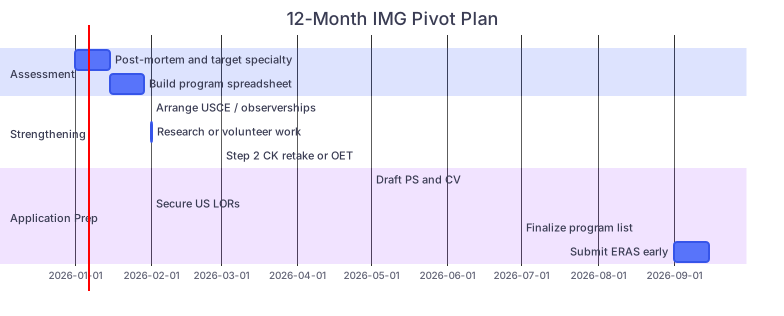
| Task | Details |
|---|---|
| Assessment: Post-mortem and target specialty | a1, 2026-01, 2w |
| Assessment: Build program spreadsheet | a2, after a1, 2w |
| Strengthening: Arrange USCE / observerships | b1, 2026-02, 4m |
| Strengthening: Research or volunteer work | b2, 2026-02, 10m |
| Strengthening: Step 2 CK retake or OET | b3, 2026-03, 3m |
| Application Prep: Draft PS and CV | c1, 2026-05, 1m |
| Application Prep: Secure US LORs | c2, after b1, 2m |
| Application Prep: Finalize program list | c3, 2026-07, 1m |
| Application Prep: Submit ERAS early | c4, 2026-09, 2w |
Your weekly non‑clinical work:
- 3–5 hours:
- Curating program data
- Emailing program coordinators (specific questions, not generic spam)
- Networking with alumni or mentors
- 3–10 hours:
- Ongoing research, QI projects, or clinical volunteering
- Regular:
- English communication practice if accent/fluency is a concern (real issue for some IMGs, and programs notice)
You treat this like a second job. Because it is.
A Quick Glance: What Strong vs Weak IMG Strategies Look Like
| Aspect | Weak Strategy | Strong Strategy |
|---|---|---|
| Program selection | Prestige‑driven, random, forums-based | Data‑driven, IMG‑heavy, visa and YOG compatible |
| Volume | 40 apps or 250+ random | 80–150 targeted based on specialty and profile |
| USCE | Observership only | 2–4 months structured, recent, with LORs |
| LORs | Home country, generic | US attendings, specific, recent |
| Personal statement | Emotional, vague, long | Focused, 1 page, addresses red flags cleanly |
| Plan B | “Try again next year the same way” | Research, prelim year, or multi‑year rebuild |
The Bottom Line
You did not “get rejected everywhere because you are an IMG.” You got rejected because:
- You applied to programs that were never set up to take you.
- You underestimated how much your scores, YOG, and USCE shape your realistic lane.
- You treated “IMG‑friendly” as a marketing phrase instead of a measurable pattern.
Your pivot going forward:
- Brutally analyze your profile and last cycle. No excuses, just facts.
- Target truly IMG‑friendly programs – heavy IMG presence, clear visa support, compatible filters.
- Fix your weakest link before you reapply – USCE, LORs, or gaps – and run a tiered, data‑driven application plan.
Do that, and you stop hoping the Match will “be nicer” next year. You give programs a concrete, credible reason to say yes.