
Most IMGs do not lose the Match because of their gap. They lose it because they pretend the gap is invisible and apply like nothing happened.
You cannot hide a 5–10 year graduation gap. You can, however, neutralize it and even turn it into a minor asset—if you choose the right programs and present the gap correctly.
Let me walk you through how to do that like a professional, not like a desperate reapplicant throwing 200 random applications into ERAS.
1. Face the Real Problem: Your Gap Is Not the Only Issue
Programs do not reject you for the gap alone. They reject you because the gap usually comes packaged with:
- No recent US clinical experience (USCE)
- Old or missing letters of recommendation
- Outdated knowledge and rusty clinical skills
- Weak or absent connections to US faculty
- Poor targeting of programs that actually take IMGs with gaps
So if you only “explain the gap” in one paragraph and do nothing else, you have solved nothing.
Your job is to build a present-day profile so strong that the graduation year becomes a secondary detail.
You do that in two parallel tracks:
- Rebuild your currency (recent work, USCE, exams, letters)
- Select programs that historically overlook long gaps for the right candidate
We will tackle both.
2. Understand How Programs Treat Grad Year Gaps
Let me be blunt. Programs do not all think alike.
Some places auto-filter anything older than 3–5 years from graduation. Others routinely take 10+ year graduates if the rest of the file is strong.
You need to stop guessing and start categorizing.
Typical program attitudes
| Program Type | Typical Grad Year Limit | IMG Attitude |
|---|---|---|
| Big-name university, competitive specialty | 3–5 years | Unfriendly |
| Mid-tier university IM/FM | 5–7 years | Selectively friendly |
| Community hospital, large IMG cohorts | 10+ years | Very friendly |
| Rural programs | Often no official limit | Very friendly |
| Preliminary-only tracks | 5–10 years | Mixed, but flexible |
The exact numbers vary, but the pattern holds:
- The more IMG-heavy the program, the more flexible the gap rule.
- Community and rural programs are your allies.
- University “name brands” usually waste your money if you graduated long ago, unless your profile is exceptional.
3. Researching IMG-Friendly Programs the Right Way
You cannot “leverage IMG-friendly programs” if you do not actually know which ones they are. Vague comments from Telegram groups do not cut it.
Here is a clean, stepwise research protocol.
Step 1: Use data tools, not rumors
Use:
- FREIDA
- Residency Explorer (if you have a USMLE/ERAS account)
- Program websites
- NRMP and state match data
- Independent IMG-oriented databases (e.g., Match A Resident, but treat it as a starting point, not gospel)
Look for:
- Percentage of IMGs in program
- Number of IMGs matched in the last 3–5 years
- Any stated graduation year cutoffs
- Phrases like:
- “We welcome international medical graduates”
- “No specific graduation year cutoff”
- “Recent graduates preferred but not required”
If a program site proudly lists only US MDs from top schools on their current residents page, move on.
Step 2: Build an IMG-friendliness filter
For each program, assign three quick labels:
IMG Density:
- High (mostly IMGs)
- Medium (mixed)
- Low (rare IMG)
Grad Year Policy:
- Explicit cutoff stated
- “Recent grads preferred” (soft cutoff)
- No statement (unknown)
Visa History:
- H-1B friendly
- J-1 only
- No visas
You want: High IMG density + no strict cutoff + visas supported.
Step 3: Verify with current residents
This is the most underused step.
- Find residents on:
- Program website
- Doximity
- Filter for:
- IMGs from your region or school
- Older graduation years (e.g., class of 2012 matching in 2023)
Message them once. Short, specific, respectful.
Example:
“Dr. Patel,
I am an IMG from India, YOG 2014, preparing for the Match in Internal Medicine. I noticed you matched at [Program] with a similar background. Could you share whether they consider applicants with older graduation years if they have recent USCE and strong Step scores? A brief reply would help me target my list correctly. Thank you for your time.”
You are not begging for a letter. You are verifying a policy in practice.
4. Choose the Right Specialty for a Long Gap
Some specialties tolerate gap years much better. If you are holding a 7–15 year gap and aiming for dermatology, that is not strategy, that is denial.
Realistically favorable specialties for long-gap IMGs:
- Internal Medicine
- Family Medicine
- Pediatrics
- Psychiatry (if you can show commitment and relevant experience)
- PM&R in some institutions
- Pathology in some places (especially if you have research/publications)
High-risk / often wasted applications for long-gap IMGs (unless you have exceptional data + strong US backing):
- Dermatology
- Plastic surgery
- Orthopedic surgery
- ENT
- Ophthalmology
- Neurosurgery
- Integrated IR/DR in many centers
- Radiation oncology
I am not saying impossible. I am saying the ROI is terrible for most.
If your primary aim is enter US GME then maneuver, start in a gap-friendly core field first.
5. Bridge the Gap on Paper: Transform “Dead Time” into a Coherent Story
Long unstructured gaps look like one thing to selection committees: risk.
Your fix: turn that “blank” period into a logically connected professional story that feeds into residency.
Step 1: Inventory everything you actually did
Do not hand-wave this. Write it out.
From graduation to now, list year by year:
- Clinical work (even if low-resource or unpaid)
- Teaching (tutoring, lecturing, mentoring)
- Research (formal or informal, manuscripts, audits)
- Non-clinical healthcare work (administration, public health, telemedicine)
- Non-healthcare work (business, family responsibilities, immigration, etc.)
There will be more than you think. The raw material is there. It just needs translation.
Step 2: Reframe it in residency language
For each activity, ask:
What does this prove about my readiness for residency now?
Examples:
- Ran a small clinic in your home country for 6 years →
- Proves continuity of patient care
- Decision-making experience
- Management of chronic disease, complex cases
- Took 3 years off for family/immigration →
- Proves stability now resolved
- Motivation to re-enter medicine seriously
- Opportunity you used to study US healthcare system, prepare for exams
Then convert into ERAS-friendly bullet points and paragraphs, not excuses.
Step 3: Write a brutally clear “Gap Paragraph”
Your personal statement and ERAS application must contain a direct, clean explanation. No drama. No self-pity. No hiding.
Template structure:
- One sentence: state the gap honestly.
- 2–4 sentences: what you did in that time that is relevant.
- 1–2 sentences: how you updated your medical competence recently.
- Final sentence: tie it to why you are ready now.
Example:
“I graduated from XYZ Medical College in 2013. From 2014 to 2020, I practiced as a general practitioner in a rural clinic in Pakistan, where I managed a broad range of undifferentiated patients with limited resources. During this time, I developed independence in decision making, longitudinal relationships with complex patients, and a strong foundation in internal medicine. In 2021, having resolved family and immigration responsibilities, I focused exclusively on transitioning to US clinical practice, completed USMLE Steps 1, 2, and 3, and engaged in hands-on US clinical experience in internal medicine. These steps have updated my knowledge and aligned my skills with the expectations of residency training in the United States.”
That paragraph answers the question the PD actually cares about:
“Can this person function in my program now?”
6. Acquire “Fresh Currency”: What You Need in the Last 12–18 Months
For long-gap IMGs, what you did in the last 12–18 months counts disproportionately. You must stack this period with residency-relevant evidence.
Here is a practical checklist.
A. US Clinical Experience (USCE) – non-negotiable
You are not competing with 2024 grads who just finished core rotations. You must build your own version of “fresh clinical exposure”.
Aim for:
- At least 8–12 weeks of USCE in your target specialty
- Preferably hands-on (sub-internships, externships, hospital observerships with real involvement, not only shadowing)
- Settings:
- Community hospitals
- IMG-heavy programs
- Safety-net / county hospitals
- Clinics run by US physicians willing to write strong letters
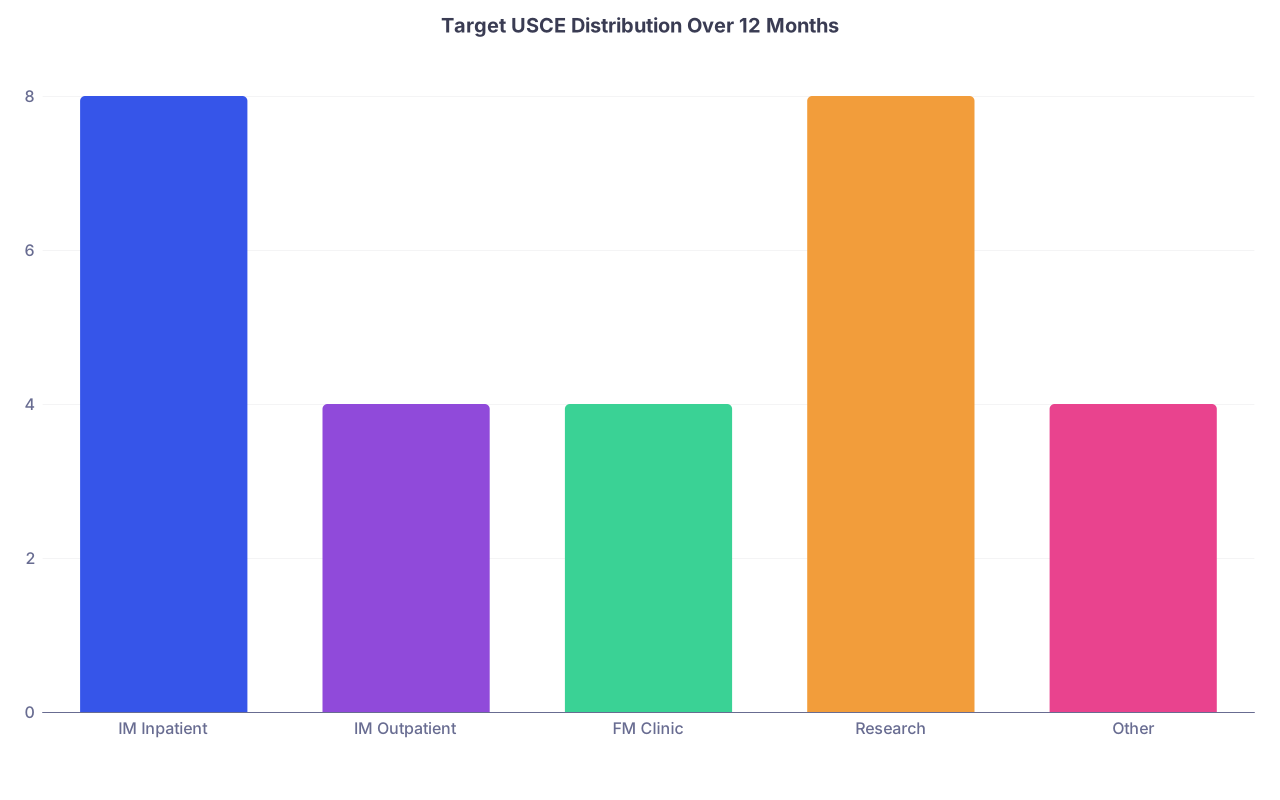
| Category | Value |
|---|---|
| IM Inpatient | 8 |
| IM Outpatient | 4 |
| FM Clinic | 4 |
| Research | 8 |
| Other | 4 |
Realistic plan for someone with a long gap targeting Internal Medicine:
- 8 weeks IM inpatient USCE
- 4 weeks IM outpatient USCE
- 4–8 weeks clinical research or QI with a US mentor
If you cannot get all that, get as close as you can. Zero USCE with a 10-year gap is a near-certain rejection pattern.
B. Updated letters of recommendation
Letters older than 2–3 years are basically dead weight for you. You need fresh letters that:
- Are from US physicians when possible
- Explicitly mention:
- Clinical reasoning
- Reliability
- Ability to adapt to US system
- Improvement over time
- Comparison to US graduates
Coach your letter writers indirectly. Provide them:
- Updated CV
- A short “summary of my work with you”
- Your specialty goal and why
They are busy. Help them remember you accurately.
C. Exams and scores
Programs use scores as an easy “safety filter” for older grads. They assume: long gap + marginal scores = risk.
Your best counter:
- Solid Step 2 CK score (if not already taken; yes, even with Step 1 pass/fail, Step 2 is your signal)
- Step 3 before Match can help, especially for:
- IMGs with visas
- Long gaps
- Internal Medicine / Family Medicine
If your scores are average, you must overperform on:
- USCE evaluations
- Letters
- Interview performance
- Program fit
7. Build a Targeted Program List: Width, Depth, and Priorities
Now to the part most applicants butcher: list construction.
The number of applications is less important than the quality of the list.
General scope (for a long-gap IMG in IM/FM)
Ballpark:
- 120–180 programs for Internal Medicine
- 100–150 for Family Medicine
- If dual-applying IM + FM:
- 80–120 IM
- 60–100 FM
Do not get religious about these numbers. Use your data.
Spread across tiers
For a long-gap IMG with decent scores and solid USCE, you want something like:
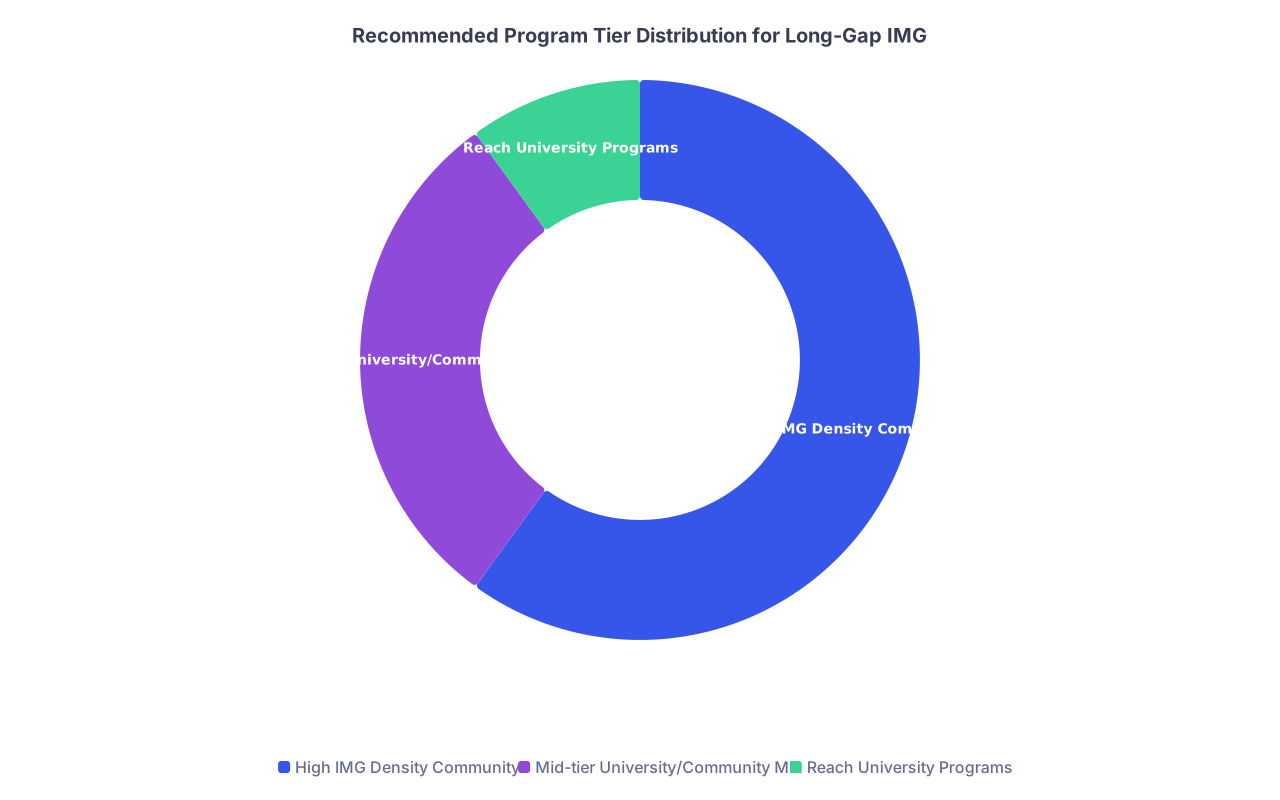
| Category | Value |
|---|---|
| High IMG Density Community | 60 |
| Mid-tier University/Community Mix | 30 |
| Reach University Programs | 10 |
- 60%: High IMG density community programs (your bread and butter)
- 30%: Mid-tier university-affiliated / hybrid programs that show some tolerance for IMGs
- 10%: Reach programs for optimism and upside, not expectation
If you are applying mainly to programs that proudly take “US MD + top 5% Step scores,” you are not serious about matching with a gap.
8. Time and Strategy: When to Apply After a Gap
A common disaster I see: IMGs with long gaps applying as soon as they get Step scores, with zero USCE and no coherent story.
You are better off delaying one cycle if needed and entering with a mature file, than rushing a half-built application.
Minimum pre-ERAS readiness checkpoint
Before September submission, you should have:
- At least 2–3 completed USCE rotations with anticipated letters
- Personal statement drafted with clear gap explanation
- CV showing continuous, meaningful activity over last 12–18 months
- Score reports uploaded and ready
- Program list mapped with IMG-friendliness research included
If you cannot manage at least that, strongly consider:
- Use the coming 12 months to:
- Build USCE
- Join research projects
- Improve English/communication (critical for interviews)
- Build relationships that may feed into advocacy
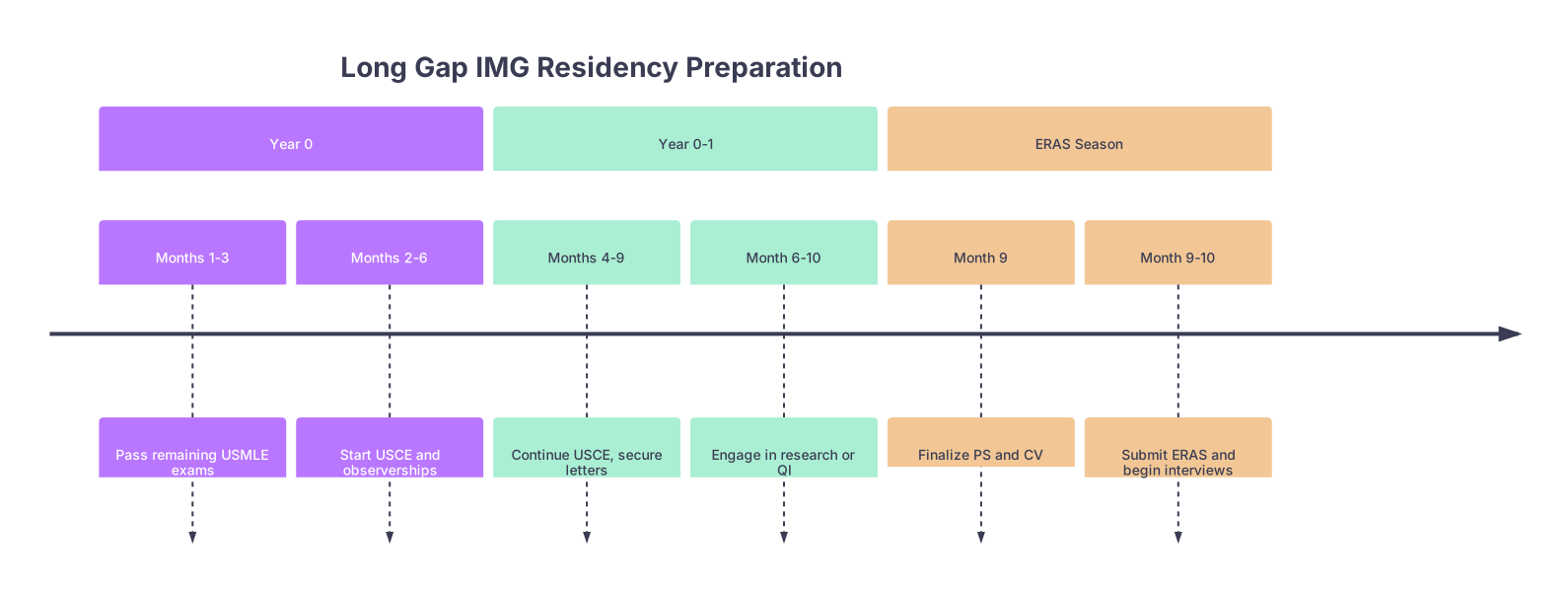
| Period | Event |
|---|---|
| Year 0 - Months 1-3 | Pass remaining USMLE exams |
| Year 0 - Months 2-6 | Start USCE and observerships |
| Year 0-1 - Months 4-9 | Continue USCE, secure letters |
| Year 0-1 - Month 6-10 | Engage in research or QI |
| ERAS Season - Month 9 | Finalize PS and CV |
| ERAS Season - Month 9-10 | Submit ERAS and begin interviews |
9. Communicating with Programs: Email and Interview Strategy
Gap applicants often come across as either apologetic or evasive. Both are bad.
Pre-interview emails
Do not write to every program explaining your gap. They do not have time to psychoanalyze strangers.
You can:
- Email PDs/coordinators strategically at:
- Programs where you have a genuine connection (alumni, mentor, region)
- Programs that have shown interest (downloaded your file, SVI invites, etc.)
Structure:
- Brief introduction (who you are, where you graduated, goal specialty)
- One sentence acknowledging your gap and what you are doing about it (recent USCE, updated exams)
- Concrete reason you are interested in that specific program (location, patient population, rotation you completed there, etc.)
- Polite close, no pressure
Example:
Subject: Application to [Program Name] – IMG with recent USCE
Dear Dr. Smith,
I recently applied to your Internal Medicine program through ERAS. I am a 2012 graduate from ABC Medical College and have since practiced as a general practitioner before transitioning toward US training. Over the past year I have completed 12 weeks of US inpatient and outpatient IM rotations, with updated USMLE scores, to align my skills with US residency requirements. I am particularly drawn to your program’s strong commitment to underserved populations and diverse IMG cohort. I would be grateful if you would review my application for possible interview consideration.Sincerely,
[Name]
AAMC ID: XXXXXXXX
Short. Controlled. Professional.
Interview handling of the gap
If they invite you despite the gap, they already see potential. Your job: do not make them regret it.
Common mistakes:
- Over-explaining and sounding defensive
- Blaming systems, countries, family, “circumstances” excessively
- Acting like the gap was purely accidental and you learned nothing
Instead, use a simple 4-step structure when they ask, “Tell me about the gap between graduation and now”:
- State the facts calmly.
- Highlight meaningful work or responsibilities during that time.
- Explain how you prepared for US residency in the last 1–2 years (exams, USCE, research).
- End with why you are now ready and committed.
Example answer (paraphrase, not script):
“I graduated in 2011. After graduation, I spent six years working as a general practitioner in a small town clinic in Nigeria. I was the primary physician for a large panel of patients, managing everything from uncontrolled diabetes to undifferentiated acute illnesses, often with limited resources. During that time, I developed strong clinical judgment and independence, but I always intended to pursue formal residency training.
Once my family and immigration situation stabilized, I focused on transitioning to the US system. Over the last 18 months I passed all USMLE exams, completed 12 weeks of US clinical experience in internal medicine, and participated in a quality improvement project focused on reducing 30-day readmissions. Those experiences refreshed my knowledge, exposed me to US hospital workflows, and confirmed that internal medicine residency here is the right next step. I am now fully committed and ready to train in a structured program.”
Confident. Honest. Forward-looking.
10. Special Considerations: Visas, Step 3, and Back-up Plans
Long-gap + IMG + visa need is a tough triad. Not impossible, but you must be tactical.
Visas
Be realistic:
- J-1: more common, more flexible; many IMG-heavy programs sponsor
- H-1B: fewer programs, often expect:
- Strong scores
- Step 3 passed before Match
- Demonstrated academic strength
If you have a long gap and require H-1B, you are playing on “hard mode.” You must:
- Narrow your list to genuine H-1B friendly programs
- Prioritize Step 3 completion
- Accept that your total viable program pool may be small
Step 3
For long-gap IMGs, Step 3 can be a real asset, not an afterthought:
- Signals readiness and knowledge currency
- Helps with visa-sponsoring programs (especially H-1B)
- Gives comfort to PDs who worry about “will they pass boards?”
Do not rush Step 3 if you will fail. But if you can pass before September or early in interview season, it strengthens your case.
Back-up plans that actually help (not just keep you busy)
If you do not match, your “Plan B year” must improve at least one of these:
- Recent clinical exposure (USCE or structured home-country hospital work)
- Research output and US academic ties
- Communication / English proficiency
- Scores (if any exam still pending)
Things that look busy but do little for your file:
- Random online courses with no practical output
- Non-medical retail work unless necessary for survival (explain briefly if needed)
- Unstructured “studying” with no exams taken
11. Quick Reality Checks: When the Gap Is Very Long (10–20 Years)
At some point, the question changes from “How do I hide the gap?” to “What is the smartest way to re-enter clinical work?”
I have seen 15–20 year post-graduation IMGs match. But those who succeeded had most of these:
- Strong continuous clinical practice in their home country
- Excellent English
- Recent, meaningful USCE with standout letters
- Good to very good exam performance
- Willingness to relocate to smaller cities and rural programs
- Absolute clarity about why they wanted residency at this stage of life
If you are in this bracket, you must be extremely tactical:
- Target only IMG-heavy, non-competitive, often rural programs
- Consider:
- Family Medicine in underserved locations
- Psychiatry in IMG-friendly states
- Be prepared for 2–3 cycles of sustained effort
- Have a parallel plan in health-related fields (clinical research, hospitalist roles abroad, telemedicine, etc.)
12. Bringing It Together: A Practical Action Blueprint
Let me condense this into a concrete, 12–18 month game plan for a long-gap IMG (say YOG 2012) aiming for IM.
Months 1–3
- Finish any remaining exam (Step 2 CK or Step 3)
- Draft initial CV
- Start serious research on IMG-friendly IM programs (build spreadsheet)
Months 3–9
- Secure 8–12 weeks of IM USCE (inpatient + outpatient)
- While on rotations:
- Be early, be prepared, volunteer for tasks
- Build strong relationships for letters
- Join one QI or small research project with a US faculty mentor
Months 6–9
- Finalize 3–4 recent letters of recommendation
- Write and refine personal statement with clear gap explanation
- Polish ERAS activities to highlight:
- Home-country practice
- Leadership
- Teaching
- Recent US experiences
Month 9 (ERAS opening/submission)
- Submit ERAS early (first week recommended)
- Apply to 120–180 carefully selected IMG-friendly IM programs
- Consider adding 40–80 FM programs if risk profile high
Interview Season (Months 10–14)
- Prepare specific gap answers and specialty motivation
- Practice communication skills extensively (mock interviews)
- Send selective update emails after major additions (e.g., Step 3 pass, accepted manuscript)

13. Mental Framing: How You See Your Gap Matters
Programs can smell shame and defensiveness from a mile away. And it is exhausting.
You are not a “damaged file.” You are a non-traditional candidate who needs to present coherence and recency. That is it.
You frame your past like this:
- “I have more real-world clinical maturity than a typical new graduate.”
- “I have now refreshed my knowledge and aligned it to US standards.”
- “I understand underserved, complex patients and want to keep serving them.”
That is exactly what many IMG-friendly community and rural programs want.
14. Final Key Points
- You cannot erase a long graduation gap, but you can outvote it with recent USCE, updated exams, strong letters, and a coherent story.
- IMG-friendly, community, and rural programs are your core battlefield. Stop wasting applications on institutions that never seriously consider long-gap IMGs.
- Treat the last 12–18 months as your “re-entry evidence period”—pack it with clinically and academically meaningful activity that proves you are residency-ready now.