
The way most IMGs build a program list is backwards. They start with prestige and location, then try to squeeze themselves into it. That is exactly how you waste thousands of dollars and end up with five interviews.
You are going to do the opposite. You will start from your profile, then systematically search for programs that have already shown they are willing to take people like you. Not “open to IMGs” in theory. In practice.
Here is the 5–step system I use with IMGs who actually match.
Step 1: Get brutally honest about your real profile
You cannot build a rational target list if you are fuzzy about your own stats. Vague ideas like “my scores are decent” or “I have some US experience” are useless. Programs think in cutoffs and patterns. You have to do the same.
1.1 Lock in your hard numbers
Open a blank spreadsheet. First tab: “My Profile”.
Create these columns and fill them in exactly:
- Step 1: Pass / fail + number if you have it
- Step 2 CK: exact score
- Attempts: any failed attempts on Step 1 / Step 2 / OET, etc.
- YOG (Year of graduation)
- Gaps: any gaps > 6 months since graduation
- US clinical experience:
- Number of months total
- Type: observership / externship / sub-I / research-only
- Visa: what you actually need (J‑1 / H‑1B / either / none)
- Specialty preference (rank 1, 2, 3)
- Publications: peer-reviewed / abstracts / posters
- Current country: where you live / train now
Do not round. If you scored 222, write 222, not “low 220s”.
1.2 Put yourself in a realistic tier
Programs do this mentally within 5 seconds of seeing your ERAS. You should too.
As a rule of thumb for IMGs in internal medicine / family med / peds (competitive specialties need higher):
- Step 2 CK ≥ 250: Strong
- 240–249: Above average
- 230–239: Solid but not special
- 220–229: Below average, needs compensating strengths
- <220: Difficult path; needs heavy IMG-friendly targeting and volume
Combine that with YOG:
- YOG ≤ 2 years ago: Fresh grad
- 3–5 years: Acceptable for many community programs
- 6–10 years: Limited set of IMG-heavy programs will consider
10 years: Very restricted; requires extremely strategic targeting
Now label yourself in the sheet:
- Score tier: Strong / Above Avg / Solid / Below Avg / At Risk
- YOG tier: Fresh / Mid / Older / Very old
Be ruthless. Overestimating your competitiveness is how people end up with 80 applications to university programs that literally have not taken a single IMG in 5 years.
Step 2: Learn to read “IMG-friendly” correctly
Most applicants stop at “this program has IMGs”. Not enough. You need to distinguish between:
- Programs that took one exceptional IMG 6 years ago
vs. - Programs that reliably rank multiple IMGs every year and support visas.
2.1 Use the right data sources
You cannot do this from ERAS alone. You need:
NRMP’s Interactive Charting Outcomes / Program Director Survey
For macro trends: which specialties, what scores, what YOG ranges typically match as IMGs.Program websites + resident pages
This is your goldmine for “who they actually train”.FREIDA (AMA) or equivalent databases
Basic filters: visas, IMG presence, positions, etc.Third-party sites and crowdsourced lists
Use with caution. Good for leads, not for final decisions.
Create a second spreadsheet tab: “Programs Raw”. You will dump everything there first.
2.2 Define what “IMG-friendly” actually means
For your purposes, a truly IMG-friendly program usually meets most of the following:
- Current or recent IMG residents
- At least 1–2 IMGs in each recent class, not just a single token IMG.
- Visa support
- Explicitly states J‑1 sponsorship at minimum; H‑1B if you need it.
- Reasonable score expectations for IMGs
- Not saying “We rarely consider IMGs” or “Minimum Step 2 250 for IMGs.”
- No impossible YOG restriction for you
- If they say “within 3 years of graduation” and you graduated 8 years ago, stop dreaming.
- Track record, not marketing
- The website says “We welcome IMGs” and the roster proves it.
Now, turn that into columns in your “Programs Raw” sheet:
- Current IMGs: Yes / No / Mixed
- Visa: J‑1 / H‑1B / Both / None / Unclear
- Explicit IMG statements: Friendly / Neutral / Restrictive
- YOG limit mentioned: number or “none”
- Stated Step cutoffs: numbers or “none”
You will fill this as you go.
Step 3: Build your initial pool using hard filters
This is where you stop clicking randomly and start using criteria.
You are going to:
- Pick 1–2 specialties (if you are applying broadly)
- Use filters to generate a program pool
- Pre-cut obvious “no chance” programs
3.1 Set non‑negotiable filters first
Think like a program coordinator doing initial screening. Apply your deal-breakers:
Visa requirement
- If you need H‑1B, you must filter for H‑1B programs only. Hope is not a strategy here.
- If J‑1 is fine, include programs that sponsor J‑1 (most IMG-friendly community IM programs do).
Specialty
- Start with your primary specialty. For internal medicine, you can consider FM or peds as backup later, but do not mix everything from the beginning or you will drown in data.
YOG
- If you are >5 years from graduation, prioritize programs that:
- Either do not mention a YOG limit
- Or explicitly say up to 7–10 years
Any “within 3 years” program goes straight to “do not apply” unless you have extraordinary circumstances.
- If you are >5 years from graduation, prioritize programs that:
Score cutoffs
- Many websites print minimums. If they say “We require Step 2 ≥ 230 for IMGs” and you have 218, move on. They are not bluffing.
Drop all this into your sheet as filters.
| Filter Type | Criterion |
|---|---|
| Specialty | Internal Medicine (categorical) |
| Visa Needed | J-1 or H-1B only |
| Step 2 CK | ≥ 225 |
| YOG | ≤ 7 years since graduation |
| IMG Presence | At least 1 IMG per year |
3.2 Generate a rough pool size
Use FREIDA or similar tools + manual browsing to compile:
- 80–120 programs for a relatively competitive IMG (Step 2 ≥ 240, YOG ≤ 3)
- 120–160 for average IMGs
- 160–220 for weaker profiles or older grads
Do not panic at the numbers. This is your initial pool, not your final apply list.
Add every potential program that survives the hard filters into “Programs Raw” with:
- Program name
- State
- Type (University / University-affiliated community / Pure community)
- Total categorical positions
You want breadth across:
- States
- Program types
- Size (small vs large programs)
Large, community-based IM programs with 10–20 categorical spots per year and lots of hospitalist work are often your best IMG bets.
Step 4: Score and segment programs like an analyst
Now the strategy starts. You are going to turn that messy list into a prioritized, rational target list using a simple scoring system.
4.1 Define your scoring criteria
Create a new tab: “Program Scores”.
Link each program from “Programs Raw” and score on 4–6 dimensions:
IMG Track Record (0–3 points)
- 0: No visible IMGs in last 3 classes
- 1: 1–2 IMGs total, unclear pattern
- 2: ~20–40% of residents are IMGs
- 3: 50%+ residents are IMGs, every class has multiple
Visa Fit (0–2 points)
- 0: No visas or unclear and you cannot verify
- 1: J‑1 only, and that is fine for you
- 2: H‑1B available and you need/strongly prefer it
Score Fit (0–3 points)
- 0: Your scores below their stated minimum or they strongly favor much higher scores
- 1: You barely meet minimums
- 2: You are solidly within their typical range
- 3: Your scores are clearly above their usual IMG residents’ scores (based on alumni CVs, etc.)
YOG / Gap Tolerance (0–2 points)
- 0: Strict “within 3 years” and you are older
- 1: They mention a limit but you are within it
- 2: No limit mentioned, or residents include older grads like you
US Clinical Experience Alignment (0–2 points)
- 0: They require hands-on USCE and you only have observerships
- 1: They prefer but do not strictly require USCE
- 2: They explicitly accept observerships or have several residents from your type of experience
Personal / Geographic Fit (0–2 points)
- 0: You would honestly hate living there (be honest)
- 1: Neutral
- 2: You have ties to the area or genuine interest (family nearby, prior work, etc.)
You end up with a maximum score of, say, 14.
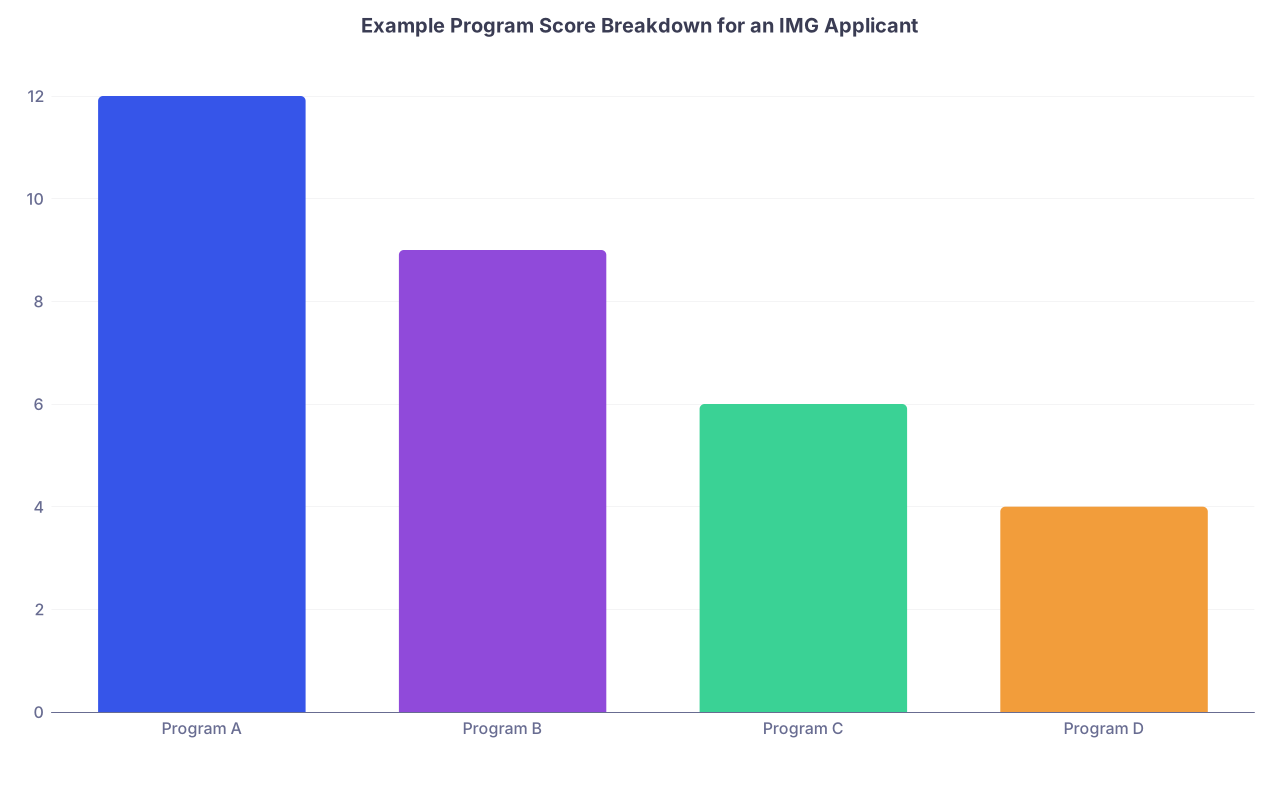
| Category | Value |
|---|---|
| Program A | 12 |
| Program B | 9 |
| Program C | 6 |
| Program D | 4 |
4.2 Categorize into reach / target / safety
Once you have scores:
- 12–14 points: High-priority “target / strong fit” programs
- 9–11 points: Reasonable “core” programs
- 6–8 points: Reach but possible
- ≤5 points: Low-yield; consider only if you need volume or have a special connection
Create a column “Bucket”:
- R = Reach
- T = Target
- S = Safety (relatively speaking—nothing is guaranteed for IMGs)
Remember, “safety” here is about probability, not prestige. A small community program in the Midwest with 70% IMG residents may be a far “safer” bet than a mid-tier university even if your scores are high.
Step 5: Finalize a balanced, IMG-focused target list
Now you turn that analytical mess into the actual list you will use on ERAS. This is where you cut, rebalance, and reality-check.
5.1 Decide total number of applications
For core IMG specialties (IM/FM/Peds) and depending on your profile:
- Strong IMG (Step 2 ≥ 250, YOG ≤ 2, solid USCE):
60–90 applications in your main specialty. - Average IMG (Step 2 235–249, YOG ≤ 5, some USCE):
90–120 applications. - Below-average / older grad (Step 2 < 235 or YOG > 5):
120–180 in main specialty, plus serious backup strategy.
This is not overkill. I have seen IMGs with 220s and 6–7 YOG years match after 160 strategic applications. And others with 40 random apps get zero interviews.
5.2 Build the distribution by bucket
A simple distribution that works for most IMGs in IM:
- 15–20% Reach
- 50–60% Target
- 20–30% Safety
So if you plan to apply to 120 IM programs:
- Reach: ~20–25
- Target: ~60–70
- Safety: ~25–35
Filter your “Program Scores” sheet by bucket and pick from the top down until you hit those numbers.
5.3 Cross-check with reality (resident lists)
Before locking anything, do a “sanity check” pass on each program in your final list:
- Go to the current residents page.
- For at least 3–4 residents:
- Note if they are US grad vs IMG
- For IMGs: which country, which YOG (if listed), what kind of prior experience
You are looking for patterns like:
- Resident bios show many IMGs from similar schools or countries as you.
- They have older grads (YOG 6–8 years out).
- Several residents did observerships, research, or prelim years before matching there.
If you see:
- 90% US grads + 1 IMG from a very famous foreign medical school with 260+ scores → that is not an IMG-friendly program for a typical IMG. That is a lottery ticket. Reclassify it as a high reach or remove it.
Update scores if needed, then adjust your buckets.
5.4 Schedule and tracking system
Now you formalize everything.
Create one last sheet: “Application Tracker” with columns:
- Program name
- ACGME / NRMP code
- State
- Bucket (R/T/S)
- Deadline
- Application submitted (Y/N + date)
- SVI / video requirements (if any)
- Supplemental ERAS / PS variant needed
- Interview invite (date)
- Outcome (interviewed / ranked / matched / rejected)
You will live in this sheet during application season.
Link each row back to your “Program Scores” data so you can see at a glance:
- Where your interviews actually come from
- Which bucket paid off
- Which “friendly” patterns were real
That feedback is priceless if you reapply.
Example: Applying the 5 steps for a real IMG profile
Let me walk through a concrete scenario, because vague theory will not help you.
Profile:
- Step 1: Pass
- Step 2 CK: 233 (one attempt)
- YOG: 2018
- USCE: 3 months observerships in IM
- Visa: Needs J‑1, H‑1B not required
- Specialty: Internal Medicine only
- Research: 1 poster, 1 case report
Step 1 – Self-assessment
- Score tier: “Solid but not special”
- YOG tier: 6 years → “Older grad”
- Gaps: 1-year non-clinical gap after graduation documented (family reasons)
Step 2 – Interpreting IMG-friendliness for this profile
You will target IM programs that:
- Have several IMGs per class
- Do not enforce strict “within 3 years” limit
- Explicitly accept observerships as USCE or do not mention strict hands-on requirements
Step 3 – Initial pool
Hard filters:
- Specialty: Internal Medicine categorical
- Visa: J‑1 sponsoring
- State: Open to all, but prioritize Midwest / South / less competitive coastal states
- YOG: Either no limit, or allow ≥ 5 years
- Explicit Step 2 cutoff: ≤ 230 is risky but may still apply; strict ≥ 240 for IMGs → drop
Result:
- Raw pool: ~200 programs
Step 4 – Scoring
You then score each program:
- IMG Track Record: Many community programs get 2–3 points
- Visa fit: All get 1 (J‑1) or 2 (if they also do H‑1B, even if you do not need it)
- Score fit: Many will be 1–2 (you barely meet or are within range)
- YOG tolerance: Programs with older grad residents get 2
- USCE alignment: Programs explicitly accepting observerships get 2
- Geographic ties: If you have a cousin in Ohio, that program gets a 2 for personal fit
After scoring, you may see:
- 30 programs with 11–13 points
- 80 programs with 8–10 points
- 60 programs with 5–7 points
- 30 programs <5 points
Step 5 – Final target list
You choose to submit 140 IM applications:
- Reach (20%): 28 programs (mostly 8–9 points but more academic or in desirable cities)
- Target (55%): 77 programs (9–11 points, heavy IMG presence, good YOG tolerance)
- Safety (25%): 35 programs (11–13 points, high IMG percentage, maybe very rural or less desirable areas)
You remove the sub‑5 point programs entirely. That is how you avoid lighting your money on fire.
You then:
- Build a few slightly different personal statement versions (community IM heavy, academic IM, specific geographic ties).
- Track invitations vs. rejections in your sheet.
- After season ends, you will know precisely which type of programs liked your profile and you adjust next year if needed.
One more layer: Timing and process
To avoid doing all this in a panic in August, spread the work.
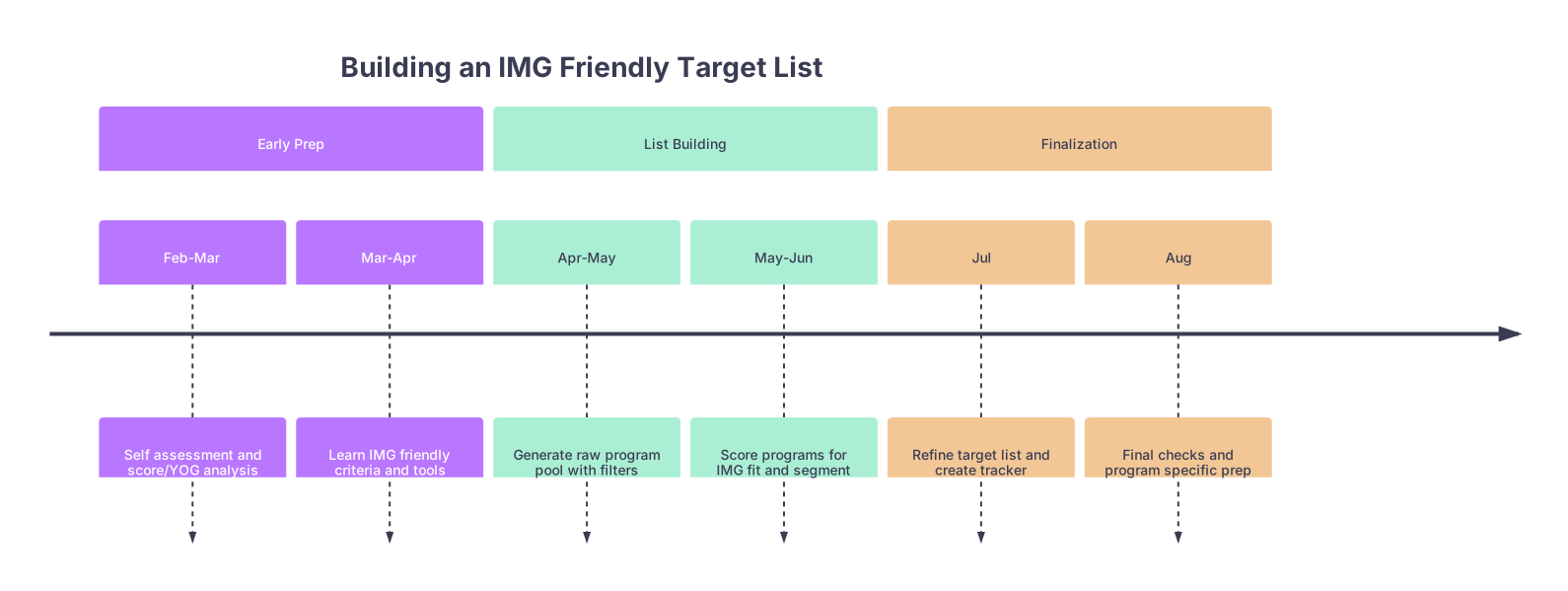
| Period | Event |
|---|---|
| Early Prep - Feb-Mar | Self assessment and score/YOG analysis |
| Early Prep - Mar-Apr | Learn IMG friendly criteria and tools |
| List Building - Apr-May | Generate raw program pool with filters |
| List Building - May-Jun | Score programs for IMG fit and segment |
| Finalization - Jul | Refine target list and create tracker |
| Finalization - Aug | Final checks and program specific prep |
Minimum decent schedule:
- 4–6 months before ERAS opens: Self-assessment + learn tools + start raw list
- 3–4 months before: Scoring and segmenting
- 2 months before: Final list + personal statements tailored to program types
- 1 month before: Double-check all requirements (supplemental ERAS, SVI, letters, etc.)
Quick recap: What actually matters
Strip away the fluff. To build an IMG-friendly target list that gives you a fighting chance:
Start from your true profile, not your fantasy.
Scores, YOG, visa needs, and USCE define your realistic range. Be brutally honest.Define IMG-friendliness with data, not vibes.
Resident rosters, visa sponsorship, past IMG intake, and explicit website rules are your core signals. Marketing language alone is useless.Score and bucket programs, then build a balanced list.
Use a simple points system to sort programs into reach, target, and safety, and then apply in volume where your odds are actually non-zero.
Do this with discipline and you stop being the IMG who “applied everywhere and heard nothing.” You become the one who gets a stack of interviews from exactly the kind of programs that have already shown they believe in training IMGs like you.