Most IMGs are wasting their observerships. That is why they leave with a certificate instead of an interview.
You do not need more observerships. You need to turn the ones you already have into real interview capital at IMG‑supportive institutions. That requires a system, not guesswork.
Let me walk you through exactly how to do that.
1. Stop Treating Observerships Like “Shadowing with a Badge”
The first fix: change your goal.
Your goal is not:
- To “see how US medicine works”
- To “get a certificate”
- To “learn EMR”
Your real goal:
- Earn 1–2 strong, specific US letters of recommendation
- Become a known quantity to at least 2–3 attendings at IMG‑friendly programs
- Leave each site with at least one concrete advocate who will:
- Respond to PD/PC emails about you
- Mention you in selection meetings
- Forward your application internally when ERAS opens
If your current observership plan does not directly produce those three outcomes, it is broken.
The mindset shift
You are not a tourist. You are a pre‑interview auditioning candidate.
That means you:
- Show up like a sub‑intern
- Think like a future colleague
- Communicate like someone the program might need to justify ranking
That is the frame for everything that follows.
2. Target the Right Kind of “IMG‑Supportive” Institution
“IMG‑friendly” is one of the most abused phrases in residency talk. A hospital that took two IMGs five years ago is not “friendly”. You want structurally supportive programs.
Look for places with:
- A consistent ≥30–40% IMG resident composition
- Clear, public observership/externship policies
- Current or recent chiefs who were IMGs
- PDs or APDs who trained as IMGs
- Explicit website language like “We welcome applications from international medical graduates”
Here is what that looks like in practice:
| Signal Type | What To Look For |
|---|---|
| Resident roster | 30–60% trained at non-US schools |
| Leadership | PD/APD or chief resident is an IMG |
| Website language | Specific IMG page, visa info, observership policy |
| Match lists | Recurrent IMGs from same foreign schools |
| Visa track record | History of sponsoring J-1/H-1B visas |
If you are doing observerships at hospitals that:
- Rarely sponsor visas
- Have 90% American MD/DO residents
- Hide their IMG policies in fine print
…you are stacking the deck against yourself.
Quick research protocol (30–45 minutes per program)
Check the residency site:
- Resident bios and medical schools
- Past resident lists (often archived)
- IMG/visa FAQ page
Search:
"[Program Name] IMG friendly"site:reditt.com [Program Name] IMG"[Program Name] J1 Visa","[Program Name] H1B"
LinkedIn:
- Search the hospital name + “Resident”
- Scan med schools in their education histories
You will find a clear pattern. Some programs repeatedly bring in IMGs from observership/externship pipelines. Those are your targets.
3. Plan Your Observership Like a 4‑Week Interview
You cannot “wing it” and then hope the PD magically remembers you in October.
You need a structure.
Before you start: 7–10 day preparation sprint
In that week before day 1:
Know the program cold
- Program size, tracks, call schedule basics
- Recent publications from faculty you will work with
- Any buzzwords the PD uses (from website, talks, YouTube, etc.)
Prepare your “mini‑packet”
- One‑page CV (US style, concise, no fluff)
- USMLE scores, ECFMG status clearly listed
- Short 3–4 line professional bio you can reuse in emails
Skill refresh
- Read 5–10 UpToDate summaries in the specialty’s core topics
Example for IM: CHF, COPD, DKA, sepsis, GI bleed, pneumonia, AKI, cirrhosis, PE - Review common US order sets and note templates (you can find sample ones online)
- Read 5–10 UpToDate summaries in the specialty’s core topics
Email the coordinator/attending (simple, direct)
Subject: “Observership Start – [Your Name], [Dates]”- Express appreciation
- Confirm start time, dress code, where to meet
- One line about your career goal (e.g., “aiming for IM residency with strong interest in cardiology”)
You are signaling: I am organized, professional, and serious.
4. Behave Like the Best Sub‑Intern on the Team
No, you cannot write orders. Yes, you can still be unforgettable.
Daily operating rules
Show up early. Leave a bit late.
- 15–20 minutes before team huddle/rounds
- Skim overnight events and vitals if given access
- Have patient lists printed, highlighted, or organized
Own 2–3 patients mentally
- Learn their key problems, meds, overnight changes
- Keep a small notebook: vitals trends, labs, imaging dates
- Be ready with 1–2 relevant literature/UpToDate points for each
Speak strategically on rounds
- Do not hijack. Do not monologue.
- Offer 1 clear, useful contribution per patient you “own”
- Example: “I looked up current guidelines; they suggest starting anticoagulation within X days in similar cases. Our patient is day Y.”
Do silent work no one else wants
- Call outside hospitals for records (with permission)
- Track down families for collateral history
- Prepare simple sign‑out lists
- Update med lists, allergies in the chart under supervision
You are trying to make one thought appear in people’s minds:
“If this person were a resident, my day would be easier.”
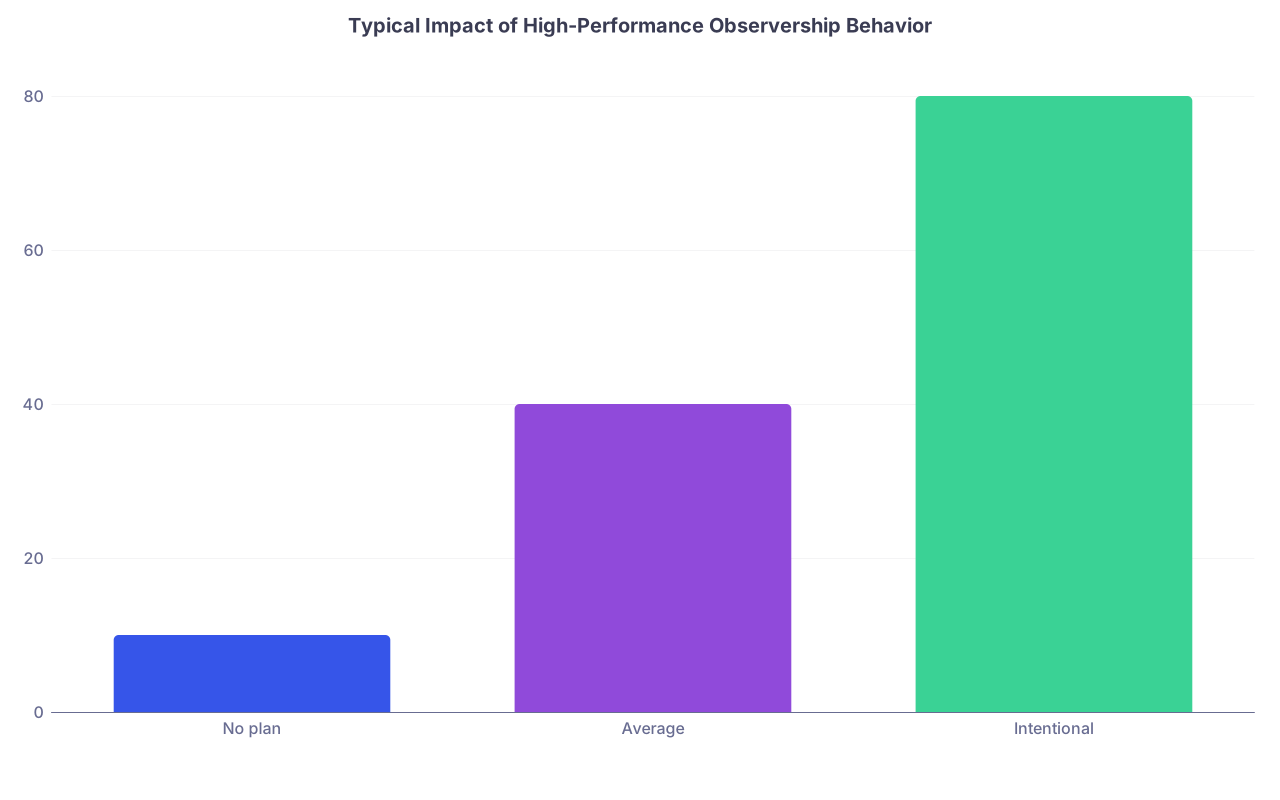
| Category | Value |
|---|---|
| No plan | 10 |
| Average | 40 |
| Intentional | 80 |
(Legend: approximate chance, in %, that at least one attending offers strong advocacy or proactive help for interviews. Yes, the gap is that big.)
5. Turn Faculty Into Advocates, Not Just Signatures
The number of IMGs who spend 4 weeks with an attending and then, on the last day, ask:
“Could you please write me a LOR?”
…with zero prior setup is mind‑boggling.
You need a structured approach.
Week‑by‑week faculty strategy
Week 1 – Establish presence
Goal: They know your name, background, and goal.
- Very brief intro on day 1:
- Name, med school, intended specialty, USMLE status
- Ask 1–2 smart, concise clinical questions per day
- Volunteer for small tasks and follow through 100%
End of Week 1:
Ask for feedback, not a favor.
“Dr X, I hope to apply to internal medicine this year, ideally in IMG‑supportive academic programs like this one. I want to make the most of this observership. Is there 5 minutes this week where you could give me honest feedback on how I am doing and how I could be more helpful to the team?”
Now you have opened a loop. Most serious attendings respect that.
Week 2–3 – Show growth and reliability
After you get feedback:
- Implement it visibly within 48 hours
- Briefly mention that you are doing so
Example:
“You mentioned I should try to anticipate labs on my patients. I started tracking their trends this morning and drafted which labs to check; could I run them by you later?”
They now see you are coachable. That is gold.
By end of Week 3:
They should be thinking, “This person is working like a sub‑I even without orders access.”
Week 4 – Convert to letter + advocacy
In the final week, assuming your performance has been strong:
“Dr X, I have really appreciated working with you. I am applying to internal medicine this cycle, focusing on IMG‑supportive programs like [hospital name] and others of similar profile. Would you feel comfortable writing me a strong letter of recommendation based on what you have seen these past weeks?”
Two key words: “strong” and “based on what you have seen.”
If they say yes, you immediately follow with:
- Updated CV
- Personal statement draft (or short paragraph of your story/interest)
- ERAS ID and time frame
Then, and this is where most people stop short, you ask a second, targeted question in a future conversation or email:
“Also, if there is any way for my application to be appropriately flagged or directed to the program leadership when ERAS opens, I would be very grateful. I am especially interested in this institution because of its support for IMGs.”
You are not begging. You are requesting procedural help. That is different.
6. Make Yourself Unmissable to the Program, Not Just One Doctor
An observership that lives entirely in one attending’s memory is fragile. People move. People forget. Committees outvote them.
You need surface area inside the institution.
Practical ways to widen your footprint
Residents
- Help with discharge paperwork prep, patient education, call backs
- Ask them (when not busy) about:
- Their match path
- PD preferences
- How interview offers are actually generated at this program
Program Coordinator
- Send a short, professional “thank you” email halfway through:
- Reiterate your interest in that residency
- Mention 1–2 specific positives about your experience
- Politely state you plan to apply there and will be grateful for any guidance
- Send a short, professional “thank you” email halfway through:
Chief resident or APD
- If you present a case or topic, invite them
- Afterward, a brief email:
- Thank them
- Attach your slide deck (if any)
- One line: “I hope to submit my ERAS application to [Program] this cycle; this observership has strongly reinforced that goal.”
You are constructing a small network of people who:
- Recognize your name
- Associate you with professionalism and effort
- Will not be confused when they see your ERAS application
7. Convert Observerships into Concrete Application Assets
An observership is only as useful as what shows up on ERAS and in the PD’s head.
Here is the conversion pipeline.
A. On paper (ERAS)
Experience section
- Use a formal title:
- “Clinical Observership in Internal Medicine – [Hospital Name]”
- Under description, emphasize:
- Bedside rounding participation
- Case presentations you gave
- QI or small project involvement (if any)
- 3–4 bullet points, outcome‑oriented, not “I observed X”
- Use a formal title:
Letters of Recommendation
- Prioritize letters from:
- IMG‑supportive program where you observed
- Attending engaged in resident education
- Someone who explicitly mentioned they will “support you strongly”
- You need 2–3 of these; more is not always better
- Prioritize letters from:
Personal Statement
- For programs where you did observerships:
- Include a specific 1–2 sentence mention of what you saw there and why it fits you
- Name the service or rotation type, not just “I loved my time at your hospital”
- For programs where you did observerships:
B. In PD/committee perception
This is where many IMGs underestimate the value of structure.
Use a simple internal tag for yourself:
- “Observer + Letter from Dr X + Presented on Y + Thank‑You email to PC”
Then, when applying, you write a brief, targeted email to the program coordinator after ERAS submission.
Subject: “ERAS Application – [Your Name], Observership with [Attending Name]”
Body (tight and respectful):
Dear [Coordinator Name],
I hope you are well.
My name is [Your Name]. I recently completed a [4‑week] observership with Dr [Name] on the [Service] at [Hospital] from [dates]. I have applied to the [Year] Internal Medicine Residency at your institution through ERAS (AAMC ID: XXXXXXXX).
This observership confirmed my strong interest in training at [Program], particularly because of its support for international medical graduates and the team culture I observed on [specific unit/service].
I wanted to briefly thank the program again for the opportunity and let you know that I would be honored to be considered for an interview. Please let me know if there is any additional information I can provide.
Sincerely,
[Name]
[USMLE scores/ECFMG status in signature]
You are connecting the dots for them: Observership → ERAS file → real person they remember.
8. Case Presentation: Your Secret Weapon
Most observerships allow, or at least tolerate, one brief case or topic presentation. If yours does, you absolutely should do one.
No, not a 45‑minute grand rounds. A clean, 10–15 minute, high‑yield talk.
How to execute a memorable mini‑presentation
Pick the right topic
- 1 specific problem seen repeatedly on the service
- Examples:
- “Initial Management of Decompensated Cirrhosis”
- “Evidence‑Based Diuresis in Acute Heart Failure”
- “Evaluating Chest Pain in Low‑Risk Patients in the ED”
Structure
- 1 slide: clinical case from your service
- 3–4 slides: guideline‑driven approach
- 1 slide: “What we could do differently next time” based on evidence
- 1 tiny slide: References
Audience
- Residents, your attending, invite any APD or chief who might be free
Follow‑through
- Email your slides to the team
- Thank them for the chance to present
- Mention how this connects to your interest in the specialty/program
You are now the IMG who:
- Worked hard
- Taught something useful
- Showed academic potential
That is the profile of “safe interview invite”.
9. Build a Multi‑Site Strategy (Without Burning Out)
If you have more than one observership, you must coordinate them like a campaign, not random islands.
Reasonable sequence
Start with a community or smaller academic hospital that is IMG‑supportive.
- Lower pressure, easier to stand out
- Practice your system
Next, an academic center that frequently ranks IMGs
- Use everything you perfected in the first site
- Aim for at least 1 major advocate here
If budget/time allow, one more program in the same region
- This helps with regional familiarity and narrative consistency
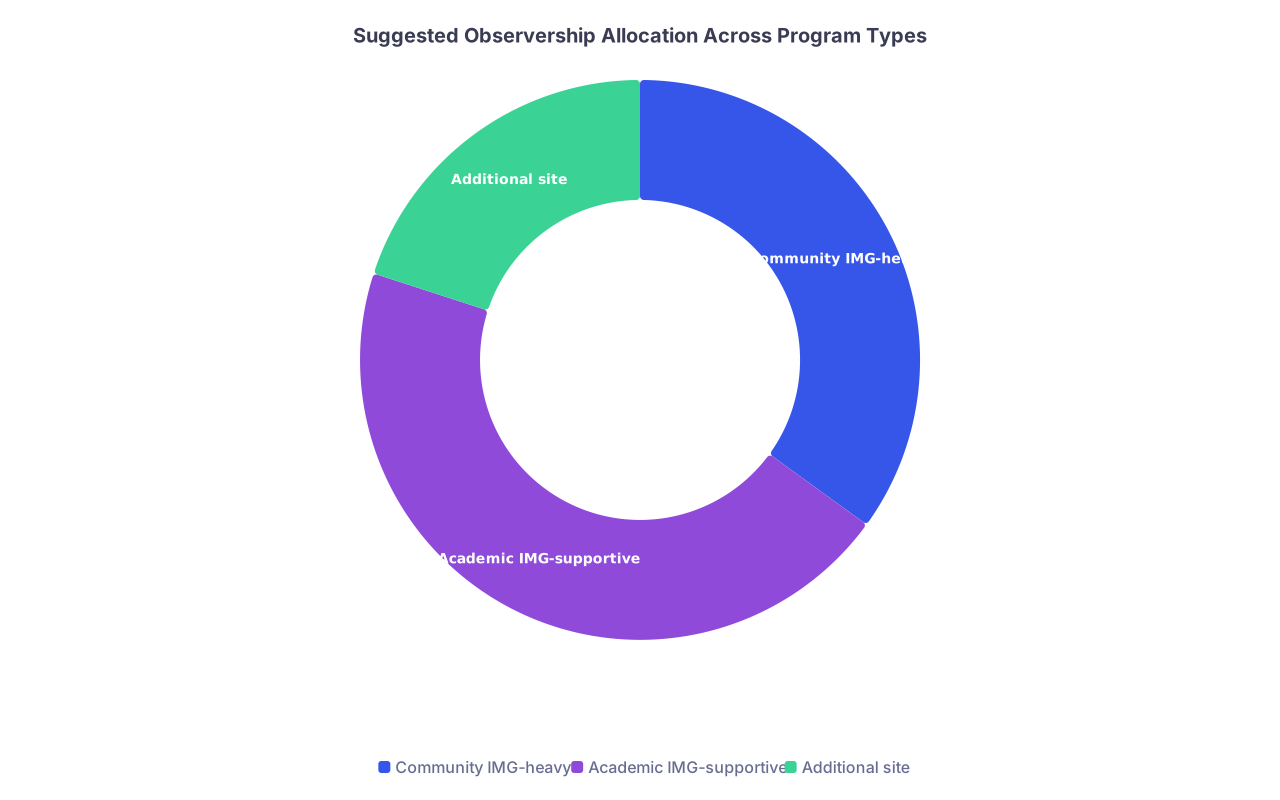
| Category | Value |
|---|---|
| Community IMG-heavy | 35 |
| Academic IMG-supportive | 45 |
| Additional site | 20 |
Do not chase quantity
Four weak observerships with no letters and no remembered impact are almost useless.
Two highly intentional observerships that produce:
- 2–3 strong letters
- Multiple faculty and residents who know you by name
- At least one PD/APD who has heard you mentioned positively
…will move your application more than all the random certificates you could frame on your wall.
10. Common Mistakes That Quietly Kill Interview Chances
I have watched IMGs sink months of effort with these entirely avoidable errors.
Acting invisible
Standing in the back, never volunteering, never asking for feedback. Bad idea. Quiet professionalism is fine; invisibility is not.Over‑talking to prove knowledge
Monologues on rounds, arguing guidelines with attendings, correcting residents in front of patients. You might be right. You will still lose.Late professionalism issues
Showing up late even twice. Phone use during rounds. Complaining about US healthcare loudly. These get remembered.Needy, last‑minute LOI behavior
Emailing attendings months later with “urgent” LOR requests when you gave them nothing to write about. That letter will be generic at best, harmful at worst.Over‑targeting non‑IMG programs
Doing observerships at institutions that “look fancy” on paper but barely touch IMGs in their match lists. You are optimizing for ego, not outcomes.
11. Put It All Together: A Simple Flow You Can Follow
Here is the process end‑to‑end.

| Step | Description |
|---|---|
| Step 1 | Select IMG supportive programs |
| Step 2 | Prepare 7 to 10 days before |
| Step 3 | Start observership like sub I |
| Step 4 | Week 1 ask for feedback |
| Step 5 | Week 2 to 3 show growth and reliability |
| Step 6 | Week 4 request strong LOR and advocacy |
| Step 7 | Expand network to residents and coordinator |
| Step 8 | Document on ERAS and personalize PS |
| Step 9 | Post ERAS email coordinator about application |
| Step 10 | Interview consideration at IMG supportive program |
You are not hoping anymore. You are running a playbook.
FAQ (Exactly 3 Questions)
1. Do I really need letters from the same institution where I want interviews, or are any US letters enough?
Any solid US letter helps, but letters from institutions that already hire IMGs and know your work carry more practical weight. A strong letter from an IMG‑supportive program that routinely ranks IMGs, especially if the writer is involved in education, is superior to a generic letter from a prestigious but non‑IMG program. Think: relevance and institutional fit over pure name brand.
2. What if my observership is very limited and they do not “allow” much participation?
You still apply the same principles, just tightened. You focus harder on: punctuality, information gathering for your attending, 1–2 high‑yield questions per day, and a short, sharp mini‑presentation if they allow it. You ask explicitly for feedback by Week 1–2 and position yourself as someone trying to learn the system quickly. Even in strict shadowing environments, I have seen IMGs walk away with strong letters because they behaved like serious future colleagues, not passive observers.
3. How many observerships do I need before applying to residency as an IMG?
There is no magic number. For most IMGs, two well‑executed observerships at IMG‑supportive institutions that produce 2–3 strong letters and real advocates are more than adequate. Beyond that, extra observerships add diminishing returns unless they are strategically at programs you strongly plan to apply to, in regions where you want to cluster your applications, or with specific mentors who can open doors. Depth and impact beat raw quantity every time.
Key points to remember:
- Treat each observership as a 4‑week interview and letter‑generating opportunity at IMG‑supportive programs, not as passive shadowing.
- Systematically convert your on‑site performance into strong letters, internal advocates, and a clear presence in the program’s memory before ERAS submission.
- Stop chasing volume; two or three highly intentional, well‑leveraged observerships will do more for your interview chances than a stack of unstructured experiences.