The brutal truth: plenty of IMGs match every year with zero formal US clinical experience. They just do not apply blindly. They target programs that actually back up their “IMG-friendly” label with real support.
You are not trying to convince every program to love you. You are trying to find the minority that will give you a fair shot without USCE—and then send them a laser–focused application that makes it obvious you understand the gap and have compensated for it.
Here is how to do that, step by step.
1. Understand the Reality: No USCE Is a Yellow Flag, Not a Death Sentence
No US clinical experience (USCE) feels like a giant red X on your application. It is not. It is a problem to manage.
Programs worry about 3 things with applicants who have no USCE:
Can you function in the US system?
- EMR use
- Documentation expectations
- Paging culture and team dynamics
- Standard orders, protocols, patient communication
Are your letters meaningful to them?
- Many PDs do not know how to interpret a letter from “Professor of Medicine, XYZ International Hospital”
- They trust US-based writers more because they know what “good” looks like
Will you survive the transition?
- They have seen residents crash: overwhelmed by autonomy, communication, or documentation
- “High-maintenance” residents burn the team and the PD
Your strategy is to answer those concerns before they ask:
- Show them you understand US medicine and have adjusted for it
- Back it up with data (scores, certifications, US-based work)
- Target programs that already have structure for IMGs
You are not trying to erase the “no USCE” issue. You are trying to neutralize it.
2. Know Which Programs Actually Support IMGs Without USCE
Most programs’ websites lie by omission.
They say:
- “We welcome IMGs”
- “We evaluate applications holistically”
Then you look at their resident list: one IMG every five years. No thanks.
You are looking for structural evidence of IMG support, not marketing fluff.
Core Features of Truly Supportive IMG Programs
Here is what I look for when advising IMGs with no USCE:
No mandatory USCE listed
- Wording like “US clinical experience preferred” is workable
- “US clinical experience required” = do not waste an application there
Clear history of IMGs in recent classes
- At least 30–50% IMGs in current residents
- Ideally from a mix of countries, not only one pipeline school
Recent “fresh” IMGs
- People who graduated within the last 3–5 years
- If all their IMGs graduated 8–10 years ago, they may now favor US grads
Low or no Step 3 obsession
- Some community programs love Step 3 for IMGs; some do not care
- With no USCE, Step 3 can be a strong compensator, but not mandatory at every program
Structured orientation or “boot camp”
- Mention of a strong intern orientation, simulation lab, onboarding curriculum
- This usually means they know how to onboard people new to the US system
Smaller university affiliates or community-based academic programs
- Pure university flagships usually drown in US MD/DO applicants
- Community programs with a university tie tend to be realistic and IMG-friendly
Quick Comparison: Support Level Indicators
| Signal Type | Strongly Supportive | Weak/Red Flag |
|---|---|---|
| Website wording | USCE preferred | USCE required |
| Current residents | 40–80% IMGs | 0–1 IMG total |
| IMG graduation years | Mix, many recent | All 8+ years since grad |
| Orientation | Mentioned, structured | Not mentioned at all |
| Step 3 attitude | Encouraged, not forced | Required for interview |
If you are not seeing at least 3–4 “strongly supportive” signals, that program moves down your list.
3. Build a Target List: Data-Driven, Not Fantasy-Driven
Blindly applying to 150 programs because someone on a forum said so is how people spend $4,000 and get 1 interview.
You are going to build a filtered list instead.
Step 1: Start with Raw Lists
Use:
- FREIDA (AMA Residency & Fellowship Database)
- Residency Explorer (if you have access)
- Program websites directly
- Specialty-specific IMG blogs/forums (for initial leads, not final decisions)
Export or manually build a spreadsheet with:
- Program name
- State
- Type (university / community / university-affiliated)
- Accepts IMGs (yes/no)
- Minimum Step scores (if listed)
- USCE requirement (required / preferred / not mentioned)
Step 2: Filter Out the Dead Ends
Remove programs that:
- Explicitly require USCE
- Do not sponsor visas (if you need one)
- Have 0 current IMGs in all PGY levels
- Are ultra-competitive academic flagships unless your scores are truly exceptional
Step 3: Analyze Actual Resident Rosters
This is where most IMGs stop. You will not.
For each remaining program:
- Open their “Current Residents” page
- Count:
- Number of IMGs vs US MD/DO
- Number of recently graduated IMGs (within ~5 years)
- Look for:
- Repeated feeder schools (e.g., multiple from the same country/school)
- Evidence they like “non-traditional” paths (previous careers, research, etc.)
If you see: “PGY-1: 4 IMGs, 2 US MD; PGY-2 similar; PGY-3 similar” — that program goes in your A-list.
If you see: “One IMG in PGY-3, none else” — B-list or discard.
Step 4: Tag Programs by Friendliness Level
Create 3 tiers:
Tier A – Highly Supportive
- 40–80% IMGs
- No USCE requirement, only “preferred”
- Visa support clear
- Recent grads accepted
Tier B – Possible
- 15–40% IMGs
- USCE “preferred,” vague wording
- A few recent IMGs but mostly older graduates
Tier C – Long Shots
- 5–15% IMGs
- Solid name recognition or preferred location
- You only keep a few of these for balance
Your application volume should be skewed: more Tier A and B, very few Tier C.
4. Compensate for No USCE: Replace It With Other “Signals”
You cannot fake US experience. But you can send strong equivalent signals.
Here is how you patch the gap.
A. Maximize Exam Strength
With no USCE, your scores matter more. Harsh but real.
- Step 2 CK becomes critical
- Step 3, if you can take it, is a big plus for IMGs without USCE
Look at how programs weigh these:
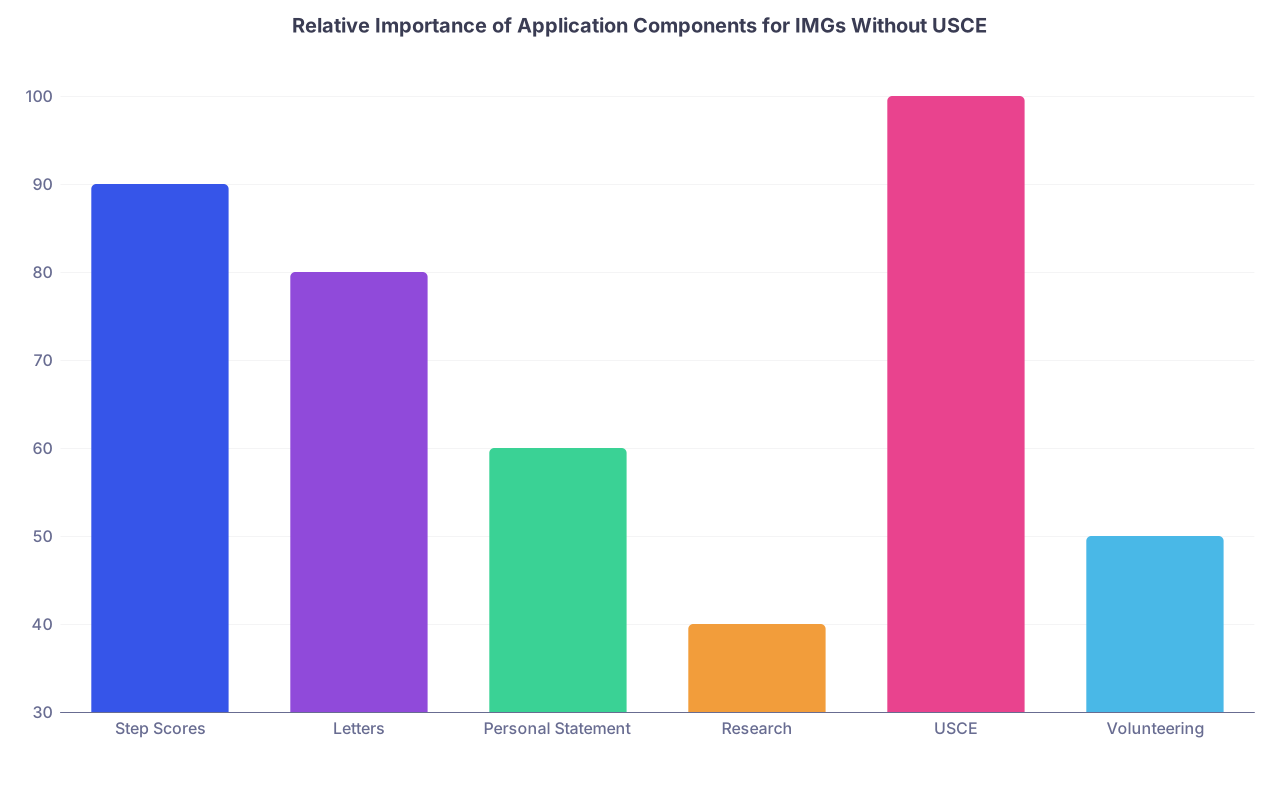
| Category | Value |
|---|---|
| Step Scores | 90 |
| Letters | 80 |
| Personal Statement | 60 |
| Research | 40 |
| USCE | 100 |
| Volunteering | 50 |
Here “USCE” is 100 for obvious reasons—you do not have it, so your other pillars must be closer to that level.
If your Step 2 is average, Step 3 can help show you can manage US-style exams and clinical reasoning.
B. Use Non-USCE Clinical Work Strategically
You may have:
- Home-country residency or practice
- Internship rotations in your country
- Volunteer clinic work
- Telemedicine roles
- NGO / mission work
Do not bury this. Elevate it:
- Show increasing responsibility over time
- Highlight skills that translate well: rapid assessment, high volume, autonomy, procedural experience
- Emphasize systems similarity: if your hospital uses structured EMR or protocols, say so
Your message: “I have functioned as a real doctor. I am not applying straight from classroom only.”
C. Secure the Right Letters of Recommendation
You probably will not have US letters. Fine. Then yours must be:
- From senior people (department heads, program directors, chief consultants)
- Very specific — not generic character references
Ask your letter writers to address:
- Your ability to adapt to new systems and guidelines
- Your teamwork, reliability, and communication with nurses and patients
- Examples of taking feedback and improving
- Any experience with English-speaking patients or international teams
If they have any exposure to the US system themselves (fellowships, conferences, collaborations), mention it in your CV and allow them to note it in the letter.
5. Replace “USCE” With “US Exposure” + Clear Readiness
You can stack multiple smaller things to approximate USCE.
A. Do US-Adjacent Experience
Not classic inpatient electives. But still meaningful:
US-based research
- Remote or in-person
- Gives you a US-based letter, even if not strictly clinical
Telehealth or case discussions with US physicians
- Remote observership-style programs
- Virtual case conferences
US certifications / courses
- BLS, ACLS (from AHA or equivalent)
- HIPAA training
- Online EMR training modules (if you can access)
Even something like consistent attendance at US-based webinars, journal clubs, or online M&M conferences can be mentioned as part of your ongoing alignment with US practice.
B. Show Clear Knowledge of US System in Your Application
This is where most IMGs with no USCE fail completely. Their personal statements read like generic “I like internal medicine because I like long-term patient relationships” essays.
You need to show you get the US reality:
- Mention familiarity with:
- Multidisciplinary rounds (case manager, social work, PT/OT)
- EMR documentation requirements
- Core quality metrics (readmission rates, CLABSI, VTE prophylaxis)
- Talk about situations in your home experience that parallel US workflows
This signals to PDs: “I will not be starting from zero the first day of intern year.”
6. Craft a Program-Specific, Gap-Aware Application
Your application must make it clear you are not ignoring the no-USCE issue—you have thought about it and prepared.
A. Personal Statement: Acknowledge and Reframe
Wrong way:
- Never mentioning your lack of USCE and hoping they do not notice.
Right way:
Briefly acknowledge it:
- “Although I have not yet had the opportunity to train directly in the US healthcare system…”
Immediately pivot to compensating strengths:
- “…I have worked for three years as a resident in a high-volume internal medicine department where we used EMR-based order entry, multidisciplinary discharge planning, and guideline-driven care very similar to US practice.”
Close the loop with readiness:
- “To prepare for residency in the US, I completed Step 3, obtained ACLS certification, and participate in weekly online case discussions with US-based physicians.”
Do not apologize. Do not write five lines of justification. Acknowledge. Offset. Move on.
B. ERAS Application: Fill in the “System-Relevant” Fields Properly
Experiences section
- Describe your roles in US-system language
- Example:
- Instead of “Medical Officer – handled ward patients”
- Use “Primary physician for 20–25 inpatients daily, responsible for admission H&Ps, daily progress notes, order entry, and discharge planning.”
Certifications
- Add BLS/ACLS with dates
- Any US-based online courses (e.g., IHI quality improvement, HIPAA training)
Languages / Communication
- If you practiced primarily in English, say so explicitly
7. Targeting and Timing: How Many Programs and When
The ideal numbers depend on your profile, but with no USCE you should err toward more applications to the right kind of programs, not just “more programs.”
A. Rough Application Volume Strategy
For a mid-range IMG with decent scores and no USCE:
- 60–90 total programs in one core specialty (e.g., internal medicine)
- Skewed heavily toward Tier A and B IMG-supportive programs
Example breakdown:
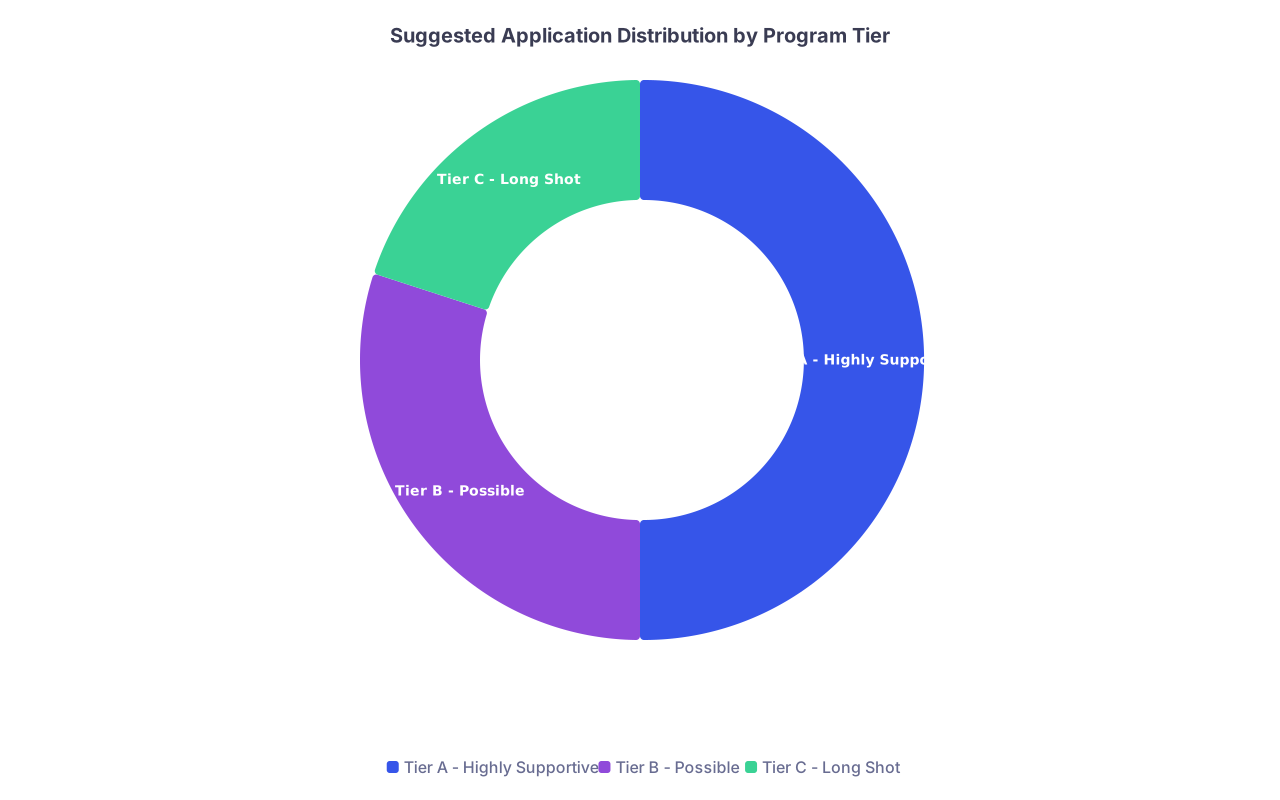
| Category | Value |
|---|---|
| Tier A - Highly Supportive | 50 |
| Tier B - Possible | 30 |
| Tier C - Long Shot | 20 |
If your scores are weaker, you may push toward 90–110, but only if you maintain discipline about targeting.
B. Apply Early. Not Fashionably Late.
Programs that are genuinely IMG-friendly often:
- Review applications continuously
- Fill most interview spots in the first 4–6 weeks after ERAS opens
You want:
- ERAS application complete and submitted on Day 1 or very close
- All letters uploaded
- Personal statement polished
- USMLE scores reported
Late + no USCE = immediate disadvantage. Early + no USCE = at least a chance to be seen.
8. Communication Strategy: How to Reach Out Without Looking Desperate
Some IMGs spam every PD and coordinator with generic emails. That hurts more than it helps.
You will be selective and precise.
When to Email
Reasonable triggers:
- You see clear IMG support but your application might be borderline on one metric
- You have a specific, program-relevant connection (research interest, geographic tie, mentor link)
- You have a meaningful update: newly passed Step 3, new publication, or new US-based experience
What to Say (and Not Say)
Bad email:
- “Dear Sir/Madam, I am a hardworking IMG and very interested in your program. Please consider my application.”
Good email structure:
Specific subject line
- “Application update – Step 3 passed (ERAS ID XXXXXXXX)”
- “IMG applicant with prior training in [similar hospital type] – ERAS ID XXXXXXXX”
4–6 concise lines:
- Who you are (IMG, year of graduation, Step 2/3 status)
- Why their program makes sense for you (concrete reason, not “good teaching”)
- One line acknowledging your lack of USCE and what you have done to prepare instead
- Thank them for reviewing your application, no begging for an interview
This does not magically guarantee interviews. But at IMG-supportive programs, coordinators and PDs do notice coherent, non-desperate communication.
9. Prepare to Perform If You Actually Get the Interview
Here is the part no one likes to admit: some IMGs with no USCE land interviews, then lose the spot in the room.
Why? They cannot articulate how they will adapt.
You must be able to answer, smoothly and directly:
Core Questions You Must Nail
- “You do not have US clinical experience. How will you adapt to our system?”
- “Tell me about the healthcare system where you currently work. How is it similar or different to ours?”
- “How have you worked with electronic medical records?”
- “Describe a time you had to adapt quickly to a new workflow or guideline.”
You answer by:
- Brief acknowledgment
- Concrete similarities in your experience
- Specific steps you have taken to prepare (Step 3, BLS/ACLS, EMR training, US-based education)
- Example of actual adaptation you have already done in your career
Practice this out loud. Record yourself. Fix the rambling.
Show You Understand the Workload and Culture
Programs fear that IMGs without USCE will be:
- Overwhelmed by volume
- Slow on notes
- Confused by pages or cross-cover
Use your real experience:
- “In my current position I cross-cover 30–40 inpatients overnight, manage admissions, and place urgent orders independently, with attending backup by phone.”
- “I already work in a multidisciplinary environment with nurses empowered to escalate concerns directly; I appreciate that team-based culture and respond quickly.”
The subtext: “I am not fragile. I have already done hard things.”
10. If You Still Do Not Match: Tighten the Strategy, Not Just Reapply
If you go unmatched once with no USCE, do not repeat the exact same application the next year.
You fix the weakest link.
Real upgrades you can make in 6–12 months:
- Get a US-based research position (even unpaid) with clinical exposure
- Pass Step 3
- Improve English fluency and communication (formal courses, Toastmasters, etc.)
- Add meaningful clinical work in your country if you were previously inactive
- Sharpen personal statement and interview skills with honest feedback from residents or faculty, not just friends
Do not just “apply earlier and to more programs.” That is what everyone says. It rarely fixes underlying issues.
FAQ (Exactly 4 Questions)
1. Is it realistic to match into residency with no US clinical experience as an IMG?
Yes. I have seen multiple IMGs match with zero formal USCE, especially into internal medicine, family medicine, and pediatrics at community or community-affiliated programs. The common pattern: strong Step 2 (often Step 3), active clinical work in their home country, targeted applications to IMG-heavy programs, and a clear explanation in their statement and interviews about how they will adapt to the US system. It is not easy, but it is absolutely realistic if the rest of the application is solid and your program list is smart.
2. Should I delay applying until I get USCE, or apply now without it?
If you are within a year or two of graduation, have competitive scores, and are clinically active, I usually recommend applying rather than losing an entire cycle waiting for perfect USCE. However, if your profile is weak (low scores, long gap since graduation, little current clinical work), then delaying 1 year to gain strong US-based research or structured observerships may be smarter. Do not delay for a random two-week observership. If you wait, wait for something substantial that clearly upgrades your application.
3. Does doing observerships or externships right before applying completely fix the “no USCE” issue?
No. Short observerships help, but they do not fully replace substantial hands-on USCE. Programs know the difference between a two-week shadowing experience and four months of real inpatient subinternship. Observerships are better than nothing mainly because of the potential US letter and your ability to speak about US hospital culture in interviews. Treat them as a partial compensator, not a magic eraser.
4. Which specialties are most realistic for IMGs without USCE?
The more competitive the specialty, the more damaging no USCE becomes. If you are applying without USCE, the most realistic options are: internal medicine (especially community and hybrid programs), family medicine, pediatrics, psychiatry in some regions, and occasionally neurology at IMG-heavy programs. Surgery, dermatology, radiology, and other highly competitive fields are extremely difficult without both strong USCE and outstanding scores. If you are set on a competitive specialty, you need a multi-year plan with US-based research, strong US letters, and ideally genuine USCE, not just observerships.
Key takeaways:
- No USCE is a serious but manageable weakness if you target genuinely IMG-supportive programs and compensate with scores, clinical activity, and clear readiness.
- Your success depends less on volume of applications and more on how precisely you select programs and how directly you address the “no USCE” gap in your application and interviews.