The usual advice to “just apply more broadly” as an IMG reapplicant is lazy and wrong. You do not need more chaos. You need a ruthless, data‑driven, targeted reapplicant plan that focuses on programs actually kind to IMGs.
You already proved this the hard way: you applied, spent thousands, maybe interviewed a bit, maybe not, and you are still unmatched. So the next cycle cannot be “same plan, more applications.” That is not a strategy. That is gambling.
Here is how you fix it—step by step—by building a residency reapplicant plan centered on IMG‑friendly programs and closing the gaps that kept you out the first time.
1. First, Perform a Brutal Post‑Match Autopsy
You cannot build a smart reapplicant plan until you know exactly why your last attempt failed. Not “maybe”, not “I think”, but hard categories and specific deficits.
Step 1: Quantify your last cycle
Write down your actual numbers, not what you “remember”:
- Number of programs applied to (by specialty and by state)
- Number of interview invites
- Number of interviews actually attended
- USMLE / COMLEX scores (including any failures and attempts)
- Year of graduation (YOG)
- US clinical experience: type and total weeks (observerships vs hands‑on electives / externships)
- Visa status (needs J‑1, H‑1B, or no visa)
- Research and publications: number and quality (case reports vs original research)
- Red flags: failures, leaves, big gaps, professionalism issues
Now categorize what happened:
- No interviews at all
- Few interviews (<5) and no rankable programs
- Reasonable number of interviews, did not match
Each of those requires a different plan.
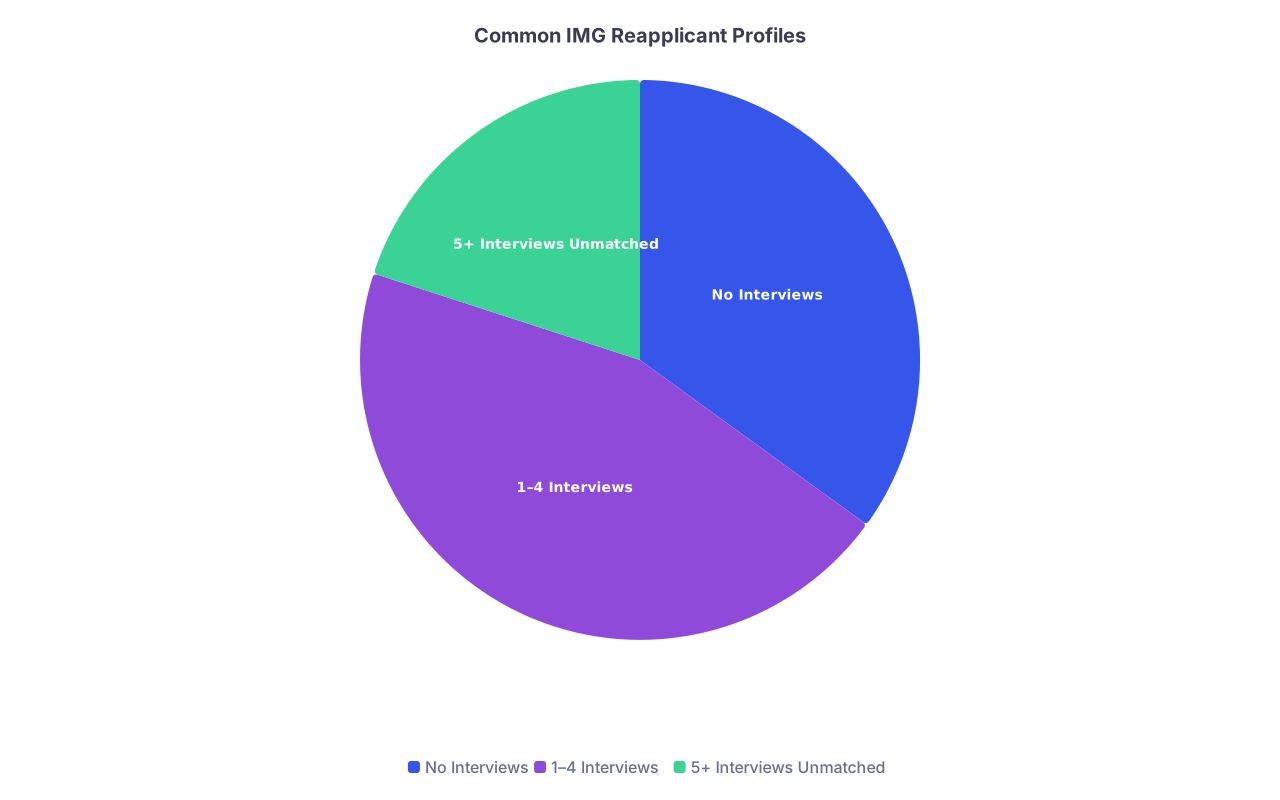
| Category | Value |
|---|---|
| No Interviews | 35 |
| 1–4 Interviews | 45 |
| 5+ Interviews Unmatched | 20 |
Step 2: Identify your primary barrier
Be honest. In almost every IMG reapplicant I have seen, the core issue is one of these:
Exam profile problem
- Low Step 1 / Step 2 CK score for your target specialty
- Failed attempt(s)
- Step 3 missing when it would help
CV / experience problem
- Little or no recent hands‑on US clinical experience
- Too many “shadowing / observership only” lines
- Weak or generic letters of recommendation
Strategy / program selection problem
- Way too many applications to programs that simply do not take IMGs
- Wrong geographic focus (chasing prestige cities vs IMG‑friendly states)
- Not filtering for visa policies
Communication problem
- Weak personal statement and application narrative
- Poor interviewing, flat or awkward interpersonal skills
- No networking or faculty advocacy
Circle your top two. Not six. Fixing everything at once guarantees you fix nothing.
2. Define a Realistic Target: Specialty, Score Band, Visa
You cannot “optimize” without a clearly defined target.
Step 1: Decide if you must change specialty
If you are reapplying to something brutally competitive (Derm, Ortho, Plastics, Rad‑Onc, Neurosurgery) as an IMG with average scores and no serious academic backing—someone needs to say it: this is fantasy.
On the other hand, many IMGs eventually match solidly into:
- Internal Medicine
- Family Medicine
- Pediatrics
- Psychiatry
- Pathology
- Neurology
- Some community General Surgery and transitional / prelim programs (more limited, but possible)
If you struggled to get any interview in Internal Medicine with 210s and attempt(s), then applying to Radiology this year is not “aiming high”. It is burning money.
If you want, you can stay in a slightly competitive field if:
- You had multiple interviews last cycle
- Feedback from mentors suggests you were close
- Your scores and profile are at or above the IMG ranges for that specialty
Otherwise, pivot.
3. Build a Data‑Driven List of IMG‑Friendly Programs
Most unmatched IMGs never actually do this. They “know” some programs are IMG friendly based on gossip, random YouTube videos, or a friend of a friend. That is not data.
Step 1: Use the right tools (and use them properly)
You need at least two sources:
NRMP / FREIDA data
- NRMP’s “Charting Outcomes in the Match” and “Program Director Survey” give score ranges and what PDs care about.
- FREIDA (AMA) lists programs, IMG percentages, and some visa info.
Third‑party filters
- Residency Explorer
- Residency program aggregators that specifically show:
- Percentage of IMGs / FMGs
- Minimum score cutoffs
- Visa sponsorship
You build a spreadsheet. Period. No spreadsheet = weak plan.
Columns should include:
- Program name
- Specialty
- City / State
- IMG % in residency class
- Any mention of “IMG friendly” on their site
- Visa: J‑1 / H‑1B / none
- Stated minimum USMLE scores
- Step 1 / Step 2 required? Step 3 helpful?
- Last YOG accepted
- Your personal fit rating (1–5)
| Program | IMG % (Est.) | Visa | Step 2 Min | YOG Limit |
|---|---|---|---|---|
| Community IM Program A | 60 | J-1 | 220 | 10 years |
| University Affiliate IM B | 40 | J-1/H-1B | 225 | 5 years |
| Community FM Program C | 55 | J-1 | 215 | None |
| Psych Program D | 35 | J-1 | 220 | 7 years |
| Pathology Program E | 70 | J-1/H-1B | 215 | 10 years |
If your last application list had fewer than 40–50 programs with ≥30–40% IMGs in the current residents, you were not strategically IMG‑focused.
Step 2: Filter aggressively for IMG kindness
You are reapplying. You need friendly, not “maybe”.
These concrete filters identify IMG‑friendly programs:
Current residents:
- At least 30–40% IMGs
- Preferably multiple IMGs from your region or similar schools
Website / documentation:
- Explicitly says they “welcome international medical graduates”
- States clear minimums instead of vague “holistic review” nonsense
- Lists visa sponsorship policies clearly
Visa:
- If you need visa, eliminate:
- “No visa sponsorship”
- “Green card / citizen required”
- Prioritize:
- J‑1 friendly at minimum
- H‑1B where possible if your exam profile is strong and Step 3 is done
- If you need visa, eliminate:
YOG (Year of Graduation):
- If you are >5–7 years out, you must target programs that explicitly accept older grads or obviously have them in current classes.
Step 3: Build tiers
You should not treat all programs the same.
Create 3 tiers:
Tier 1 — High probability
- IMG %: ≥50%
- Visa: matches your needs
- Your scores: meet or exceed their stated minimums
- Geography: includes states historically friendly to IMGs (NY, NJ, MI, IL, TX, FL, etc., depending on specialty)
Tier 2 — Reasonable
- IMG %: 25–49%
- You are at or just below their average scores
- Good but not perfect YOG or visa fit
Tier 3 — Reach / long shot
- IMG %: 10–24%
- Score or YOG slightly below typical
- Still not “IMG hostile,” but you are an underdog
Your application distribution for a reapplicant IMG should lean heavily to Tier 1 and 2. Something like:
- 50–60% Tier 1
- 30–40% Tier 2
- <10% Tier 3
Not 50% at dreamy university programs that take two IMGs per decade.
4. Fix the Core Weakness: Scores, Experience, or Presentation
Now that your target list is more rational, we fix the actual reasons you did not match.
Scenario A: You had no interviews
This usually means one or more of:
- Score(s) below 210 or multiple attempts
- No US clinical experience, or only observerships
- You applied to too many IMG‑unfriendly or visa‑unfriendly programs
- Sloppy or obviously weak application (personal statement, incomplete ERAS, LOR gaps)
What to do in 6–12 months:
If exams are the main issue
- If you have pending Steps:
- Prepare seriously (dedicated schedule, Qbanks, NBME assessments, tutor if needed) to secure a strong Step 2 CK or Step 3.
- If you already graduated all exams and scores are low:
- Step 3 can sometimes offset a weaker Step 2, especially for IM and FM.
- But another failed attempt will destroy your chances. Only take Step 3 if practice scores are safely above a passing range.
- If you have pending Steps:
Get recent, hands‑on US clinical experience
- Aim for 12+ weeks of solid USCE in your chosen specialty:
- Community hospital externships
- Inpatient rotations, not just outpatient shadowing
- Avoid mostly pure observerships if you can. They rarely produce strong letters.
- Aim for 12+ weeks of solid USCE in your chosen specialty:
Secure powerful letters
- You want at least 2–3 letters from US attending physicians who:
- Supervised you directly
- Can comment on your work ethic, reliability, communication, and teamwork
- Are willing to be specific, not generic
- You want at least 2–3 letters from US attending physicians who:
Scenario B: You had some interviews (1–4) but no match
Good. This means someone was willing to interview you. The barrier is either:
- Not enough total interviews, due to poor targeting or marginal scores
- Weak interviewing and communication
- Poor ranking strategy
Fix list:
Increase the number of interviews
- Improve your IMG‑friendly program filtering and apply smarter, not just more.
- Add more community and smaller regional programs.
- Consider a slightly less competitive specialty if you were originally on the edge.
Treat interviewing as a skill, not a personality trait
- Practice with:
- Mock interviews (faculty, residents, paid services if necessary)
- Behavioral questions: “Tell me about a time…” with structured answers (STAR format)
- Focus on:
- Clear, concise stories
- Owning your weaknesses without sounding defeated
- Demonstrating real understanding of the US healthcare system and team roles
- Practice with:
Adjust your narrative
- If your personal statement read like a generic IMG essay (“ever since I was a child…”), rewrite it.
- The reapplicant PS should:
- Acknowledge, briefly and professionally, that you are reapplying
- Show what you have done since last cycle (concrete improvements)
- Articulate why this specialty and why this environment (community, underserved, academic, etc.)
Scenario C: You had 5+ interviews and still did not match
This is almost always a rank list / fit / interview problem.
You need to ask yourself honestly:
- Were you ranking only “prestige‑seeming” programs at the top and pushing smaller community hospitals down, even though they liked you more?
- Were your answers stiff, overly rehearsed, or excessively negative about your home country or previous training?
- Did you struggle with English fluency, pacing, or listening?
Your fix is focused on:
- Interview performance: record mock sessions, get brutal feedback, fix your nonverbal cues, long answers, or defensive tone.
- Rank list discipline: next time, you rank every program you could live with, in order of how much they seemed to want you and how well you fit. Not where you “dream” of being.
5. Leverage Time Between Cycles Strategically
Your gap year(s) can either look like dead space or like targeted growth. You choose.
Priority activities that help IMGs reapplying:
US Clinical Work (even if not residency)
- Research assistant roles in US hospitals
- Clinical assistant / scribe roles (in some states)
- Longitudinal unpaid clinical work with strong letter writers
Research with Output
- It does not need to be NIH‑level science.
- Case reports, QI projects, chart reviews with posters or publications.
- Present at local conferences if national is too competitive.
Step 3 (for certain candidates)
- Especially helpful if:
- You want Internal Medicine, Family Medicine, or Psychiatry
- You need H‑1B visa and the program requires Step 3
- But again: only if your practice metrics are solid.
- Especially helpful if:
Objective language and communication improvement
- If your English clarity or accent caused issues:
- Targeted language coaching
- Toastmasters or similar speaking groups
- Telehealth scribe roles (forces quick, accurate communication)
- If your English clarity or accent caused issues:
Network intelligently (not desperately)
- Don’t spam program coordinators with generic emails.
- Instead:
- Connect with alumni from your school who matched in the US (LinkedIn / Facebook groups).
- Ask focused questions about their programs and how they approached applications.
- Attend specialty society meetings or virtual events and actually talk to people.
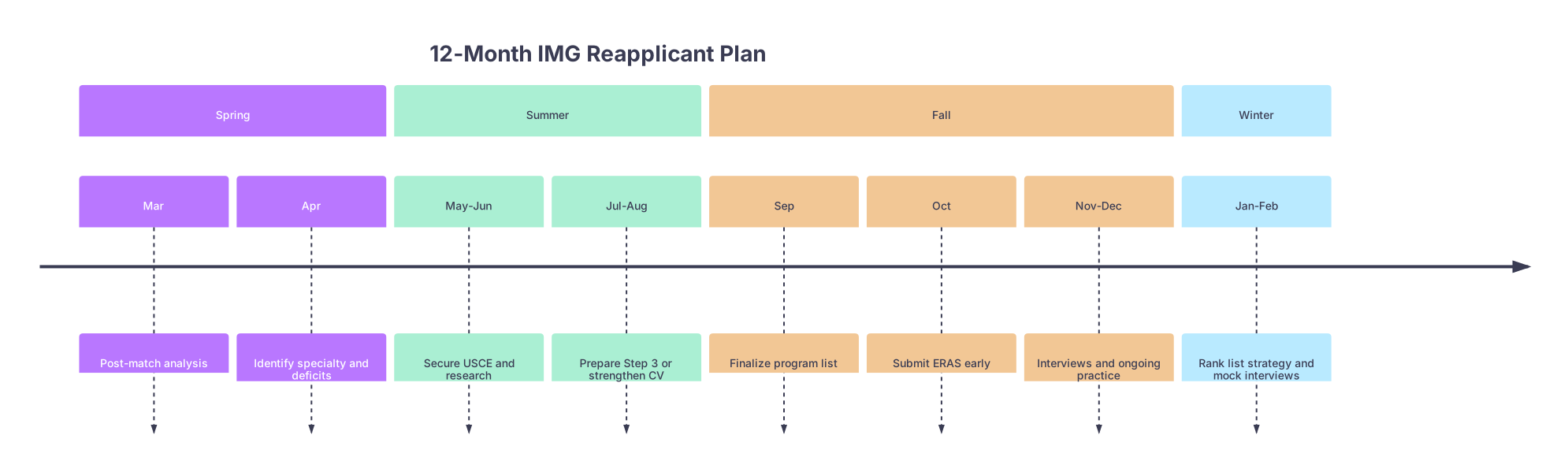
| Period | Event |
|---|---|
| Spring - Mar | Post-match analysis |
| Spring - Apr | Identify specialty and deficits |
| Summer - May-Jun | Secure USCE and research |
| Summer - Jul-Aug | Prepare Step 3 or strengthen CV |
| Fall - Sep | Finalize program list |
| Fall - Oct | Submit ERAS early |
| Fall - Nov-Dec | Interviews and ongoing practice |
| Winter - Jan-Feb | Rank list strategy and mock interviews |
6. Application Execution: How Reapplicants Should Apply Differently
You do not get credit for “trying again.” You get credit for showing evidence of change.
Submit early and clean
As an IMG reapplicant, you cannot afford:
- Late letters
- Missing Step 2 CK (if it was your main weak spot)
- Half‑finished personal statements
ERAS on opening week. Not a month later.
Customize where it matters
You cannot write 120 custom personal statements. But you can:
- Use 2–3 versions:
- Community‑focused version (underserved, continuity of care)
- University‑affiliate version (teaching, research interest)
- Psych‑ or niche‑focused version (if specialty specific)
In each, adjust:
- Short paragraph explaining what you did since last cycle
- Why this type of program is the environment where you will thrive
Communicate as a reapplicant without sounding defeated
You do not need to open with, “I did not match.” Programs can see your history.
You do need to:
- Briefly acknowledge growth:
- “Since my previous application, I have completed 16 additional weeks of hands‑on US clinical training in community Internal Medicine settings and passed Step 3.”
- Show reflection:
- “These experiences have strengthened my understanding of longitudinal patient care and improved my confidence in complex inpatient management.”
Not: “I was devastated and heartbroken last year…” Save that for your therapist, not your PD.
7. Special Notes on Visas and Older Graduation Years
Visa‑requiring IMGs
If you need J‑1 only:
- Good news: Many community IM / FM / Psych / Peds programs sponsor J‑1 routinely.
- Make sure your program list explicitly confirms this, not “assume”.
If you need or prefer H‑1B:
- You must:
- Have Step 3 completed before they file your visa.
- Often have stronger scores and fewer red flags.
- Focus on:
- Programs historically known to offer H‑1B (often listed on their websites or shared by prior IMGs).
- States and institutions with robust legal / HR infrastructure (big systems, not tiny hospitals).
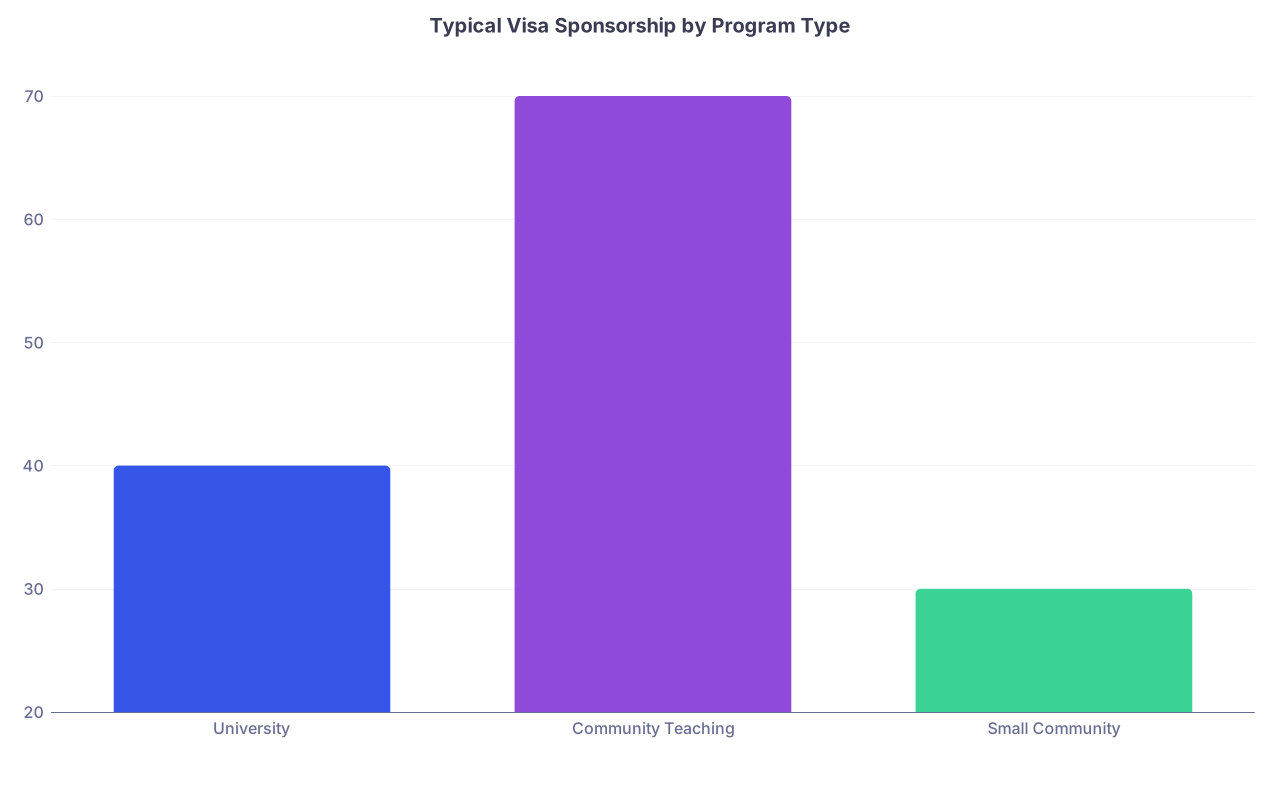
| Category | Value |
|---|---|
| University | 40 |
| Community Teaching | 70 |
| Small Community | 30 |
(Values = approximate percentage of programs in each category that sponsor any visa for IMGs; actual numbers vary, but you get the pattern.)
Older year of graduation (YOG > 5–7 years)
You are not out. But your list must be even more surgically chosen:
- Seek:
- Programs that clearly state “no YOG limit” or mention 10‑year limits.
- Programs where current residents include older graduates (check photos and bios).
- Your gap explanation:
- Must be structured:
- Continuous clinical practice
- Research or teaching roles
- Not 5 years of “studying for exams” with no other output
- Must be structured:
8. Example: Turning a Failed Cycle Into a Targeted Plan
Let me walk you through a composite case I have seen versions of a hundred times.
Profile:
- IMG, YOG 2017
- Internal Medicine applicant
- Step 1: 221 (first attempt)
- Step 2 CK: 227 (second attempt)
- No Step 3 yet
- Observerships: 8 weeks total
- No US publications
- Requires J‑1 visa
- Last cycle: Applied to 120 IM programs, mostly university and big coastal cities
- Outcome: 1 interview, no match
Why they failed:
- Weak USCE (observerships only)
- Attempt on Step 2
- Poor program selection (too academic, too coastal, not IMG‑focused)
- No Step 3 to offset the attempt and build confidence for PDs
Reapplicant Plan (12 months):
Spring–Summer:
- Enroll in 12–16 weeks of hands‑on IM externships at community hospitals in IMG‑friendly states.
- Secure 2–3 letters from US IM attendings.
- Start Step 3 prep with strict score thresholds for practice tests.
Late Summer:
- Take Step 3 only once NBME / CCS practice results are comfortably in passing territory.
- Build research or QI project with at least one poster or abstract.
Early Fall:
- Completely rebuild program list:
- 70+ programs with ≥50% IMGs, J‑1 friendly, community‑based.
- 40–50 programs with 25–49% IMGs (reasonable fits).
- <10 “reach” university programs that clearly take IMGs.
- Completely rebuild program list:
Application execution:
- ERAS submitted on opening day.
- Personal statement includes:
- One tight paragraph on growth since last cycle (USCE, Step 3, QI project).
- Strong focus on community IM, continuity, and underserved patients.
Interview preparation:
- Weekly mock interviews starting in October with recorded sessions.
- Targeted work on explaining exam attempt without excuses, focusing on resilience and improved performance.
This plan does not guarantee a match. Nothing does. But it moves this applicant from “near zero” probability to the realm where double‑digit interviews are possible if they execute well.
9. Common Pitfalls That Kill IMG Reapplicants
I see the same self‑inflicted wounds every year:
- Reapplying with essentially the same CV and hoping “this time will be different”.
- Adding more ultra‑competitive or IMG‑unfriendly programs “just in case”.
- Ignoring Step 3 when it would significantly help (especially for IM/FM with visa needs).
- Blaming “the system” instead of facing legitimate weaknesses in communication or professionalism.
- Wasting money on shiny “CV boosting” courses or fake “research fellowships” that do not produce real output or letters.
Do not do these. Every dollar and every hour needs to push you toward:
- Better metrics,
- Stronger letters,
- Clearer narrative, and
- A smarter, IMG‑focused program list.
Quick Recap: What Actually Changes Your Odds
Three points you should not forget:
Strategy beats volume. As an IMG reapplicant, you win by targeting programs truly kind to IMGs—high IMG percentages, clear visa support, realistic score expectations—not by randomly increasing application numbers.
Visible growth matters. Between cycles, you must create real, documentable improvement: more and better USCE, stronger US letters, possibly Step 3, and a more mature, grounded narrative.
Interviews decide everything. Once you get your foot in the door, your performance and how honestly, confidently, and clearly you present yourself are what carry you over the line. Treat interviewing as a skill to train, not a lottery.
FAQ (Exactly 3 Questions)
1. Should I email programs to tell them I am a reapplicant and still very interested?
You can, but do it surgically. Do not send mass generic emails. A short, specific message to a program where you rotated, interviewed previously, or have a genuine connection can help. Include a brief update on what has changed since last cycle (USCE, Step 3, new letters). If you have no real connection, your email will usually be ignored or mildly annoy them.
2. Is it ever smart for an IMG reapplicant to skip a cycle and wait another year?
Yes, if your profile is currently uncompetitive and you cannot realistically change it in a few months. For example, no USCE, failed attempts, no Step 2 CK yet, or very old YOG with no recent clinical work. In those cases, forcing an application this year just burns money and labels you a weaker reapplicant. Use a full year to build USCE, pass remaining exams solidly, and line up meaningful letters.
3. How many programs should an IMG reapplicant apply to?
There is no magic number, but for IM / FM / Psych, most reapplicant IMGs end up in the 80–150 range. The key is not the raw count; it is the composition. If at least half of those are truly IMG‑heavy, visa‑friendly, community‑oriented programs that match your profile, your chances rise. If you send 200 applications to the wrong mix of programs, you will repeat the same result.