
It is mid-January. You just got your Step 2 CK score back, and it is lower than you hoped. Your email inbox is not exactly overflowing with interview invites. ERAS is in. You cannot retake anything. And now you are staring at your rank list draft thinking: “Did I just ruin my Match?”
You did not. But your current strategy might.
If you are an IMG with mediocre or low Step scores, you cannot play the same game as AMGs with 250+ and home programs. You need a different playbook. Specifically:
- You need to shift your target toward IMG-friendly, score-flexible programs
- You need more true safeties, not just “not top 10”
- You need to stop wasting time on places that will never rank you, no matter how “nice” the interview felt
I am going to walk you through exactly how to rebuild your list and approach so that low scores become a constraint, not a death sentence.
1. Reality Check: What “Low Step” Means For An IMG
Let me be blunt. For most IMGs:
- Step 2 CK < 225 = high risk
- 225–235 = borderline / salvageable with smart strategy
- 235–245 = fine, if the rest of your app is aligned and realistic
Yes, there are exceptions. No, you are probably not the exception.
Here is the part applicants get wrong: programs do not just “like higher scores.” Many have hard filters set in ERAS software. If you are below their line, some PD will never even see your name.
So your first job is to stop pretending you are competitive where you are not and ruthlessly pivot to programs:
- Known to take IMGs regularly
- Historically matching people in your score range
- Located in regions and hospital types that actually need labor, not prestige
If you do this early enough, you can absolutely still match.
2. The IMG-Friendly Sweet Spot: Which Programs Actually Take You Seriously
Forget the brochure language. What matters is who programs actually rank and match.
Here is where IMGs with lower scores consistently find traction:
- Community-based Internal Medicine (especially in underserved or less popular locations)
- Community-based Family Medicine
- Psychiatry at less well-known institutions in less popular regions
- Preliminary internal medicine or surgery years as a foothold when categorical is unrealistic this cycle
Less consistently, but possible with stronger profiles even with modest scores:
- Pediatrics at community programs
- Neurology at IMG-friendly centers
- Pathology and some hospital-based specialties (but these are more research-sensitive)
What is usually off the table with low Step scores as an IMG:
- Derm, Ortho, ENT, Plastics, Rad Onc, Neurosurgery (do not waste your application fees)
- Highly competitive academic IM programs at big brand names in NYC/Boston/California
- Elite categorical surgery, anesthesia, EM without extremely strong compensating factors
You want places where:
- IMGs make up at least 30–40% of the residents
- There are multiple residents from your country/region in the last 3–5 years
- The program is not in a top 10 most desirable city
Here is a rough comparison of where low-to-mid score IMGs tend to succeed:
| Program Type | Typical IMG % | Score Sensitivity | Realistic for Low Step IMGs |
|---|---|---|---|
| Big academic university | 0–10% | Very High | Rarely |
| Community university-affil | 20–40% | Moderate | Sometimes |
| Pure community hospital | 40–80% | Lower | Often |
| Rural / underserved | 50–90% | Lowest | Best bet |
If you do not know which category a program falls into, you have not done enough homework.
3. How To Identify Real IMG-Friendly Safety Nets (Not Fake Ones)
Most people’s “safety” programs are not safe at all. They are just “places I have heard of that are not Harvard.”
Here is a five-step filter to find real IMG-friendly nets:
Step 1: Check actual resident rosters
Go to the program website. Look at the current residents and alumni.
Look for:
- International med schools (esp. Caribbean, India, Pakistan, Middle East, Eastern Europe, Latin America)
- Multiple IMGs per class, not just one token person
- Recency — if all the IMGs graduated >5–7 years ago, the PD may have changed the culture
Red flags:
- All residents from US MD/DO
- 1–2 IMGs total in the whole program
- Residents only from a narrow group of “top” international schools
Step 2: Use data, not vibes
You have tools. Use them.
- NRMP Charting Outcomes in the Match (IMG edition) – see realistic ranges
- Residency Explorer / FREIDA – look at % IMGs, average Step 2 (where listed), program type
- Online IMG match forums / databases to see where people in your score bracket matched
If you are 225 and a program’s average Step 2 is 245 with 5% IMGs, you are burning an application.
Step 3: Look at geography and desirability
Unpopular = opportunity.
Higher yield regions for IMG-friendly safety nets:
- Midwest (non-Chicago), Deep South, some parts of the Rust Belt
- Smaller cities / towns in Texas (though Texas has its own quirks)
- Rural or semi-rural community hospitals affiliated with state schools
Lower yield:
- NYC/Boston/California/Seattle/Chicago downtown cores
- Tourist magnets (Miami, San Diego, Denver, Honolulu)
Step 4: ECFMG and visa patterns
If you need a visa, this matters. Check:
- “We sponsor J-1” = baseline OK
- “We sponsor J-1 and H-1B” = very IMG-aware, higher potential
- “No visa sponsorship” = hard pass if you are not a US citizen/GC
Look on program websites, FREIDA, or email the coordinator if unclear.
Step 5: Watch for code words in program descriptions
Things that often signal score rigidity:
- “Highly competitive applicants”
- “Preference given to US graduates”
- “USMLE Step 2 > 240 preferred”
More hopeful language:
- “We welcome applications from international graduates”
- “We value life experience and holistic review”
- “We have a long history of training IMGs”
None of this is absolute. But you are looking for patterns.
4. How Low Scores Change Your Target Specialty Strategy
You cannot have everything: your dream specialty, your dream city, your dream program name. Not with weak numbers. You have to decide what you care about most: matching in any specialty vs holding out for exactly what you want.
Scenario A: You just want to be in US residency
Then you should:
- Prioritize IM or FM categorical positions at IMG-heavy community programs
- Add a few prelim IM or surgery spots in backup regions
- Be willing to go almost anywhere for training
Scenario B: You strongly prefer a field like Psych, Neuro, Peds
If your Step 2 is:
- < 225: You need a lot of IMG-heavy IM/FM safeties alongside a handful of your preferred specialty
- 225–235: Apply broadly to your preferred specialty at IMG-friendly programs, but anchor with IM/FM programs where your odds are higher
Scenario C: You are trying for something like Anesthesia, EM, categorical Surgery
With low scores as an IMG, these are uphill.
You need:
- Serious US-based research and letters in the specialty
- A parallel plan (IM/FM, prelim years) that you are genuinely willing to do
- Clear eyes: many in your position match into a different specialty and discover they actually like it
Being stubborn about specialty with weak scores is how you end up unmatched.
5. Rebuilding Your Rank List: A Practical Framework
Let us talk numbers. For IMGs with low Step scores who did get a reasonable number of interviews (say 6–12 total), the rank list structure should not be random.
Tier your interviews honestly
Divide your interviewed programs into three tiers:
- Reach: You are below their usual range or they have low IMG representation
- Match: Your profile fits their apparent norms
- Safety: Heavy IMG presence, modest reputation, non-glamorous location
A healthy, survival-focused rank list for a low-score IMG might look like:
- 10–20% Reach
- 30–40% Match
- 40–60% Safety
If your current rank list is:
- 70% coastal city programs
- 70% university-branded places
- Only 1–2 true community IMG-heavy hospitals
You are overestimating your profile.
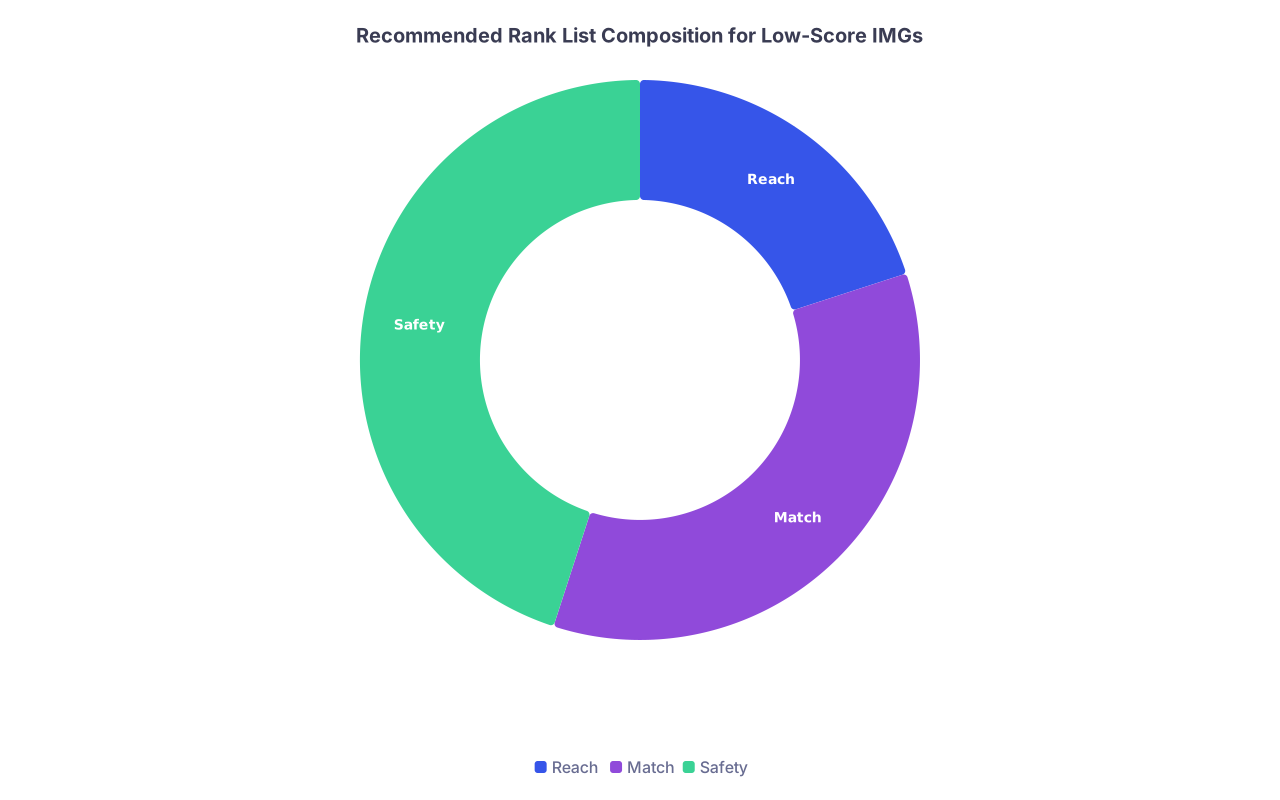
| Category | Value |
|---|---|
| Reach | 20 |
| Match | 35 |
| Safety | 45 |
How to rank when you liked a “reach” place more
You should rank programs in the order you would be happiest training, not in the order you think they will rank you. But that rule has a caveat for IMGs with weak scores:
If you are not sure a program is truly “rankable” for you, the “follow your heart” mantra becomes dangerous.
Practical approach:
Rank any place that:
- Interviewed you fairly
- Has some IMG presence
- Did not explicitly or implicitly signal they never take your profile
Do not anchor your list with:
- Elite university IM programs with 1/30 IMGs across all classes
- Highly competitive city programs where every co-interviewee was US MD with AOA
You can still put a couple of these at the top if you really liked them. But your safety nets must be numerous and ranked high enough that the algorithm sees them before you end up unmatched.
Concrete example
You are an IMG with Step 1 pass, Step 2 = 227. You got 9 IM interviews:
- 2 university-affiliated IM programs in major cities (10% IMGs)
- 3 mid-size city community programs (40% IMGs)
- 4 small-city or rural community IM programs (70%+ IMGs)
What I have seen work:
- Rank 1–2 of the university-affiliated if you truly loved them
- Then immediately start ranking the mid-size and rural IMG-heavy programs
- Do not bury the rural programs at the bottom because your ego hates the city name
I have seen too many people put the rural programs 7–9, then not match at 1–6 and end up scrambling. They would have matched at #7 if they had simply ranked it higher.
6. Expanding Your Safety Net: Mid-Season Adjustments
If you are still early in the season and clearly undershooting on interviews, you need to take action now, not after Match Week.
Here is the mid-season rescue protocol:
1. Expand your application list to high-yield regions
Target more:
- Midwest community IM/FM
- Southern/rural areas that explicitly list IMGs in their rosters
- Programs with late or rolling interview cycles
You are looking for places where:
- They posted on social media about still reviewing applications
- Current residents mention “we often interview candidates into January/February”
2. Send targeted, concise interest emails
Do not send generic spam. That goes straight to trash.
Your email to PD or PC should:
- Be 5–7 sentences max
- Highlight: your USMLE scores (honestly), ECFMG status, USCE, visa needs, and why their program (specific reason)
- Attach ERAS CV or politely reference your AAMC ID
You are not begging. You are making it absurdly easy for them to consider you when they have a cancellation.

| Step | Description |
|---|---|
| Step 1 | Realize low interview count |
| Step 2 | Reassess competitiveness |
| Step 3 | Identify IMG-heavy programs |
| Step 4 | Send targeted interest emails |
| Step 5 | Monitor for late invites |
| Step 6 | Attend and rank highly |
| Step 7 | Strengthen backup plans |
| Step 8 | Get new interview? |
3. Leverage any US contacts
If you have:
- An attending who trained at a program
- A former resident from your home school now in US residency
- A mentor who knows a PD
Ask for a brief email of support. One email from a trusted colleague can push your application from “ignored” to “reviewed.”
7. Using Prelim and Transitional Years As Deliberate Safety Nets
If your Step scores are weak and your specialty choice is competitive, prelim and TY years are not a failure. They are a bridge.
When prelim makes sense
You are:
- Aiming for categorical surgery, anesthesia, or a tough IM program
- Weak on scores but have decent USCE and letters
- Willing to work hard for one year and reapply with US performance data
You should:
- Apply to prelim IM and surgery positions in IMG-heavy hospitals
- Rank them on the same list (you will have separate rank lists for categorical vs prelim when needed)
- Treat that intern year as a paid audition: show PDs you can function well in US system
What you cannot do is “just grab any prelim” and then coast. That is how you end up as a perpetual prelim with no categorical offer.
8. Red Flags You Are Still Aiming Too High
Quick diagnostic. If any of these apply, you are likely still in denial:
- Your top 10 programs are all in big coastal cities
- More than half of your ranked programs have <20% IMGs
- Your friends with higher scores and similar background are worried about matching at the places you listed
- You are counting on “my interview went really well” to overcome 20–30 point score gaps
Be smarter than that.
9. A Practical 7-Day Action Plan To Fix Your Strategy
If you are panicking now, do this over the next week.
Day 1–2: Data audit
- List all programs you applied to or interviewed at
- For each, write down:
- City/State
- Program type (university vs community)
- % IMGs
- Visa status
- Mark each as Reach / Match / Safety honestly
Day 3: Rank list restructuring (if applicable)
- Move clear IMG-heavy community programs higher than your ego prefers
- Keep a few dream programs at the top, but not at the cost of burying your only real safety nets
Day 4–5: Expansion (if application season still open)
- Identify 20–40 additional IMG-heavy programs that:
- Sponsor your needed visa
- Show recent IMGs on their rosters
- Submit late applications
- Send targeted interest emails to 10–15 of them
Day 6: Backup pathway planning
If you are very late in the season or clearly under-interviewed:
- Map out:
- SOAP strategy (which specialties, which types of programs)
- Next-cycle improvements (USCE, research, Step 3)
- If possible, plan one US-based activity (observer/extern, research) that strengthens your reapplication
Day 7: Sanity check with someone experienced
Show your revised list to:
- A faculty member who works with IMGs
- A senior resident who matched as an IMG
- Someone who will not just say “you will be fine” but actually tell you the truth
If they look at your list and wince, fix it again.
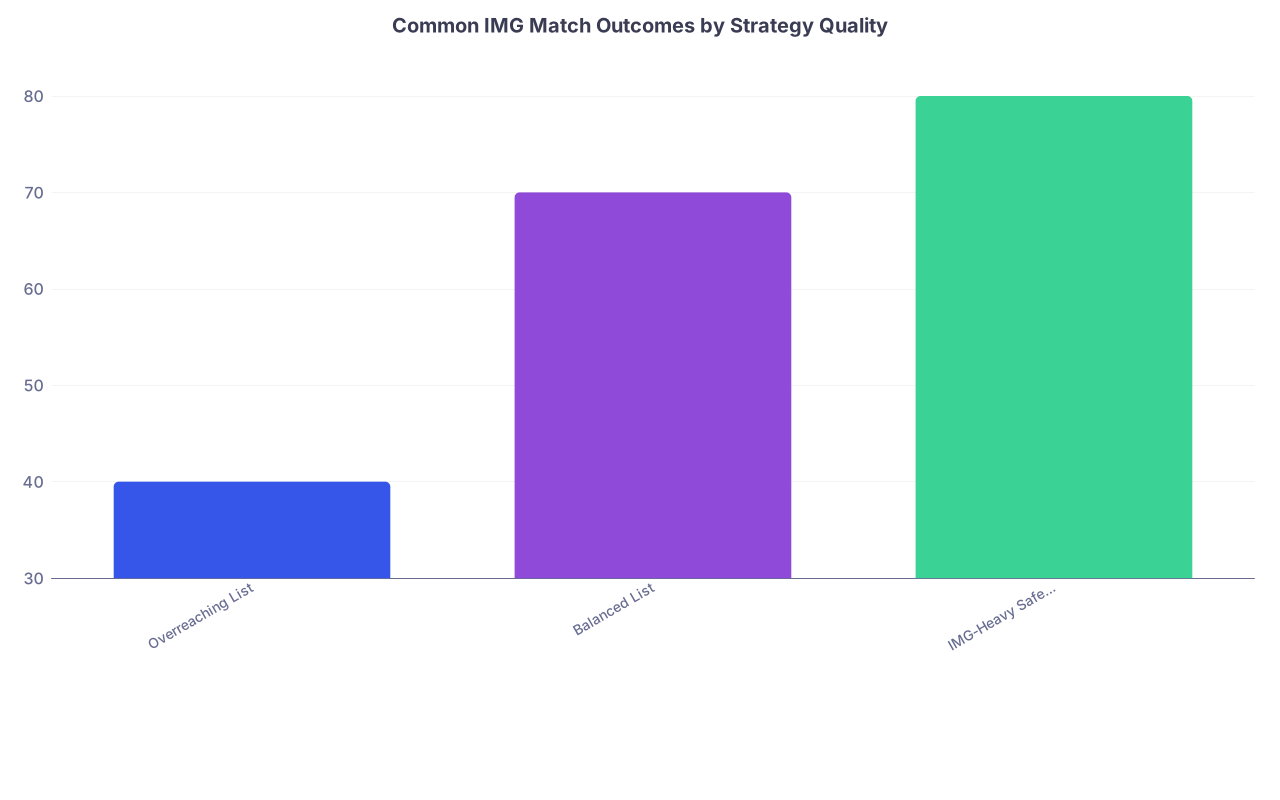
| Category | Value |
|---|---|
| Overreaching List | 40 |
| Balanced List | 70 |
| IMG-Heavy Safety Focused | 80 |
(Values represent approximate % of similar-profile IMGs I have seen match over the years with each strategy type. Not exact statistics, but a good reality check.)
10. Mental Game: Detach Pride From ZIP Codes
A lot of good IMGs blow their Match for one dumb reason: pride.
They would rather go unmatched than train in a small city they have never heard of. They chase “New York” or “California” like a brand label, ignoring the fact these markets are flooded with strong US grads.
Listen carefully:
- A solid IM or FM residency in a small Midwestern town beats no residency in Manhattan
- After residency, your US board certification matters more than what city you trained in
- You can still move later. Fellowship, jobs, locums, telemedicine — there are ways back to big markets
Your first objective is survival: get into the system. Once you are in, your options multiply. From outside, they shrink every year.

11. Quick Specialty-Specific Notes For Low-Score IMGs
A few short, targeted comments.
Internal Medicine
Best overall target.
- Focus on:
- Community-based programs with strong hospitalist pipelines
- Places where multiple residents come from Caribbean + South Asia
- Boosters that help even with low scores:
- Strong US inpatient LORs
- Evidence of reliability and work ethic
Family Medicine
Often underused by IMGs chasing prestige.
- Pros:
- Extremely IMG-friendly in many regions
- More holistic review, less score-obsessed
- Pathway to outpatient work, procedures, sports med, etc.
If you truly just want to practice medicine in the US, FM should be aggressively on your list.
Psychiatry
Very popular now, more competitive than 10 years ago.
- Still doable for IMGs, but:
- You need targeted psych USCE and letters
- Program saturation in big cities means you must look at less glamorous regions
Surgery / Anesthesia / EM
With low scores and IMG status, treat these as:
- Primary goal only if you have very strong compensating factors
- Otherwise, more as a long-term aspiration: prelim year now, reapply later, or pivot to IM/FM and subspecialty that uses procedures.

12. If You Do Not Match: Use That Year Ruthlessly Well
If March comes and you do not match, do not waste the next 12 months licking wounds. Use them.
Priority order for low-score IMGs planning to reapply:
- US Clinical Experience (hands-on if possible)
- Step 3 passed early, especially if you need a visa
- Consistent, documentable activity – not “gap year sitting at home”
- New, powerful US-based letters
A year of USCE + Step 3 + strong LORs + a smarter, IMG-heavy application strategy can absolutely turn an unmatched year into a successful re-application.

FAQ (Exactly 3 Questions)
1. My Step 2 is under 220 as an IMG. Should I still apply this cycle or wait?
If you already applied, keep going, but be brutally realistic: you must lean heavily into IMG-saturated IM/FM programs and be prepared for SOAP or reapplication. If you have not applied yet and your profile has no strong USCE or research, waiting one year to strengthen your file (USCE, Step 3, strong letters) and then applying smartly is often the better move. I have seen many people with sub-220 scores match on a second try once they had serious US-based experience and a smarter list.
2. Should I rank a program that seemed disorganized or had bad reviews, just because it is IMG-friendly?
If you can safely work there and complete residency, then yes, you should still rank it above “no residency.” You are not marrying the hospital. You are trading three hard years for a US license and a career. That said, if you see extreme red flags (chronic violations, unsafe patient care, residents actively warning others away), you can choose to rank it lower or not at all. But do not reject a merely “imperfect” community program because you are comparing it to glossy university marketing.
3. Is it dishonest to email programs highlighting my strengths when I know my scores are weak?
No. That is exactly what you should be doing. You are not hiding your scores; they see them in ERAS. Your email’s job is to pull their attention to everything else: your solid USCE, work ethic, language skills, underserved service, research, or life experience. Programs know scores are not the full story. Many will give a low-score IMG a serious look if someone stands out as mature, reliable, and already adapted to US clinical culture.
Key takeaways:
- Low Step scores as an IMG do not end your chances, but they do force you to pivot hard toward IMG-heavy, less glamorous, more realistic safety nets.
- The residents currently in a program tell you more than the website slogan. If they look like you—IMGs, modest scores, visa needs—that is where you belong on your rank list.
- Your first objective is to get into any solid US residency. Prestige and location are secondary. Once you are inside the system, you can maneuver. Outside, you are stuck.