
The way most IMGs are choosing “IMG‑friendly” residency programs is dangerously wrong.
They are chasing programs with high numbers of IMGs on the roster and assuming that equals support, safety, and a fair shot. It does not. Sometimes it just means “cheap labor, low support, high burnout.” I have watched too many IMGs match into those programs, only to be miserable, isolated, or quietly pushed toward failure.
If you are an international medical graduate, you cannot afford this mistake.
You are not just looking for acceptance. You are looking for a place that will not grind you down, exploit your visa dependence, or treat you as a disposable service block. Those are very different targets.
Let me walk you through the biggest traps.
The Core Mistake: Counting Heads Instead of Reading Signals
Most IMG forums and Telegram groups repeat the same lazy advice:
“Just filter by programs that took a lot of IMGs last year. Those are IMG-friendly.”
This is shallow and sometimes outright harmful.
High IMG numbers tell you one thing only: that the program has taken IMGs. That is it. It says nothing about:
- How they treat those IMGs.
- Whether the IMGs graduate on time.
- Whether IMGs are getting fellowships or jobs.
- Whether IMGs get interviews based on merit, or are just filling unfilled spots in the SOAP.
- Whether those IMGs had any support learning U.S. systems, documentation, or communication norms.
Some programs have 60–80% IMGs because:
- They have trouble attracting U.S. grads due to reputation, location, or workload.
- They are in areas with high service demands and low pay, so they lean on visa‑dependent IMGs who are less likely to leave.
- They are constantly churning residents — people leave, quit, or are non‑renewed — and they keep refilling with desperate IMGs.
On a spreadsheet, it looks “IMG-heavy.” On the ground, it can feel like being trapped.
Here is what people ignore: a “low‑IMG” program with strong structural support, transparent expectations, and a few thriving IMGs can be far more IMG‑friendly than a “mostly IMG” program that burns through residents.
Stop counting raw numbers and start evaluating policies and patterns.
Red Flag #1: High IMG Intake, Weak Outcomes
Programs that sincerely support IMGs do not just admit them. They train them to succeed.
If the only statistic you care about is “% of current residents who are IMGs,” you are only seeing the front door. You are not asking what happens to them afterward.
You should be hunting for match‑to‑graduation and graduation‑to‑fellowship/employment patterns. This is where programs quietly expose themselves.
Look at this comparison:
| Program Pattern | What You See | What It Often Means |
|---|---|---|
| Many IMGs, few recent fellowship matches | IMG-heavy roster | Limited advocacy, weak letters, lower training reputation |
| Many IMGs, high attrition each year | Frequent PGY2/PGY3 spots open | Punitive culture, inadequate support, “weed out” mentality |
| Few IMGs, strong outcomes for those present | Small IMG cohort | Selective but genuinely invested in IMG success |
| Moderate IMGs, consistent on-time graduation | Stable class sizes | Structured training, predictable expectations |
I have watched IMGs celebrate matching into a program “full of IMGs,” only to realize:
- Two seniors “resigned” (translation: pushed out).
- One PGY‑2 is redoing the year “for performance issues.”
- The only recent fellowship match was one U.S. grad; none of the IMGs got interviews.
You must ask:
Do IMGs graduate on time?
Do they move on to decent jobs or fellowships?
Or do they just survive.
If a program will not talk clearly about outcomes, that is not an accident.
Red Flag #2: Visa “Friendliness” That Is Really Visa Leverage
Another common trap: confusing “They sponsor visas” with “They care about IMGs.”
Visa sponsorship is a basic requirement, not a sign of virtue. A supportive IMG program does more than just file your H‑1B or J‑1 paperwork.
Here is where people get misled:
- The program website proudly says: “We sponsor J‑1 and H‑1B visas.”
- Current residents in photos look heavily international.
- The program is located in an underserved area where domestic interest is low.
Everyone starts calling it “very IMG-friendly.”
But behind the scenes, I have seen:
- J‑1 residents threatened with non‑renewal over minor issues, knowing they cannot easily transfer.
- H‑1B sponsorship dangled as leverage for taking extra calls, saying yes to “voluntary” shifts, or keeping quiet about workload and mistreatment.
- No real educational support for adjusting to U.S. documentation, billing, and medicolegal risk — just “figure it out or get written up.”
A genuinely supportive IMG program:
- Has clear, written, consistent policies for J‑1 and H‑1B residents.
- Treats visa residents and non‑visa residents the same in disciplinary and evaluation processes.
- Does not weaponize immigration status in performance conversations.
- Provides access to institutional legal/immigration advisors, not just “talk to GME office.”
A program using your visa as a leash is not IMG‑friendly. It is opportunistic.
Red Flag #3: No Structure for Bridging International Gaps
The U.S. system is different. Documentation. EMR usage. Autonomy expectations. Communication norms. Med‑legal risk. All of it.
Strong IMG‑supportive programs know this and build structure around it.
Weak programs assume: “If they matched, they will just adapt.”
Here are specific supports that separate real IMG‑friendly programs from the impostors:
Orientation that is more than two days of PowerPoints.
Do they have:- Dedicated sessions for U.S. clinical documentation with real examples?
- Supervised practice notes with feedback before you are thrown into full coverage?
- Explanations of common medicolegal pitfalls and how to avoid them?
Feedback that is early and specific, not just end‑of‑rotation ambushes.
IMGs coming from different feedback cultures often get blindsided by U.S. evaluation styles. Good programs:- Provide mid‑rotation check‑ins.
- Put feedback in writing.
- Focus on remediation, not vague criticism.
Support for communication differences.
This is not just “accent.” It is phrasing, assertiveness, how to disagree with attendings, how to escalate concerns.If all you hear is “just speak up more” or “be more confident,” that is lazy. Programs that actually care offer practical coaching.
Programs that lack all of this but still fill 60–70% of their positions with IMGs are not IMG‑friendly. They are simply relying on your desperation and your inability to complain.
Red Flag #4: Residents Sound Tired, Vague, or Afraid
If you want to know whether a program is truly IMG‑friendly, ignore the spreadsheet and listen to the residents. Their tone tells you more than the website ever will.
Patterns I pay attention to on virtual open houses, resident calls, or unofficial chats:
Residents give very generic answers to difficult questions:
“How does the program support struggling interns?”
Answer: “We are a family here, everyone helps each other.”Translation: There is no formal remediation process they trust enough to describe.
IMGs in advanced years are strangely quiet during Q&A, letting the chief or PD-friendly residents do the talking.
When asked about fellowship or job placement, they only name a few U.S. grads or avoid specifics:
“People have gone into cards, GI, etc.”
But no names. No recent years. No actual institutions.When you ask privately about workload or culture, they pause and then say something like,
“It is a great place to learn if you are willing to work hard,”
or
“You get used to it.”That is often code for “this place is rough, but I have no exit.”
During your research, look for slight tension in their voice when visas are mentioned, when performance issues are mentioned, when “support” is mentioned.
If current IMGs cannot speak freely, that is your warning.
What Actually Defines an “IMG‑Friendly” Policy
You want to stop hunting “IMG‑heavy” and start hunting “IMG‑supportive.” Different criteria. Much more protective.
A truly IMG‑friendly residency program tends to have:
Transparent selection criteria for IMGs
They tell you up front:- Minimum Step scores they realistically consider.
- Limits on year of graduation.
- Required U.S. clinical experience (and what counts).
- Whether they sponsor J‑1, H‑1B, or both.
If they are vague or “decide case by case” on everything, expect inconsistent treatment later too.
Structured orientation and ongoing teaching
Not just for IMGs, but with awareness of IMG needs:- Clear introduction to EMR, order entry, and documentation standards.
- Teaching on U.S. healthcare systems, insurance, and discharge planning.
- Accessible senior residents who understand what it is like to transition in.
Fair and documented evaluation processes
You should be able to ask:- How do you handle a resident struggling in the first 6 months?
- Are there written remediation plans?
- How many residents have been non‑renewed in the last 5 years?
And actually get an honest, specific answer.
Evidence of IMG success beyond just being there
This is the critical one. Look for:- IMGs in chief resident roles.
- IMGs matching into fellowships in the last 3–5 years.
- IMGs hired as faculty or hospitalists in solid positions.
- IMGs presenting at conferences, publishing, or leading QI projects.
If a program has none of that, but “a lot of IMGs,” understand what that really means. Those IMGs are not thriving. They are just staying.
How to Audit Programs So You Do Not Get Trapped
You need a more sophisticated filter than “IMG‑friendly” from a random list online. Here is a practical way to vet programs without burning all your time.
Step 1: Use numbers only as a starting screen
Yes, you can begin with programs that historically take IMGs. Just do not stop there.
Then do the second pass: look for signals of actual support.
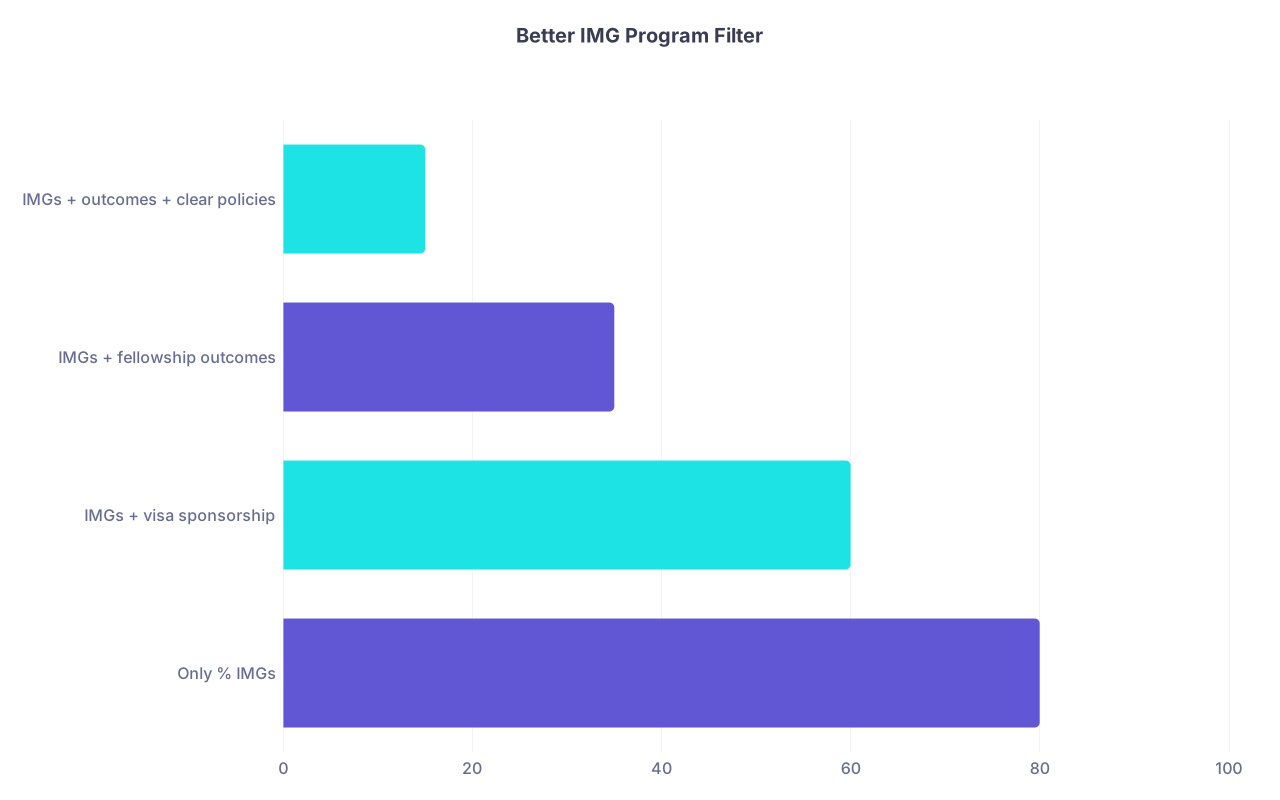
| Category | Value |
|---|---|
| Only % IMGs | 80 |
| IMGs + visa sponsorship | 60 |
| IMGs + fellowship outcomes | 35 |
| IMGs + outcomes + clear policies | 15 |
The programs in that last category — IMGs + outcomes + clear policies — are the ones you want to prioritize, even if they are “less IMG-heavy” on paper.
Step 2: Stalk the website like an investigator
You are looking for specific evidence, not just pretty photos.
- Check resident lists from multiple years (Wayback Machine if needed). Do IMG names persist across years with consistent class size?
- Look at alumni pages. Are IMGs listed with fellowships and jobs? Or does the listing conveniently stop after “Class of 2019”?
- Read the handbook or policy PDFs if they are public. How do they talk about evaluations, remediation, and contract renewal?
Programs that are proud of their IMG outcomes will show them off. Programs that hide them usually have a reason.
Step 3: Ask targeted, uncomfortable questions
Do not waste your precious interview time asking, “Is your program IMG-friendly?”
They will all say yes. Meaningless.
Ask instead:
- “In the last 5 years, how many IMGs have successfully matched into fellowships, and in what fields?”
- “How does the program support residents who are adjusting to the U.S. system and struggle initially with documentation or communication?”
- “Can you describe your remediation process for residents who are not meeting expectations, and how often that leads to non‑renewal?”
- “Are there any differences in how J‑1/H‑1B residents are treated in terms of moonlighting, rotations, or renewal decisions?”
Watch how specifically they answer. Vagueness is not your friend.
The Emotional Trap: Desperation and Flattery
IMGs are often in a weaker bargaining position. You are abroad, you are anxious, you read too many horror stories, and you feel like any U.S. match is better than no match.
Programs know this. Some will flatter you:
- “We love IMGs here, they are the backbone of our hospital.”
- “Our IMG residents are our hardest workers.”
- “We could not function without our international graduates.”
Sounds great. Actually, it is a bit chilling.
You want a program that values you as a learner, not just a workforce. Beware any language that:
- Emphasizes how hard you will work but says very little about what you will learn.
- Praises IMGs for “never complaining” or “always available.”
- Frames you as “grateful” rather than as a colleague.
Gratitude is nice. Dependency is dangerous.
Specialty-Specific Pitfalls
Not all specialties treat IMGs the same way. The mistake is using one mental model for all.
For example:
Internal Medicine, Family Medicine, Pediatrics: Many community programs are IMG-heavy. Some are incredible; others are pure service mills. Your risk of confusing “many IMGs” with “safe program” is highest here.
Psychiatry: Increasingly IMG-filled, but variable supervision. Be especially wary of programs with many off-site clinics staffed almost entirely by residents and very few faculty.
General Surgery: Fewer IMGs overall. A program that takes multiple IMGs and actually graduates them is often a stronger sign of support. If you see IMGs but hear about frequent extensions or non‑renewals, that is danger.
Neurology, Pathology: Often more IMGs, but also more variability in supervision and call structures. Look closely at how often residents scrub in solo, manage complex cases overnight, or cross-cover without clear backup.
Do not blindly copy “IMG-friendly program lists” without asking when they were last updated and how they define “friendly.” Many of those lists are just historical IMG percentages with none of the nuance that protects you.
A More Ruthless, More Protective Mindset
Let me be blunt. Some programs see you as:
- Cheaper than a locums physician.
- More compliant than a U.S. grad.
- Less likely to report abuse, because you are terrified of losing your visa.
If you pick based only on “Where did IMGs match last cycle?” you are volunteering to be that person.
Adopt a different mindset:
- You are not just trying to get in.
- You are trying to get out — trained, healthy, competitive, employable.
Every time you look at a program with 70% IMGs, ask yourself:
“Are these people thriving or trapped?”

| Step | Description |
|---|---|
| Step 1 | Start - Research Programs |
| Step 2 | Low priority |
| Step 3 | Check outcomes |
| Step 4 | High risk - Avoid |
| Step 5 | Review policies |
| Step 6 | Medium risk - Caution |
| Step 7 | Talk to residents |
| Step 8 | High risk - Avoid |
| Step 9 | Apply and rank with confidence |
| Step 10 | Program has IMGs? |
| Step 11 | Fellowships and jobs for IMGs? |
| Step 12 | Clear visa and remediation policies? |
| Step 13 | Residents speak freely and positively? |
Follow that logic instead of just “sort by % IMG.”
Final Takeaways
Do not confuse visibility with safety. A roster full of IMGs proves they will take you, not that they will protect you.
The programs that truly support IMGs show it in three places: transparent policies, consistent outcomes, and residents who can speak without fear. Rank those higher, even if the spreadsheet says they are “less IMG-heavy.”
If you remember nothing else: you are not only matching into a program; you are entrusting them with your visa, your training, and your career. Treat “IMG-friendly” as a claim they must prove, not a label you blindly believe.