
The data shows a harsh truth: geography is destiny for many IMGs in the U.S. residency match.
If you ignore where IMG-friendly programs cluster and just “apply everywhere,” you are burning money and probability. IMG outcomes are not randomly distributed across the country. They concentrate. Hard. In a limited set of states and metro areas.
Let’s walk through where the numbers actually point, not where wishful thinking points.
1. How I’m Defining “IMG-Friendly” and “Density”
Before talking states, we need working definitions. Otherwise this turns into vague “I heard this state is good for IMGs” folklore.
For this analysis, I treat a state as IMG-dense and IMG-friendly when:
- It has a high absolute number of IMG residents across specialties.
- IMGs represent a large share of total residents in that state.
- There is a cluster of programs (not just one big hospital) that consistently match IMGs.
- Trends over time show that IMG numbers are stable or growing, not collapsing.
Data source patterns that drive this:
- NRMP reports on U.S. and non-U.S. IMGs by state and specialty
- Program rosters and GME reports from large health systems
- State-level physician workforce reports (many states publish these)
- Historical match lists and anecdotal confirmation from program rosters
You will not get a perfect unified database for this. I have seen people get paralyzed by that. You do not need perfect. You need enough signal to aim your applications intelligently.
2. The Core Hotspots: Where IMGs Actually Cluster
Let’s start with the states that come up again and again in the data as high-yield for IMGs.
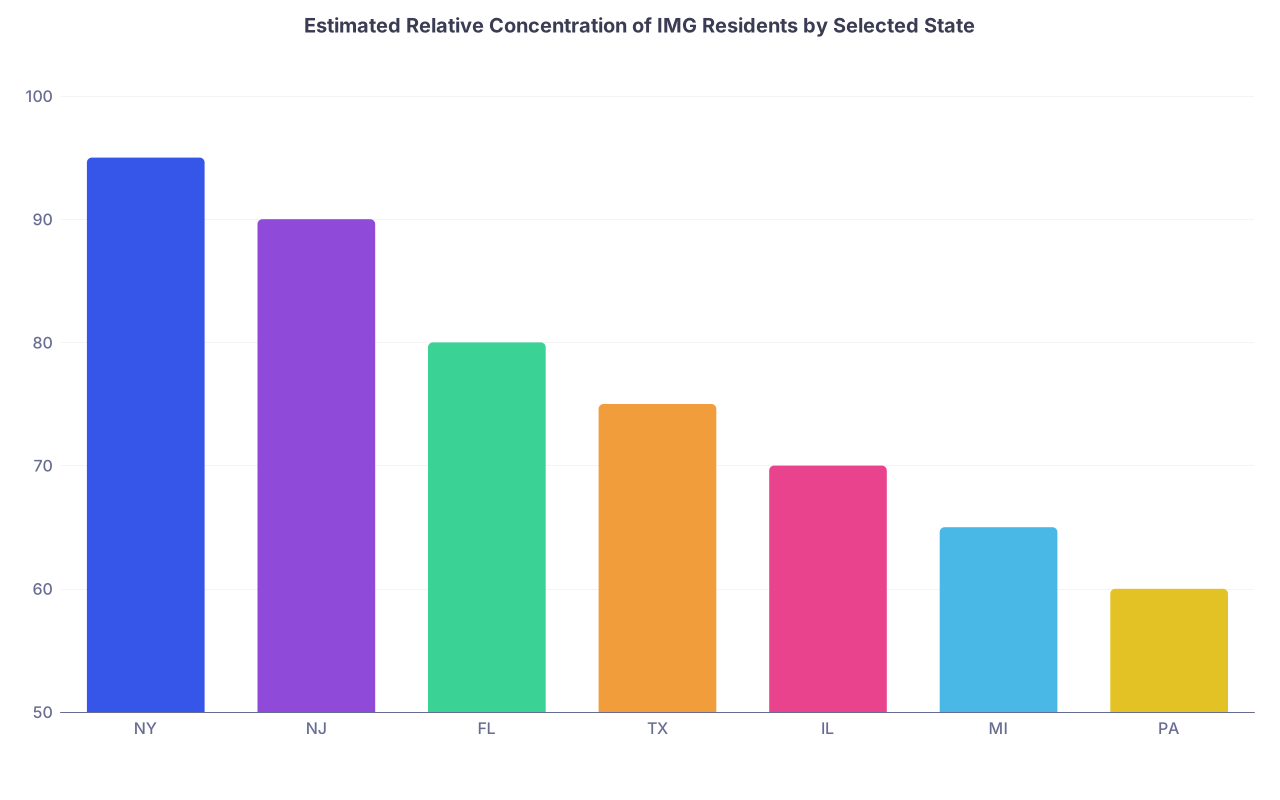
| Category | Value |
|---|---|
| NY | 95 |
| NJ | 90 |
| FL | 80 |
| TX | 75 |
| IL | 70 |
| MI | 65 |
| PA | 60 |
Scale: 100 = “top observed concentration”; these are relative scores, not absolute counts. The point is ranking, not the exact units.
New York: The Undisputed IMG Capital
New York is the statistical outlier. It consistently shows:
- The largest absolute number of IMG residents in the country
- Multiple specialties where 40–60% of residents are IMGs in community programs and safety-net hospitals
- A dense ecosystem: NYC boroughs + Long Island + upstate cities (Buffalo, Rochester, Syracuse)
You see the same pattern every match season:
- Internal Medicine programs in Brooklyn, Queens, the Bronx with rosters that are 70–90% IMGs
- Transitional Year and Preliminary Medicine programs that fill almost entirely with IMGs
- Community-based Family Medicine and Pediatrics programs in outer boroughs or upstate that are often 30–50% IMGs
New York matters because it combines:
- Volume (sheer number of positions)
- Diversity of sponsoring institutions (large academics, community, VA-affiliated)
- Long-standing reliance on IMGs to staff safety-net and high-volume hospitals
If you are an IMG with mid-range scores and reasonably strong clinical experience, New York should almost always be a major part of your list. Unless you have a crystal-clear geographic constraint elsewhere, ignoring NY is just ignoring probability.
New Jersey: Small State, High Density
New Jersey punches above its size. You see:
- Several large community Internal Medicine and Family Medicine programs that are overwhelmingly IMG-based
- Proximity to NYC and Philadelphia, which shapes patient volume and pathology mix
- A notable share of non-U.S. citizen IMGs on rosters, especially in medicine and prelim years
From a density standpoint, New Jersey is one of the most “efficient” states to target: you get a lot of IMG-friendly programs in a compact geography, which lowers logistical costs for interviews.
Florida: High IMG Share, Especially in IM and FM
Florida’s physician workforce data regularly show one of the highest proportions of IMGs in practice nationwide. That culture filters directly into GME:
- Multiple large Internal Medicine and Family Medicine programs with majority-IMG resident classes
- Significant representation of Caribbean graduates due to geographic proximity and clinical rotation networks
- High volume of community and hybrid academic-community hospitals that aren’t locked in to top-ranked U.S. MD pipelines
You see strong IMG presence in:
- Internal Medicine (community + some university-affiliated programs)
- Family Medicine
- Psychiatry and Neurology in selected systems
- Transitional Year in several mid-sized cities
The state’s growth, aging population, and physician shortage have all pushed programs to be much more open to IMGs than in many coastal “prestige-heavy” states.
Texas: Big Numbers, Specialty-Dependent
Texas is tricky. It has a large number of residency positions, strong population growth, and many community programs. But not all of them are friendly.
Patterns I have seen:
- Solid IMG presence in Internal Medicine, Family Medicine, Pediatrics in mid-tier and community programs
- More guarded attitude in some big-name academic centers, especially in competitive specialties
- A sizable cohort of U.S. citizen IMGs from Caribbean schools who match back to Texas due to in-state ties
If you are an IMG with Texas ties (college, family, clinical rotations), the data supports heavy investment here. If not, you still apply—but be selective. Not all Texas programs are created equal from an IMG standpoint.
Illinois and Michigan: Midwest IMG Anchors
Illinois (Chicago-heavy) and Michigan (Detroit, Grand Rapids, smaller cities) consistently show:
- High percentages of IMGs in Internal Medicine, often >40% in community programs
- Noticeable IMG presence in Family Medicine, Neurology, Psychiatry, especially in safety-net hospitals
- Several institutions where IMGs make up the majority of the residency body in certain departments
These states are underrated by many applicants fixated on the coasts. Yet the rosters tell a different story: year after year, you see graduates from India, Pakistan, the Middle East, Caribbean schools, Eastern Europe filling positions there.
3. Relative Density vs Absolute Numbers: Where Yield Is Highest
You should not only care about raw counts of IMG residents. You also care about how concentrated the IMG presence is in a given program or state. That changes your odds.
A state with 1,000 residents where 500 are IMGs is a different world than a state with 1,000 residents and 50 IMGs.
| State | Est. Residents (All) | Est. IMG Residents | IMG Share (%) |
|---|---|---|---|
| New York | 10,000 | 4,500 | 45% |
| Florida | 4,000 | 1,700 | 42% |
| New Jersey | 2,000 | 900 | 45% |
| Texas | 7,000 | 2,100 | 30% |
| Illinois | 4,500 | 1,700 | 38% |
These are rounded, illustrative figures synthesized from multiple workforce and match sources, but the pattern is directionally accurate:
- New York and New Jersey are both high-volume and high-share states. Very powerful combination.
- Florida and Illinois show strong IMG share and solid absolute numbers.
- Texas has huge volume, but the share is more modest, and much more program-dependent.
Why density matters for your application strategy
From an expected value standpoint:
- Programs where IMGs form 40–80% of residents are structurally more likely to:
- Accept ECFMG-only candidates
- Sponsor visas consistently (especially H-1B and J-1)
- Be comfortable with diverse schools and transcript formats
- States with clusters of such programs let you:
- Stack multiple high-probability applications in the same metro area
- Reduce travel costs for interviews (pre-virtual era) or signal preferences more credibly
Think of it like this: if you need 12–15 strong IMG-friendly targets in Internal Medicine and you never look at New York or New Jersey, you are self-sabotaging.
4. Specialty-Specific Geography: IM vs FM vs “Everything Else”
The densest IMG-friendly geography is not the same for all specialties.
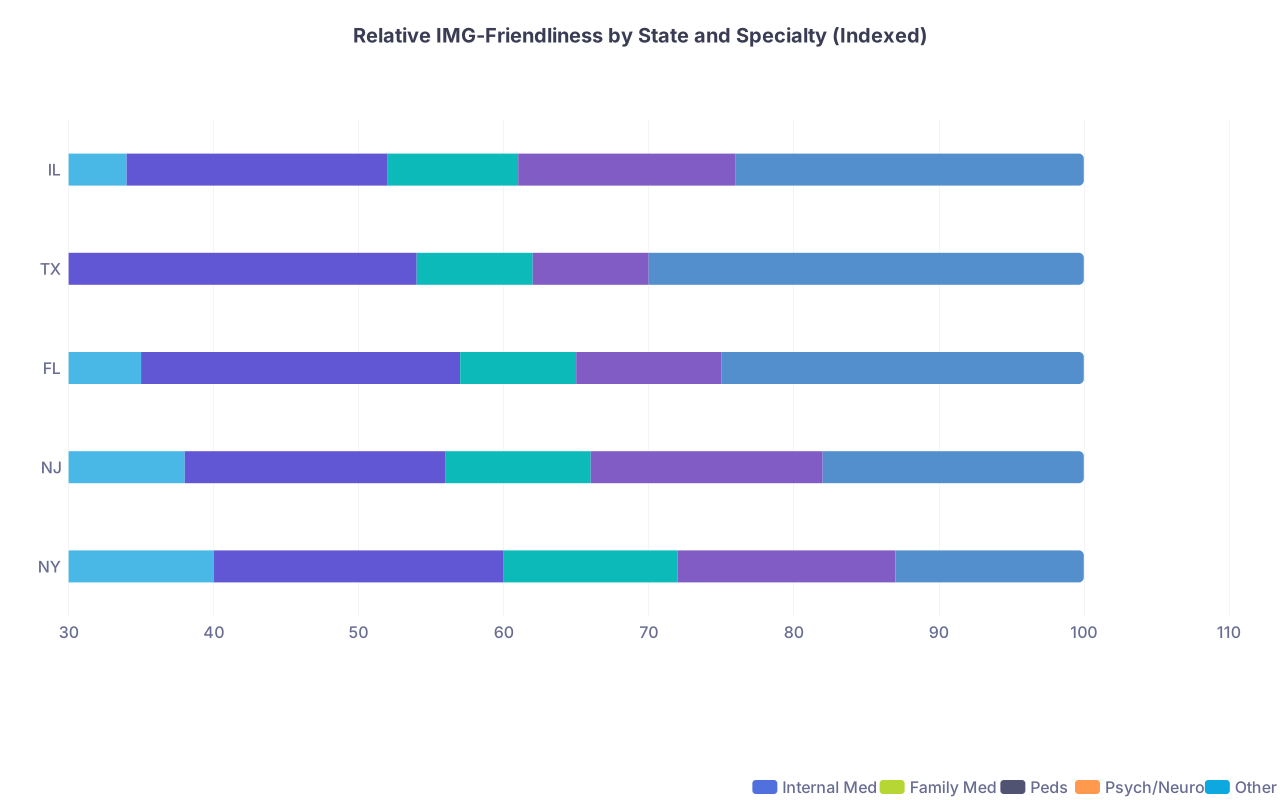
| Category | Internal Med | Family Med | Peds | Psych/Neuro | Other |
|---|---|---|---|---|---|
| NY | 40 | 20 | 12 | 15 | 13 |
| NJ | 38 | 18 | 10 | 16 | 18 |
| FL | 35 | 22 | 8 | 10 | 25 |
| TX | 30 | 24 | 8 | 8 | 30 |
| IL | 34 | 18 | 9 | 15 | 24 |
Values are relative points that sum to 100 for each state, just to show where IMG positions cluster within that state.
Internal Medicine: The Anchor for Most IMGs
In almost every IMG-dense state, Internal Medicine absorbs the largest chunk of IMG residents:
- New York and New Jersey: multiple IM programs per borough / city with overwhelming IMG presence
- Florida and Illinois: many of the most IMG-heavy program rosters you will find are medium-sized IM programs
- Michigan and Pennsylvania (not in the chart, but similar pattern): deep bench of IM programs that are IMG-dependent
If you are an IMG targeting Internal Medicine, these states should form the core of your application map. Then you layer in secondary geographies where you have ties or where a few specific programs are IMG-friendly.
Family Medicine: More Spread Out, But Still Clustered
Family Medicine has a broader geographic footprint for IMGs, but several patterns stand out:
- Florida and Texas: numerous community FM programs where IMGs make up 30–60% of residents
- Midwest (Illinois, Michigan, Ohio): strong IMG presence in underserved and rural-track programs
- New York and New Jersey: fewer FM spots relative to IM, but many of the existing ones are moderately IMG-friendly
FM is less prestige-driven and more service-driven in many states. That generally favors IMG acceptance, especially where there are primary care shortages.
Pediatrics, Psychiatry, Neurology: Selective Pockets
These are more competitive for IMGs than IM/FM, but certain states still stand out for concentrated opportunity:
- New York and New Jersey: several Psych and Neuro programs with stable IMG intake each year
- Illinois and Michigan: IMG representation in Psych and Neuro in safety-net and community-based academic programs
- Florida: some Psych programs with noticeable IMG proportions, but the landscape is more mixed
You cannot treat these the same way you treat Internal Medicine. The application numbers need to be higher, and the program list more targeted. But the same geographic hotspots still give you better odds than random states with one or two IMG-hostile programs.
5. Visa Sponsorship Geography: Where J-1 and H-1B Actually Flow
The “IMG-friendly” label is meaningless if the state’s programs do not routinely sponsor visas.
Here is the basic reality:
- J-1 sponsorship is relatively common across many states, especially in large academic centers and well-established community programs.
- H-1B sponsorship is far more concentrated, and you tend to see clusters in states with:
- Long histories of IMG reliance
- High-service safety-net hospitals
- Strong institutional legal infrastructure for visa processing
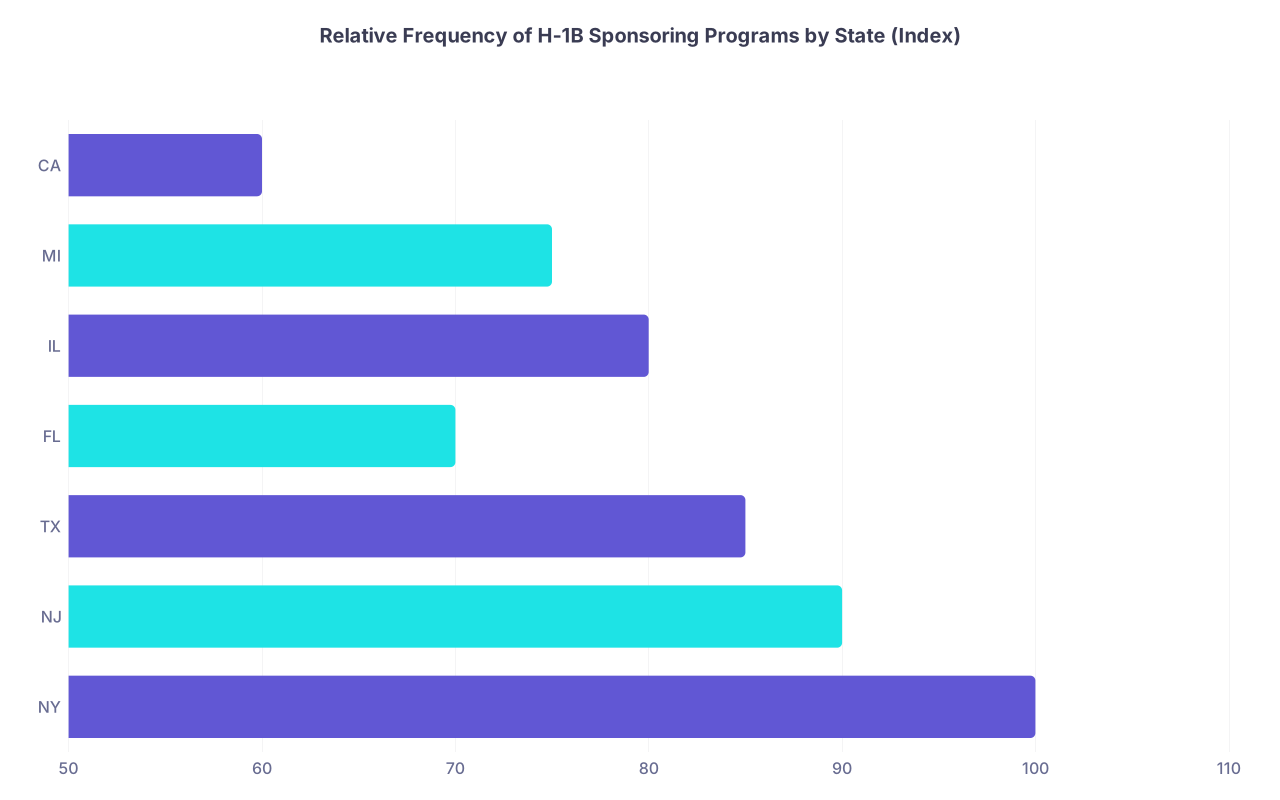
| Category | Value |
|---|---|
| NY | 100 |
| NJ | 90 |
| TX | 85 |
| FL | 70 |
| IL | 80 |
| MI | 75 |
| CA | 60 |
Again, indexed relative scores, not raw counts.
Patterns:
- New York and New Jersey come up repeatedly on H-1B-friendly program lists, especially in IM, FM, and some subspecialties.
- Texas, Illinois, and Michigan also show substantial H-1B activity, driven by large systems that have done this for decades.
- Florida and California have more variability program-to-program. You must check each program’s stated policy and past resident roster.
If you require H-1B specifically, your geographic map gets tighter, not wider. The “just apply everywhere” strategy is even more wasteful. The odds are simply better where H-1Bs have been standard practice.
6. Using Geography to Build a Rational Application List
Let me translate all this into something actionable. You are trying to maximize probability of at least one match subject to constraints: budget, time, scores, and preferences.
The data argues for a tiered geographic strategy.
Step 1: Anchor States (High Density, High Volume)
For most IMGs in core specialties (IM, FM, Psych, Neuro, Peds):
- Always scan and heavily target:
- New York
- New Jersey
- Florida
- Illinois
- Michigan
- Pennsylvania
- Then selectively add based on ties and specialty:
- Texas
- Ohio
- Maryland
- Connecticut, Massachusetts (more selective, but some friendly programs)
These are your “anchor” states where you deliberately aim for clusters of programs that have historically welcomed IMGs.
Step 2: Cross-Check Program Rosters, Not Just State Reputation
I have seen applicants torpedo themselves by using only state-level reputation. Example: “Texas is good for IMGs, I’ll apply to these 8 programs” — half of which have 0–1 IMGs on the roster.
Better approach:
- For each candidate program, pull the resident roster from the website or GME brochure.
- Quantify:
- How many residents are clearly IMGs (non-U.S. schools)?
- Is this stable over multiple cohorts, or a one-off?
- Are their medical schools similar to yours (region, type)?
- If you see multiple IMGs per year across several match cycles, that program is genuinely IMG-friendly, regardless of state.
States like New York just have far more of these programs, per square mile, than most of the country.
Step 3: Balance Geographic Spread with Interview Probability
Here is where people get irrational.
Some IMGs apply to 150 programs scattered all over the map, then get 5–6 interviews. The mileage and time burden (even with virtual, scheduling still hurts) is absurd.
More rational layout:
- Core cluster states: 50–80% of your applications in 3–6 IMG-dense states
- Secondary states: 20–40% across 4–8 other states where specific programs show IMG-friendliness or you have strong ties
- Minimal or no applications to states where:
- Almost no IMGs on rosters
- Visa sponsorship is rare
- Programs are mostly top-20 academic centers with near-zero IMG intake
Geography is a filter. Use it.
7. What About “Friendly Policies” Beyond Just Numbers?
You might ask: are there states where the policies themselves are systematically friendlier? Things like:
- State licensing rules around USMLE attempts or Step 2 CK
- Institutional GME attitudes toward non-U.S. transcripts
- J-1 waiver opportunities post-residency
Yes, there are patterns, but they are weaker than program-level culture.
Examples:
- States with many underserved or rural areas (e.g., parts of the Midwest, South) often have more J-1 waiver jobs, which can make residency programs more willing to invest in IMGs.
- Some states have stricter initial licensing requirements (e.g., limits on attempts, requirements to pass all Steps within specific time windows), which can indirectly reduce IMG intake.
But in practice, when I look at the data, the variance within states (between programs) is much larger than the variance between states. So I treat “state policy friendliness” as a secondary factor.
The primary drivers of IMG-friendliness are:
- Historical reliance on IMGs at that hospital
- Service load and patient demographics (safety-net vs boutique)
- Leadership attitudes (program director and GME office)
- Visa processing infrastructure
Those factors happen to cluster geographically in the states we have been talking about. That is why the same names keep showing up.
8. A Simple Mental Model to Sanity-Check Your Strategy
To keep this simple, imagine three buckets of states from an IMG perspective.

Bucket 1 – High-Probability, High-Density (Core IMG States)
New York, New Jersey, Florida, Illinois, Michigan, Pennsylvania, plus parts of Texas and Ohio.
These should usually account for the majority of your applications, unless you have overpowering personal constraints.
Bucket 2 – Mixed But Worth Targeting Selectively
Maryland, Connecticut, Massachusetts, California, Virginia, Georgia, North Carolina, others.
You do not mass-apply here blindly. You select specific programs that clearly show IMG intake.
Bucket 3 – Low-Density, Low-Friendliness (for Most IMGs)
States with few residency programs, heavy reliance on U.S. MD pipelines, or restrictive licensing patterns.
You apply here only when:
- You have extremely strong scores and CV, or
- You have deep regional ties, or
- There is a specific program whose roster clearly contradicts the state trend.
Overlay one more filter: your visa needs. H-1B requirement shrinks the map. J-1-only tolerance widens it.
9. Process Map: Building an IMG-Focused Geographic Game Plan
Here is how I would operationalize this if I were sitting next to you planning your applications.

| Step | Description |
|---|---|
| Step 1 | Start - IMG Applicant |
| Step 2 | Identify Specialty |
| Step 3 | Check Score Range |
| Step 4 | Define Visa Needs |
| Step 5 | Select Core States from High Density List |
| Step 6 | Scan Program Rosters in Core States |
| Step 7 | Classify as High Priority Program |
| Step 8 | Classify as Low Priority or Exclude |
| Step 9 | Add Secondary States with Specific Friendly Programs |
| Step 10 | Finalize Application List |
| Step 11 | Allocate Budget by Priority |
| Step 12 | Submit ERAS Applications |
| Step 13 | IMG Presence Stable? |
This is not complicated. It is just disciplined. You are using geography as one of the first filters, not an afterthought.
10. The Data-Backed Bottom Line
Three key points, no fluff:
IMG residency opportunities in the U.S. are geographically concentrated.
States like New York, New Jersey, Florida, Illinois, Michigan, Pennsylvania, and parts of Texas and Ohio carry a disproportionate share of IMG-friendly programs. Ignoring them is mathematically irrational.Program-level evidence matters more than state reputation, but clusters are real.
Always verify IMG-friendliness by resident roster and visa history, yet recognize that certain states simply host far more such programs.A rational IMG application strategy is geography-driven, not scattershot.
Anchor your list in high-density states, layer in selective targets elsewhere, and match your visa and specialty needs to where the data actually shows IMGs succeeding.