
The myth of “IMG‑friendly” programs falls apart the moment you look at interview-to-match ratios. The data show that many of these so‑called friendly programs are simply high‑volume filters: they invite a lot of IMGs, rank a fraction, and match even fewer.
You are not competing for “interviews.” You are competing for “matches per interview slot.”
Let me walk through the numbers and where they break the narrative.
1. The hard math: interviews, ranks, and actual match probability
Start with the basic constraint: every categorical residency position in the NRMP match effectively needs about 1.1–1.3 ranked applicants to fill reliably. Programs know this and behave accordingly.
For each PGY‑1 position, a typical program will:
- Interview about 10–20 applicants
- Rank perhaps 8–15 of them meaningfully
- End up matching 1 per position (by definition), sometimes from their top 3–5
The hunt for “IMG‑friendly” programs usually focuses on the share of IMGs in the current resident class. That is noisy and backward‑looking. The more informative metric is:
IMG Match Probability per Interview = (Number of matched IMGs) ÷ (Number of IMG interview slots)
That tells you, conditional on sitting in the chair on interview day, what your odds look like.
To keep this concrete, let me break down a stylized example.
Say Program X advertises as IMG‑friendly:
- 12 categorical positions
- 1,800 total applications
- 400 applications from IMGs
- 120 total interviews
- 50 interviews to IMGs
- 12 matched residents, 5 of them IMGs
The crude metrics:
- Overall interview rate: 120 / 1,800 ≈ 6.7%
- IMG interview rate: 50 / 400 = 12.5%
- IMG share of interviews: 50 / 120 ≈ 41.7%
- IMG share of matched residents: 5 / 12 ≈ 41.7%
Looks fantastic. This is exactly what ends up on those “IMG‑friendly program lists.”
But the key metric is:
- IMG match per interview: 5 ÷ 50 = 10%
- Overall match per interview: 12 ÷ 120 = 10%
So in this (idealized) scenario, the program is neutral once you reach the interview stage. IMG and AMG interviewees convert to residents at roughly the same rate.
Now look at what happens at programs that use IMGs to “pad the list” without actually matching many of them.
2. How “friendly” programs game the optics
The pattern I see repeatedly when people send me spreadsheets of “results by program” from WhatsApp groups and Telegram channels is this:
- The program has 30–60% IMGs across all applicants
- It interviews a non‑trivial number of IMGs (often 20–40% of interview slots)
- But year after year, only 1–2 IMGs match, despite 10–40 IMG interviews
Sometimes that is due to weaker applicant profiles. Sometimes it is structural bias. The effect is the same: the marginal ROI per IMG interview is poor.
Let me formalize this with comparative numbers.
| Program Type | IMG Interviews | IMGs Matched | IMG Match per Interview |
|---|---|---|---|
| High-yield 'friendly' | 20 | 8 | 40% |
| Neutral | 40 | 8 | 20% |
| Low-yield 'friendly' | 40 | 2 | 5% |
| Token 'friendly' | 20 | 0–1 | 0–5% |
Those bottom two categories are where many list‑based “IMG‑friendly” recommendations go wrong. They optimize the wrong metric:
- They track whether IMGs are present, not how efficiently those interviews convert to matches.
- They highlight “10+ IMGs interviewed” without asking “how many actually matched?”
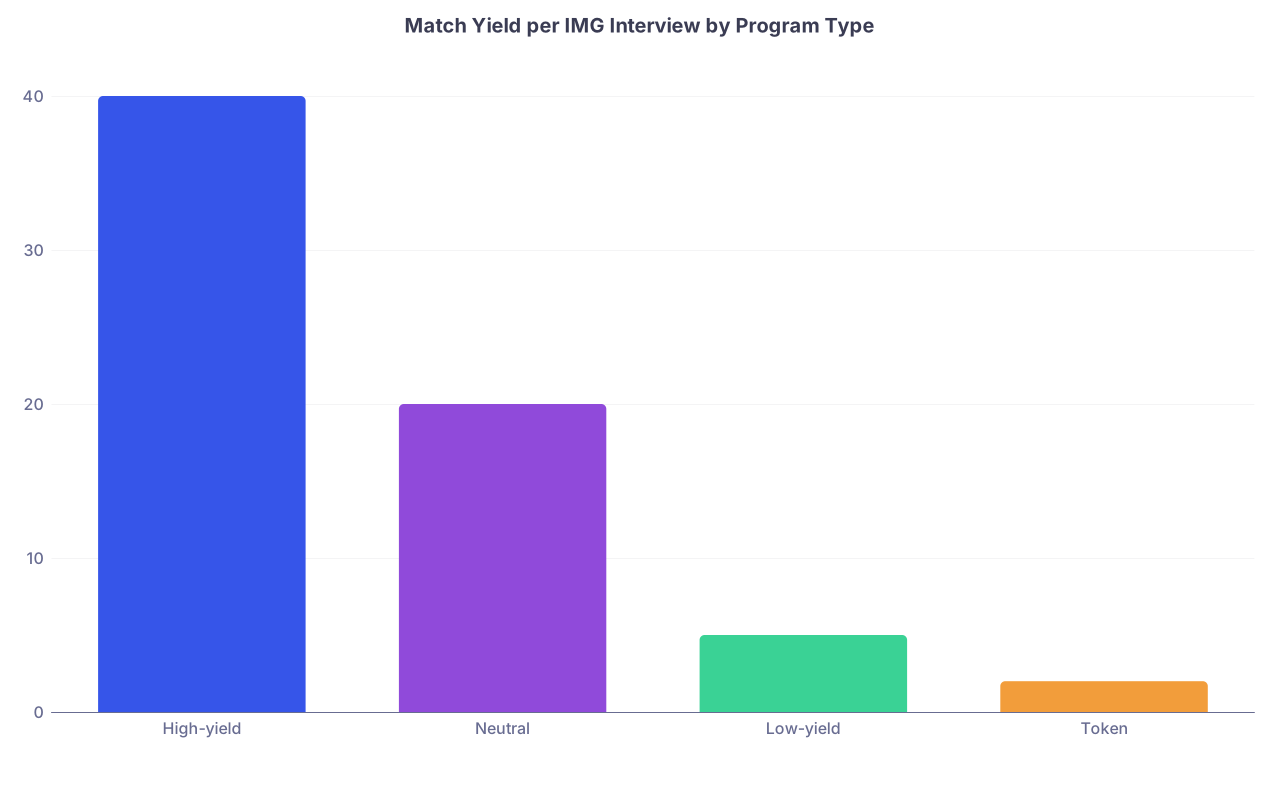
To visualize the difference in yield, imagine the following simple comparison.
| Category | Value |
|---|---|
| High-yield | 40 |
| Neutral | 20 |
| Low-yield | 5 |
| Token | 2 |
If you distribute your limited 10–15 interview invites across these categories, your overall match probability changes dramatically.
For example, 5 interviews at 40% yield and 5 at 5% yield:
- Expected matches = (5 × 0.40) + (5 × 0.05) = 2 + 0.25 = 2.25 “expected” positions
Now compare that with 10 interviews all clustered at 5% yield programs:
- Expected matches = 10 × 0.05 = 0.5
Same number of interviews. Four‑to‑five‑fold difference in expected outcome.
This is why blindly chasing any program that ever matched an IMG is not data‑driven strategy. It is superstition dressed up as advice.
3. What the NRMP data actually show about IMGs
Let us ground this in national data.
From recent NRMP Charting Outcomes and annual Results and Data reports (patterns stable over the last several cycles):
- US citizen IMGs have match rates around 55–60%
- Non‑US citizen IMGs have match rates around 55–60% in IM, lower in competitive specialties
- Certain specialties (Internal Medicine, Family Medicine, Pediatrics, Neurology, Pathology, Psychiatry) routinely fill 20–50% of slots with IMGs in many programs
- Others (Dermatology, Plastic Surgery, ENT, Ortho) are effectively closed to most IMGs
But again, these are macro statistics. Your actual experience depends on the micro behavior of specific programs.
In practice, IMG match probability is a multiplicative product of a few factors:
- Probability of interview at a given program
- Probability of being ranked if interviewed
- Probability of that rank position converting to a match
If we simplify and look only at step 2 and 3 combined, we get the “match per interview” metric. You can think of your total match odds roughly as:
Overall Match Probability ≈ 1 − Π(1 − pᵢ)
Where pᵢ is the match probability for each program i where you interview. And pᵢ is not constant across all “friendly” programs.
For a typical IMG candidate:
- At truly IMG‑integrated community IM programs, I often see pᵢ in the 25–40% range
- At name‑brand university programs that “like diverse backgrounds,” real pᵢ can be under 5–10% for IMGs
- At some community programs with heavy visa complexities, pᵢ collapses if you require H‑1B instead of J‑1
Run the math for two profiles:
- Candidate A: 8 interviews, each with pᵢ ≈ 30% (strong IMG‑heavy community programs)
- Candidate B: 12 interviews, each with pᵢ ≈ 8% (big‑name “we interview IMGs but rarely rank them high” programs)
Expected match:
- A: 1 − (1 − 0.30)⁸ ≈ 1 − (0.70⁸) ≈ 1 − 0.057 ≈ 94.3%
- B: 1 − (1 − 0.08)¹² ≈ 1 − (0.92¹²) ≈ 1 − 0.383 ≈ 61.7%
Fewer interviews. Better targeted. Much higher match probability.
4. How to approximate match-per-interview ratios for “friendly” programs
Programs do not publish “IMG match per interview” statistics. You are forced to estimate.
You have four semi‑reliable data sources:
- NRMP / FRIEDA / program websites: PGY‑1 class lists, often with medical school and nationality
- Resident LinkedIn and Doximity profiles: country of med school, visa status
- Crowd‑sourced interview spreadsheets (Reddit, Telegram, WhatsApp): who was invited where
- Personal network: seniors from your school or coaching groups sharing where they matched vs interviewed
The process that actually works looks like this:
Pick a recent cycle (two years is better than one).
For a given program, estimate:
- How many IMGs are in current PGY‑1 and PGY‑2 classes
- Whether they are US vs non‑US citizen (often guessable from profile)
- How many IMG interview invites show up in public spreadsheets / groups
Compute a rough lower‑bound estimate:
- IMG match per interview (non‑US) ≈ (# non‑US IMGs in PGY‑1 + PGY‑2) ÷ (Estimated # non‑US IMG interview slots per year × 2)
- Same for US‑IMGs if you want to separate them
Flag programs where:
- The program regularly shows up with 10–30 IMG interviewees in public sheets
- But has 0–1 non‑US IMGs in each incoming class
Those are the classic “interview‑friendly, match‑unfriendly” places.
Let me illustrate a hypothetical but very common pattern.
Program Y over two cycles:
- Categorical IM positions: 12 per year
- Reported IMG interviewees on public lists: ~30–40 per year
- Current PGY‑1 class: 1 non‑US IMG, 2 US‑IMGs
- Current PGY‑2 class: 1 non‑US IMG, 1 US‑IMG
Rough estimate over two years:
- Non‑US IMGs matched: 2
- Non‑US IMG interviewees (est.): ~60 (30 per year × 2)
- Estimated non‑US IMG match per interview: 2 ÷ 60 ≈ 3.3%
This is what I would label “token friendly.” Looks great in marketing material. Devastating in actual odds.
Contrast that with a genuinely IMG‑oriented community IM program.
Program Z over two cycles:
- 10 categorical IM spots per year
- 20–25 IMG interviewees per year
- Current PGY‑1: 5 IMGs (3 non‑US, 2 US)
- Current PGY‑2: 5 IMGs (3 non‑US, 2 US)
Two‑year non‑US IMG numbers:
- Matches: 6
- Interviewees (est.): ~40–50
- Match per interview: ~6 ÷ 45 ≈ 13.3%
Still not stellar, but four times better than Program Y.
5. Patterns in specialties and program types
Not all specialties behave the same. Nor do all program types.
You can roughly stratify by both IMG density and typical match yield.
By specialty (high‑level averages from recent cycles)
For IMGs, the distribution of match outcomes by specialty consistently shows:
- Internal Medicine: large absolute number of IMG matches, many programs with >30% IMG residents
- Family Medicine: similarly open, but fewer H‑1B options in some states
- Pediatrics, Psychiatry, Neurology, Pathology: moderate to high IMG representation at selected programs
- General Surgery, EM (variable), OB/GYN: pockets of IMG‑friendliness, often community‑based, but far from universal
- Top‑tier competitive fields: very low IMG representation almost everywhere
The more a field depends on small “prestige‑driven” departments, the lower your actual pᵢ as an IMG, regardless of interview invites.
By program structure
The data show a few consistent patterns:
University‑based, big‑name:
- May interview many IMGs, especially with strong scores and research
- Often prefer AMGs higher on rank list
- IMG match per interview frequently in single digits
University‑affiliated community (large teaching hospitals):
- Middle ground; some are heavily IMG‑inclusive, others are AMG‑dominant
- Variability is high; you must do program‑specific homework
Community programs without big‑name branding:
- Where many IMGs actually match
- Typically fewer total interview slots, but a higher proportion of them translate into matches for IMGs, especially if past classes are IMG‑heavy
Newer programs (started within last 5–7 years):
- Often rely on IMGs to fill early years
- Match per interview can be quite high for IMGs initially, then drift as the program matures
To make this concrete, here is a stylized comparison (not real data, but consistent with multi‑cycle patterns I have reviewed).
| Program Category | IMG Share of Interviews | IMG Share of Matches | Approx. IMG Match per Interview |
|---|---|---|---|
| Big-name University IM | 25% | 5–10% | 5–8% |
| Univ-affiliated Community | 35–45% | 25–35% | 15–25% |
| Community, IMG-heavy | 50–70% | 50–70% | 25–40% |
You can see why chasing an interview at Brand Name University X often has worse return than a visit to a seriously IMG‑heavy community program in the Midwest.
6. “Friendly” marketing vs actual selection behavior
I have heard program directors say the same few phrases at pre‑interview dinners and Q&A webinars:
- “We value diversity in all forms, including international backgrounds.”
- “We have had many excellent IMG residents here.”
- “We do not have a preference for US vs international grads once you are in the interview pool.”
Sometimes that is honest. Sometimes it is aspirational. Sometimes it is PR.
The only variable I trust more than these statements is the actual resident roster over several years.
If a program has:
- 0 non‑US IMGs in PGY‑1 to PGY‑3
- A handful of US‑IMGs at most
- Yet shows up repeatedly on “IMG interview” spreadsheets with double‑digit invites
Then I treat the “friendly” label as fiction. The implied IMG match per interview is near zero.
On the flip side, I have seen programs that barely show up in Reddit chatter but have:
- 60–80% of residents from non‑US medical schools
- Stable patterns of H‑1B and J‑1 sponsorship
- Graduates from a broad range of Caribbean, South Asian, Middle Eastern, and Eastern European schools
These are your true “friendly” environments. They simply do not advertise it aggressively.
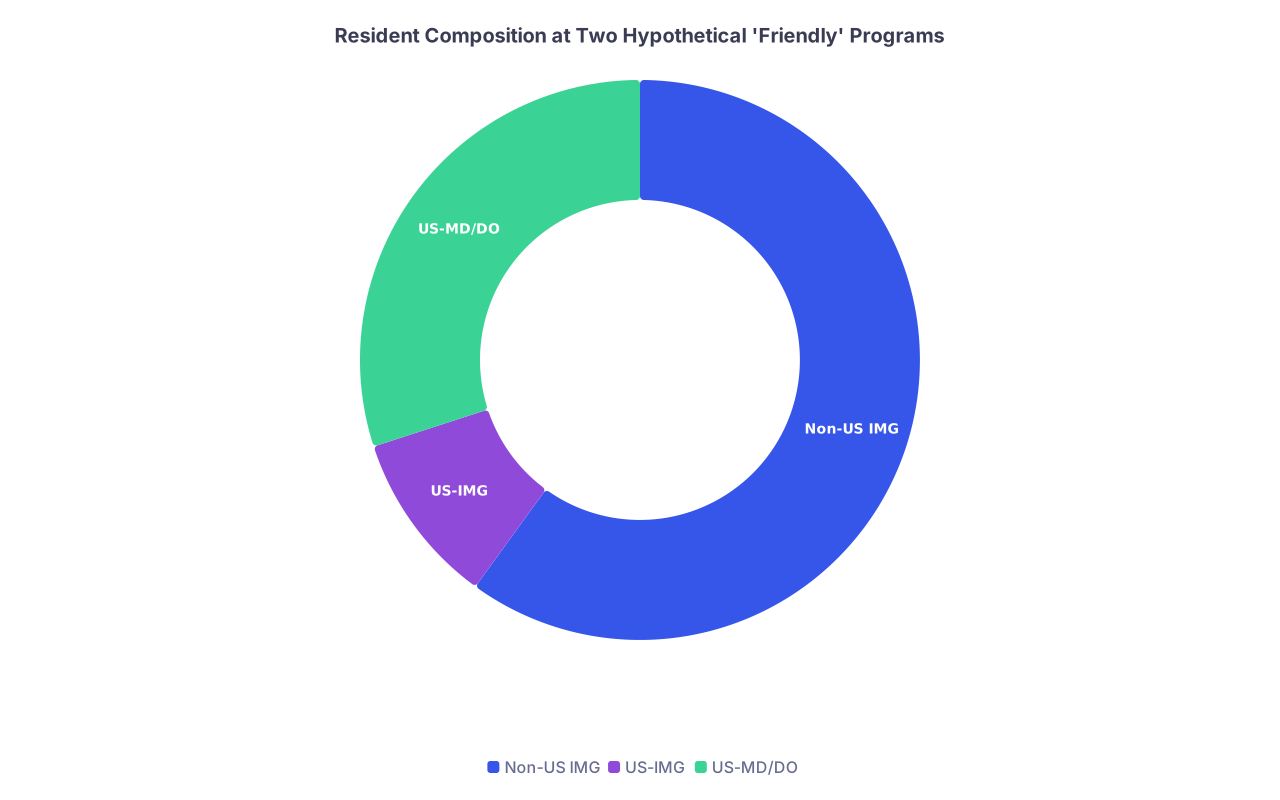
| Category | Value |
|---|---|
| Non-US IMG | 60 |
| US-IMG | 10 |
| US-MD/DO | 30 |
(Think of the above as Program Z: an IMG‑heavy community IM program. Now imagine Program Y with reversed proportions—10% non‑US IMG, 10% US‑IMG, 80% US‑MD/DO—despite inviting the same number of IMGs to interview. The second one is “friendly” on paper only.)
7. Practical strategy: how to use interview-to-match data as an IMG
Let me be blunt. By the time interview season starts, most of your levers (scores, publications, USCE) are already fixed. Your remaining power lies in how you rank programs and where you hustle for late‑cycle signals.
Here is how to behave rationally with incomplete but useful data.
Step 1: Re‑classify programs, not as “friendly vs unfriendly,” but as “high‑, medium‑, low‑yield”
Use this triage:
- High‑yield: multiple recent non‑US IMGs in every class, clear visa sponsorship history, residents from your region/school type
- Medium‑yield: some IMGs each year; mix of backgrounds; a few Caribbean / non‑US grads, but AMGs still majority
- Low‑yield: almost no IMGs matched in recent years despite known IMG interview activity
Rank lists should be weighted heavily toward high‑ and medium‑yield if your goal is to maximize match probability rather than prestige signaling.
Step 2: Adjust expectations by visa requirement
Visa demand changes the math. J‑1 is one level of selectivity; H‑1B is another.
- Programs that are truly H‑1B friendly will usually have multiple current H‑1B residents.
- If you see only J‑1s, treat claims of future H‑1B openness cautiously. That affects your effective pᵢ downward.
Your “yield” at a nominally friendly program drops close to zero if they rarely or never sponsor your visa type.
Step 3: Use late‑cycle behavior as an extra signal
I have seen programs with ambiguous patterns suddenly become much clearer during January–February:
- If they send additional communications to IMGs, offer second‑look chances, or invite you to resident meet‑ups, your pᵢ probably ticks up.
- If they ghost all IMG‑heavy channels while selectively engaging AMGs, that is your warning sign.
You will not convert this into an exact percentage. But you can at least avoid over‑ranking low‑yield “friendly” places just because they looked nice on interview day.
8. Visualizing the value of targeting high‑yield friendly programs
Let me sketch two hypothetical IMG applicants with equal profiles.
Both receive 10 interviews:
- Applicant 1: 6 at high‑yield IMG‑heavy community programs (pᵢ ≈ 30%), 4 at medium‑yield (pᵢ ≈ 15%)
- Applicant 2: 2 at high‑yield, 3 at medium‑yield, 5 at low‑yield university‑based programs (pᵢ ≈ 5%)
Expected match probability:
Applicant 1:
- 6 with p=0.30 → combined no‑match prob ≈ 0.7⁶ ≈ 0.118
- 4 with p=0.15 → no‑match prob ≈ 0.85⁴ ≈ 0.522
- Overall no‑match ≈ 0.118 × 0.522 ≈ 0.0616 → match ≈ 93.8%
Applicant 2:
- 2 with p=0.30 → no‑match ≈ 0.7² ≈ 0.49
- 3 with p=0.15 → no‑match ≈ 0.85³ ≈ 0.614
- 5 with p=0.05 → no‑match ≈ 0.95⁵ ≈ 0.774
- Overall no‑match ≈ 0.49 × 0.614 × 0.774 ≈ 0.232 → match ≈ 76.8%
Same interview count. Different mix. About a 17‑point swing.
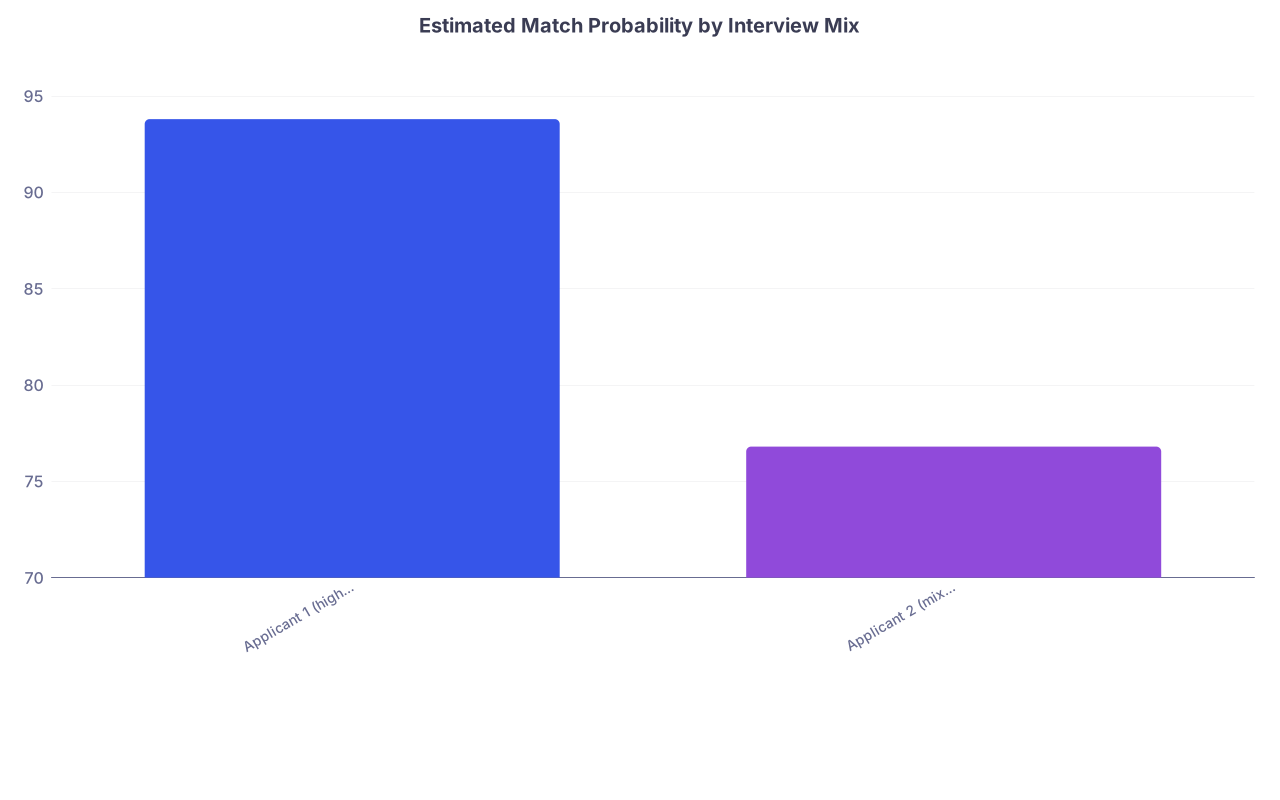
| Category | Value |
|---|---|
| Applicant 1 (high-yield focused) | 93.8 |
| Applicant 2 (mixed with low-yield) | 76.8 |
You cannot control which exact invites you get. But you can absolutely control how much mental energy you spend chasing low‑yield prestige versus quietly ranking the places that actually match people like you.
9. What the data really say about “IMG‑friendly” branding
Let me summarize the reality as someone who has stared at too many spreadsheets from past cycles:
- “IMG‑friendly” is often a marketing label, not a statistical fact.
- The primary variable that matters once you reach the interview is match per interview slot, not how welcoming the website text sounds.
- Programs that genuinely integrate IMGs into their resident body show it consistently in their rosters year after year.
So when you see a program proudly advertising “we welcome IMGs”:
- Ask: “How many current residents are IMGs?”
- Ask: “How many are on visas similar to mine?”
- Ask your seniors: “How many of our alumni interviewed there vs actually matched?”
Because the data are unforgiving:
- Programs with high interview volume but low IMG match yield will burn your hopes at scale.
- A smaller number of interviews at consistently IMG‑heavy community or hybrid programs can do far more for your actual probability of matching.



| Step | Description |
|---|---|
| Step 1 | Identify IMG friendly claims |
| Step 2 | Check resident roster |
| Step 3 | Low yield - treat as risky |
| Step 4 | Check visa history |
| Step 5 | Estimate yield from prior cycles |
| Step 6 | Classify as high or medium yield |
| Step 7 | Rank cautiously or low |
| Step 8 | Many current IMGs? |
| Step 9 | Matches with your visa type? |
Key takeaways
- Do not confuse “IMG‑friendly branding” with high match yield per interview. The latter is what affects your odds.
- Use resident rosters, visa patterns, and past‑cycle anecdotes to approximate IMG interview‑to‑match ratios, then weight your rank list toward programs with consistently high IMG representation.
- A smaller set of interviews at truly IMG‑integrated community or hybrid programs usually beats a long list of low‑yield “prestige” interviews at programs that rarely match IMGs, no matter what their websites claim.