The belief that “IMG-friendly” residency programs are just a few generous outliers is wrong. The data shows clear, structural patterns: some program types consistently match international medical graduates (IMGs) at 3–5 times the rate of others.
You are not guessing in the dark. If you understand the numbers by program type, you can target places where friendly policies are built into the system, not just claimed on a website FAQ.
Below I will break down IMG match rates by:
- Broad program type (university vs community vs hybrid)
- Sponsorship behavior (J-1 vs H-1B)
- Specialty competitiveness
- U.S. vs non-U.S. IMGs
…and translate that into where your application dollars actually have leverage.
1. The Big Picture: IMGs in the Match
Start with scale. You need to know what you are fighting for.
From recent NRMP data (2022–2024 cycles; numbers rounded):
- Total residency positions: ~39,000–40,000
- Filled by U.S. MD seniors: ~18,000–19,000
- Filled by U.S. DO seniors: ~7,000–8,000
- Filled by all IMGs (U.S. citizen + non-U.S.): ~7,500–8,000
So IMGs account for roughly 20% of all matched residents in the main Match. Not a niche group. A fifth of the workforce.
Now split that by IMG category:
- U.S. citizen IMGs (US-IMGs): ~5,000 matched / ~8,000 applicants → match rate ≈ 60–65%
- Non-U.S. IMGs (NF-IMGs): ~4,000 matched / ~7,000 applicants → match rate ≈ 55–60%
These are overall rates. But the variance by specialty and program type is huge.
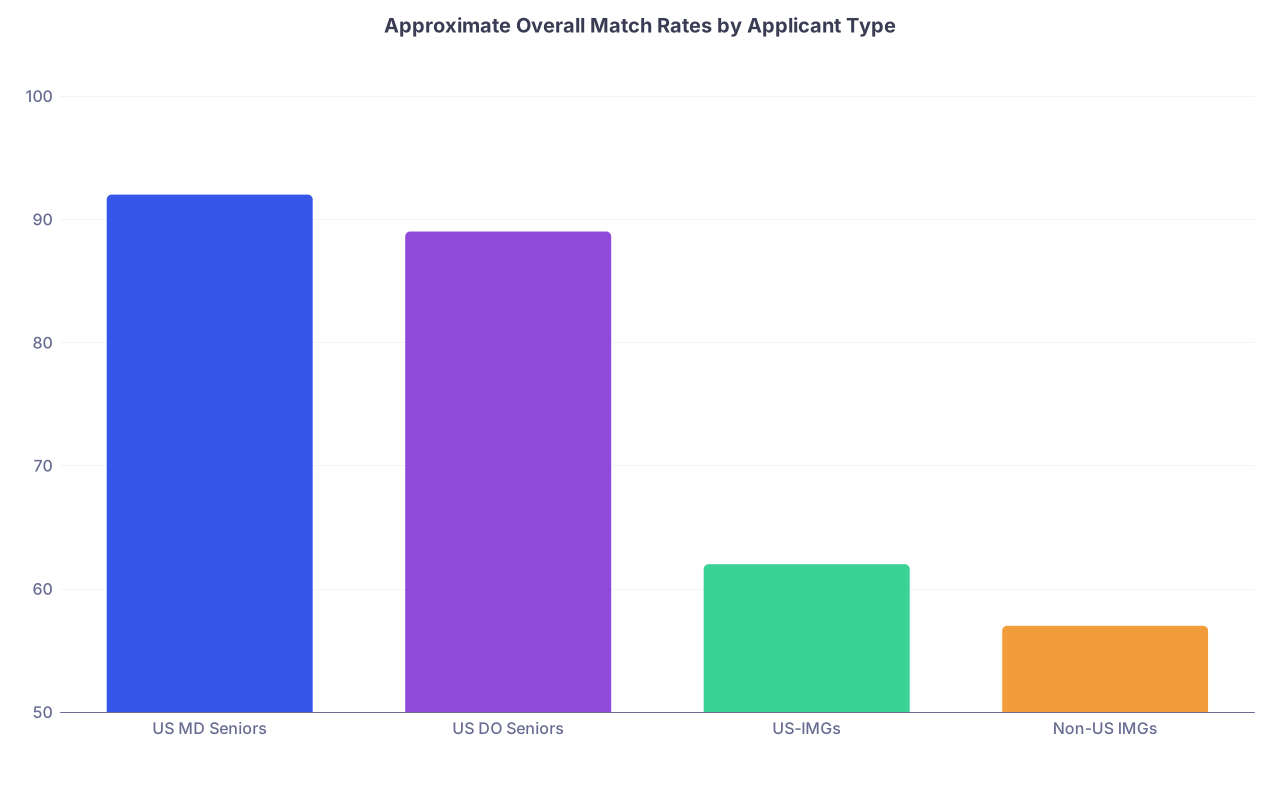
| Category | Value |
|---|---|
| US MD Seniors | 92 |
| US DO Seniors | 89 |
| US-IMGs | 62 |
| Non-US IMGs | 57 |
US MD seniors in core specialties often sit at 90%+ match rates. IMGs in certain specialties are under 5%. That spread is where “friendly policies” become visible in the numbers.
2. Program Type: Where IMGs Actually End Up
Let’s get to the architecture of programs. Not all residencies are structurally similar.
You will see three broad categories in the NRMP and program advertising:
- University-based programs (major academic medical centers)
- Community-based, university-affiliated (hybrid)
- Pure community programs (often smaller hospitals, regional systems)
The stereotype: “University hates IMGs, community loves them.” The data: mostly supports this, but with nuance.
2.1 Distribution of IMGs by Program Type
Across Internal Medicine, Family Medicine, Pediatrics, Psychiatry, Neurology and a few others, program rosters show a consistent pattern when you sample resident lists and match data:
- University-based:
- IMG proportion commonly 0–20%
- Community/university-affiliated:
- IMG proportion commonly 20–60%
- Pure community:
- IMG proportion commonly 40–80%
When you look at program websites listing resident medical schools for the entire house staff, you repeatedly see this pattern: name-brand university programs with one or two IMGs per class (if any), versus suburban community hospitals where IMGs are the majority.
Let’s put a comparative snapshot (approximate, based on multiple specialties and public rosters):
| Program Type | Typical IMG Share of Residents |
|---|---|
| University-based (top 30) | 0–10% |
| University-based (non-elite) | 10–25% |
| Community, university-affiliated | 25–60% |
| Pure community hospitals | 40–80% |
| Small rural/community (newer) | 60–90% |
Where “friendly policies” exist in reality: in the hiring history. If a program has been 60% IMG for the last 5 years, that is not an accident or a fluke. That is policy and practice.
2.2 Why Community and Hybrid Programs Favor IMGs
From a data perspective, the incentives are clear:
- Community/hybrid programs:
- Often in less desirable locations (for U.S. grads) → lower U.S. MD/DO demand
- High service workload → need full rosters, reliably
- More comfortable with J-1 visas through ECFMG; some will process H-1B
- Historical reliance on IMGs becomes a reinforcing cycle: IMGs match there, tell friends, pipeline builds
- University programs:
- Large supply of home and regional U.S. MD/DO graduates
- Heavy research emphasis; want publications, U.S. med school networks
- More bureaucracy around visas; some departments explicitly avoid H-1B
- Competitive reputation → 2,000+ applications for 10–20 spots; IMGs become only a small fraction of the interview pool
Friendly policy is not about a line on the website. It is about who they actually match year after year.
3. IMG Match Rates by Specialty and Program Type
Now to what you really care about: where you actually have a shot.
I will split this into three buckets, driven by NRMP data trends and publicly reported match lists:
- High-IMG specialties (many community positions; IMGs a large share)
- Mixed but accessible specialties
- Low-IMG / hostile territory for most IMGs
3.1 High-IMG Specialties: Where Policies Are Clearly Friendly
These are the “workhorse” specialties that keep U.S. hospitals running. They are also where community and hybrid programs dominate.
Common examples:
- Internal Medicine (categorical)
- Family Medicine
- Pediatrics (to a lesser extent)
- Psychiatry
- Neurology
- Pathology
Patterns from NRMP Charting Outcomes / Outcomes and Data:
- IMGs fill:
- Internal Medicine: ≈ 40–45% of filled spots (combined US-IMG + Non-US IMG)
- Family Medicine: ≈ 30–35%
- Pathology: ≈ 35–40%
- Neurology: ≈ 30–35%
- Psychiatry: ≈ 25–30%
Compare that to specialties like Dermatology or ENT where IMG percentages are often in single digits.
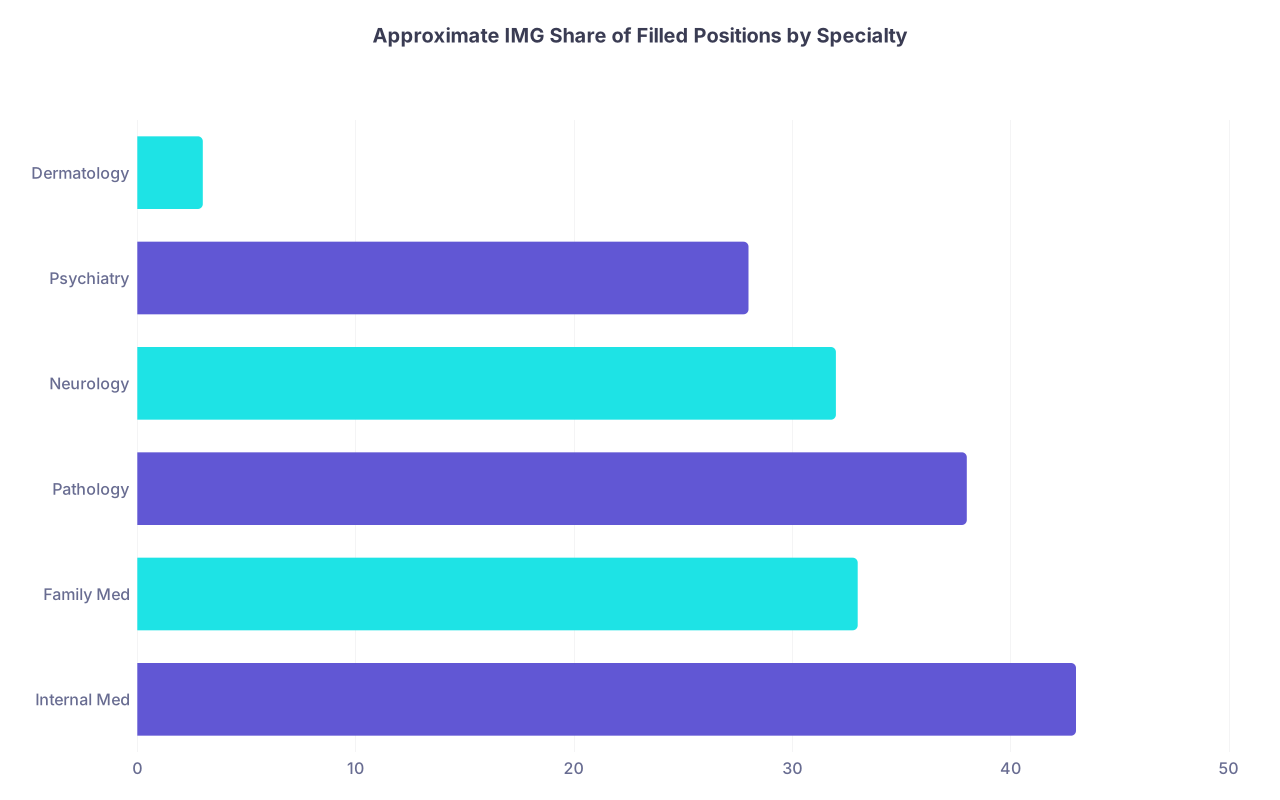
| Category | Value |
|---|---|
| Internal Med | 43 |
| Family Med | 33 |
| Pathology | 38 |
| Neurology | 32 |
| Psychiatry | 28 |
| Dermatology | 3 |
Inside these specialties, the friendliest program types are:
- Community and hybrid programs in:
- Midwest (Ohio, Michigan, Indiana, Kansas)
- South (Texas, Florida, Georgia, Louisiana)
- Northeast second-tier cities (Pennsylvania outside Philly, upstate NY, New Jersey community systems)
- Newer programs established in the last 10–15 years, especially osteopathic-legacy hospitals now ACGME-accredited
Anecdotally—and I have seen this pattern in countless application spreadsheets—IMGs who scatter 80–100 applications into Internal Medicine community/hybrid programs and have solid Step 2 scores (say 230+ USMLE or 520+ equivalent) will often pull 10–20 interviews. Same person applying mostly to top 30 university programs? Maybe 1–2 invites, sometimes zero.
3.2 Mixed but Accessible: Where Targeting Matters
These specialties have sizeable IMG presence, but it is highly concentrated in specific program types:
- Anesthesiology
- Emergency Medicine (less IMG friendly recently)
- OB/GYN
- General Surgery (prelim vs categorical split is huge)
- PM&R (Physical Medicine & Rehab)
Core pattern:
- University programs in these fields are closer to hostile territory for non-superstar IMGs
- Community or hybrid programs—especially those associated with mid-tier universities or large health systems—often have 20–40% of their classes as IMGs
For example, in General Surgery:
- Overall IMG presence in categorical surgery is relatively low (~10–15%)
- But some community surgery programs have 30–40% IMGs
- Prelim surgery spots: IMGs can dominate 50–70% of positions in some hospitals
So “friendly policy” here means:
- They actually rank IMGs into categorical spots, not just prelim
- They routinely sponsor visas for them
- Their resident list shows several IMGs from non-U.S. schools across multiple years
3.3 Low-IMG Specialties: You Need Extreme Outliers or Backup Plans
Here are the specialties where IMG match rates are brutally low in competitive programs:
- Dermatology
- Plastic Surgery
- Neurosurgery
- Orthopedic Surgery
- ENT
- Radiation Oncology
- Ophthalmology
If you look at Charting Outcomes, the number of matched IMGs per year in some of these is in single digits nationally. Many high-prestige university departments have zero IMGs across all PGY levels.
Program types that are even mildly “friendly” here:
- Rare community-based or hybrid programs that:
- Are not top-20 academic brands
- Are in non-major metros
- Explicitly list J-1 visa sponsorship and show residents from non-U.S. schools
But volume is the problem. Even the “friendlier” programs have 1–2 IMGs over several years, not dozens.
If you aim at these, statistically sane strategy for an IMG is dual-application:
- Competitive field as primary
- Internal Medicine / Family Medicine / Pathology as backup, heavily targeted to community/hybrid programs
4. Visa Sponsorship: J-1 vs H-1B and What It Signals
Visa policy is one of the clearest proxies for “IMG-friendly” behavior.
Broadly:
- J-1:
- Sponsored through ECFMG
- Legally simpler for programs
- Most IMG-heavy programs accept J-1 routinely
- H-1B:
- Higher administrative workload and cost
- Requires passing Step 3 before start
- Fewer programs offer it; but those that do often have a long history of working with IMGs
From analyzing hundreds of program websites and FREIDA entries, you see three program patterns:
- “No visas of any kind” – de facto IMG-hostile.
- “J-1 only” – standard IMG-friendly, especially in community/hybrid IM.
- “J-1 and H-1B considered” – very IMG-integrated; particularly attractive to strong candidates.
| Visa Policy Description | Practical Signal for IMGs |
|---|---|
| No visa sponsorship | Avoid; effectively closed |
| J-1 only | Baseline IMG-friendly |
| J-1, H-1B considered | Strong IMG integration |
| Case-by-case / vague wording | Risky; check current residents |
Key point: program type correlates with visa behavior.
- University programs:
- Many will accept J-1 but quietly filter out non-U.S. IMGs in practice
- H-1B tends to be formalized only in IM, Anesthesia, Path, some Surgical subs
- Community programs:
- Disproportionately where you see routine J-1 acceptance and, in some cases, H-1B sponsorship, because their recruitment pool depends on IMGs
Before you call a program “IMG-friendly,” check both:
- Stated visa policy
- Actual resident list (how many current residents need visas)
If those two do not align, trust the resident list.
5. U.S.-IMG vs Non-U.S. IMG: Same Programs, Different Odds
One nuance people miss: the same “IMG-friendly” program type does not treat all IMGs identically.
Recent NRMP data:
- U.S.-IMG match rate: ~60–65%
- Non-U.S. IMG match rate: ~55–60%
This gap is smaller than it used to be, but it persists. And by specialty, it can widen substantially.
In many community Internal Medicine programs, you will see:
- A mix of:
- U.S. citizens who went to Caribbean / international schools
- Non-U.S. citizens from South Asia, Middle East, Eastern Europe, Latin America
But the interview yield often tilts slightly toward U.S.-IMGs because:
- No immigration risk
- No future J-1 waiver issues
- Less bureaucratic overhead for credentialing and background checks
So what does that mean practically?
If you are a non-U.S. IMG:
- You need to lean even more heavily into historically high-IMG programs, especially those with clearly international resident rosters and explicit J-1 comfort.
- University-only strategies are almost always dead on arrival unless your metrics are exceptional (top of class, strong research, 250+ scores, etc.).
If you are a U.S.-IMG:
- Community and hybrid programs are still your statistical home, but you have slightly more breathing room to mix in mid-tier university programs—especially in Internal Medicine, Neurology, Psych.
6. How to Identify Programs with Truly Friendly Policies
Do not trust marketing language. Trust data.
Here is a simple, data-driven screening approach that reflects what high-yield IMGs actually do when they build program lists.
6.1 Four-Filter Method
Resident composition
- Check last 3 years of residents on the program’s site.
- Count approximate percentage of IMGs (non-U.S. and U.S.-IMG).
Rule of thumb: - <10% IMG → functionally not IMG-friendly, unless top-tier stats.
- 10–30% → mixed; could be OK if your profile is strong.
30% → structurally IMG-friendly.
Visa practice (not just policy)
- Do current residents include people from countries that need J-1?
- Is there at least one H-1B resident in recent years (if you care about H-1B)?
If yes, the program is operationally used to handling these issues.
Program type and location
- Community or hybrid in non-major metros = high yield.
- Major-city, university-flagship programs = lower yield, especially for non-U.S. IMGs without strong research.
NRMP / FREIDA data (if accessible)
- Look for "Percent of residents that are IMGs" fields where available.
- Cross-check total positions vs. filled positions by IMG in that specialty regionally.

| Step | Description |
|---|---|
| Step 1 | Identify Specialty |
| Step 2 | Pull Program List |
| Step 3 | Check Resident Backgrounds |
| Step 4 | Check Visa Practice |
| Step 5 | Selective Consideration |
| Step 6 | Low Priority |
| Step 7 | Confirm J1 or H1B Fit |
| Step 8 | Add to High Priority List |
| Step 9 | Add to Medium Priority List |
| Step 10 | Add to Low Priority or Exclude |
This is not theory. This is exactly how savvy IMGs prune a 400-program list down to a 120-program target set that actually results in 10–20 interviews.
7. Concrete Examples by Program Type and Specialty
To make this less abstract, here is how IMGs typically spread applications when aiming for Internal Medicine (core high-IMG field) vs Anesthesiology (mixed field).
7.1 Internal Medicine, Non-U.S. IMG, Step 2 ~235
Realistic, data-informed distribution:
- 70–80 programs:
- Community or hybrid IM in mid-sized cities, strong IMG presence
- 20–30 programs:
- University-affiliated community hospitals in larger cities
- 5–10 programs:
- Genuine university programs with visible IMG presence and J-1 acceptance
Program types to avoid wasting applications on:
- Top-25 brand-name IM departments that list almost entirely U.S. MD and top international schools (Aga Khan, All India, etc.) with heavy research portfolios.
- Programs with “no visa sponsorship” or vague language and zero visible IMGs.
7.2 Anesthesiology, U.S.-IMG, Step 2 ~240
More constrained, but possible with the right program types:
- 40–50 programs:
- Community-based anesthesiology residencies, often within large health systems, frequently in the Midwest and South.
- 20–30 programs:
- University-affiliated programs with historical IMG ratios of 10–30% and explicit J-1 policy.
Backup strategy that serious applicants actually use:
- Parallel applications to 40–60 Internal Medicine programs of the type described above.
- This dual approach dramatically increases overall match probability, because IMGs in Anesthesia alone risk single-digit interview counts even with decent scores.
8. Where “Friendly Policies” Truly Exist — Condensed
If you want to summarize this in one line: Friendly policies are where IMGs already are.
Look for program types and patterns like these:
- Community and hybrid programs where:
- 30–80% of residents are IMGs
- J-1 is routine; H-1B often considered
- Specialties: Internal Medicine, Family Medicine, Neurology, Psychiatry, Pathology
- Newer or expanding programs:
- Established in last decade, rapidly increasing class size
- Often located outside coastal megacities
- Large health systems with multiple community hospitals:
- They may have a flagship university hospital (low IMG) but their affiliated community sites can be heavily IMG-based.
Programs that talk about “valuing diversity” but match 95% U.S. MDs are not your friends. Programs that quietly run on IMG labor year after year are.
FAQ (exactly 4 questions)
1. Are university programs always bad options for IMGs?
No, but they are low-yield unless your profile is strong. Data from resident rosters shows many mid-tier university programs with 10–25% IMGs, especially in Internal Medicine, Neurology, and Psychiatry. Those are reasonable stretch options for IMGs with solid scores and some U.S. clinical experience. Top-25 brand-name university programs in competitive cities, however, often have under 10% IMGs and 2,000+ applicants; for most IMGs, the probability of an interview there is extremely low.
2. How many IMG-friendly programs should I apply to?
For high-IMG specialties like Internal Medicine, most non-U.S. IMGs with average-to-strong scores apply to 80–120 programs, with at least 70% being community or hybrid programs where IMGs form 30% or more of the resident body. U.S.-IMGs sometimes get away with slightly fewer (60–100), but the majority still go to community/hybrid settings. Application volume without targeting is useless; targeted high-volume applications correlate with 10–20+ interviews in successful cycles.
3. Does having a research-heavy CV compensate for IMG-unfriendly program types?
Sometimes, but the effect is smaller than people think. Research helps most in academic-heavy specialties (Internal Medicine with a subspecialty focus, Neurology, Pathology, Anesthesia). It can move you from “auto-filter reject” to “maybe interview” at some university programs. But it rarely overcomes systemic bias in ultra-competitive specialties (Dermatology, Ortho, Plastics) or at top-10 academic institutions which are flooded with U.S. MDs with both research and home institution connections.
4. How do I quickly tell if a program is truly IMG-friendly?
Use a three-step check: first, scan the resident list and count how many medical schools are outside the U.S. and Canada; if that is under 10%, move on. Second, verify that at least some of those IMGs are from less “elite” schools, not just a handful of famous international institutions. Third, check visa history—do you see residents from countries that require J-1, and does the website clearly state J-1 sponsorship? If all three are positive and the program is community or hybrid in structure, the data strongly suggests genuinely friendly IMG policies.