
Most programs that say “We welcome IMGs” do not actually welcome IMGs. They tolerate them—under certain conditions.
Let me walk you through what faculty and program directors really mean when those words show up on websites, in webinars, and on interview days. This is the stuff they say in closed-door meetings, not on brochures.
You’re going to see three layers:
- What they say publicly.
- What they actually screen for.
- How you can read the signals and position yourself.
If you’re an IMG and you treat “we welcome IMGs” as literal, you’re going to waste years and thousands of dollars. If you treat it as code and learn to decode it, your odds go up fast.
The Public Line vs The Closed-Door Conversation
On the website or webinar, you’ll hear:
“We value diversity and welcome applications from international medical graduates.”
Behind the door in the selection committee room, the conversation sounds more like this:
“We can take one or two IMGs this year. If they’re US-IMGs with strong Step 2 and at least one US LOR from someone we know, I’m fine with it. But no more visa headaches, and no more people who have never worked in a US system.”
That’s the real dialogue.
Most faculty talk about IMGs in three buckets:
- US-IMGs (Caribbean and US citizens who studied abroad)
- Non-US IMGs with US clinical experience and clean scores
- Non-US IMGs without USCE, with gaps, or with multiple attempts
Publicly, all three are “welcome.”
Privately, bucket 3 is dead on arrival at almost every mid-to-high tier program.
Here’s the uncomfortable truth:
When a program truly welcomes IMGs, you will see it in their match list, not in their marketing.
The Four Real Meanings of “We Welcome IMGs”
Let’s decode the phrase, because it’s used to mean very different things.
1. “We welcome IMGs” = “We already have to take some IMGs”
Some community and lower-tier university programs functionally depend on IMGs because US grads don’t rank them highly. Faculty will never say this in public, but in executive meetings it’s explicit:
“We’re not competitive with US grads. Our pipeline is IMGs, and that’s fine as long as we screen carefully.”
These programs tend to:
- Sponsor visas regularly
- Have 40–80% IMGs in their residency classes
- Interview large numbers of IMGs (including fresh grads abroad)
They’re not doing you a favor. They’re filling their workforce. That can actually be to your advantage—if you hit their internal cutoffs.
You’ll see match lists where:
- Many last names are clearly non-US
- Multiple residents list foreign medical schools you recognize
- They’ve consistently had IMGs for the last 5–10 years, not just in one random year
Those programs don’t just “welcome” IMGs. They run on them.
2. “We welcome IMGs” = “We occasionally take strong IMGs who look like US grads”
This is the majority of university programs that say the phrase.
Translation in the faculty room:
“We’ll take an IMG if they have:
– Step scores at or above our US median
– US clinical experience with strong letters
– No major red flags
– Not too much time since graduation
And ideally, a faculty advocate.”
They’re usually talking about:
- US-IMGs from Caribbean schools with solid Step 2
- Non-US IMGs who’ve done US observerships/externships, maybe research
- People with some US ties or citizenship/permanent residency
If you’re an IMG with:
- Multiple attempts
- 5+ years since graduation
- No USCE
They’ll still say “you’re welcome to apply” during Q&A. Then your application goes straight into the silent rejection pile.
3. “We welcome IMGs” = “We legally cannot say we don’t”
Here’s the blunt part. Some programs effectively do not take IMGs but cannot publicly state it for legal, institutional, or PR reasons.
What the PD says in a webinar:
“We review all applications holistically and absolutely welcome IMGs.”
What they say in the selection meeting:
“I don’t want to be the one chasing visa paperwork again. We have plenty of US grads. Unless they’re extraordinary or already doing research with us, I’m not interested.”
Clues you’re dealing with this type:
- Last 3–5 match lists: nearly 100% US grads (MD/DO)
- No visible current residents from foreign schools
- They don’t sponsor visas or they bury that information
- They use vague language: “to be determined” or “case-by-case” when you ask about visas
These are the programs IMGs waste the most time and money on because the website copy looks friendly but the historical data is brutal.
4. “We welcome IMGs” = “We value cheap labor, and we’re not ashamed of it”
A smaller but very real group. Usually safety-net hospitals or poorly resourced community programs with heavy workload and minimal academic support.
Behind closed doors:
“We will always have IMG applicants. They’re hard-working and grateful. As long as they keep the lights on here and don’t complain, this system works.”
They take many IMGs, but you need to be honest about what you’re walking into:
- High patient loads
- Limited teaching
- Possibly chaotic admin
- Less protection from exploitation
Sometimes this is still the right stepping stone. But it’s not “we welcome you” so much as “we need you.”
The Quiet Filters Faculty Use on IMG Applications
Let me tell you how your file is actually reviewed.
Nobody is “holistically reviewing” 5,000 applications one by one. Coordinators and chiefs prescreen using hard filters long before faculty see your name.
| Filter Type | Typical Threshold for IMGs |
|---|---|
| Step 2 CK Score | 230–240+ for mid-tier |
| YOG (Year of Grad) | ≤ 5–7 years |
| US Clinical Exp. | ≥ 2–3 US letters |
| Visa Sponsorship | Only J-1 at many programs |
| Attempts/Failures | 0–1 max, often none |
Step Scores: The IMG Surcharge
For IMGs, “average” is not enough. Faculty assume additional risk: unknown school quality, potential communication issues, less familiarity with US systems.
So their internal monologue is harsh:
“If I can get a US grad with 225, why would I take an IMG with 225? If I’m going IMG, I want 240+ or something special.”
Do some programs accept IMGs with lower scores? Yes—especially high-IMG community programs. But at academic centers, you are almost always held to a higher bar than US grads.
Year of Graduation: The Hidden Age Bias
Most programs will never write this on their website, but they do have an internal graduation cutoff. You’ll hear this in selection huddles all the time:
“She graduated in 2014. That’s 11 years out. What has she been doing? We have too many fresh grads to justify this.”
Reality:
- Some say “we prefer graduation within 5 years”
- Others unofficially screen out >7 years unless they have continuous clinical work
- A few IMG-heavy programs are more flexible if you’ve been actually practicing
If you’ve been a practicing physician abroad, that can help if it’s clearly documented and recent. But big gaps with vague “clinical experience” descriptions? Immediate concern.
US Clinical Experience and Letters
When faculty say “USCE preferred,” hear this as:
“If you don’t have USCE, we’re not taking you, with rare exceptions.”
And not all USCE is equal. There’s an unspoken hierarchy:
- US sub-internships / acting internships where you carried patients, wrote notes
- Hands-on externships in reputable hospitals
- Observerships at strong academic centers
- Paid “experience” mills nobody respects
And for letters, faculty play favorites. This is the part applicants underestimate.
Common example:
“He has a letter from Dr. X in cardiology at our affiliate hospital. Dr. X trained here. I know he’s picky. If he likes this applicant, I’m willing to interview.”
Compare that to:
“Three generic letters from unknown community docs I’ve never heard of. Pass.”
You need to understand: one credible US letter from a known name or known institution is worth more than three long, fluffy letters from random people.
Visa Sponsorship: What They Won’t Tell You on Zoom
Visa policy is where the gap between public language and reality gets huge.
On the FAQ, they’ll write:
“We sponsor J-1 visas and, in some cases, H-1B visas.”
What this often means internally:
- J-1? Usually fine, low friction, ECFMG handles a lot
- H-1B? Major headache unless they’re desperate or you’re exceptional
Behind the curtain, I’ve seen conversations like:
“I really liked this applicant, but I don’t want to deal with H-1B again. Legal killed me last time. Let’s go with the J-1 candidate.”
Or:
“We’ll list H-1B as possible, but realistically we are not going to do it this year.”
If you need H-1B, your pool of truly IMG-friendly programs shrinks drastically, no matter what the website claims.
How to Tell if a Program Actually Welcomes IMGs
Ignore their words. Look at their history, structure, and behavior.
1. Analyze their resident roster and match list
This is the single most reliable signal.
You want to see:
- Multiple IMGs every year, not one token candidate
- Variety of foreign schools, not just one pipeline school they’re married to
- Clear evidence across PGY1–PGY3/4, not just one odd class
If they have one IMG in PGY3, none in PGY2, none in PGY1? That’s not an IMG-friendly program. That’s an exception who had an internal connection.
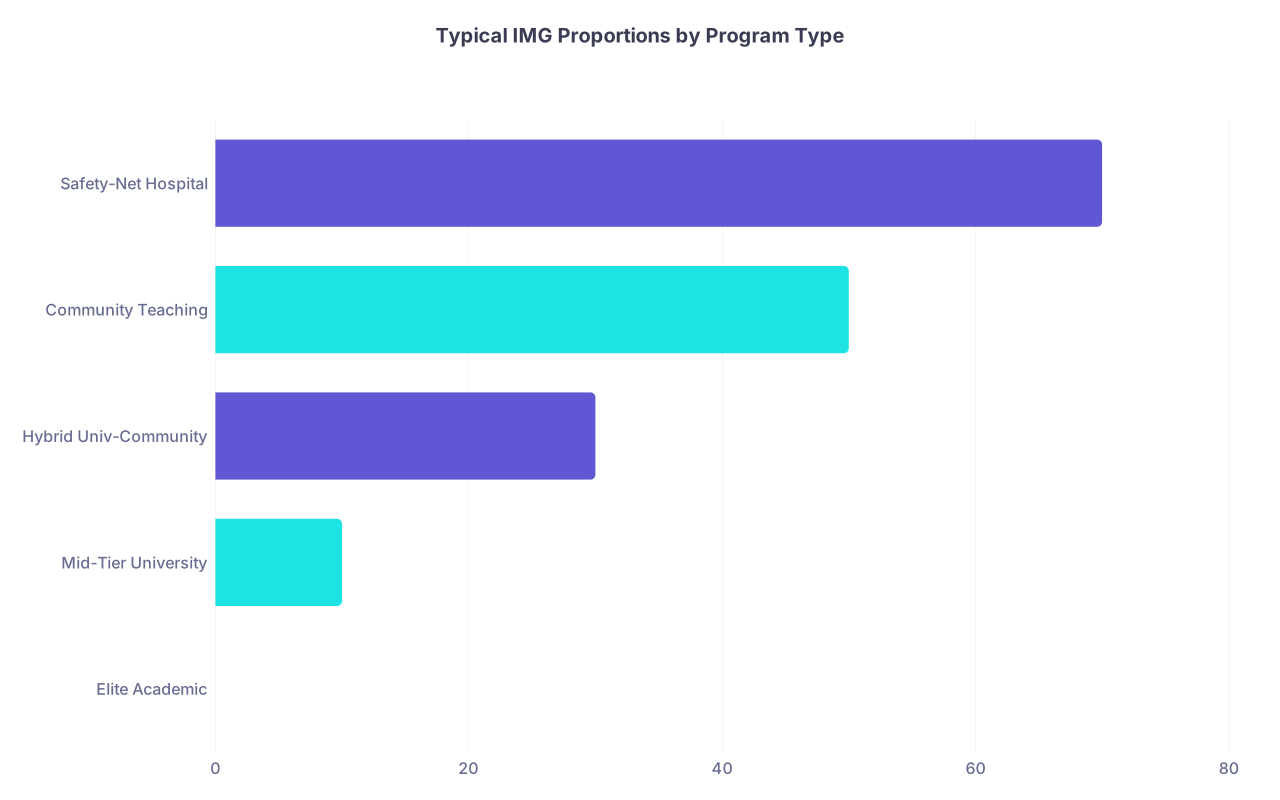
2. Check their percentage of IMGs over several years
Most serious IMG-welcoming programs have a high proportion of IMGs. Here’s roughly what it looks like:
| Category | Value |
|---|---|
| Elite Academic | 0 |
| Mid-Tier University | 10 |
| Hybrid Univ-Community | 30 |
| Community Teaching | 50 |
| Safety-Net Hospital | 70 |
If a program:
- Consistently has 30–70% IMGs
- Lists visa sponsorship clearly
- Has multiple IMGs in chief or leadership roles
That’s “we actually welcome IMGs,” not just “we put the phrase on our website.”
3. Watch how they talk about visas and USCE when pressed
On Q&A sessions or email responses, the tone changes when you get specific.
True IMG-friendly program:
- “Yes, we sponsor J-1 for all qualified candidates; H-1B is available and we’ve done it in the last few years. Many of our current residents are on visas.”
- “USCE is strongly preferred due to supervision and licensure rules, but we have taken candidates with strong international clinical experience and excellent metrics.”
Fake-friendly program:
- “We review H-1B sponsorship on a case-by-case basis” (translation: almost never)
- “USCE preferred but not required” (and they still only interview IMGs who have it)
You’ll see the difference in how concrete their answers are.
Strategies That Actually Move the Needle for IMGs
Enough decoding. Let’s talk leverage. What can you actually do to break through this system?
1. Map out truly IMG-friendly programs using data, not vibes
Don’t guess. Build a structured target list.
Steps:
- Go specialty by specialty (FM, IM, psych, etc.)
- For each program, pull resident list and last 3–5 years of match data if available
- Mark: number of clearly IMG names/schools, visa notes, % IMG overall
- Cross-reference with any word of mouth from seniors or forums, but trust hard data more than anecdotes
You should end up with:
- A core list of high-IMG programs where you’re in their typical profile
- A secondary list of intermediate programs where you’re an above-average IMG candidate
- A very short “reach” list where they rarely take IMGs, but you match their one-off previous IMG profiles (same school, powerhouse scores, research, etc.)
2. Optimize for the filters you can control
You can’t change where you went to med school. You can influence everything else.
- Step 2 CK: If you’re not yet matched and your score is borderline, a strong Step 3 sometimes helps reframe you as lower risk. But in many programs, Step 2 already did the damage. Be realistic.
- USCE: Prioritize rotations or observerships in hospitals with residencies. Especially ones that actually list IMGs among their residents.
- Letters: Seek out attendings who are connected—either they trained at your target institutions, or they’re recognized in the field.
I’ve sat in meetings where the entire debate over an IMG basically came down to:
“She has a letter from Dr. Y, and he almost never writes strong letters. If he’s impressed, I’m willing to gamble.”
It really can be that simple.
3. Know when to stop applying to impossible programs
This is the brutal financial trap.
Many IMGs keep throwing applications at places with:
- Zero IMGs on the current roster
- No visa sponsorship
- No history of taking foreign grads for years
Because the website still says “We welcome IMGs.”
You need to be colder than that. If they have no IMGs, no visas, and your profile doesn’t scream “exceptional,” they don’t welcome you. They welcome your ERAS fee.
How Faculty Actually Talk About Strong vs Weak IMG Applicants
Let me give you the real contrast. These are paraphrased from actual committee discussions I’ve been part of.
The “easy yes” IMG
- Step 2 CK: 245+
- Graduation: within 3–5 years
- USCE: 2 sub-internships at US teaching hospitals
- Letters: two strong US letters, one from known faculty or strong institution
- Visa: J-1 okay, no prior failures
Faculty reaction:
“Scores are solid. Letters are excellent. She rotated at our affiliate, feedback was good. No real concerns. I’m fine with inviting her.”
No drama. No huge philosophical debate about IMGs. They check boxes, they get invited.
The “we like them, but no” IMG
- Step 2: 225
- Graduation: 8–10 years ago
- USCE: observership only
- Letters: nice but generic from unknowns
- Visa: needs H-1B
Faculty reaction:
“I like their story. They seem resilient. But with the age, lower scores, and H-1B, I don’t see us justifying it with our current applicant pool. If we had more spots, maybe.”
They may genuinely like you. That does not translate to an interview. Emotion bends, filters don’t.
The Real IMG-Friendly vs Fake-Friendly Program Patterns
Let’s put the patterns side by side.
| Feature | Real IMG-Friendly | Fake-Friendly |
|---|---|---|
| Resident Roster | 30–70% IMGs | 0–5% IMGs |
| Visa Sponsorship | Clear J-1, often H-1B | Vague, “case-by-case” |
| Match Lists | IMGs every single year | Rare or no IMGs for many years |
| Website Language | Concrete, specific | Generic “we welcome diversity” |
| Q&A Answers | Direct, detailed | Evasive, non-committal |
You don’t need to be an insider in that program to read this. It’s all public—you just have to stop believing the marketing copy and watch their behavior.
Two Things Most IMGs Misunderstand About “We Welcome IMGs”
First misunderstanding:
They think it’s a promise. It’s not. It’s a legal and PR-safe phrase that keeps them covered while they do whatever they want with the rank list.
Second misunderstanding:
They assume that because a program has one IMG, it’s IMG-friendly. Sometimes that person:
- Had deep internal connections
- Transferred from another program
- Was a fluke match in an odd year
Look across classes and years, not at one face in a group photo.
A Quick Visual: Your Path From “Welcome” to “Actually Interviewed”
Here’s roughly how the invisible filter system looks for IMGs, in the eyes of a typical mid-tier university program:

| Step | Description |
|---|---|
| Step 1 | ERAS Submitted |
| Step 2 | Filtered Out |
| Step 3 | Faculty Review |
| Step 4 | Interview Offered |
| Step 5 | US-IMG or Non-US IMG |
| Step 6 | Step 2 High Enough |
| Step 7 | Step 2 Very High |
| Step 8 | USCE Present |
| Step 9 | Visa Type Acceptable |
| Step 10 | Strong US LOR |
Every “we welcome IMGs” program has some version of this in place. They just don’t diagram it on their website.