
The belief that “IMG‑friendly residencies are lower quality” is lazy, wrong, and frankly unsupported by any serious data.
You hear it everywhere: on Reddit threads, in hallway whispers, from that one “advising” attending who finished training in 1993 and has not looked at NRMP data since. The assumption is simple: if a program takes a lot of international medical graduates (IMGs), it must be desperate… which must mean bad training.
Reality is messier. And a lot more interesting.
IMG‑friendly does not equal low quality. Often it just means different incentives, different geography, or different prestige signaling. Sometimes it means they actually care more about clinical ability than pedigree.
Let me walk you through what the data and on-the-ground reality actually show.
What “IMG-Friendly” Really Signals (And What It Does Not)
People throw “IMG‑friendly” around like it’s a synonym for “bottom of the barrel”. That’s nonsense.
IMG‑friendly typically just means a program:
- Consistently ranks and matches a meaningful proportion of IMGs
- Does not have rigid cutoffs that quietly screen out foreign schools
- Has leadership that is culturally comfortable with training international grads
That’s it. It doesn’t automatically tell you anything about:
- Board pass rates
- Procedural exposure
- Call structure
- Teaching culture
- Fellowship matches
The NRMP publishes data every year: IMGs match in internal medicine, family medicine, pathology, neurology, psych, even some competitive subspecialties. Many of those programs have 40–80% IMG residents. Yet their graduates pass boards, get fellowships, and practice in major systems just fine.
The “IMG‑friendly = bad” myth hangs on one lazy assumption: that US MDs always flock to the “best” programs, and whatever’s left must be second rate. That’s not how the market actually works.
Follow the Incentives: Why Some Solid Programs Take More IMGs
Programs do not become IMG‑friendly by accident. They move that way because of geography, competition, and workforce needs.
A few real-world drivers:
Location and desirability
A community hospital in a mid-sized Midwestern city just cannot compete with MGH or UCSF for US MDs who want big-name coastal life. That doesn’t mean they train worse. It means their applicant pool is different.Service-heavy safety-net hospitals
County hospitals and safety-net systems serve sicker, poorer, more complex patients. The work is hard. US MDs often chase lifestyle and prestige; IMGs are often more open to “I’ll work hard if you train me well and sponsor my visa.” Programs respond accordingly.Visa and workforce realities
Some regions desperately need physicians to stay locally after training. IMGs on J-1 or H-1B are more likely to accept underserved positions later. Hospital administrations notice that.Brand vs substance
Programs with weaker “name recognition” among US grads may still have excellent teaching faculty and insane clinical volume. They don’t win the prestige contest, so they win by being open to IMGs who are hungry, qualified, and willing.
Being IMG‑friendly often means the program is:
- Less brand-obsessed
- More open to nontraditional pathways
- Positioned in a region less desirable to US grads
None of those automatically degrade your training. In some cases, they improve it.
What the Data Actually Shows: IMGs Perform Just Fine
People rarely bother to look at outcome metrics. But when you do, the “IMG‑friendly = poor training” story falls apart fast.
Let’s look at board pass rates and performance.
Many states publish pass rates by program. In internal medicine, for example, you’ll see plenty of IMG‑heavy, mid-tier community programs with 90–100% ABIM pass rates across several years. Meanwhile, there are “US‑heavy” programs with worse numbers.
The bigger point: board performance correlates much more with:
- How selective the program is (for anyone, IMG or US grad)
- How much they invest in didactics and exam prep
- Resident workload and burnout
…than with the IMG percentage of the class.
Here’s a simplified comparison to illustrate the point.
| Program Type | IMG % | Board Pass Rate | Clinical Volume | Prestige Reputation |
|---|---|---|---|---|
| University Flagship IM Program | Low | Very High | High | Very High |
| Strong Community IMG-Heavy IM | High | High | Very High | Moderate |
| Weak Community US-Heavy IM | Low | Moderate/Low | Moderate | Low |
| Safety-Net IMG-Heavy IM | High | Moderate/High | Very High | Low/Moderate |
Notice the problem with the simplistic myth. You can’t read “IMG‑friendly” off that table and predict training quality.
And no, IMGs aren’t dragging programs down. In many cases they’re propping programs up.
There are papers showing IMGs often practice in underserved areas, take tougher shifts, and are overrepresented in hospitalist work and night float. They’re the workhorses in many systems. You can argue that’s problematic from a labor standpoint. You cannot argue they’re inherently worse physicians.
Where the Myth Came From (And Why It Persists)
The myth has roots. They’re just old and rotting.
Historically, some truly weak community programs survived by accepting anyone with a pulse and visa. Those places existed, and a few still do. Bad supervision, abusive call schedules, chronically failing board rates. Residents were often IMGs simply because no one else wanted to be there.
So older attendings mentally fused “terrible program” with “IMG‑heavy program”.
Then throw in prestige culture: US MDs from “good” schools are told — implicitly or explicitly — that any program that “has to take IMGs” is beneath them. No nuance, no data. Just pedigree snobbery disguised as concern for training quality.
The myth sticks because:
- It’s easy. One simple rule: “IMG‑friendly = bad.” No need to do homework on programs.
- It flatters egos. If you’re a US grad at a big-name place, believing this makes you feel special.
- It’s self-reinforcing. People on forums repeat it as if it’s established fact.
I’ve heard faculty casually say, “Oh, that place is full of IMGs, must be rough,” without ever seeing their board pass rates, ICU census, or fellowship match lists. That’s not analysis. That’s bias.
The Real Question: What Actually Predicts Training Quality?
If you want to know whether a residency will train you well, stop obsessing over the IMG percentage and start looking at what matters.
At minimum, for any program — IMG‑friendly or not — you should be asking:
What are the board pass rates over the last 5–7 years?
Not one cherry-picked year. A pattern. If they won’t tell you, that’s a red flag.What does a typical call month look like?
How many admissions per call? How many patients on your ward list? Are seniors supervising or drowning?Who actually teaches?
Are there dedicated teaching attendings? Or are you just service coverage for private attendings who disappear after rounds?What are graduates doing?
Do recent grads match into known fellowships, hospitalist jobs they actually wanted, or at least stable primary care roles? Or is there a suspicious silence when you ask?What’s the culture?
Do residents look exhausted and bitter, or tired-but-proud? Do chiefs know what’s going on with their interns? Do PDs know their residents by name?
None of this is unique to IMG‑friendly programs. The same checklist applies to “prestigious” places. Difference is: prestige makes people skip the checklist and just trust the brand.
Where You Should Be Cautious: Red Flags That Matter
Let me be clear: not all IMG‑friendly programs are good. Some are, bluntly, bad. Just not because they like IMGs.
Here’s where your skepticism is warranted:
- Chronic board failures with no plan to fix it
- No structured didactics (“We’re too busy clinically” is not a virtue)
- Zero transparency about schedule, case volume, or outcomes
- High attrition (people quitting or transferring regularly)
- Residents who warn you away off-record during interviews or on social media
Some of those places are IMG‑heavy. Some are not. The common denominator is dysfunction, not visa sponsorship.
The Other Side: How IMG-Heavy Programs Can Be Better For Training
Here’s the part no one tells you out loud: some IMG‑friendly programs offer stronger clinical training than more prestigious, US‑heavy ones.
I’ve seen this in internal medicine and surgery especially.
You walk into a county hospital with a 70–80% IMG residency class. It’s chaotic. The ED is overflowing. ICU is constantly at capacity. Residents run codes, place lines, manage ventilators by PGY‑2. Attendings actually rely on them.
Compare that with a glossy university program where:
- Every meaningful procedure is handed to fellows
- Residents are shielded by NPs, PAs, and hospitalists from “scut” and from real responsibility
- ICU decisions are all fellow-led, leaving residents as note-writers and button-clickers
Prestige buys you letters, name recognition, and better fellowship doors. It does not automatically buy you hands-on skill.
Many IMGs I’ve talked with from “no-name” but high-volume programs are clinically lethal: unphased by septic shock, comfortable with difficult airways, efficient on the wards. They had to be. The hospital would not run without them.
That unglamorous grind often lives in IMG‑heavy programs. Calling those “lower quality” is clueless.
How to Judge an IMG-Friendly Program If You’re an IMG
If you’re an IMG yourself, the stakes are even higher. You can’t afford to let prestige myths distract you from what matters.
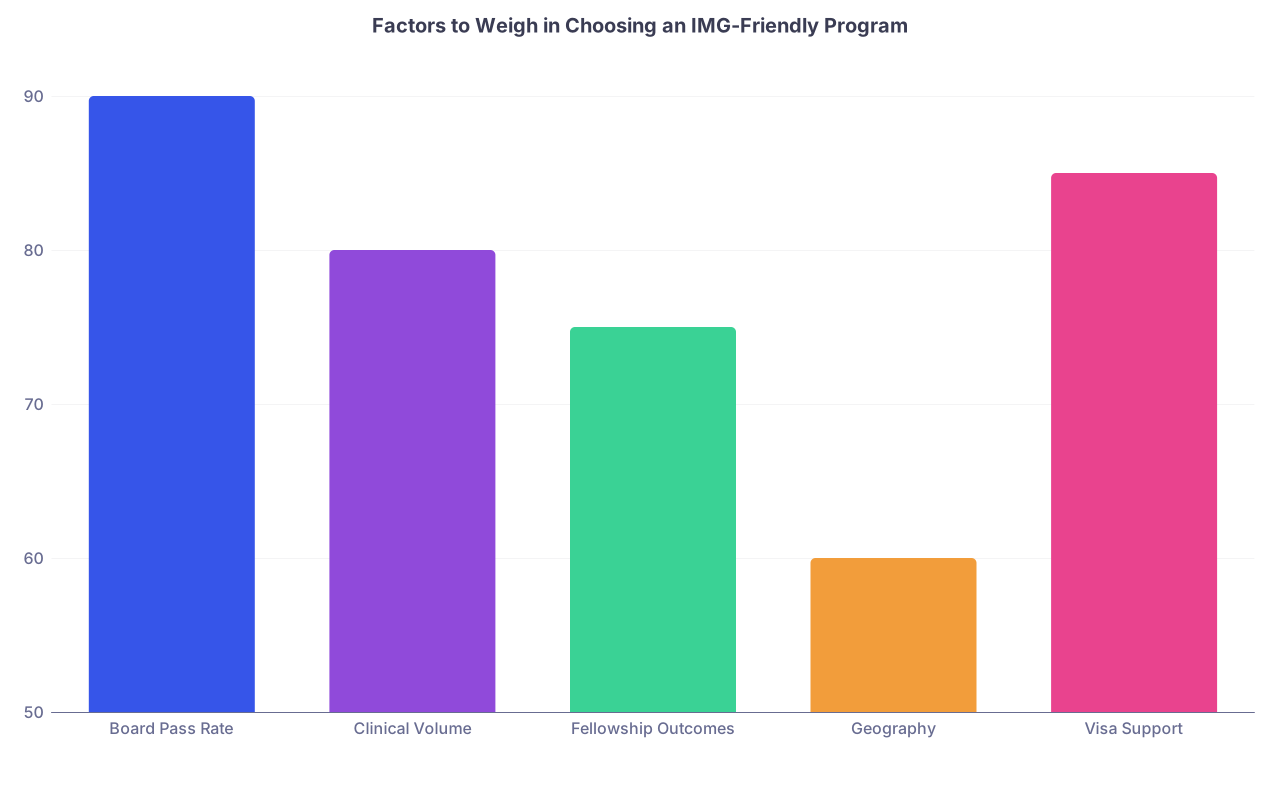
Here’s how to think about IMG‑friendly options, with less emotion and more strategy.
| Category | Value |
|---|---|
| Board Pass Rate | 90 |
| Clinical Volume | 80 |
| Fellowship Outcomes | 75 |
| Geography | 60 |
| Visa Support | 85 |
That chart is the hierarchy I see smart applicants use.
They prioritize:
- Solid board pass rates and exam support
- Strong clinical exposure (ICU, ED, procedures, complex patients)
- Some track record of graduates landing fellowships or decent jobs
- Robust visa support and a PD who clearly understands the process
They don’t chase “US‑heavy” or “IMG‑light” as a quality proxy. They know that’s noise.
If a program is IMG‑friendly but weak on all five of those? Walk away.
If a program is IMG‑friendly and strong on several? Stop apologizing for ranking it high.
Why US Grads Should Care Too
This isn’t just an IMG issue. US MDs and DOs get hurt by this myth as well.
Many US grads avoid IMG‑heavy programs out of ego or misinformation. They’d sometimes be better served training at a high-volume, IMG‑friendly county hospital than at a low-volume, sleepy community program that happens to be US‑heavy.
Over the years I’ve heard variations of this line from residents:
“I almost didn’t rank this place because ‘too many IMGs’ but it’s the best thing that happened to my training.”
Here’s what often happens when you ignore the myth and look at substance:
- You get more responsibility, sooner
- You’re surrounded by colleagues who had to fight like hell to get there and do not take it for granted
- You see pathologies your med school only mentioned in passing
If you’re serious about being competent, you should be far more interested in who will train you and what they’ll let you do than in the passport mix of your co-residents.
A Quick Reality Check: Outcomes Over Labels
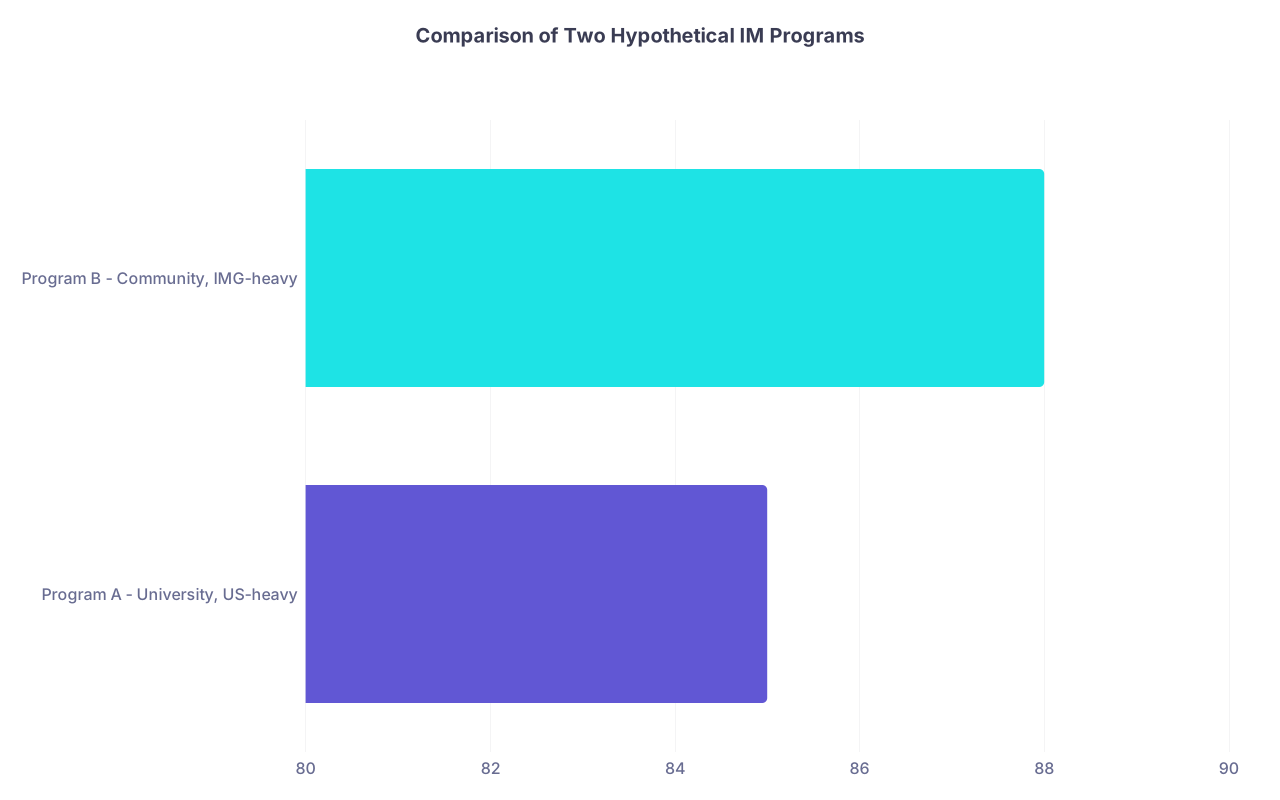
Let’s tie this back to real outcomes. Imagine two internal medicine programs:
| Category | Value |
|---|---|
| Program A - University, US-heavy | 85 |
| Program B - Community, IMG-heavy | 88 |
Say that bar is their 5-year ABIM pass rate: 85% vs 88%.
Program A is a university affiliate, mostly US grads. Program B is a community hospital, 70% IMGs.
Is it remotely rational to call B “lower quality” purely because of its resident mix? No. Yet that’s how people talk.
When you’re choosing where to spend 3–7 years of your life, you can either:
- Buy into that lazy narrative and hope the brand saves you
- Or act like a professional and interrogate the metrics that actually affect your career
You get one residency. You should not waste it obeying someone else’s prestige hierarchy.
The Bottom Line
IMG‑friendly residencies do not automatically mean lower training quality. They mostly reflect geography, workforce needs, and openness to international grads, not built-in weakness.
If you remember nothing else, keep these three points:
- Judge programs by outcomes — board pass rates, clinical exposure, graduate placements — not by the percentage of IMGs in the roster.
- Some of the most clinically intense and educationally rich programs are IMG‑heavy; some of the weakest are not. The myth has it backwards.
- Whether you’re IMG, DO, or US MD, your job is to separate brand mythology from real training quality. Look at the data, listen carefully to current residents, and ignore anyone who equates “IMG‑friendly” with “inferior.”