
IMG‑friendly does not mean fellowship‑dead. It usually means you’re looking at the data wrong.
This myth survives because people mix up “not Harvard” with “no chance.” They see a program that takes a lot of IMGs, notice it’s not a big‑name ivory‑tower place, and jump straight to: “Fine for a visa, but I’ll never get cards/GI/onc from there.”
That’s not how the real world works.
Top fellowships do not care about a magic badge called “IMG‑friendly.” They care about track record, mentorship, research, and whether someone in their circle can vouch for you. Some so‑called “IMG‑friendly community programs” quietly send grads into legit, name‑brand fellowships every year. You just never see those on Reddit screenshots.
Let’s walk through what actually matters, where this myth comes from, and how to tell if an IMG‑heavy program is a launch pad or a dead end.
Where This Myth Comes From (And Why It’s Lazy Thinking)
I’ve heard this line way too often on interview trails and WhatsApp groups:
“If a program takes a lot of IMGs, that means their residents aren’t competitive. So you won’t match a competitive fellowship.”
It sounds logical until you look at actual match lists.
There are three big things feeding this myth:
People confuse “brand name” with “outcomes.”
“Top fellowship” is often code for “I’ve heard of it.” Someone matches GI at a strong but mid‑tier university, and everyone undervalues it compared to a big coastal name that actually takes fewer fellows and has worse clinical volume.Survivorship bias from the loudest voices.
The IMGs who end up bitter and unmatched in fellowship are extremely vocal online. The ones who quietly matched heme/onc at Mayo or cards at a solid university? They’re busy starting fellowship, not posting breakdown threads.Garbage program research.
Applicants browse a website, see no glossy “Fellowship” page or a single understated PDF, and assume “no one matches anywhere good.” Most programs do a terrible job showing off their successes, especially smaller academic‑community hybrids that actually treat their IMGs fairly.
The reality? There are three kinds of “IMG‑friendly” programs, and they are not equal.

The Three Types of IMG‑Friendly Programs (Only One Is Toxic)
Stop lumping every IMG‑friendly program into the same bucket. They’re not the same species.
1. The “Workhorse” Community Program (Limited Fellowship Pipeline)
This is the stereotype people have in their heads. Busy community hospital. High census. Minimal research. Faculty clinically strong but not academically plugged in. Fellowship “support” equals a generic letter and a “good luck.”
These places often:
- Have few or no in‑house fellowships
- Don’t track or publish where residents match
- Have attendings who did not train in academic environments themselves
Do people ever get GI/cards/onc from these? Yes. But they’re usually the outliers who grind out research with external mentors, cold‑email, and basically build their own pathway.
This is where the myth is half‑true: if all you know is “program takes many IMGs,” and you never look deeper, you can absolutely land at a place that historically places poorly in competitive fellowships.
But this is not the whole story.
2. The Hybrid Academic‑Community Program (The Underrated Sweet Spot)
This is where the myth really breaks.
These programs:
- Are affiliated with a mid‑tier or regional medical school
- Have a couple of in‑house fellowships (cards, heme/onc, maybe GI, pulm/crit)
- Push residents into research via QI, outcomes projects, abstracts at major meetings
- Have at least a few faculty with recognizable names, NIH grants, or active publications
They often take a lot of IMGs. They’re not brand‑name magnets. But their residents routinely match:
- In‑house fellowships (which are often surprisingly strong)
- Regional university programs
- Occasionally “big” names when someone builds a strong CV
These programs blow up the myth. They are IMG‑friendly and fellowship‑friendly. Just not “Instagram prestige” friendly.
3. The Heavy‑Hitting IMG‑Friendly Academic Program (Yes, They Exist)
There are university‑affiliated, research‑active, fellowship‑heavy programs that are overtly IMG‑friendly:
- Many Caribbean/foreign grads on the roster
- Strong in‑house fellowships
- Tons of poster/abstract output at meetings
- PDs who actually articulate a strategy for IMGs going into competitive subspecialties
These are rarer. But they absolutely exist in internal medicine, neurology, psych, anesthesia, pathology, even some surgery‑adjacent specialties.
This is the category that sends multiple IMGs every year into name‑brand fellowships. The myth simply ignores them.
What the Data and Patterns Actually Show
You want numbers, not vibes. Here’s how the patterns actually play out.
Fellowship Match vs Program Reputation
Fellowship PD surveys (NRMP‐sponsored and specialty society surveys) almost always rank these as top factors:
- Program director’s letter and narrative
- Letters from known faculty
- Research/abstracts in the subspecialty
- Interview performance
- USMLE/COMLEX performance
- Program reputation (but usually framed as “do we know and trust this PD/faculty?”)
Notice what’s missing: “Does this residency take IMGs?” No one cares. They care about the quality of the graduates they’ve seen from that program.
Here’s a simplified comparison of actual outcomes I’ve seen across IM‑heavy programs:
| Program Type | IMGs per Class | In-House Fellowships | Typical Outcomes for Strong Resident |
|---|---|---|---|
| Pure community, no affiliation | 60–80% | None | Cards at low-volume community, hospitalist jobs |
| Hybrid academic-community | 50–70% | 1–3 fellowships | In-house cards/onc, regional university GI/pulm |
| IMG-friendly university program | 30–50% | 4–6 fellowships | Mix of in-house and national-name fellowships |
No, this is not a peer‑reviewed randomized trial. But it matches what I’ve seen from actual match lists and LinkedIn‑stalking former residents.
Trends: IMGs Are Not Frozen Out Like Before
Look at recent fellowship rosters in competitive fields:
- Cardiology
- GI
- Heme/Onc
- Pulm/Crit
You’ll notice a not‑trivial fraction of fellows are IMGs who trained at solid but non‑elite programs. The fellowships care about:
- Publications and abstracts in their field
- Strong subspecialty letters that say “this resident is already functioning like a fellow”
- Trust in the sending PD
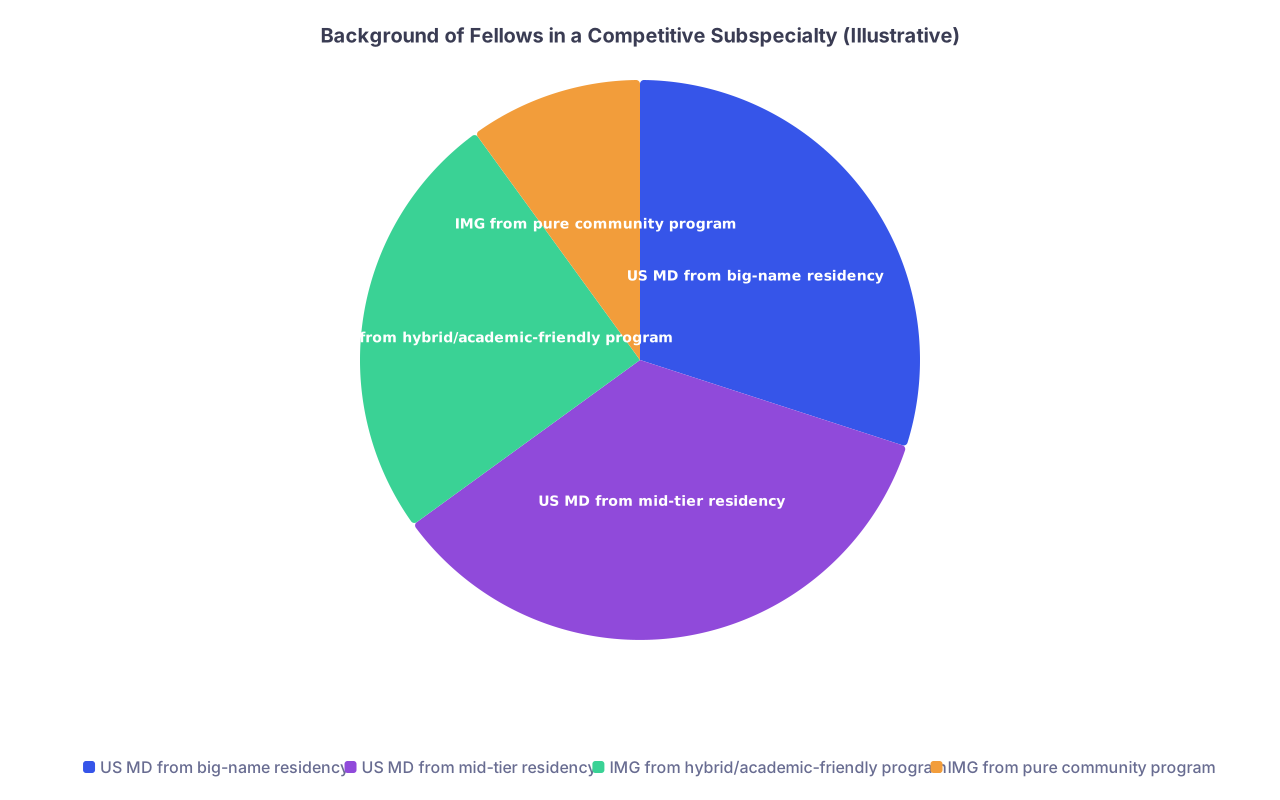
Here is the kind of distribution you’ll see on a competitive fellowship roster (roughly):
| Category | Value |
|---|---|
| US MD from big-name residency | 30 |
| US MD from mid-tier residency | 35 |
| IMG from hybrid/academic-friendly program | 25 |
| IMG from pure community program | 10 |
The myth pretends that last 35% does not exist. It does.
How to Tell If an IMG‑Friendly Program Can Launch You to Top Fellowships
This is where you stop believing marketing slogans and start reading the fine print.
There are four questions that separate “IMG‑friendly and future‑friendly” from “IMG‑friendly and stuck”:
1. What Do the Last 3–5 Fellowship Match Lists Actually Show?
Do not accept vague website language like “our graduates go on to excellent fellowships.” That phrase is basically wallpaper.
You want names. Years. Programs.
If the program does not publish it, ask on interview day:
“Could you share where your last few residents matched for fellowship, including subspecialties like cards, GI, and heme‑onc?”
If they hand‑wave, change the subject, or give only generic examples (“we’ve had people go to very strong programs”)—that’s a red flag.
If they can rattle off specifics? Different story:
- “Last 3 years: GI at our institution, GI at [regional university], cards at [good academic center], heme/onc at [major cancer center].”
That’s not theoretical. I’ve heard versions of that at programs most applicants would dismiss as “mid.”
2. Are There Real Subspecialty Mentors, Or Just Names on a Website?
Another pattern: some programs list “GI faculty” but those people are clinically buried with no academic footprint and no time for mentorship.
A serious fellowship pipeline usually looks like:
- Faculty who actually attend major conferences (ACC, ACG, ASCO, CHEST)
- Residents with posters at those meetings
- Subspecialty clinics where residents can work closely with those attendings
During your interview, ask chiefs or seniors:
“If I’m interested in heme/onc, what kind of research or mentorship have prior residents had?”
If the answer is concrete (“Dr. X runs our myeloma group, residents usually get 1–2 abstracts in second year, we present at ASH regularly”), you’re in good territory.

3. What’s the Program’s Culture Around Fellowship?
At some IMG‑heavy programs, the unofficial message is: “We train hospitalists. If you want fellowship, that’s on you.”
At better IMG‑friendly programs, the culture is:
- Faculty asking interns early what they’re interested in
- Chiefs helping line up research mentors
- PDs running fellowship prep sessions and letter strategy meetings
- Support for attending conferences (with funded travel if you present)
Ask explicitly on interview day:
“How does the program support residents who want to apply for competitive fellowships?”
If the answer boils down to “we write you letters,” that’s weak. If they talk about deadlines, mock interviews, and pushing you to produce work—they’re serious.
4. Do Their Fellows Actually Land at Competitive Places Too?
Here’s the overlooked trick: if a program has its own fellowships (cards, GI, onc, pulm/crit, etc.), look where their fellows end up after training.
If those fellows:
- Take academic jobs
- Do advanced fellowships at big centers
- Publish seriously
Then you’re in a strong ecosystem. It means the subspecialty divisions are plugged into the wider academic network. That helps you, even as a resident.
The Harsh Truth: Your Choices Matter More Than the Label “IMG‑Friendly”
Now for the uncomfortable part. A lot of IMGs use the phrase “IMG‑friendly” as an excuse to turn off their brain.
They sort programs by “takes IMGs,” apply blindly, match somewhere, and then act shocked when that place has zero research and no fellowship track record.
You cannot outsource your due diligence.
Here is the reality:
- An IMG at a strong hybrid/academic‑friendly program who behaves like a future fellow—seeks mentors, does projects, reads seriously—will often outmatch a US grad who coasts at a more famous but passive program.
- An IMG at a pure service‑heavy community program with no strategy who does nothing extra will not “accidentally” fall into a top GI or cards spot. That fantasy is dead.
Top fellowships don’t blacklist you because your residency has a lot of IMGs. They just expect you to prove you’re exceptional in that environment.
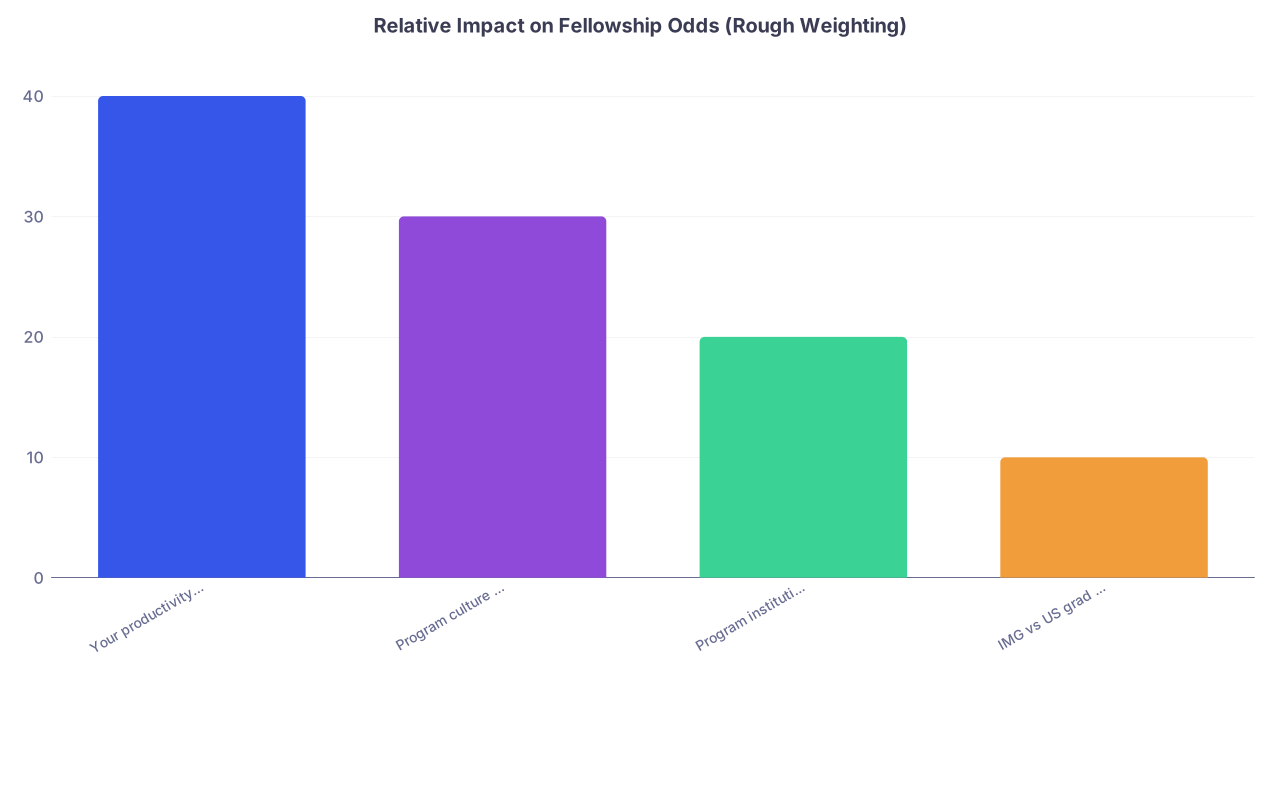
Think of it this way:
| Category | Value |
|---|---|
| Your productivity & letters | 40 |
| Program culture & mentorship | 30 |
| Program institutional reputation | 20 |
| IMG vs US grad status | 10 |
The myth acts like “IMG‑friendly” automatically nukes that “institutional reputation” bar to zero. It doesn’t.
There are IMG‑friendly programs with:
- NIH‑funded cardiologists
- GI divisions that present at DDW every year
- Onc attendings who are well known in narrow niches
Those names on your CV matter a lot more than whether your co‑residents went to med school in the US or abroad.
Concrete Red Flags: When “IMG‑Friendly” Really Does Mean Stuck
There are programs where the myth is mostly true. You should know how to spot them.
Big warning signs:
- No one can show you a written fellowship match list
- Chiefs describe recent matches vaguely (“cards somewhere in the Midwest”)
- No departmental grand rounds, M&M, or scholarly atmosphere
- Zero or one resident in the last 3–5 years matched into cards/GI/onc/pulm at any recognizable academic place
- PD openly says, “We focus on training hospitalists” and leaves it at that
These are the places where, yes, if you dream of top‑tier subspecialty training, you’re mostly on your own. Some residents still make it, but it’s an uphill climb.
Flip side? If a program ticks most of the following, the myth is nonsense:
- Clear, specific fellowship outcomes, including competitive fields
- Consistent track record of multiple fellows per year
- Residents with names on posters at real national meetings
- Subspecialty faculty whose names show up on PubMed when you search them
- Chiefs who can tell you, without hesitating, exactly how they prep applicants for fellowship
If you find that and they still happen to be “IMG‑friendly,” you’ve found an asset, not a liability.

| Step | Description |
|---|---|
| Step 1 | IMG Applicant |
| Step 2 | Select programs by more than IMG-friendly label |
| Step 3 | Limited research and mentorship |
| Step 4 | Research, mentorship, in-house fellows |
| Step 5 | Strong research and networks |
| Step 6 | Outlier fellowships possible with massive individual effort |
| Step 7 | Consistent matches into good fellowships |
| Step 8 | Regular matches into top fellowships |
| Step 9 | Program type |
Bottom Line: The Myth Is Lazy, Not Just Wrong
Strip it all down and you’re left with three key truths:
IMG‑friendly does not equal fellowship‑toxic. The real variable is whether the program has a documented track record, active subspecialty mentors, and a culture that supports fellowship applicants. Many IMG‑heavy programs quietly do.
Top fellowships care more about your output and your letters than your co‑residents’ passports. If you produce strong work with known faculty and get powerful letters, you can match highly from a non‑elite, IMG‑friendly program.
You cannot just chase “IMG‑friendly” and hope for the best. If fellowship matters to you, interrogate match lists, mentorship, and research reality. Ignore the myth and do real homework—because the difference between “IMG‑friendly dead end” and “IMG‑friendly launch pad” is exactly that level of scrutiny.