
The idea that “IMG-friendly” hospital systems are just exploiting cheap foreign labor is lazy, half-true, and dangerously misleading.
There is a kernel of truth: some hospitals absolutely lean on IMGs to plug holes in ugly, underfunded parts of the system. But if you think that explains the entire pattern of where IMGs match, why those programs exist, and what the data show about outcomes, you’re missing 80% of the story.
Let’s unpack what’s actually going on.
The “IMG-Friendly” Label: More Nuanced Than TikTok Thinks
When people say “IMG-friendly hospital,” they usually mean one of three things, which get blurred into a moral judgment:
- Programs that take a relatively high percentage of IMGs every year
- Community or safety-net hospitals where US grads often avoid applying
- Large systems (HCA, NYC H+H, some regional networks) that show up again and again on IMG match lists
On social media, this quickly turns into: “Those places are just using IMGs as cheap labor nobody else wants to do.”
Here’s the problem: the labor is not actually that cheap. And the “IMG-heavy” pattern is mostly driven by supply and demand of residency positions, not hidden wage games.
US residency salaries for PGY1–PGY3 are usually set across an institution, not per program and not per passport.
| Year/Role | Annual Salary (USD) |
|---|---|
| PGY1 Resident | 60,000–65,000 |
| PGY3 Resident | 66,000–72,000 |
| PGY5 Resident | 73,000–80,000 |
| US Median Income | ~58,000 |
Programs cannot legally pay IMGs less than US grads for the same PGY level. Visa residents fall under the same institutional GME pay scales. So if you think IMGs are “cheap” in the sense of lower salary — wrong. That part is just fiction.
What is true: residents in general are underpaid relative to the revenue they generate. But that applies equally to USMDs, DOs, and IMGs. The exploitation is of trainees as a class, not “foreign” trainees in isolation.
Why So Many IMGs Cluster in Certain Systems
If it’s not a direct wage gap, why do you see so many IMGs in particular systems?
Because US grads and program directors are not randomly distributed. The match is brutally simple:
- Many USMDs avoid lower-prestige community programs, smaller cities, or safety-net hospitals.
- Those programs still need residents to function and meet service demands.
- IMGs, who face far fewer options, are willing to go where US grads aren’t—geographically and reputationally.
- Those programs, in turn, learn the visa process, build a track record with IMGs, and become “IMG-friendly.”
This is not abstract. Look at the yearly NRMP data: internal medicine, family medicine, pediatrics, psychiatry, and some prelim surgery spots have large IMGs shares, especially at community and safety-net institutions. Orthopedics at a big-name coastal academic center? Basically zero IMGs.
So “IMG-friendly” is often just code for: “We cannot fill with US grads alone, and we’re competent at handling visas.”
That’s a pipeline and access story, not purely an exploitation story.
Follow the Money: How Programs Actually Think About Residents
Say this out loud and mean it: Every hospital system exploits residents financially. That’s how the system is built.
Residents work long hours, generate RVUs, support call schedules, and get a fixed salary that’s far below the value they produce. That’s true in Harvard’s flagship internal medicine program and in a small community hospital in the Midwest.
Where IMGs come in is not a special discount tier. It’s more like this:
- Medicare pays hospitals for residency positions (DGME + IME payments), generally not differentiated by IMG vs US grad.
- Hospital CFOs look at total residency slots as revenue and labor capacity.
- Programs in less desirable locations or with lower reputations simply cannot fill their Medicare-funded slots with US grads alone.
- So they lean into IMGs—because the alternative is leaving funded positions unfilled, which is financially and operationally dumb.
Do some systems treat IMGs as more “expendable” or less likely to complain? Yes, I’ve seen that in practice. But the pay structure is not how they’re saving money—where they sometimes cut corners is support, teaching quality, research infrastructure, mentorship, and wellness.
Exploitation is more about working conditions and leverage than about base salary.
Visa Status: Where the Power Imbalance Actually Lives
If there’s one place where IMG exploitation is structurally baked in, it’s visa dependence.
Here’s the uncomfortable reality:
- J-1 and H-1B residents are more vulnerable. Their ability to stay in the country depends on good standing, renewal, and program support.
- Switching programs, reporting abuse, or taking extended leave can feel far riskier for visa-dependent trainees.
- Programs know, consciously or not, that these residents have less mobility.
So the question isn’t “are IMG-friendly programs paying IMGs less?” They aren’t. The real questions:
- Are these programs more likely to staff the heaviest, least educational rotations with IMGs?
- Are they slower to protect them from abusive attendings or unsafe workloads because they assume IMGs will not push back or leave?
- Do they quietly select IMGs who signal “grateful, compliant, won’t rock the boat”?
That’s where the exploitation argument actually holds water.
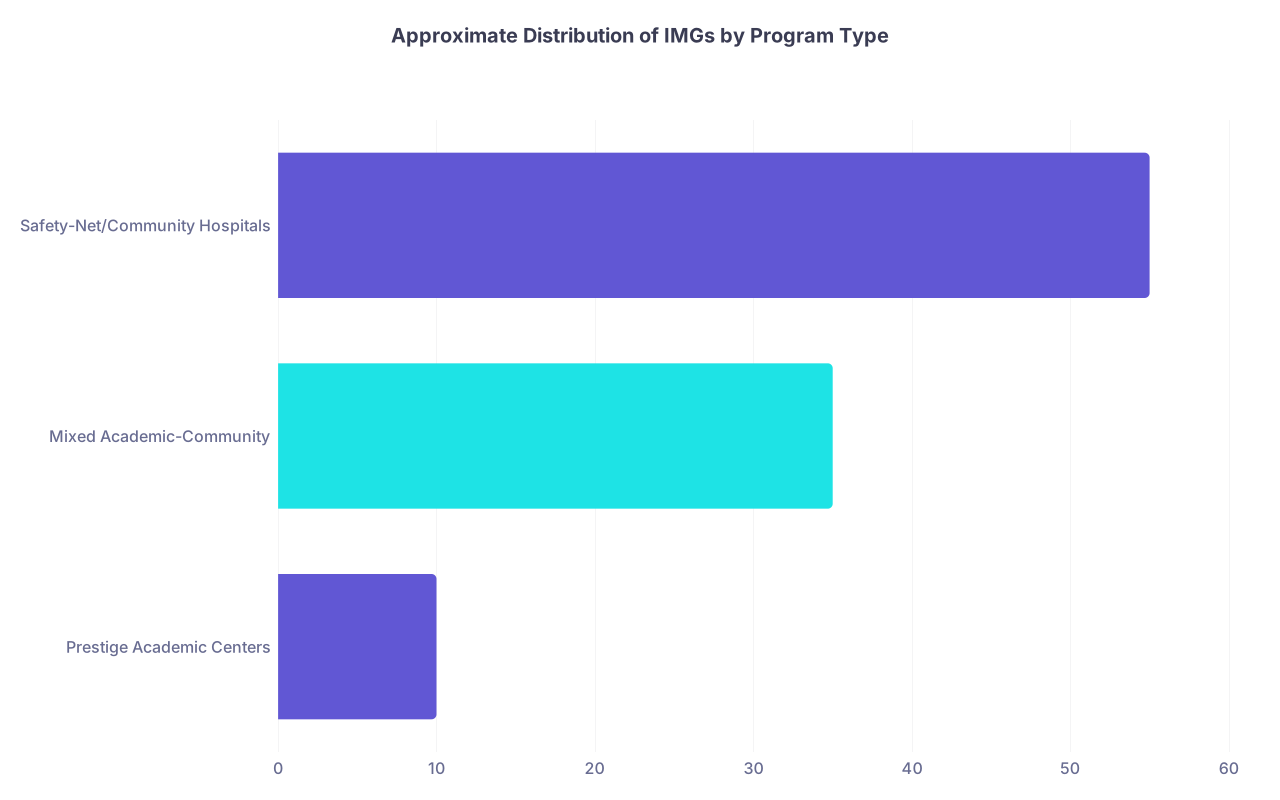
| Category | Value |
|---|---|
| Prestige Academic Centers | 10 |
| Mixed Academic-Community | 35 |
| Safety-Net/Community Hospitals | 55 |
The more a system relies on visa-dependent IMGs to keep entire services functioning (overnight cross-cover, ICU nights, ED admits), the more risk there is that “friendly” becomes “you can’t afford to say no.”
Not every IMG-heavy program is abusive. Some are excellent. But this is where you should focus your skepticism, not on the myth that they’re just paid less.
What the Data Say About Quality and Outcomes
There’s a persistent background insult here: that “IMG-friendly” means low quality, both of training and care. The actual research is far less flattering to that stereotype.
Multiple studies have compared outcomes of patients treated by IMGs vs US grads in the US system. The punchline:
- In several large observational studies, patient mortality and readmission rates under IMG primary care physicians were similar or sometimes better than under US-trained physicians.
- Quality metrics in many internal medicine and primary care settings show no consistent disadvantage for IMGs.
That doesn’t mean every IMG is a superstar. It means the simplistic “cheap labor = worse care” story does not hold up at the population level.
Training quality is more variable. There are programs—often smaller, service-heavy, with minimal academic culture—where “residency” looks like labor in exchange for board eligibility, with teaching as an afterthought. These are disproportionately the same places that are very IMG-heavy.
But here’s the key distinction: that’s not because the residents are IMGs. It’s because the program is weak, and US grads with options mostly avoid it. The IMGs are the canary, not the cause.
If you took that same bad program and filled it with USMDs at the same salary, it would still be exploitative. It would just be harder for it to fill.
Where “IMG-Friendly” Is Actually a Good Sign
You’ll rarely hear this on Reddit: there are places where a strong IMG presence is actually a marker of institutional competence and openness.
I’ve seen this pattern repeatedly:
- Academic or hybrid programs in less “sexy” cities (think mid-sized Midwest, South, or Northeast communities) that routinely recruit top-tier IMGs with publications, prior residency abroad, or PhDs.
- Departments that have long-term attendings who were once IMGs at the same place and stayed on faculty.
- Systems that are very organized with H-1B sponsorship, waiver pathways, and long-term career planning.
These are not bottom-of-the-barrel programs. I’ve watched IMGs from such places match GI, cards, heme-onc, anesthesia fellowships at brand-name institutions. Those residents are not “cheap labor.” They’re the backbone of the program.
If an institution:
- Actively supports research
- Has alumni IMGs in strong fellowships and faculty roles
- Has stable leadership and clear feedback systems
- And still takes 40–60% IMGs annually
That’s not exploitation. That’s diversity plus competence in dealing with international talent.
The Real Red Flags You Should Look For
Instead of vaguely fearing “IMG-friendly = exploitative,” you should be asking very pointed questions about how labor and teaching are balanced.
During interviews or Q&A, you want to pin down signals like these:
- How often are you on pure service rotations that feel like scut with minimal teaching?
- Who staffs the hardest call rotations and night shifts—are the same people (often IMGs) bearing disproportionate load?
- What’s the faculty-to-resident ratio on teaching rounds?
- How often do residents get formal didactics, protected? Do people actually attend or are they constantly being paged away?
- What percentage of graduates match into fellowships, and where?
If residents answer with vague, strained smiles, or you hear “we’re like a family” 10 times and almost nothing about actual education, that’s your red flag—IMG or not.
This is also where “friendly to IMGs” can mean very different things:
- Friendly because they’ve built an actual support structure, understand the visa process, and advocate for long-term careers.
- “Friendly” because they know they can work you hard and you won’t leave.
The label is useless without the context.

Let’s Talk Numbers: Applicant Pressure and System Demand
Step back. Why do “IMG-friendly” systems exist in the first place?
Because the US has:
- Far fewer residency positions than total global applicants
- A growing reliance on IMGs to staff primary care and underserved areas
- A locked-in funding mechanism that makes it difficult to expand GME slots dramatically
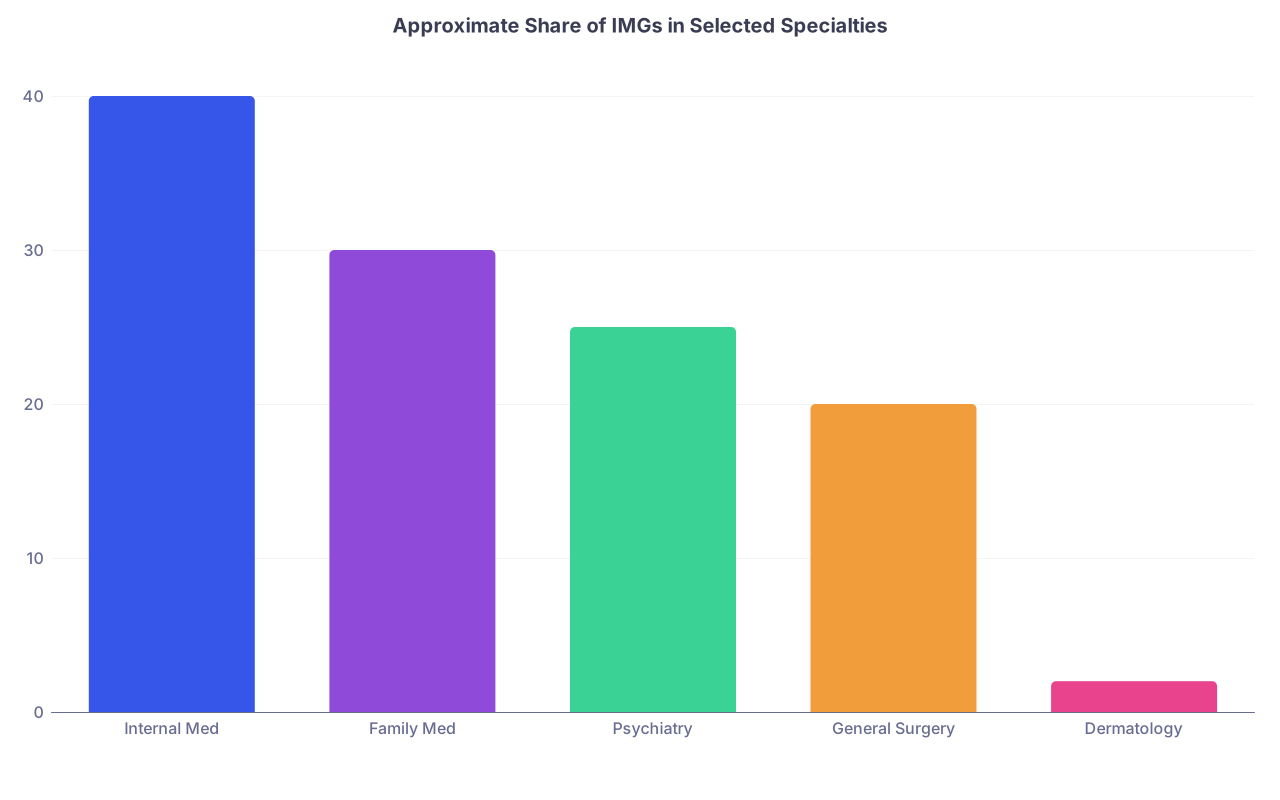
| Category | Value |
|---|---|
| Internal Med | 40 |
| Family Med | 30 |
| Psychiatry | 25 |
| General Surgery | 20 |
| Dermatology | 2 |
Internal medicine and family medicine in particular would be in deep trouble in many regions without IMGs. Some hospital systems treat that reliance as a reason to invest in these residents. Others treat it as leverage.
Blaming “IMG-friendly” hospitals for exploiting cheap labor misses the structural pressure: the US needs these residents. Funding and workforce planning are a mess. IMGs are filling the gaps left by US policy failures.
That’s not a defense of bad programs. It’s just where the real responsibility lies.
How to Use This If You’re an IMG (Or a US Grad Considering These Programs)
If you’re an IMG, here’s the mindset shift: don’t assume “IMG-friendly” is bad. Assume it’s a flag that demands more questions.
You’re trying to answer:
- Is this program using IMGs as a long-term part of its identity and success, with clear evidence of former IMGs thriving?
- Or is it plugging dangerous coverage holes every year with rotating, replaceable faces?
Ask residents how many co-residents left mid-training. Ask how many graduates over the last five years are in solid fellowships or satisfying hospitalist jobs. Ask whether faculty actually know their residents, or just their service coverage needs.
If you’re a US grad looking at IMG-heavy places, don’t be arrogant and dismissive. The presence of IMGs does not mean a program is low tier. What matters is output: alumni, teaching, scholarship, and how the program responds when residents struggle.

Stop Chasing the Wrong Myth
“IMG-friendly = exploitation of cheap foreign labor” is an attractive, cynical story. It’s also lazy and largely wrong on the money side and crude on the ethics side.
The reality is more uncomfortable and more useful:
- Residents as a group are underpaid relative to the work they do. IMGs are not a special discount tier; they’re just more constrained and thus more easily pressured.
- IMG-heavy programs vary wildly: some are outstanding, some are mediocre, some are predatory. The IMG ratio alone tells you almost nothing about quality.
- The true red flags are about workload, support, visa leverage, and career outcomes—not about whether a hospital system is “friendly” to IMGs on paper.
If you remember nothing else:
- The system exploits residents. Visa dependence makes IMGs more vulnerable, not cheaper.
- “IMG-friendly” is a starting point for hard questions, not a verdict for or against a program.
- Judge programs by how their residents learn, live, and land after graduation—not by lazy myths about cheap labor.