
Last week I watched an IMG frantically refreshing their email every 30 seconds in the hospital cafeteria. They’d matched at an “IMG-friendly” internal medicine program, told everyone back home, started browsing apartments near the hospital. Then the email came: visa delay, possible denial, “we’re monitoring the situation.” Their face just… dropped.
If you’re reading this, you’re probably wondering the same thing I keep hearing: “I know this program is IMG-friendly, but how safe is it really once visas get involved? Like… can I still lose everything after I match?”
Let’s talk about the part nobody wants to say out loud: you can match and still not start because of visa issues. It’s rare. But not zero. And that’s exactly the kind of thing people like us stay up all night thinking about.
What “IMG-Friendly” Actually Means (And What It Doesn’t)
Here’s the first thing that messes with your head: “IMG-friendly” is not the same as “visa-safe.”
When a program calls itself IMG-friendly, usually it means:
- They routinely interview and rank IMGs
- They have multiple current residents who are IMGs
- They’re used to ECFMG paperwork, Step scores from abroad, weird transcripts, etc.
That’s good. Necessary, even. But for visa safety, you need more than that.
Some programs are:
- IMG-friendly but don’t sponsor visas at all
- IMG-friendly and sponsor only J-1
- IMG-friendly and sponsor J-1 and H-1B (gold tier, if they actually know what they’re doing)
- IMG-friendly “depending on the year” (translation: chaos)
If a program’s website just says “we welcome IMGs” and doesn’t explicitly say something like:
- “We sponsor J-1 visas through ECFMG”
or - “We sponsor both J-1 and H-1B visas”
…assume nothing. IMG-friendly is about who they’ll interview. Visa sponsorship is about who they can actually bring here to work.
And yes, it’s absolutely possible to match to a program that loves IMGs but then tells you, “sorry, we don’t handle visas.”
Where Things Can Go Wrong Even at “Good” Programs
You want the horror scenarios, right? The worst-case stuff we all imagine at 3 a.m. Here they are, bluntly.
1. Program changes policy after you apply
I’ve seen this too many times. You filter ERAS by “Visa Sponsorship: J-1 and H-1B,” you apply to 80+ programs. By the time they rank, leadership changes, GME office changes, institutional policy shifts.
You matched. But now:
- They suddenly “no longer sponsor H-1B”
- Or they’ve decided “only J-1 going forward”
- Or they cut IMG spots quietly
Most of the time, if you matched under old expectations, they’ll try to honor that. But it’s not guaranteed. And nobody will put a 100% guarantee in writing for you beforehand. That’s the ugly truth.
2. DS-2019 or H-1B petition delays
Even if the program is solid and wants you there:
- ECFMG can be slow issuing DS-2019
- USCIS can sit on H-1B petitions
- Administrative processing at the embassy (221g) can drag for weeks or months
Programs have start dates. GME offices have rules. If you’re not cleared by a certain cut-off, they may:
- Delay your start date (best case)
- Put you on unpaid leave until cleared
- In very rare, extreme cases, rescind the position if it’s clear you cannot start at all
The vast majority of the time, delays resolve. But the in-between phase feels like hell.
3. Consular visa refusal or security check
This is the nightmare one.
You:
- Get DS-2019 or H-1B approval notice
- Book your embassy appointment
- Show up with every document, every printout, your ECFMG certificate, your match letter
- And the officer starts asking weirdly detailed questions, or says “we need to do additional processing”
Or worse: they outright refuse under 214(b) or 221g never resolves.
Programs can’t fight the US consulate. They might send a support letter, but they can’t override a refusal. And they can’t hold a residency spot open indefinitely while the State Department decides if it feels like answering.
Is this common? No. But again, not zero.
Hard Reality: No Program Can Be 100% “Safe”
If you’re looking for the magical residency that can guarantee: “You will not have visa issues, under any circumstances,” you’re going to drive yourself insane. It doesn’t exist.
Here’s the split of “control” you’re dealing with:
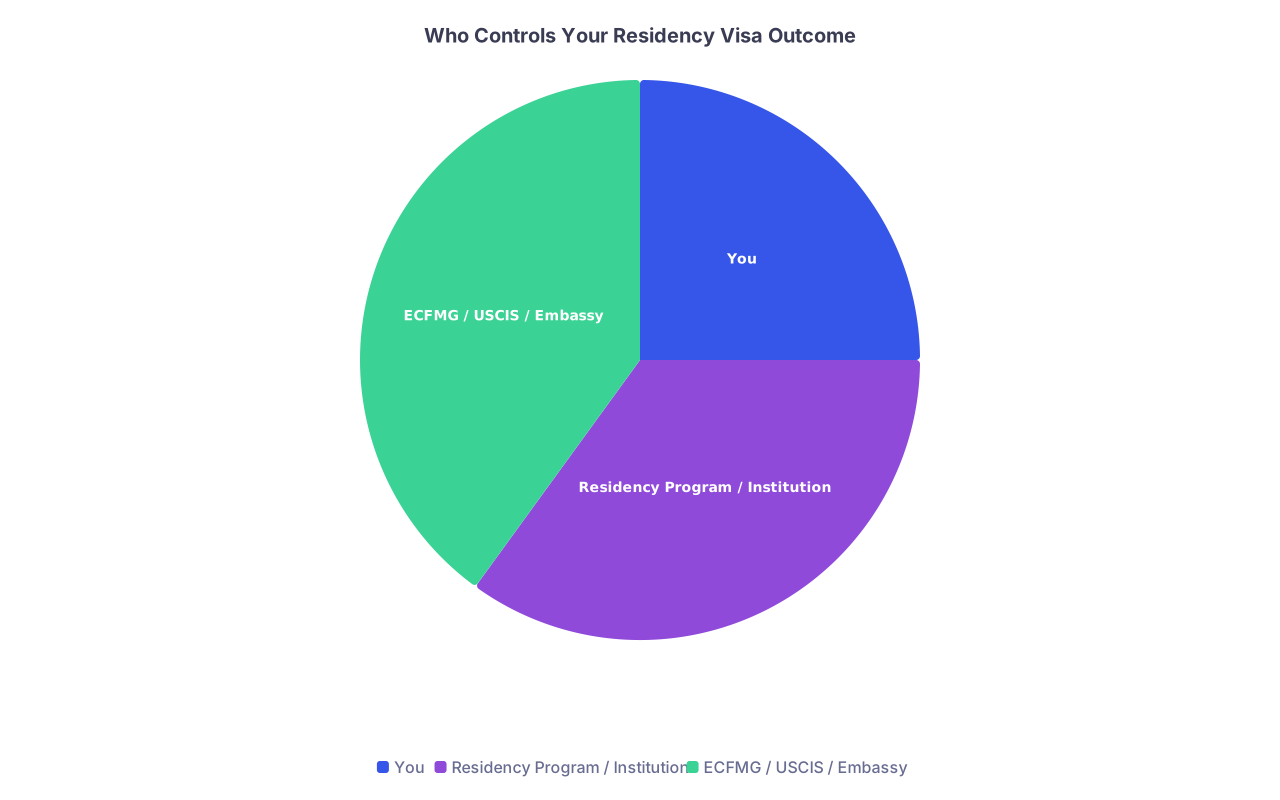
| Category | Value |
|---|---|
| You | 25 |
| Residency Program / Institution | 35 |
| ECFMG / USCIS / Embassy | 40 |
You control:
- Applying to places that actually sponsor
- Having clean, consistent documents
- Not lying or “adjusting” anything
- Booking your visa interview early
Program controls:
- Whether they sponsor J-1/H-1B
- How quickly they send paperwork
- How hard they advocate for you internally
Nobody controls:
- Consulate mood
- Sudden policy changes
- Security checks
- Random processing delays
This doesn’t mean you’re doomed. It just means “IMG-friendly” doesn’t erase the uncertainty. It only makes the odds better.
How to Actually Judge How “Safe” a Program Is for Your Visa
This is the part everyone skips. They see “We sponsor J-1 visas” on a website and stop asking questions. That’s how you get blindsided.
You need to become slightly annoying. Persistent. The IMG who emails program coordinators with very specific questions. You’re not being difficult. You’re protecting your entire career.
Here’s what I’d do for any program I’m seriously ranking:
1. Ask exactly what they sponsor
Not “Do you sponsor visas?”
Ask:
- “Do you sponsor J-1 visas for IMGs every year?”
- “Do you currently sponsor H-1B for incoming residents, and how many in the last 2–3 years?”
And don’t settle for vague answers like “we usually try” or “it depends.” That’s how you end up at a program that suddenly “can’t do it this year.”
2. Ask how many current visa-holding residents they have
If a program has:
- 6–10+ residents on J-1/H-1B
- Over multiple PGY levels
That tells you they have systems in place, not just one random IMG they helped once under unusual circumstances.
If they hesitate or say “we had one a few years ago” – that’s not comforting.
3. Ask what happens if visa processing is delayed
This is the really telling question:
- “If my visa processing is delayed and I can’t arrive by July 1, what does your program typically do?”
Look for answers like:
- “We’ve had this before; we delayed the start date by a month”
- “We can sometimes start people later if paperwork is in process”
Be cautious if you hear:
- “We’d have to discuss that if it happens”
- “We haven’t had that before, not sure”
Translation: you’re the test case.
4. Check history of unmatched / replaced IMGs
Ask current residents privately:
- “Has anyone ever matched here and then not started because of visa problems?”
- “Did anyone start late because of delays?”
- “How supportive was GME during that process?”
People will tell you more on WhatsApp or Instagram DMs than during official meet-and-greets. Use that.
J-1 vs H-1B: Which Is “Safer” for Not Getting Screwed?
This part makes everyone crazy because there’s no perfect option.
Quick and dirty comparison:
| Factor | J-1 Visa | H-1B Visa |
|---|---|---|
| Who sponsors | ECFMG + program | Program alone |
| Typical processing speed | Usually faster | Often slower |
| Exam requirement | USMLE Step 3 not required | Step 3 required before start |
| Home return rule | 2-year home requirement | No built-in 2-year rule |
| Common for residency? | Very common | Less common |
If your anxiety is specifically: “I don’t want to lose my spot because of visa denial/delay,” then:
J-1 is usually more predictable for residency start.
ECFMG and programs are used to it. It’s a standardized system.H-1B involves more moving parts.
Program lawyers, USCIS timelines, cap-exempt vs not, Step 3 deadlines. More points of failure.
The problem? Everyone online screams, “H-1B or nothing!” because of future job issues and waiver pathways. That’s valid… later. But it doesn’t matter how good your future job prospects are if you never actually start residency.
If a stable, historically reliable J-1 sponsoring program loves you vs a shaky, inconsistent H-1B promise from a place that “might” do it… I know what I’d pick if I were terrified of losing my spot.
Red Flags That a Program Is Not As Safe As It Looks
Some things I’ve seen that made my stomach drop:
- Their website says “We sponsor J-1 and H-1B,” but current residents privately say: “They haven’t done H-1B for years.”
- Program director says in an email: “We’d love to support H-1B, but it’ll depend on GME approval and funding.” That’s not a yes. That’s a maybe-year-from-now-disaster.
- Nobody on their current roster is on a visa. Just US citizens/GC even though they’ve “had IMGs before.” Where are they? Did they all just magically not need visas?
- They seem strangely uninterested in clarifying your visa type during interview season. Programs that take this seriously start thinking about visa needs early. If they never ask, they might not be ready.
Don’t ignore that uncomfortable feeling when people dodge direct visa questions. That intuition is usually right.
How Often Do People Actually Lose Their Spots Because of Visa?
Here’s the part that should calm you down a little.
Most IMGs who:
- Match at programs with a real history of sponsorship
- Have clean documents
- Don’t misrepresent anything
…do eventually get their visas and start. Maybe late, maybe after a few terrifying weeks of waiting, but they start.
Actual total loss of residency because of visa denial is:
- Uncommon
- Usually linked to serious document problems, misrepresentation, criminal/immigration history, or very specific background/security concerns
- Sometimes related to programs that never should’ve promised sponsorship in the first place
But does the fear go away just because the numbers are in your favor? No. You’re not a statistic. You’re thinking, “What if I’m the exception?”
I get that. That’s exactly how my brain works too.
What You Can Do Now To Lower the Risk
You can’t remove all risk. But you can move yourself out of the “high chance of disaster” group.
Here’s what I’d be doing if I were ranking right now:
Prioritize programs with strong, visible IMG presence on visas.
Scroll their resident list. LinkedIn-stalk if you have to. Look for J-1/H-1B patterns.Email coordinators with targeted questions.
Not a long essay. Three or four razor-sharp questions about:- Visa types sponsored
- Number of current residents on visas
- Policy for delayed start due to visa issues
Fix every tiny document inconsistency now.
Names, dates, graduation year, passport details, ECFMG status. Consular officers hate confusion. Confusion leads to “administrative processing.” You don’t want that.If possible, book a reasonably early visa interview.
Don’t wait for the perfect moment. Earlier appointment = more buffer for delays.Have a mental backup plan.
Not because you’re doomed, but because sleeping is easier when your brain knows, “Even if the worst happens, I’ll reapply, fix X, and go again.”
When you tell your anxious brain “There is literally no backup option,” it goes feral. Give it something.
The Quiet Truth About “Safe” Programs
No program can promise you: “You will not have visa problems.” If they do, they’re lying.
What a truly IMG + visa-friendly program can offer is:
- A track record of getting IMGs in on J-1/H-1B year after year
- Administrators who’ve seen delays before and didn’t immediately abandon the resident
- Clarity, not vague “we’ll see” promises
- Honest answers when you ask direct questions
You’re not crazy for being scared. You’re not dramatic for refreshing your email 100 times a day. So much of your life is hanging on decisions by people who don’t even know your name.
But you’re not powerless either.
If you remember nothing else, remember this:
- IMG-friendly is not enough; you need visa-history-friendly.
- Ask brutally direct questions before you rank, even if you feel annoying.
- The odds are actually in your favor if you choose programs with real sponsoring history and keep your documents clean.
You’re allowed to be scared. Just don’t let that fear stop you from doing the practical, unglamorous, slightly awkward things that actually protect you.