
It’s late. Your spreadsheet is open. You’ve got 30 tabs of program websites, Reddit threads, and SDN posts. Your cursor is hovering over a program that proudly says: “We are IMG-friendly.”
And your brain goes:
“Are you though? Or are you just… saying that because you couldn’t fill with US grads last year?”
Now you’re stuck.
If you trust it and rank them high, are you setting yourself up to get burned on Match Day?
If you ignore it, are you throwing away one of the few places that might actually take you seriously as an IMG?
Let’s be blunt: “IMG-friendly” is one of the most abused, vague, and misleading phrases in residency. I’ve seen applicants cling to it like a life raft. I’ve also seen people crushed because they believed it blindly.
Let’s untangle this, without sugarcoating.
What “IMG-Friendly” Usually Means (And What It Doesn’t)
You see “IMG-friendly” on:
- Program websites
- Random blog lists
- WhatsApp groups
- Consultants trying to sell you “curated program lists”
The problem? Everyone uses it differently. And no one defines it.
In practice, when a program or list says “IMG-friendly,” it usually means one of these:
- They’ve taken at least a few IMGs in the past. Ever.
- They don’t officially require US citizenship or green card.
- They’ll consider IMG applications, not auto-filter them out.
That’s… it.
It does not automatically mean:
- They sponsor visas reliably.
- They like your profile (year of graduation, scores, attempts).
- They rank IMGs high enough to actually match them.
So no, you shouldn’t blindly trust any “IMG-friendly” claim. But you also shouldn’t ignore it completely. It’s a starting point, not a guarantee.
I know, very comforting.
Hard Reality Check: How to Tell If a Program Is Actually IMG-Friendly
Forget what they say. Look at what they do.
There are four things I care about way more than the words “IMG-friendly”:
- How many current residents are IMGs?
- Do they sponsor visas (and which ones)?
- What does their match list / resident list look like over time?
- Do their filters align with your profile (scores, YOG, attempts)?
Let’s break this down.
1. Count the IMGs in Their Program Photos
This is the single most honest “IMG-friendly” metric.
Go to their website. Find:
- Current residents
- Recent graduates
- Alumni pages
Look at names, med schools, countries. It’s not perfect, but you get a feel quickly.
If a program calls itself IMG-friendly and in a full residency class of 36 over 3 years you see one IMG from 8 years ago? That’s not IMG-friendly. That’s “we once made an exception.”
On the other hand, if you see:
- People from India, Pakistan, the Caribbean, Eastern Europe, Middle East, Latin America
- Multiple IMGs per class
- Consistent pattern year after year
That’s your proof.
2. Check Visa Sponsorship – Not Just “We Consider IMGs”
You’re an IMG needing J-1 or H-1B?
I don’t care what their website says about “we welcome IMGs” if right below that they say:
- “We do not sponsor visas”
- Or worse: say nothing about visas at all
If you need a visa and they don’t sponsor any → they are not IMG-friendly for you. Full stop.
Here’s where programs differ:
| Visa Type | Who Sponsors | Notes |
|---|---|---|
| J-1 | ECFMG | Most common; many community programs |
| H-1B | Program/Hospital | Fewer programs; often need Step 3 |
| None | N/A | You must already have US work authorization |
If your situation is: “IMG + no green card + no US citizenship,” then the filter is brutal:
- No mention of visa sponsorship? Assume no until proven otherwise.
- “We only sponsor J-1”? Fine, that’s workable for most.
- “We sponsor H-1B for strong candidates”? That might be real… or aspirational. Ask current residents if possible.
Programs that truly are IMG-friendly almost always have clear visa language somewhere.
3. Look at Patterns Across Multiple Years
One accidental IMG class doesn’t mean anything.
Pay attention to:
- Are there IMGs in each PGY year?
- Are they from a variety of schools and countries, or just one pipeline school?
- Are they mostly US-IMGs (Caribbean) or also non-US-IMGs?
Example of a genuinely IMG-friendly pattern:
- Internal Medicine, 12 residents per year
- Each class: 6–8 IMGs, mixed US-IMG and non-US-IMG
- Program lists med schools from multiple countries
Example of fake-friendly:
- Website says “We value diversity and welcome IMGs”
- Resident list: 30 US MD, 2 US DO, 0 IMGs
- Last 5 years: maybe one Caribbean grad
I’d trust the second program’s numbers over the first one’s words every single time.
Red Flags When Programs Say “IMG-Friendly”
Let’s talk worst-case scenarios, since that’s how your brain is probably wired right now.
Red flags I’ve seen, again and again:
“IMG-friendly” list online, but program’s own data doesn’t back it up
Those blog posts that list 50–100 “IMG-friendly” programs? Many are scraped from old NRMP data or just copied from each other. Things change. PDs change. Sponsorship changes. Don’t trust any static list.Website copy sounds nice, but residents are 100% US grads
If they “love diversity” but haven’t matched a single non-US grad in recent years, that’s marketing, not reality.They attend IMG-heavy recruitment events but rarely match IMGs
I’ve seen programs show up to IMG webinars and virtual fairs to get application volume, then match exactly one IMG every five years. They love your ERAS fee. They don’t necessarily love your application.They say ‘we have no cutoffs’ but unofficially do
“We review applications holistically.” Sure. Then you learn later from a resident that no one under 230 ever gets an interview. Always assume there are unpublished filters.Vague or evasive answers about visas or IMGs at open houses
If you ask, “Do you sponsor J-1 or H-1B?” and they say, “We’ve done it in the past” or “depends on the year,” that’s code for: don’t rely on us.
Programs that are truly IMG-friendly are usually pretty open and confident about it: “We have many IMGs, we sponsor J-1, we occasionally do H-1B, and here’s our current resident roster.”
How to Actually Use “IMG-Friendly” When Building Your Rank List
So what do you do with all this? Because you still need an actual rank list by that terrifying deadline.
Here’s the blunt framework I give people:
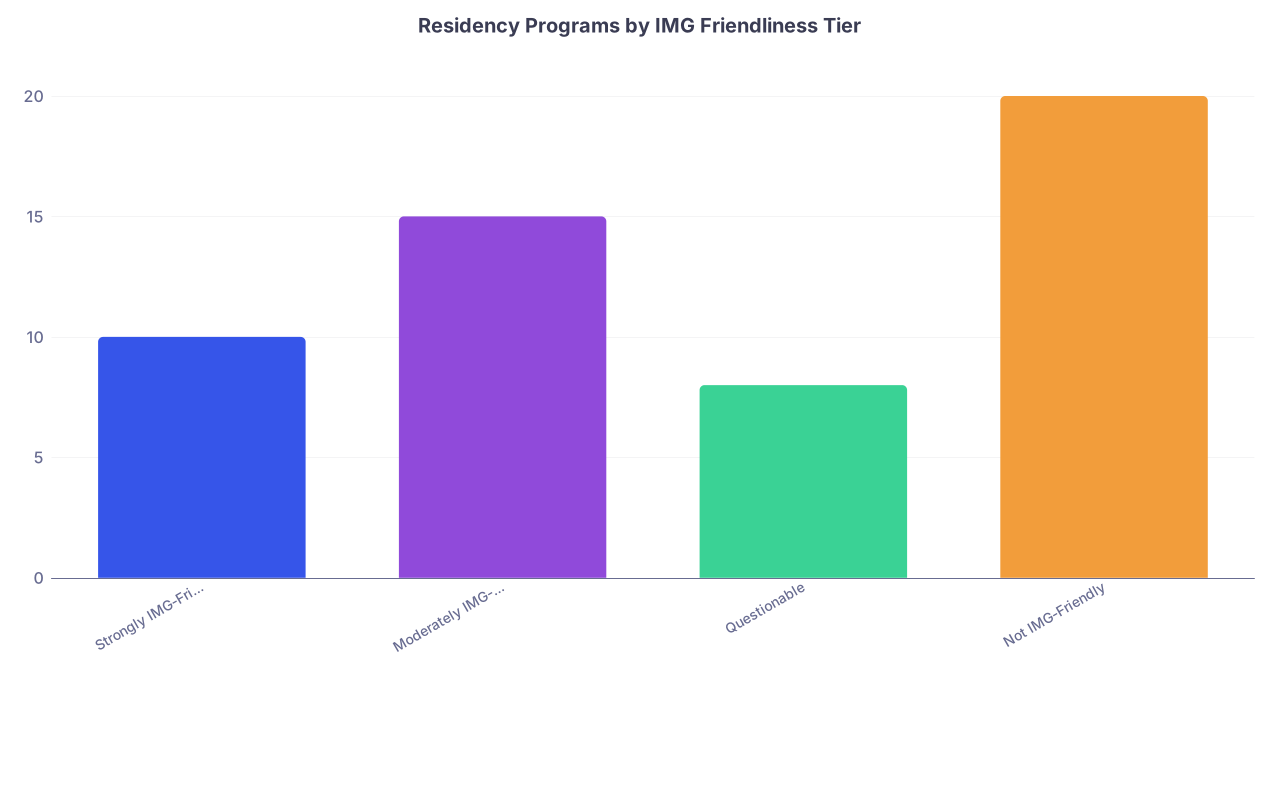
| Category | Value |
|---|---|
| Strongly IMG-Friendly | 10 |
| Moderately IMG-Friendly | 15 |
| Questionable | 8 |
| Not IMG-Friendly | 20 |
Think of programs in tiers based on evidence, not marketing.
Tier 1: Strongly IMG-Friendly
Signs:
- Multiple IMGs in every class
- Clear visa policy on website
- Recent graduates match into fellowships, not just disappear
- You see your “type” of profile among current or past residents (YOG, scores, country)
These are your anchor programs. They deserve to be ranked high if you’d actually be willing to train there.
Tier 2: Moderately IMG-Friendly
Signs:
- Some IMGs, but mostly US grads
- They sponsor J-1 consistently, maybe H-1B for a few
- You see at least a few non-US-IMGs in recent years
These can absolutely match you, especially if your profile is strong. But they’re not “safe.” Nothing is.
Tier 3: Questionable but Possible
Signs:
- Maybe one IMG in the last several years
- Visa language is vague or absent
- Reputation online is mixed: some people say they interview IMGs rarely
You can rank these, but don’t emotionally depend on them. Think of them as “lottery ticket” programs, not your backbone.
Tier 4: Realistically Not IMG-Friendly (For You)
Signs:
- No IMGs currently or in recent memory
- No visa support and you need one
- All grads are US MD/DO from mid- to high-tier schools
These are basically fantasy picks unless you have something very unique (US PhD, heavy research, personal connection).
You can absolutely throw a few of these on your rank list if you interviewed there and liked them. But don’t count on them to save your Match.
Common Paranoid Thoughts (And What’s Actually True)
Let’s hit a few of the “what if” spirals that hit at 2 AM.
“What if they invited me just to fill interview slots, but they never really rank IMGs?”
Happens. Especially at brand‑name or borderline-competitive programs.
Reality:
- Some programs do “IMG interviews” as token diversity or backup.
- But if they interviewed you, you’re not zero on their list. You’re just… maybe lower than you’d be at a community-heavy IMG program.
That’s why mix matters. Don’t rank only “fancy” places that rarely match IMGs.
“If they say IMG-friendly, does that mean I’m safe if I rank them highly?”
Absolutely not. “IMG-friendly” means “we can match IMGs, and we sometimes do.” Not “we guarantee we’ll pick you if you like us.”
I’ve seen very strong IMGs go unmatched from “IMG-friendly” programs because:
- They didn’t do well on interview day
- There were simply too many strong candidates
- The program had an internal candidate or US grad they preferred
Your protection against this is length and diversity of your rank list, not one magical friendly program.
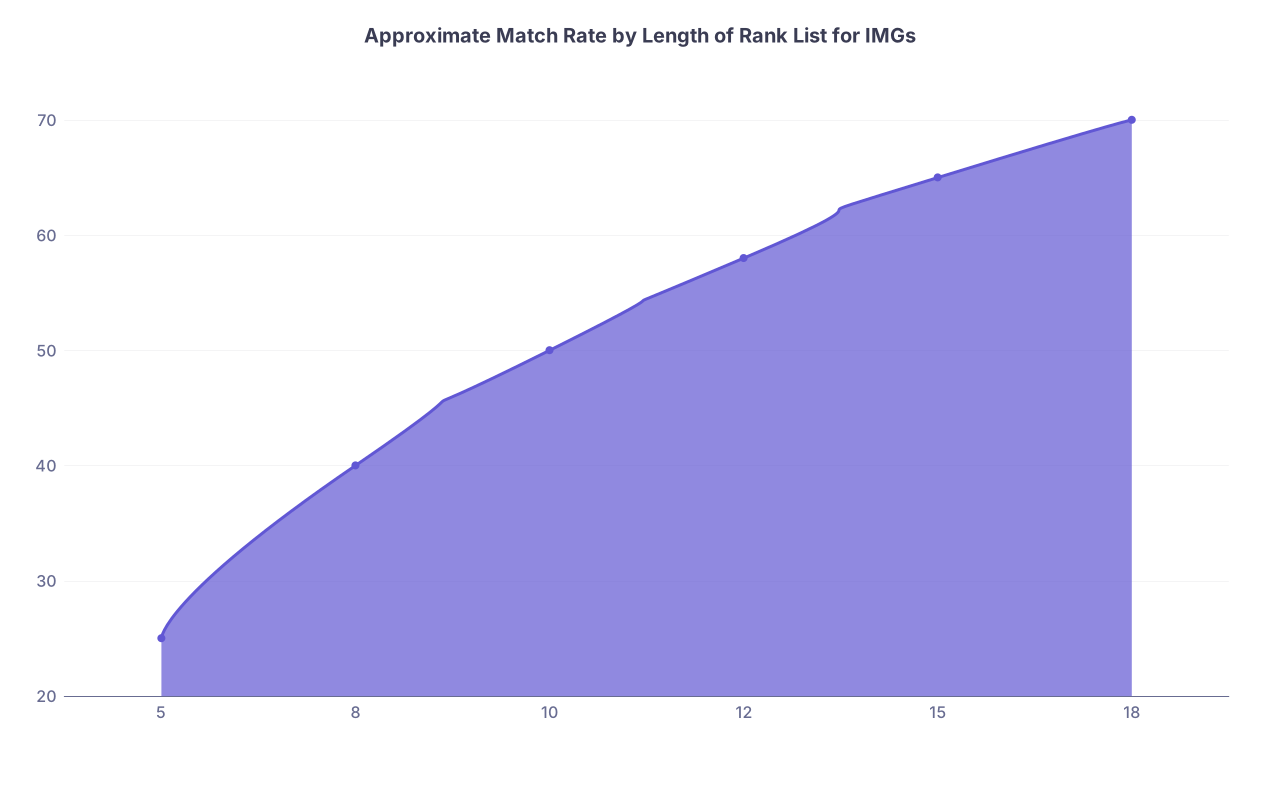
| Category | Value |
|---|---|
| 5 | 25 |
| 8 | 40 |
| 10 | 50 |
| 12 | 58 |
| 15 | 65 |
| 18 | 70 |
(Exact numbers vary, but trend is real: more reasonable programs ranked = better odds.)
“If I rank an IMG-heavy program high, does that make me look ‘less competitive’ somehow?”
No. Nobody sees your rank list except NRMP. PDs don’t get a notification that you also ranked a community program in rural nowhere.
Rank what you’d actually be okay matching at. That’s it.
How I’d Personally Sanity-Check a List of “IMG-Friendly” Programs
Let’s say someone hands you a list of 40 “IMG-friendly Internal Medicine programs.” Here’s how I’d quickly sort them:
- Open each program’s website.
- Go straight to “Current Residents.”
- If there’s:
- 5+ IMGs overall and at least 1–2 per class → keep as potential Tier 1 or 2
- 0–1 IMG in total and unclear visa policy → push toward Tier 3 or 4
- Google:
Program Name IMG J-1 H1B SDN Redditfor real stories. - Check FREIDA for basic filters (YOG, visa, attempts, Step attempts).
You’ll be shocked how fast 40 “IMG-friendly” programs turn into:
- 8–12 truly solid options
- 10–15 “maybe, if everything aligns”
- The rest… marketing or outdated info
And that’s the thing nobody tells you: for IMGs, it’s not about chasing every place that might tolerate IMGs. It’s about finding the few that actually invest in them.
Using “IMG-Friendly” When Ranking – Without Losing Your Mind
Here’s how you turn all this into an actual rank strategy that doesn’t keep you up every night.
Start with: Where did I feel respected?
Not just tolerated. Not eye-rolled, not grilled only about visa or YOG. Those automatically move up your list.Cross-check: Do their residents look like me?
If you’re a 2018 grad from India with one attempt on Step 2, and the only IMGs they’ve ever taken are fresh grads with 260+, that’s a mismatch.Trust consistent patterns over single data points.
One IMG success story from your school at a “dream” program doesn’t make it a safe bet. Watch what they do every year.Force yourself to include enough real IMG-heavy programs.
That includes places that aren’t glamorous. Rural. Community. Off the radar. The programs that don’t brag but quietly fill with IMGs every year.Remember: Rank = preference, not prediction.
Don’t rank based on where you think you’re more likely to match. Rank based on: “Would I rather be at Program A than Program B if both said yes?” The algorithm rewards honesty here, not strategy.

| Step | Description |
|---|---|
| Step 1 | Interviewed Program |
| Step 2 | Do not rank or rank very low |
| Step 3 | High risk - treat as lottery |
| Step 4 | Moderate option |
| Step 5 | Strong IMG-friendly |
| Step 6 | Place on rank list based on preference |
| Step 7 | Visa sponsored for you |
| Step 8 | Current IMGs in program |
| Step 9 | Would you still be happy here |
Quick Sanity Checklist Before You Trust “IMG-Friendly”
If you’re about to rank a program highly because someone called it IMG-friendly, pause and ask:
- Can I see multiple IMGs in their current or recent classes?
- Do they clearly sponsor the visa I need?
- Are there people with a background roughly like mine who’ve actually matched there?
- Did I feel like a real candidate on interview day, not a backup or checkbox?
If you can’t say yes to at least 2–3 of those, don’t stake your mental health on that program.

FAQ (Exactly 4 Questions)
1. If a program has only US-IMGs (Caribbean) and no non-US-IMGs, is it still IMG-friendly for me as a non-US grad?
It’s partially IMG-friendly at best. Caribbean grads often have more US clinical experience and sometimes different visa or citizenship situations. If you’re a non-US-IMG needing a visa, and their residents are all US-citizen Caribbean grads, that’s not strong evidence in your favor. You can still rank them, but don’t treat them as a safe option.
2. Should I email programs to ask, “Are you IMG-friendly?”
That question by itself is too vague and honestly a bit useless. Ask specific things: “Do you sponsor J-1 visas?” “Have you had non-US-IMG residents in recent years?” “Do you have any YOG cutoffs?” Concrete questions get concrete answers. Even then, what they do historically still matters more than what they reply in a single email.
3. I interviewed at a so-called IMG-friendly program but got the vibe they cared only about my visa and YOG. Does that mean they won’t rank me?
Not automatically, but it’s a bad sign. If most of the interview focused on “How will you handle your visa?” rather than your clinical experiences, goals, or fit, they might be nervous about the logistics more than excited about you. I’d still rank them if you’d be okay matching there, but I’d lean more heavily on programs where you felt seen as a doctor, not just a paperwork problem.
4. Is it a mistake to rank a less “IMG-friendly” program above a very IMG-heavy one if I liked it more?
No, not a mistake—as long as you don’t build your entire list that way. Put your true preferences on top, including a few reaches or less-IMG-heavy programs you loved. Then back it up with a solid base of programs that consistently take IMGs like you. The disaster scenario isn’t ranking some reaches high; it’s ranking only reaches and ignoring the programs that were quietly your best shot.
Key points to walk away with:
- “IMG-friendly” is marketing; resident rosters and visa policies are reality.
- Rank based on real patterns (multiple IMGs, clear visa support), not labels or wishful thinking.
- Protect yourself by having enough truly IMG-heavy programs on your list, then layer your dream or borderline ones on top according to your actual preference.