
This article is for educational purposes only. It is not financial advice, not legal advice, and not tax advice. Figures vary by individual circumstances, consult a qualified professional before acting.
Introduction
So you've found a residency program that welcomes IMGs. They've got a friendly website, current residents who look like you, and a mission statement that doesn't reek of gatekeeping. Then you dig into their board pass rates and your stomach drops. Eighty-five percent on the first try. Sometimes lower. What's going on, and should you run?
Let's get something straight first. The conventional advice you'll read on forums is garbage on this topic. It splits neatly into two equally wrong camps. Camp one says "avoid any program below 90%, they'll ruin your career." Camp two says "board pass rates don't matter, just work hard and you'll be fine." Neither position holds up against the actual data.
Here's what the data actually shows. Board pass rates tell you something important, but not what most people think they tell you. They're a lagging indicator. They reflect admissions philosophy, curriculum structure, and the culture of remediation more than they reflect the quality of teaching. A program with a 95% pass rate might be coasting on the quality of residents it selects, not the quality of education it delivers. A program sitting at 82% might be taking chances on nontraditional candidates and providing aggressive support that the numbers don't capture.
This matters to your career because board certification is non-negotiable for licensure, hospital privileges, credentialing, and eventually every job you'll apply for. Failing your boards once isn't fatal. Failing twice can be. The program you choose shapes your odds, but not in the simplistic way the fear-mongers suggest. You need to understand what you're actually looking at when you see a pass rate number, and you need to ask better questions than "what's your pass rate."
The Core Challenge
The biggest trap IMG applicants fall into is treating pass rate as a standalone metric. It's not. It's the output of a system, and without understanding the inputs, the number is noise.
Let's walk through the common pitfalls.
Pitfall one: You don't ask about the denominator. A program that had 12 residents take the exam and 10 passed has an 83% pass rate. A program that had 50 residents and 42 passed has an 84% pass rate. These are wildly different situations. Small programs produce volatile statistics. One bad year with three failures can tank a five-year rolling average that makes a program look much worse than it is. I've seen applicants reject a solid community program because a single cohort of three residents had two first-attempt failures, dragging the reported rate to 33% for that year. The program's five-year average was actually 88%. Context is everything.
Pitfall two: You don't distinguish first-attempt from eventual pass rates. Some programs report these honestly. Many don't, or they bury the distinction. A program where 100% of residents eventually pass but only 70% pass on the first attempt is telling you something very specific: their residents are underprepared at the standard testing window but catch up with additional time. That's a curriculum timing problem, not necessarily a quality problem. It could become your problem if your fellowship timeline depends on early certification.
Pitfall three: You confuse selectivity with teaching quality. This is the one nobody wants to hear. Programs that exclusively take USMLE scores above 250 and top-tier allopathic graduates will have high pass rates regardless of how they teach. Their residents would pass if the faculty did nothing but show up and read the newspaper. Programs that take IMGs with scores in the 220s, gaps in training, and uneven clinical experience are playing a different game. A pass rate of 85% in that context might represent extraordinary educational work. But the number alone won't tell you that.
Pitfall four: You ignore the trend. A program that went from 78% to 89% over five years is improving. A program that went from 94% to 82% is decaying. The direction matters more than the current value. Decay usually signals faculty turnover, curriculum disruption, or a change in leadership. Improvement signals investment and accountability. Ask for the year-by-year numbers, not just the rolling average. If they won't give you the year-by-year data, that's its own answer.
Now, how do you actually navigate this? You stop asking whether the pass rate is "good" and start asking what produced it.

Call the program coordinator. Not the program director yet, the coordinator. They're the one who actually tracks this data and they're more likely to give you straight numbers without the institutional spin. Ask three questions. What's the five-year first-attempt pass rate? What's the eventual pass rate? And the one that separates good programs from defensive ones: what happens when a resident fails?
That third question is where the truth lives. Programs with strong support systems will describe a clear process. Didactic restructuring, dedicated study time, individualized learning plans, mentorship pairing, sometimes funded board prep courses. Programs without support systems will get vague. "We work with the resident individually." That means nothing. If they can't articulate a structured response to failure, they don't have one.
You should also look at the ACGME program requirements for your specialty. Some specialties require programs to provide board preparation support. If the program is meeting the minimum and nothing more, that tells you about the culture. Programs that exceed minimums invest in their residents. Programs that barely meet them are checking boxes.
There's also the question of self-selection. In some IMG-friendly programs, residents who feel they're not ready will delay their board attempt by choice. The program supports this. This makes first-attempt rates look lower but eventual rates look strong. Is that bad? Not necessarily. It might reflect a culture that prioritizes readiness over optics. But if you're planning to apply for fellowship on a tight timeline, you need to know whether delayed attempts are common and whether they create problems for your career sequence.
The deepest pitfall is emotional. IMG applicants, after months of rejection and anxiety, often feel they have no right to be choosy. So they suppress their concerns. They see a shaky pass rate, feel uneasy, and tell themselves they'll just study harder. Studying harder is not a strategy. Residency is a structural environment. If the structure doesn't support board success, individual grit gets you partway but not all the way. The data on board performance consistently shows that structured curricular support outperforms independent study. You are not exempt from this because you're motivated.
Actionable Next Steps
Here's your step-by-step plan.
Step one: Pull the publicly available data. Start with the ACGME program requirements and data resources. Some specialties publish pass rate data through their boards. FREIDA has limited information but can tell you program size, which gives you the denominator context. If the program's website doesn't list pass rates, that's a flag, not a dealbreaker, but a flag.
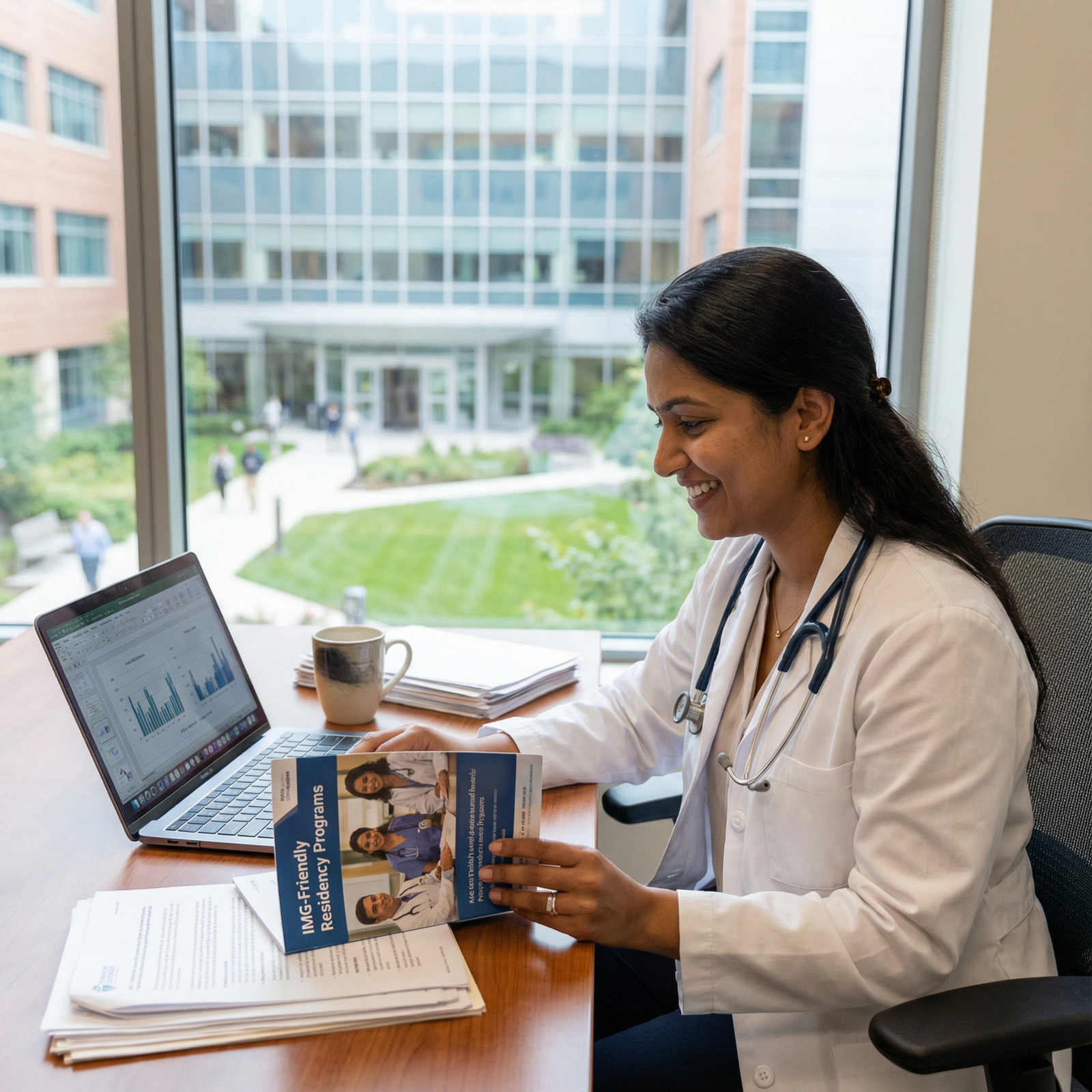
Step two: Build a comparison spreadsheet. List the programs you're seriously considering. For each, track: five-year first-attempt pass rate, eventual pass rate, program size, trend direction, and whether they have a stated board prep curriculum. Leave columns blank where you can't find data. The blanks tell you what to ask.
Step three: Do your interviews of the program during their interviews of you. Most IMG applicants treat interviews as performances where they need to impress. Flip the dynamic. You are evaluating them. Ask current residents, not faculty, residents, these specific questions: "When was the last time a resident failed the boards, and what did the program do?" "Do residents get dedicated study time, and is it protected?" "What board prep resources does the program provide?" Listen for specificity. Vague answers are red flags. Specific, detailed answers mean the program has actually dealt with this and has a system.
Step four: Check the program's recent accreditation history. ACGME citations related to curriculum or educational outcomes are public information. A program with a shaky pass rate and recent citations related to educational quality is a problem. A program with a shaky pass rate and a clean citation history might simply be working with a challenging applicant pool and doing its best.
Step five: Talk to recent graduates. Not the ones the program forwards you to. Find them on your own through alumni networks, LinkedIn, or professional associations. Ask them one question: "Did you feel prepared for your boards, and if not, what was missing?" Graduates who felt prepared will tell you quickly. Graduates who didn't will tell you even more quickly, and their specifics are gold.
Resources to use. The ACGME Data Resource Book gives you national pass rate context so you know what average actually means for your specialty. Your specialty board's website often publishes pass rate statistics by year. The AMA's FREIDA database gives program demographics. But your best resources are people. Program coordinators, current residents, and recent graduates will tell you more than any published dataset.
Don't rely on online forums for pass rate information. The data shared there is frequently outdated, misremembered, or fabricated. People post numbers from memory that are wrong, and those numbers spread. Go to primary sources or don't go at all.
Summary
Here's the bottom line. A shaky board pass rate at an IMG-friendly program is not automatically disqualifying, and it's not automatically safe to ignore. The number is a starting question, not an answer. What matters is the system behind the number: how the program selects residents, how it supports them, what happens when someone fails, and whether the trend is improving or declining.
Be prepared. Walk into your research with specific questions and a framework for interpreting what you hear. Focus on high-yield areas, structured board prep, protected study time, a clear remediation process, and honest conversation with current residents and recent graduates. Reject the binary thinking that says high pass rates mean good programs and low pass rates mean bad ones. The reality is more complex and more knowable than that, if you're willing to do the work of finding out what's actually behind the numbers.